Hello, this is Flower Jem.
The tax filing season is approaching again this year.
When I was in elementary school, I was the type who rushed to finish my summer homework right before school started again. That part of my personality has not changed even now. There are many pearl pieces I should make, and many I want to make, but this three-day weekend I am at my parents’ home, working on my tax return.
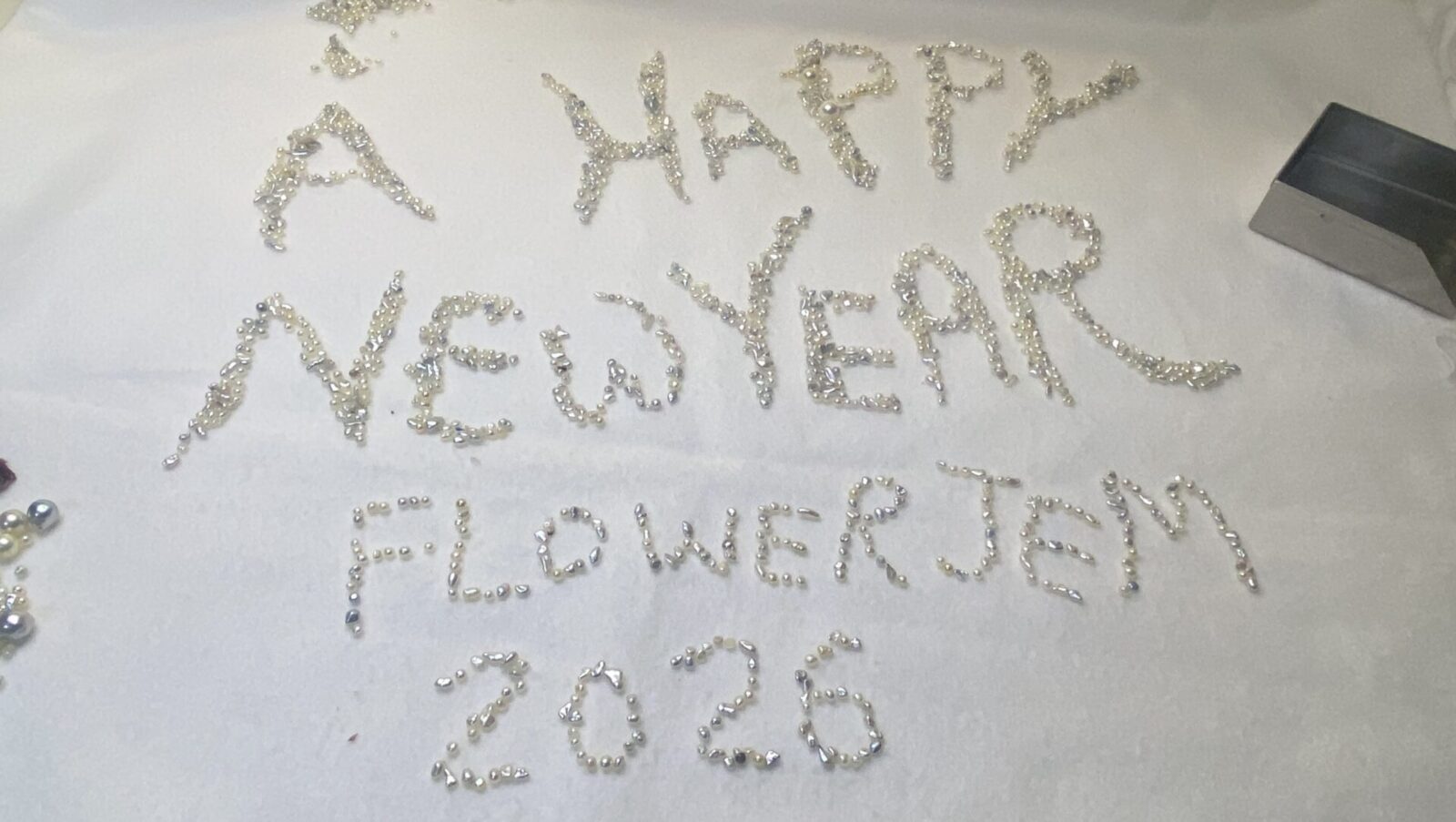
Meanwhile, at pearl farms, the harvest season has been underway since December, and the auctions are just about to begin.
The pearl farm owned by the pearl company where I previously worked has also started harvesting. However, I hear that the quality of the harvested pearls is not good. The mortality rate of Akoya oysters is high, and overall, farming results are said to be poor.
This information comes from former colleagues at that company. Hearing about these conditions, I find myself hesitating to ask the farm managers directly about the quality of the harvest.
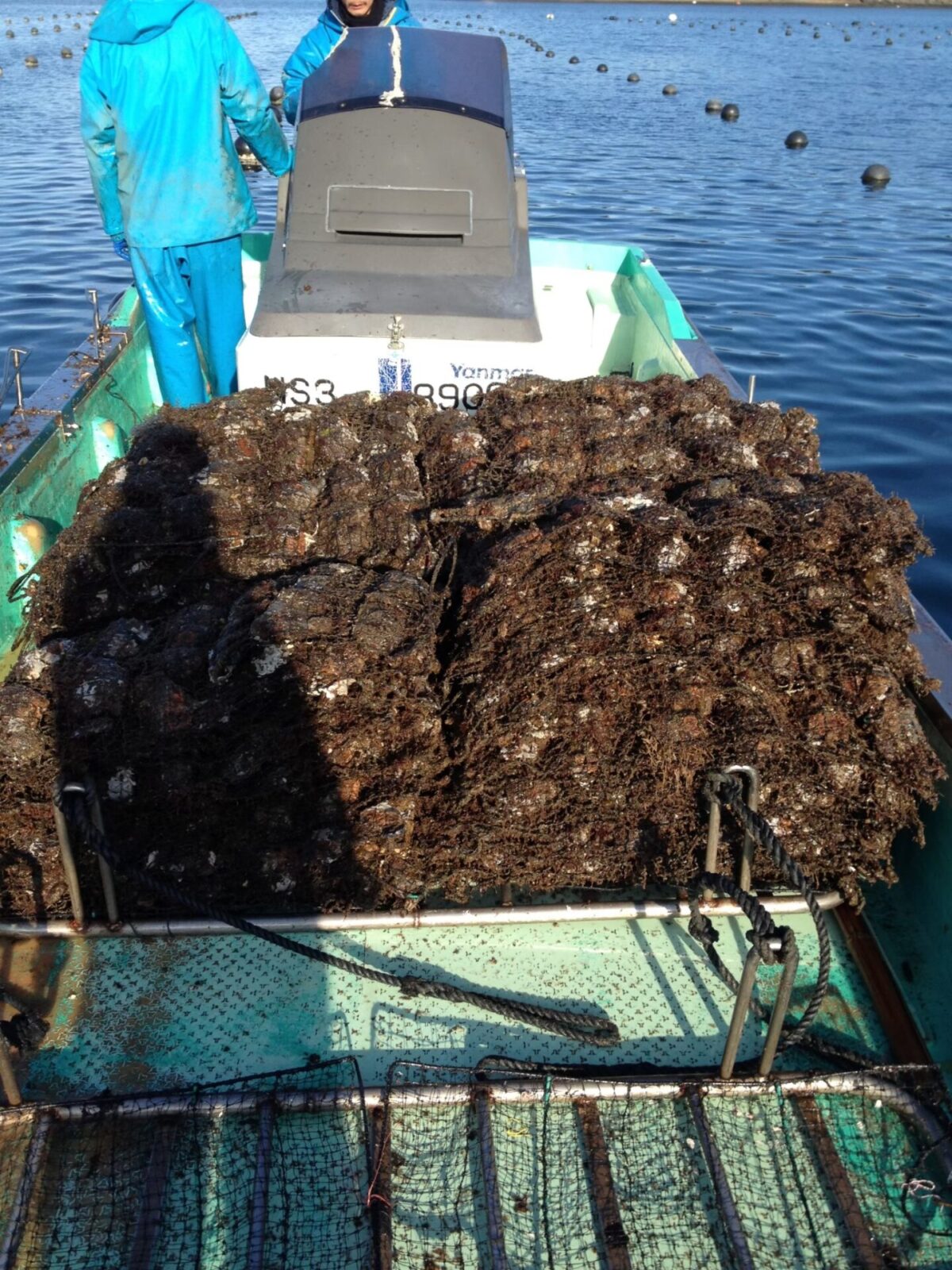
Among several farm managers, I hear that one is in a very bad mood due to poor results, while another is in quite a depressed mental state.
Over the past few years, the sea conditions around pearl farms in various regions have not been favorable for Akoya oysters. In every area, the oysters seem to be growing more slowly.
Basically, the size of the nucleus used to form a pearl is determined by the size of the Akoya oyster. To cultivate large Akoya pearls in the eight to nine millimeter range, which is considered large for Akoya pearls, a nucleus of corresponding size is required. However, oysters large enough to accept such nuclei are also necessary. With the recent slow growth of Akoya oysters, it has become difficult to insert nuclei large enough to aim for eight or nine millimeter pearls.
The pearl business is fundamentally a weight-based business.
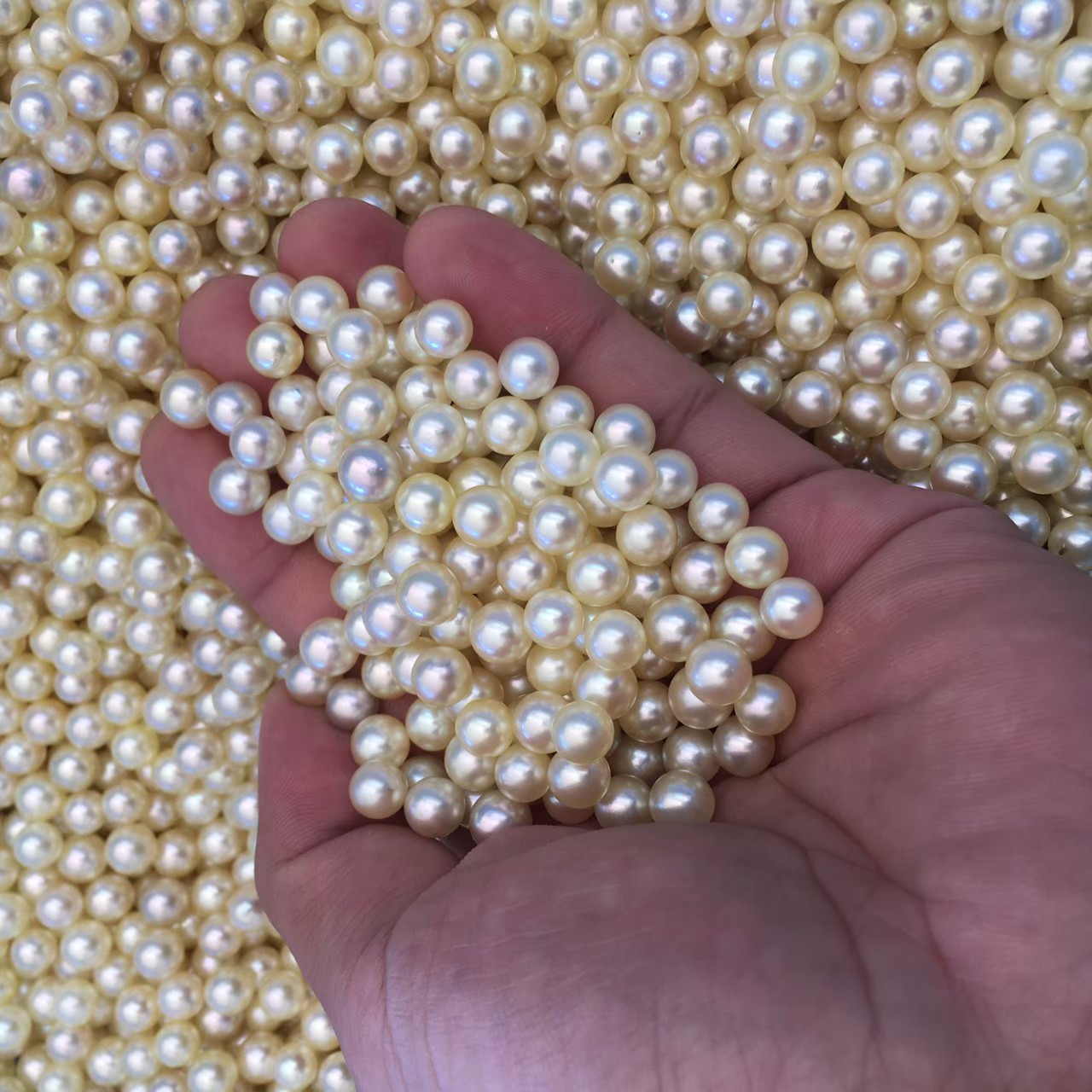
Rather than cultivating and producing a small quantity of top-grade pearls, cultivating and producing a large quantity of mid-grade pearls generates more profit.
Let us assume that one hundred pearls are cultivated and produced. If one hundred six millimeter pearls and one hundred nine millimeter pearls of the same quality are produced, there is a significant difference in profit between the two.
A six millimeter pearl weighs about 0.1 monme, while a nine millimeter pearl weighs about 0.3 monme. For one hundred pearls, that becomes ten monme for six millimeters and thirty monme for nine millimeters. (Monme is a unit used in the pearl industry; one monme equals 3.75 grams.) Even with the same number of pearls, there is a threefold difference in weight between six millimeters and nine millimeters.
For example, suppose that in a given year the unit price for first-grade pearls is 100 dollars per monme, and that all of the six millimeter and nine millimeter pearls mentioned above are first-grade quality. The price of ten monme of six millimeter pearls would be 1,000 dollars, while thirty monme of nine millimeter pearls would be 3,000 dollars. If the grade drops by one rank, the price falls by about 40 percent. If the nine millimeter pearls drop one grade, their value would become 1,800 dollars.
Even though the same one hundred pearls are produced, one hundred six millimeter pearls, even if all are first-grade, generate only about 1.8 times less revenue than one hundred nine millimeter pearls of semi–first-grade quality.
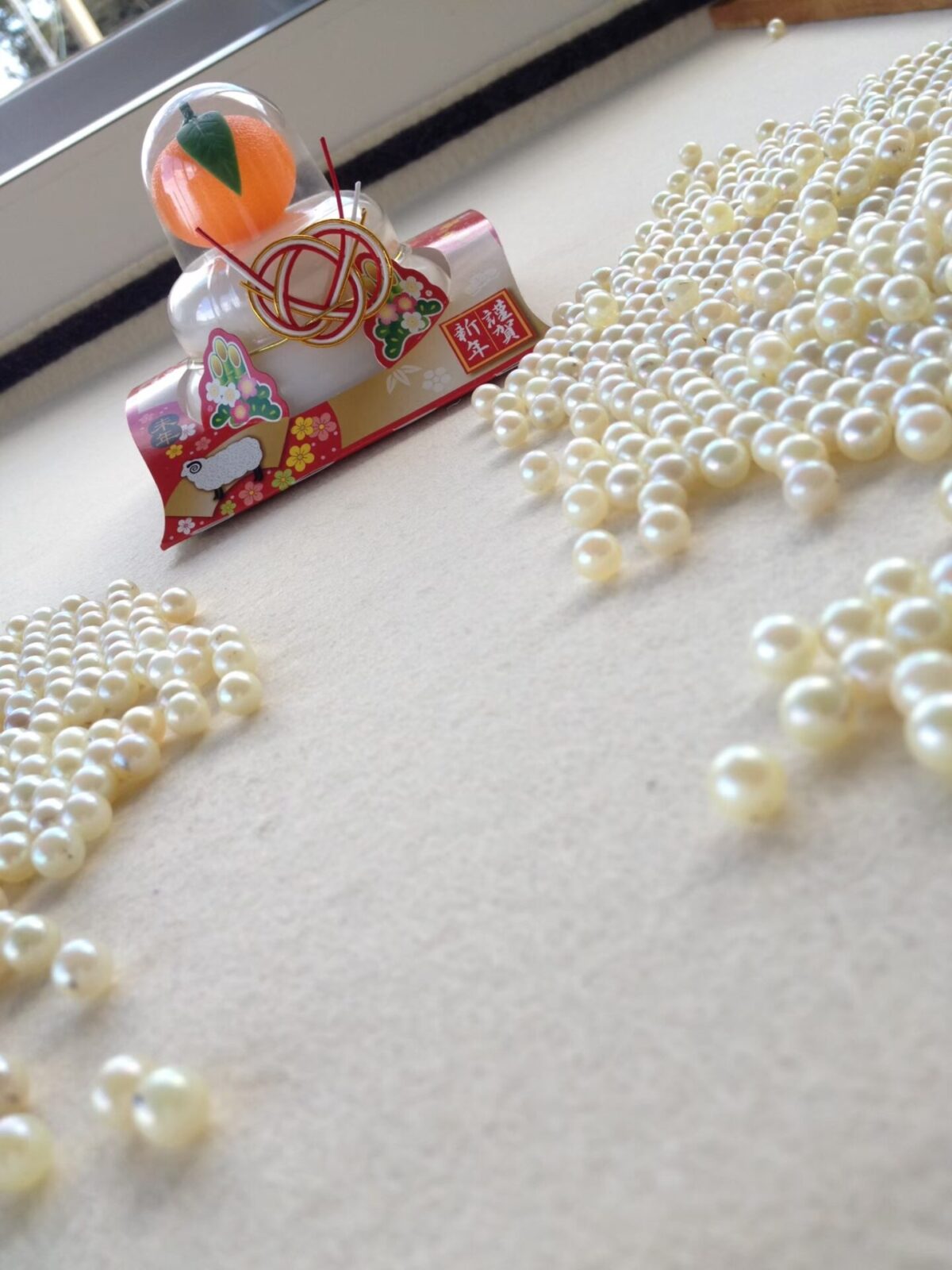
Of course, not every nucleus inserted into an Akoya oyster becomes a pearl. About 40 percent of the oysters die during the farming process, and some expel the nucleus along the way. This is a very simplified explanation, but it illustrates how pearl size alone can create a large difference in price.
Moreover, the work required to insert nuclei to produce one hundred pearls is almost the same whether the target size is six millimeters or nine millimeters.
A nucleus insertion technician can insert nuclei into about eight hundred Akoya oysters per day, with some variation. Using a very rough calculation, if we assume that none of the oysters die and all become pearls, eight hundred six millimeter pearls would result in eighty monme (800 × 0.1 monme), while eight hundred nine millimeter pearls would result in 240 monme (800 × 0.3 monme). At a unit price of 100 dollars per monme, that would be 8,000 dollars for six millimeters and 24,000 dollars for nine millimeters.
This means that simply by inserting the same number of nuclei in a single day, one worker can create such a large difference in value depending on pearl size.
For this reason, pearl farmers aim to cultivate Akoya oysters that can produce pearls even one millimeter larger. However, Akoya oysters do not grow large so easily. For various reasons, some farmers choose to focus on cultivating high-quality pearls centered around six millimeters. With six millimeter pearls, it is also possible to insert two nuclei into a single oyster and produce two pearls.
I will leave that topic for another time.
For now, I hope you understand that pearl trading is fundamentally based on weight, that for the same quality larger pearls are more expensive due to their greater weight, and that in recent years, slow oyster growth has made it difficult to cultivate and produce large pearls. This is the situation the Akoya pearl farming industry currently faces.
Of course, in reality, things are not nearly this simple. Even among six millimeter pearls, round ones are more valuable, while baroque ones are cheaper. Thin nacre lowers value, while thick nacre raises it. The same is true for luster, which can be considered the life of a pearl.
In addition, many other factors such as surface wounds and the concentration and color of impurities inside the pearl affect its unit price and value.
Nevertheless, the basic principle remains that pearls are traded by weight.
Now, while the quality of the harvest affects valuation as described above, market conditions also have a very strong influence on pearl prices.
Looking at market history over the past fifty years, even pearls of the same quality have seen first-grade unit prices as low as 20 dollars per monme and as high as 400 dollars per monme. Based on the market of a given year, each pearl is evaluated according to its quality.
I have heard that when first-grade pearls were priced at 20 dollars, second-grade pearls attracted almost no buyers. Conversely, when first-grade pearls reached 400 dollars, even pearls that previously had no price were given some level of value.
Auctions have rules that prohibit pearls below a certain unit price from being listed. When market prices rise, those thresholds rise as well, and pearls that previously did not qualify for auction could be offered.
From around 2022 to 2024, Akoya pearl prices reached unprecedented, historically high levels. Since then, prices have been gradually declining, and it seems that by late January we will have a clearer picture of how far they have fallen.
It is said that trading and distribution in the Akoya pearl industry have slowed. From that perspective alone, one might expect prices to fall at the upcoming auction. However, many pearl dealers still hold large inventories of pearls purchased at high prices. Winning pearls cheaply at auction would also lower the valuation of their existing inventory. Some companies reportedly hold pearls worth as much as 100 million dollars. For them, there is a strong incentive to prevent prices from falling at this auction.
Considering the global economy and pearl demand, it seems reasonable to expect prices to decline. But when focusing on the large volume of high-cost inventory held by dealers, it also seems that prices may not fall so easily. While it is not a cartel, I am watching closely to see whether dealers participating in the auction will collectively bid above a certain level to support the market.
Another important factor is that China has long been the primary source of demand for Akoya pearls. In Japanese news, China’s economy is often reported as being in serious difficulty. On the other hand, according to one very capable Chinese buyer, the Chinese economy is expected to recover soon, and they are already preparing to hold large quantities of pearls. Once many pearl dealers realize that China’s economic strength has returned, pearl prices will rise again. Before that happens, they appear to be trying to stock up on pearls.
There is a lot of information like this, but personally, I do not really know what will happen. Every year, various predictions circulate right up until the auction, yet none of those forecasts ever seem to come true.
If I try predicting that predictions will be wrong, perhaps the Akoya pearl market will drop sharply this season.
With that in mind, I decided to write this article sharing my personal view of the market just before the auction.
There is one more piece of news.
Until now, Flower Jem has shared videos on YouTube showing the process of making pearl jewelry and introducing finished pieces. These videos are mostly unedited, but even adding subtitles and minimal editing still requires several hours. To save that time, I have decided to start live streaming. With live streaming, there is no need for video editing at all. And because it is live, I can show mistakes and failures more openly than before. Smooth, flawless production may be nice, but I believe there is more value in moments when things do not go well.
That said, due to time zone differences, many of these live streams will likely take place while most of you are asleep. Also, unlike many live streams, I will not be talking while I work. I am not fluent in English, so I will simply work silently.
This may change over time if I continue.
So far, I have only done about three live streams, but strangely, even with zero viewers, there is a unique sense of tension. Occasionally one or two people stop by and then leave after a few minutes. That level of audience might actually be more comfortable.
This has become quite long, but that is the news. If you happen to come across a Flower Jem live stream in the future, I would be happy if you leave a comment saying, “Take it easy.” I will respond by silently waving my hand.
I will end this rambling article here. Thank you, as always, for reading.
Pearl Bless You
Flower Jem

Comment