
When people hear “pearl sorting,” they may imagine separating good pearls from bad ones. In the sorting work I actually did, I looked at size, color, shape, luster, and other qualities while also thinking about what each pearl would be used for. This article is a record of the sorting I carried out when I was working with pearls.
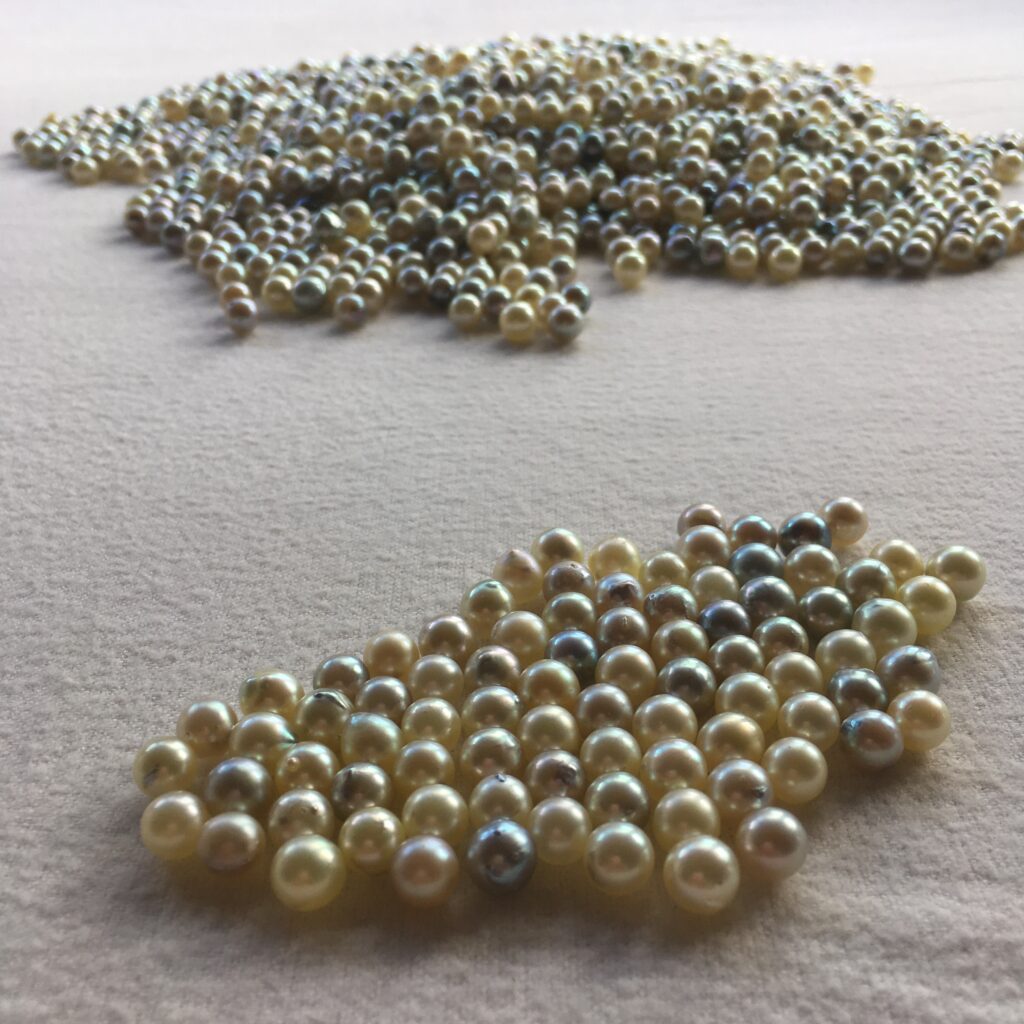
How Pearl Sorting Begins
Pearl sorting may sound very specialized and difficult. It is not necessarily difficult, but it does require experience, and the basic criteria are simple things such as size, color, and shape. The process is simple, yet there may be more depth to it than it first appears. This article is a record of the pearl sorting I carried out every year during the harvest season over a period of ten years.
Pearl sorting begins with a simple question: what makes one pearl different from another?
Even pearls harvested from the same farm and the same season can vary greatly in luster, shape, color, surface quality, size, and nacre thickness. Sorting is the process of reading those differences and deciding where each pearl belongs.
In this article, I would like to show how pearl sorting begins and why this seemingly simple work requires experience, patience, and a clear sense of what you value in a pearl.
This year’s pearl harvest has finally begun and I have started sorting pearls.
Here is a rough guide on how to sort pearls.
Removing Pearls That Cannot Be Used
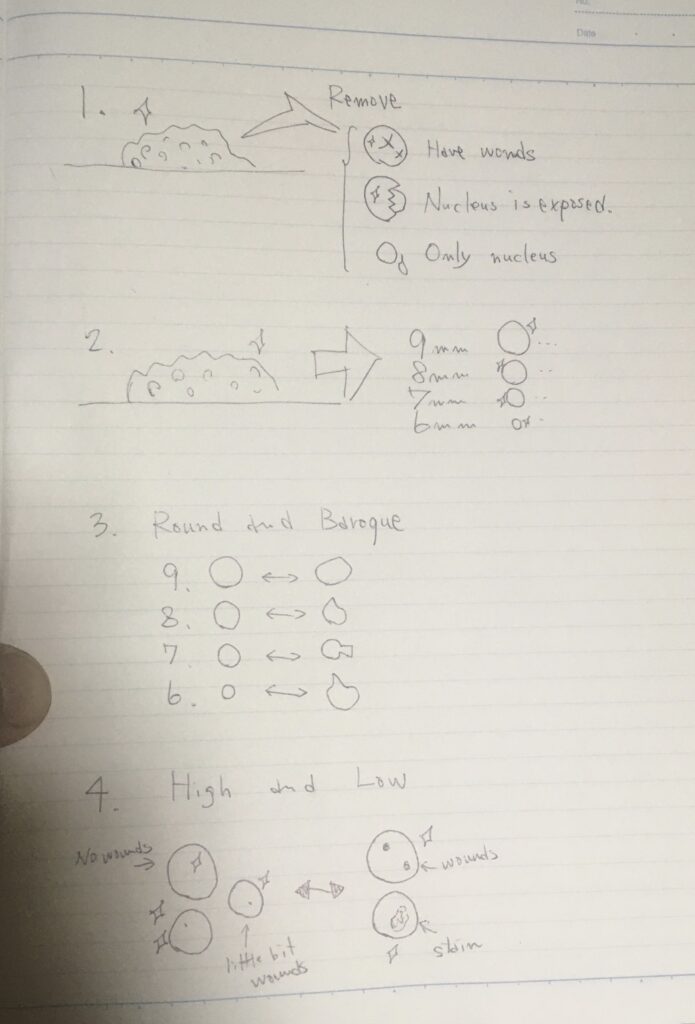
Some of the freshly harvested pearls from Akoya oysters never become commercial products. The nucleus is exposed or cracked.
Sorting by Size, Shape, and Grade
First remove those NG pearls.
Then sort by size from 6mm to 9mm. Then start sorting by size. Today I was in charge of 7mm pearls. 7mm pearls are first sorted into round and baroque. Then sort the rounds into high and low grades.
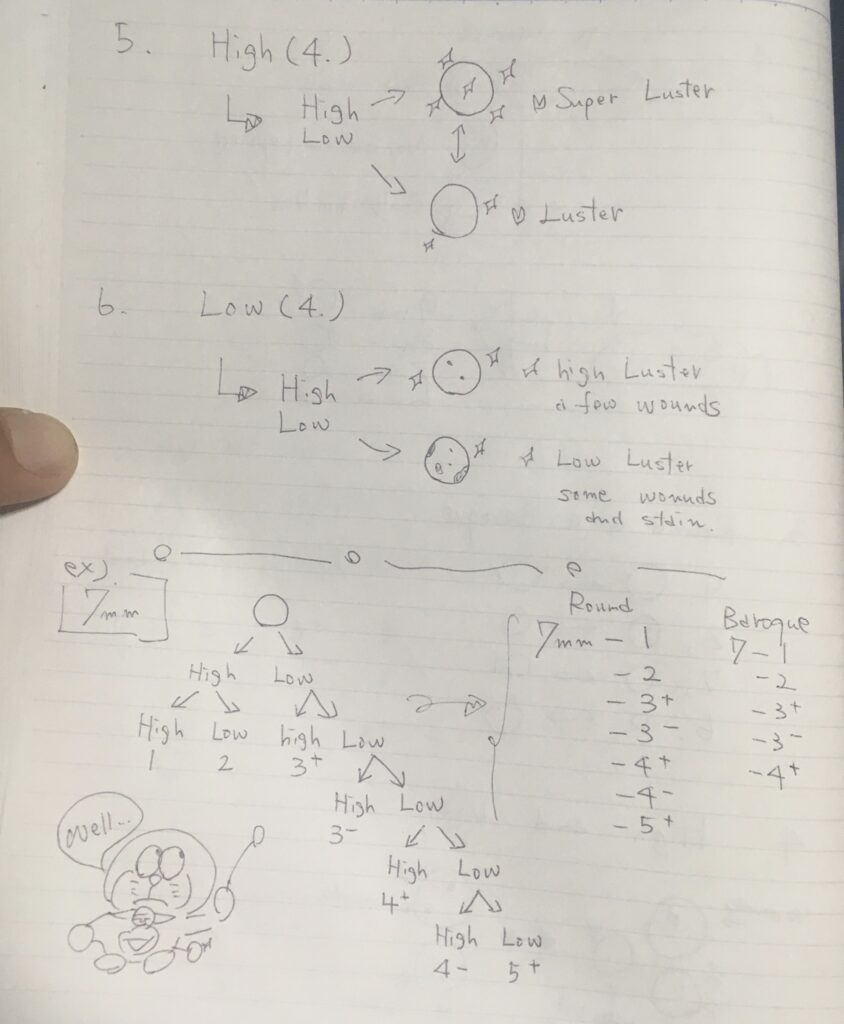
Superior pearls are those that have no wounds or only one small wound and a high brilliance. Inferior means other pearls. Then, we will further divide the upper class into upper class and lower class. Pearls with no wounds and strong brilliance and other pearls are sorted.
If you would like to understand the qualities used to judge pearls in more detail, you may also enjoy:
Why Pearl Sorting Becomes So Complex
As shown in the figure, when sorting 7mm size pearls, there are about 8 types of round pearls. However, since there are several types of Akoya oysters even for 7 mm pearls, there are several types of work to divide them into these eight types. In addition, colored pearls such as blue and red, and baroque are also graded in the same way. Similar sorting is required for 9 mm and 8 mm.
Like the Earth and Moon, the Solar System and the Milky Way, pearl sorting also requires quite a lot of sorting.
To my surprise, I think this analogy is a clumsy one. This time, I introduced the sorting of pearls very simply. I’m glad that you were even a little interested. Sorting pearls sounds complicated, but I think it’s also simple.
Pearl sorting is not only about classification. It also reflects what we choose to value in a pearl.
As a side note, the image used for this article’s thumbnail shows a view I often saw on my way back from the pearl farm in Tsushima to the place where I was staying during business trips. Below this road, you can see a maze of narrow inlets, and pearl farms are scattered throughout the area. After spending an entire day sorting pearls, I would sometimes feel almost as if my brain were short of oxygen. In those moments, this ordinary scenery was strangely calming and comforting.
Continue through the Library
Related Videos
To see how selected pearls become Flower Jem jewelry, browse the Earrings collection.
Subscribe for Pearl Stories🐾
Receive occasional letters from my workshop —
stories about pearls, silverwork, Lulu the little dog, and quiet life in Japan.
As a thank you, you’ll get a secret code for 30% off —
usable every time you order, only here, not on Etsy.
I don’t send spam. Just little notes filled with love and pearls 💫
You can read our privacy policy for details.

Comment