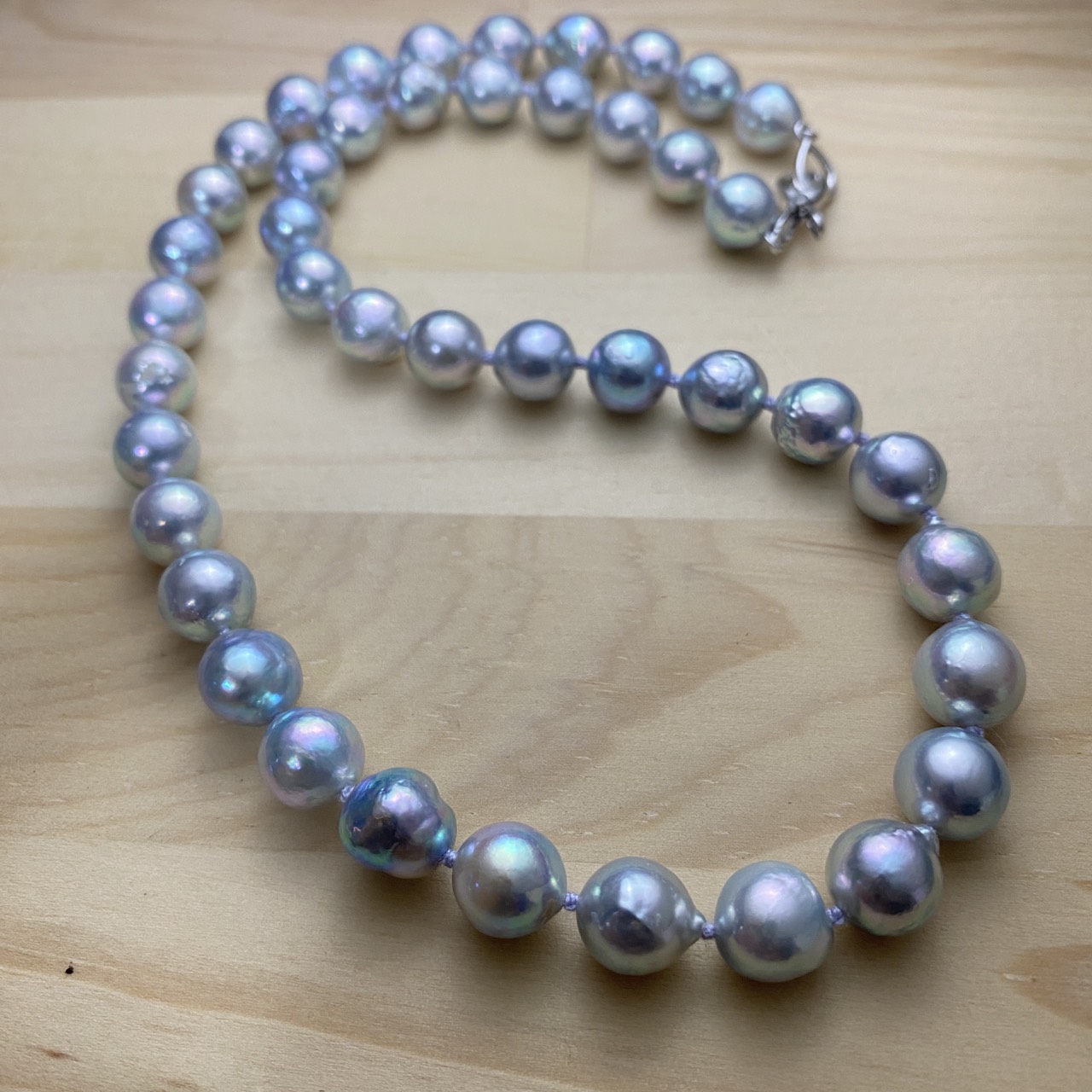
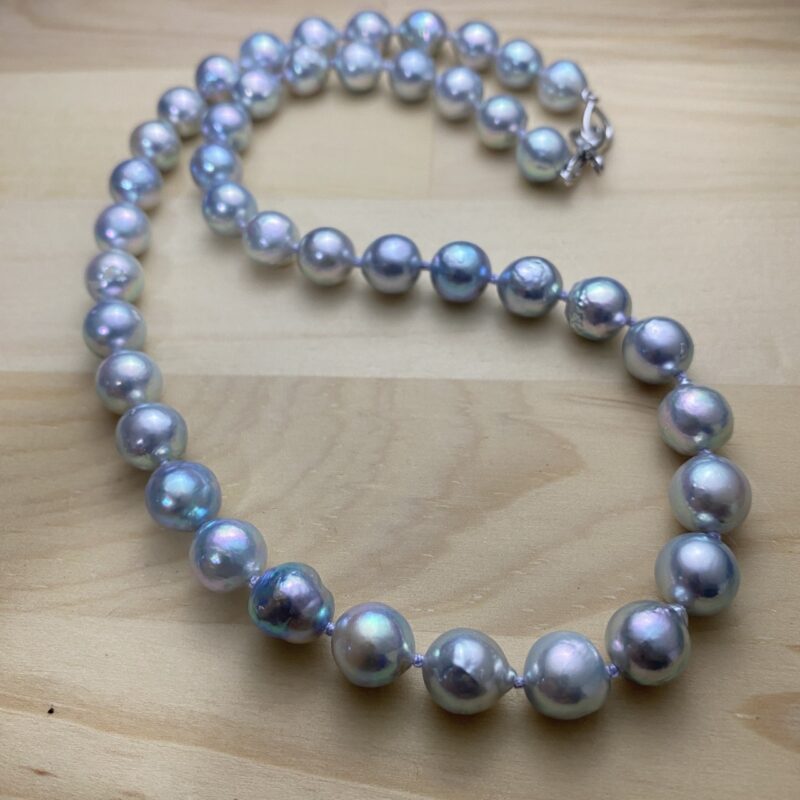
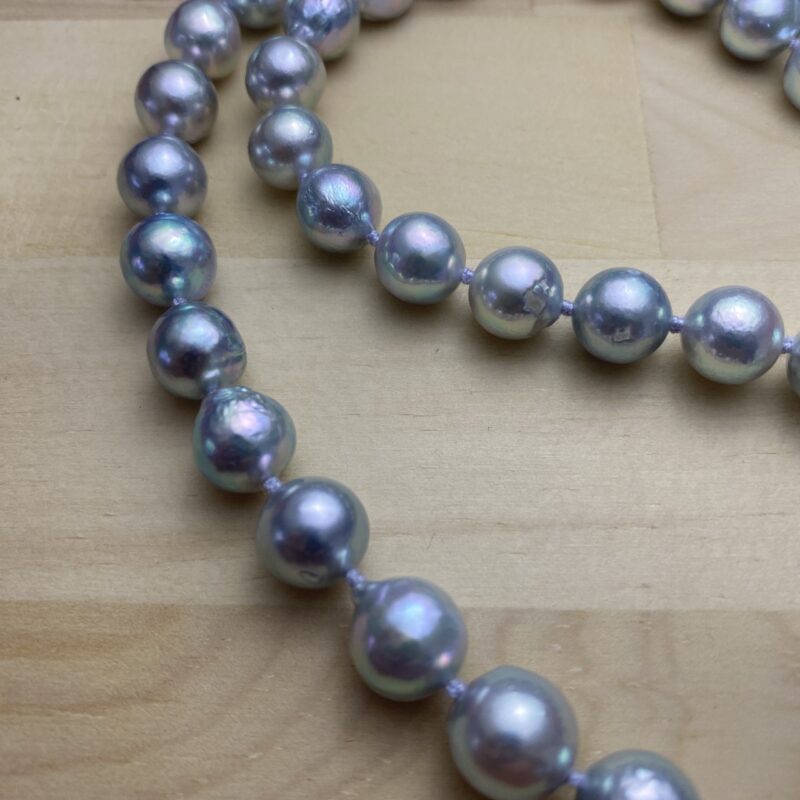
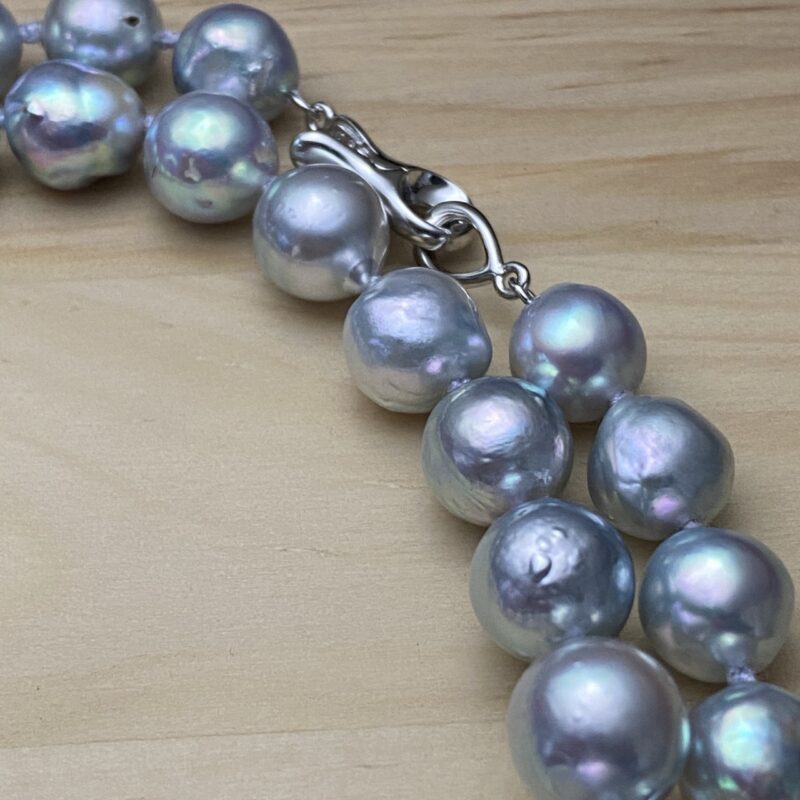
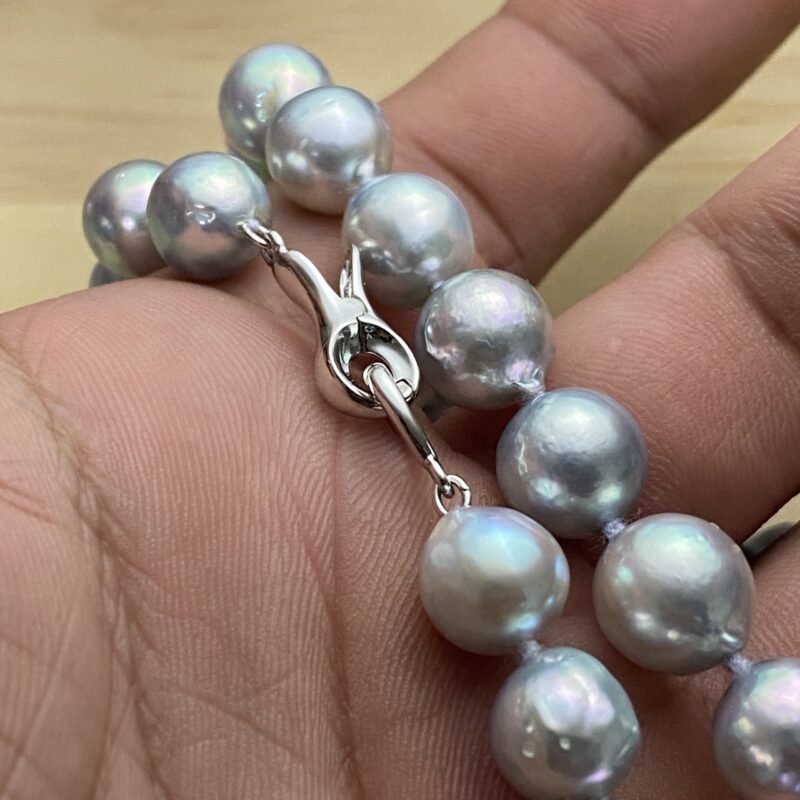
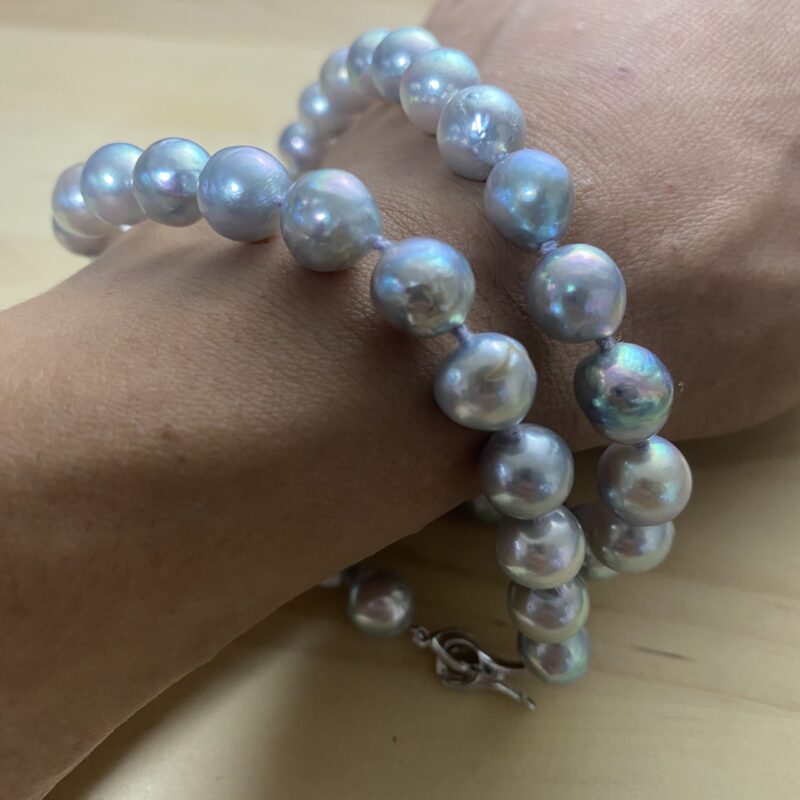
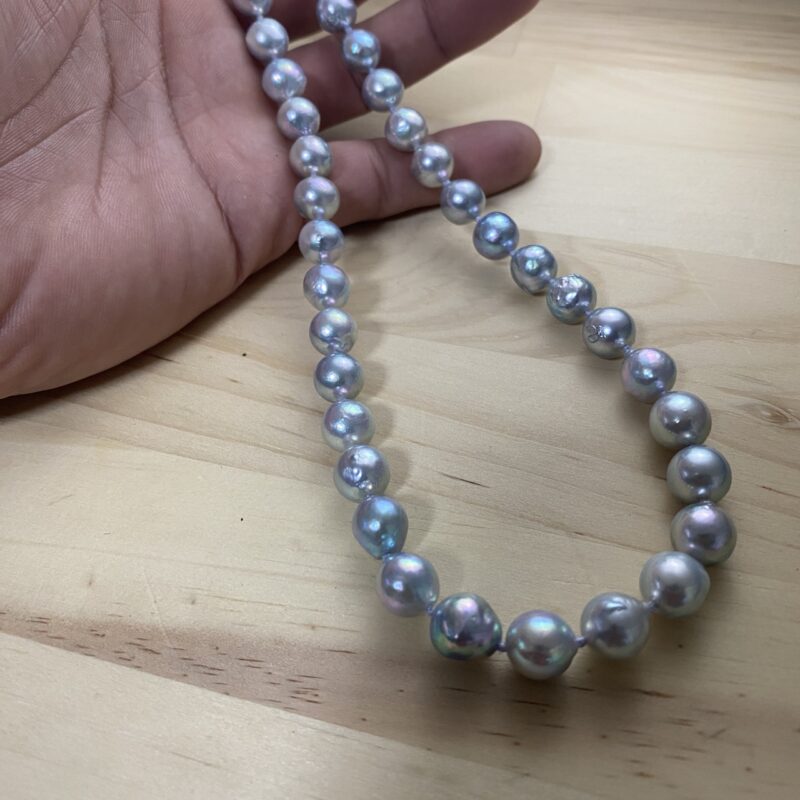
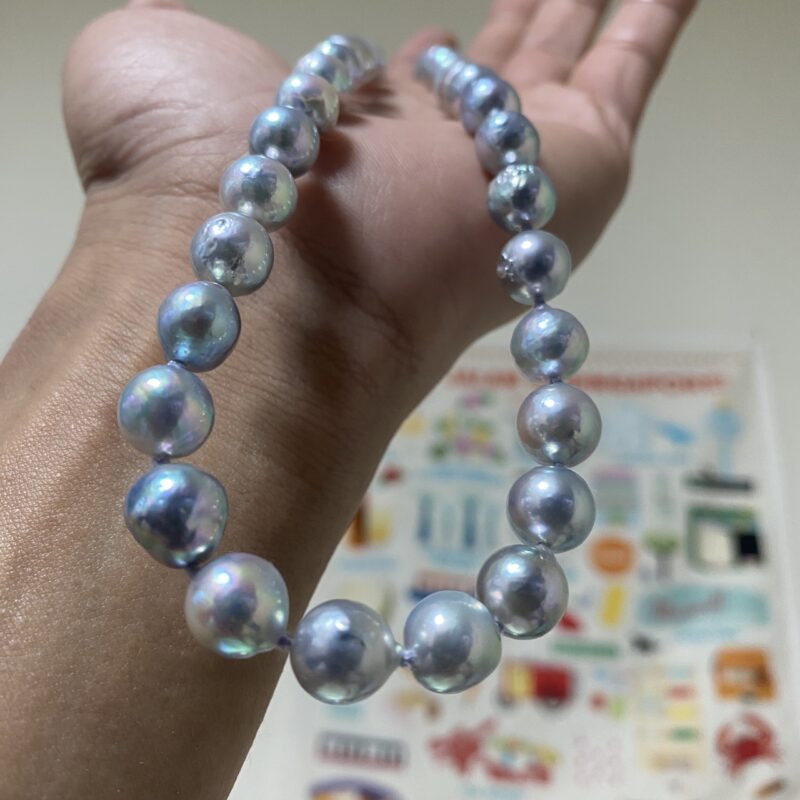
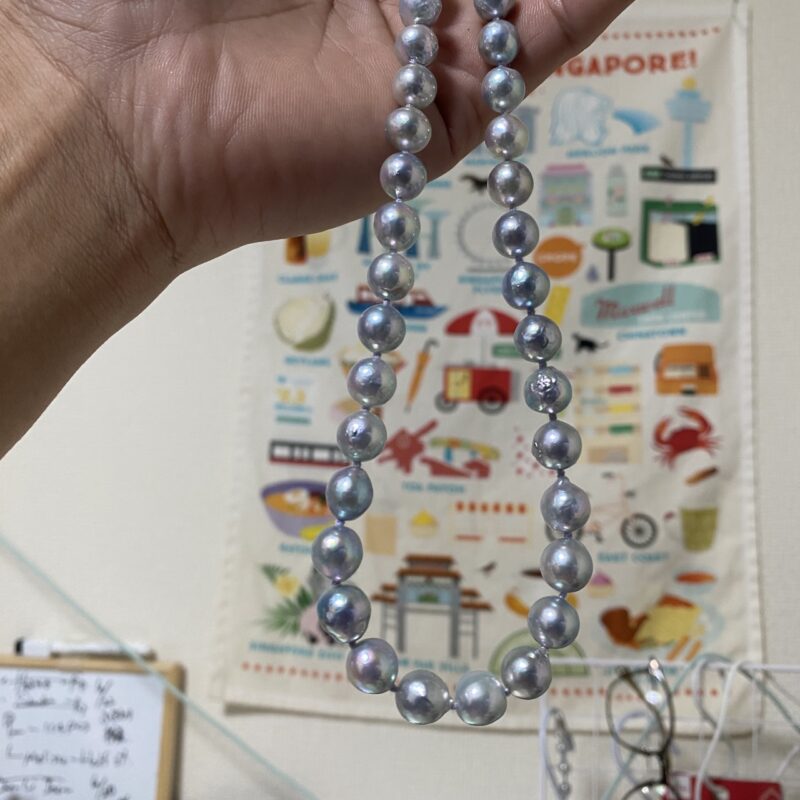
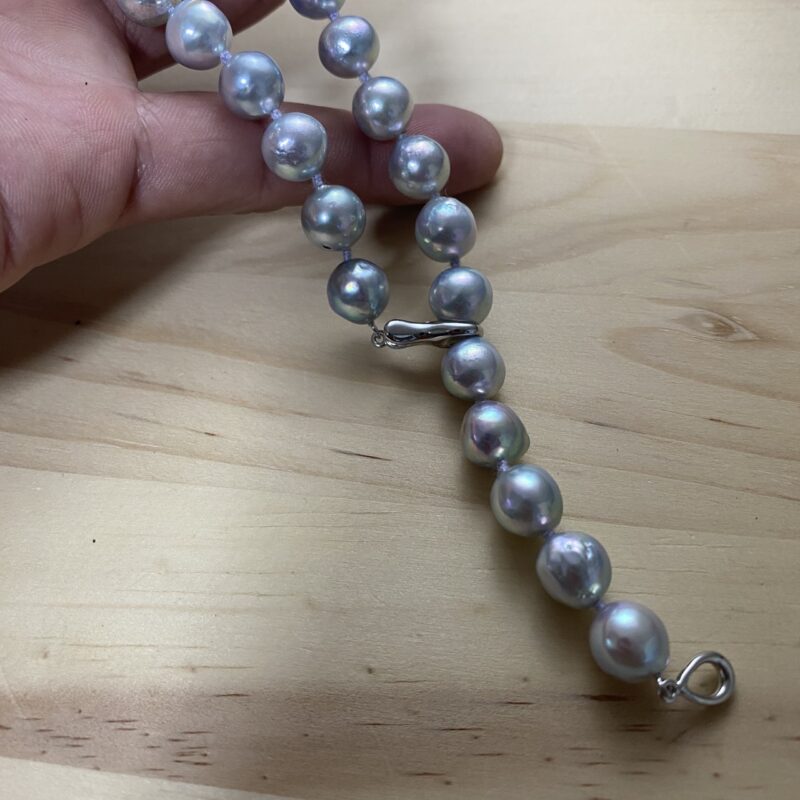
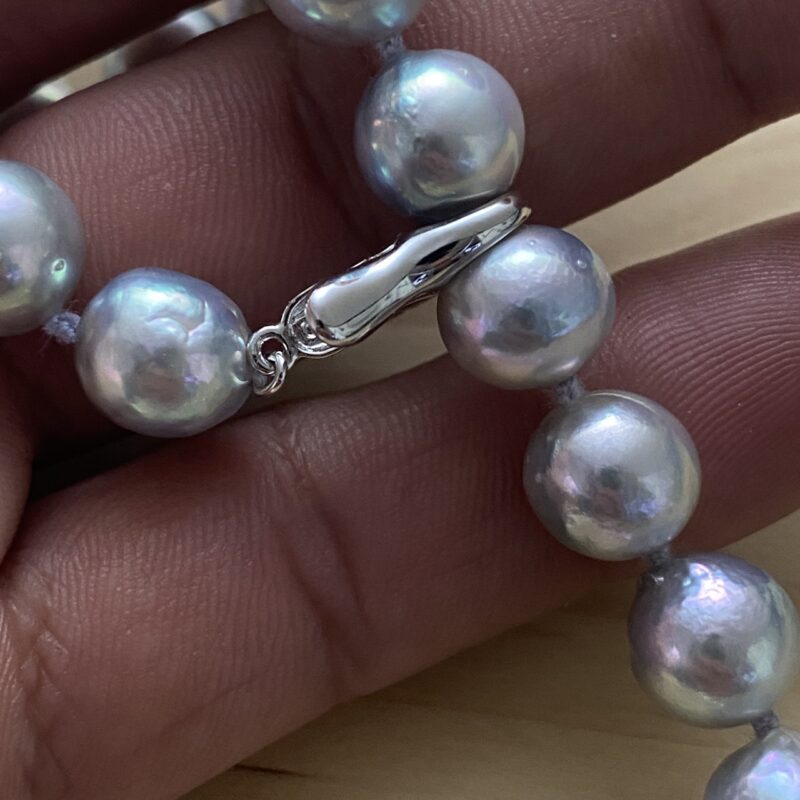
9–10mm Japanese Akoya Natural Blue Baroque Pearl Necklace, 18.1 Inches, All-Knotted, Silver Clip Clasp, Saltwater Pearl
#F Drops of the Monsoon Rain
$1,300.00
1 in stock
🌸At the end of summer, natural blue-silver pearls emerge from exhausted Akoya oysters. Knotted with lavender thread, this necklace brings a new way to enjoy pearls, perfect for your everyday life.
🌸Drops of the Monsoon Rain
🌸🌸About This Necklace
You seem to have an interest in natural blue Akoya pearls.
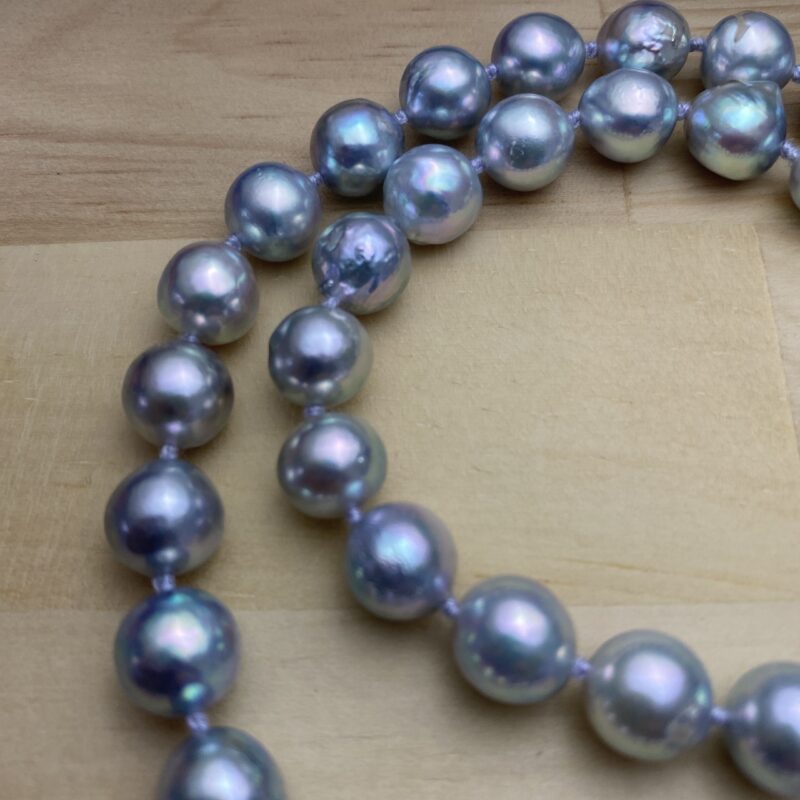
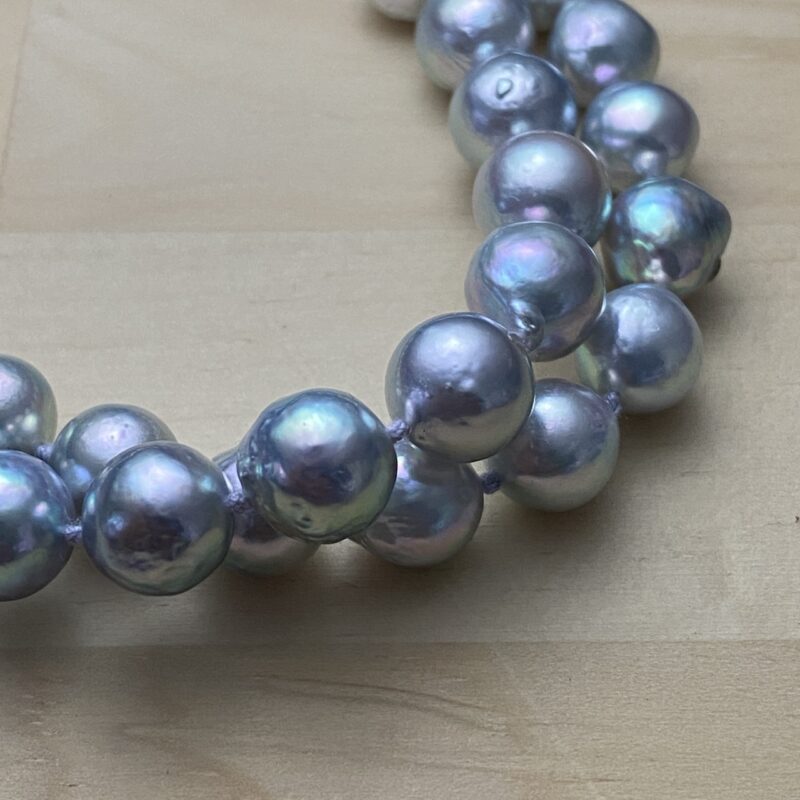
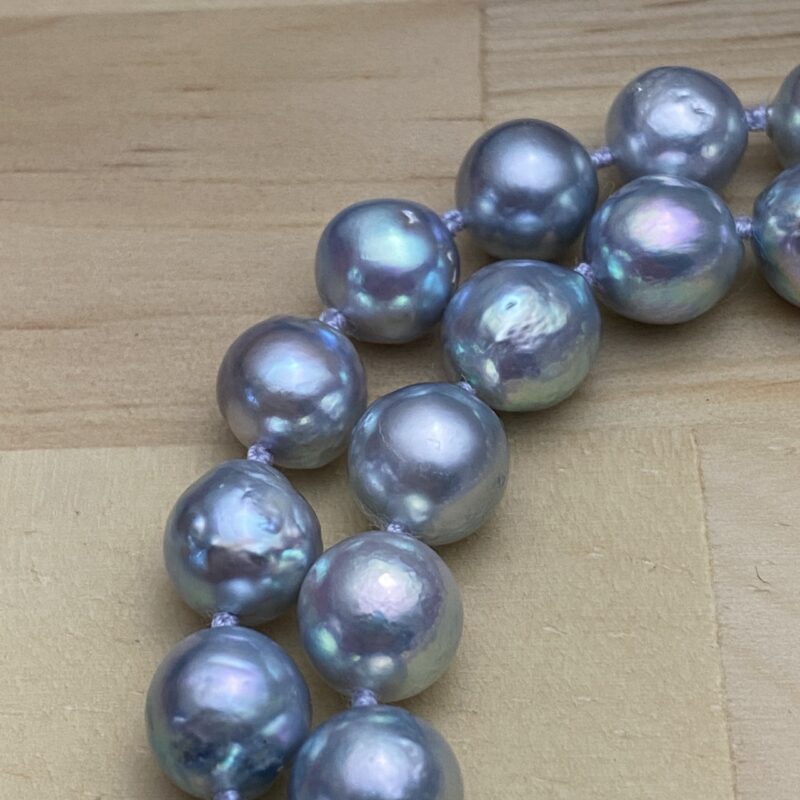
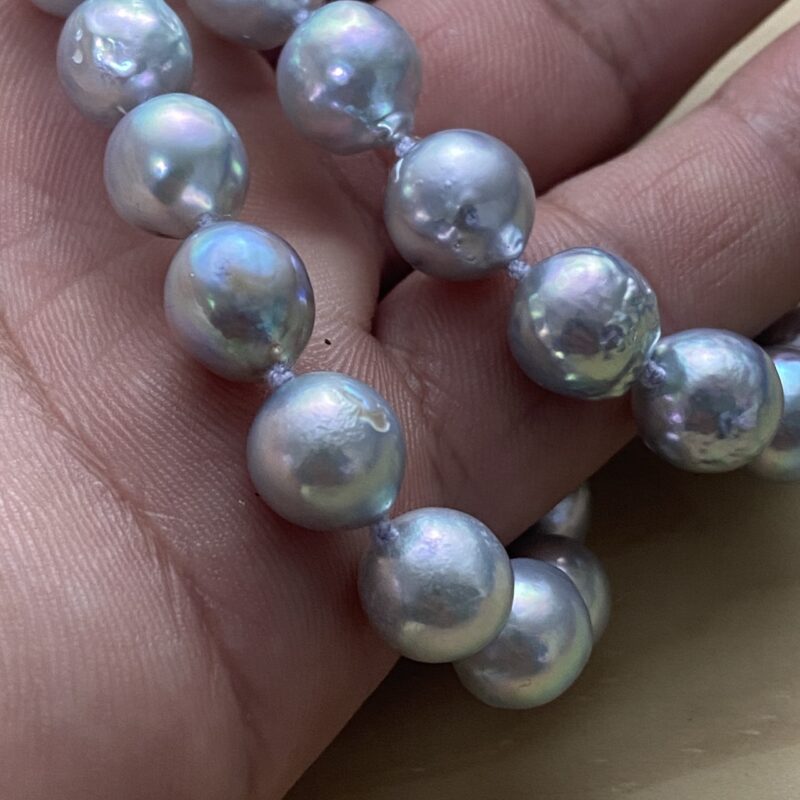
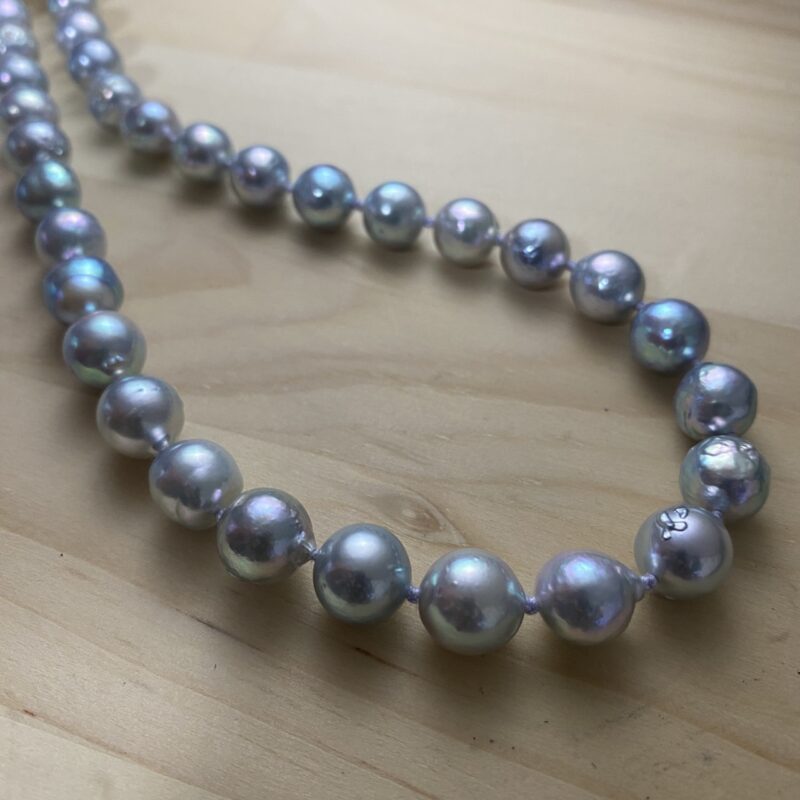
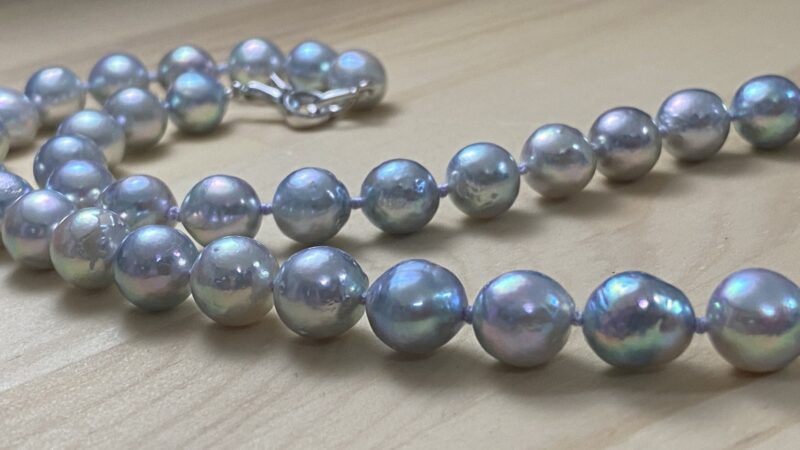
The pearls used in this necklace measure 9.0–9.9 mm and have a baroque shape with natural colors ranging from blue to blue-silver.
As for luster, I would rate them around 3.5 out of 5.
Among these pearls, some are near-round while others have noticeable surface textures and irregularities.
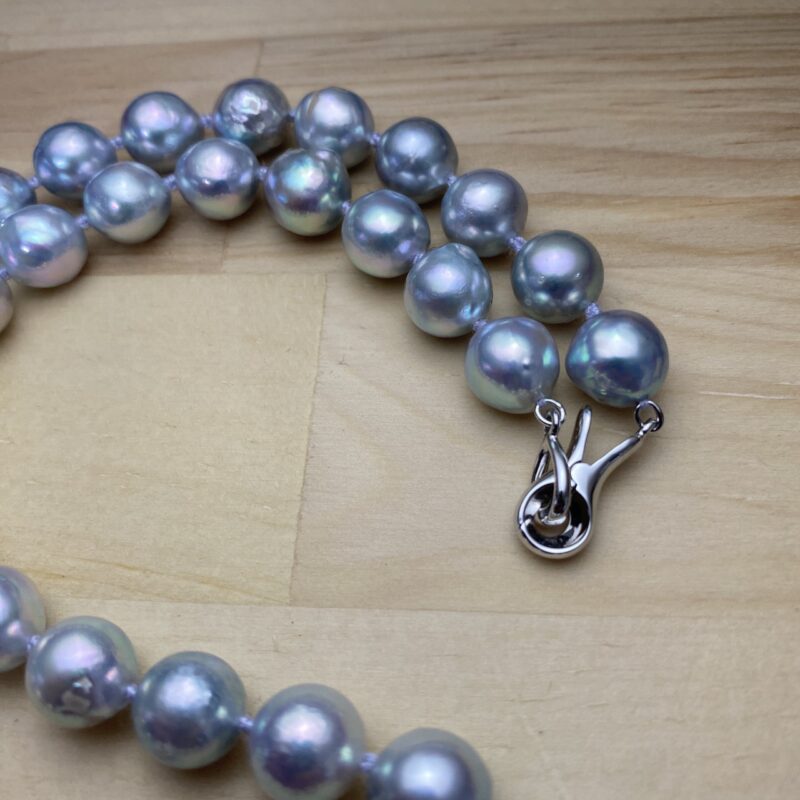
The necklace is all-knotted using lavender-colored polyester thread.
With a conventional all-knotted necklace, a single knot is made between each pearl. However, at Flower Jem, I prefer to emphasize the knots themselves. First, I create a larger knot by looping the thread twice through a single loop. Then I repeat the same process once again.
In other words, each space between two pearls contains a knot formed by four loops of thread.
Even with these larger knots, the soft lavender color prevents them from becoming visually overwhelming.
Instead, the lavender knots seem to give the entire necklace a gentle and elegant atmosphere.
🌸🌸About Colored Knotting
A traditional strand of pearls is beautiful and possesses a sense of dignity.
At the same time, it often carries a strong formal impression. Such necklaces naturally suit formal occasions, but they are not always something people feel comfortable enjoying casually in everyday life.
For that reason, I believe that an all-knotted necklace made with colored thread creates a more relaxed feeling and becomes easier to enjoy as part of daily life.
🌸🌸Why Are Blue Pearls Blue?
Many people appreciate the beauty of natural blue pearls, and they are sometimes described as rare pearls.
Strictly speaking, however, it may be more accurate to describe them not as rare, but as the result of failure.
Pearl farmers do not set out to cultivate blue pearls.
Their goal is to produce white or white-pink pearls.
More precisely, every pearl farmer hopes to produce round pearls with white-pink colors, because those pearls generally command the highest prices.
Yet no matter how carefully they pursue that goal, baroque pearls and blue pearls are still harvested.
Why blue pearls are created has never been fully explained.
As someone who has been involved in pearl farming for nearly ten years and who is also a fan of blue baroque pearls, I would like to share several possible reasons that may explain their existence.
🌸🌸 Why Are Blue Pearls Blue?
🌸🌸🌸 Theory 1: Donor Tissue
The first possible explanation involves donor tissue.
Pearls are created by inserting a nucleus into an Akoya oyster.
At the same time, a tiny piece of tissue from another Akoya oyster is inserted together with the nucleus. This tissue is believed to secrete nacre around the nucleus and form the pearl.
I have heard that once this piece of tissue is inserted into the oyster, it essentially dissolves and loses its original form. However, it may continue to function at a microscopic level that cannot be seen with the naked eye.
This donor tissue is taken from the mantle edge of the oyster, near the area where the shell opens and closes.
Cells from the outer side of this mantle edge produce the prismatic layer, which forms the outer shell surface.
Meanwhile, cells from the inner side produce nacre, the beautiful iridescent material that lines the inside of the shell.
Because of this structure, pearl farmers select tissue from the nacre-producing portion of the mantle edge when preparing donor tissue for pearl cultivation.
However, it is said that a small amount of prismatic-layer-producing tissue is intentionally included.
According to many experienced pearl farmers, if too much of this prismatic-layer-producing tissue is included, the likelihood of producing blue pearls increases.
Since the prismatic layer forms the dull brown exterior of the shell, pearls containing a larger influence from these cells often show lower quality characteristics as well.
For that reason, great care is taken to include only a very small amount of this tissue.
This is considered one possible reason blue pearls are created.
By the way, this theory comes from conversations I have had with pearl technicians and farm managers who have performed nucleus insertions for more than forty years, and in some cases are still doing so today.
None of them claim that this explanation is absolute truth.
However, many of them say something similar:
“There are probably several reasons. But if donor tissue is cut incorrectly, pearl quality clearly decreases, and blue pearls tend to appear more frequently.”
Of course, that is not scientific proof.
It is simply an observation repeated by people who have spent decades working with Akoya oysters every day.
🌸🌸🌸Theory 2: Oyster Fatigue
The second possible explanation is fatigue.
The process of nucleus insertion into Akoya oysters takes place every year from April through December.
Pearls produced from oysters implanted in different months are said to develop different characteristics depending on when the nucleus was inserted.
Pearls implanted between April and June are typically harvested in January of the following year.
Because their cultivation period is relatively short, the nacre layers often remain thinner, resulting in pearls with a cleaner and more refined appearance.
However, pearls implanted in June are somewhat different.
The oysters used in April and May are carefully managed from the previous year to prevent them from carrying eggs.
By June, however, seawater temperatures begin to rise, and the oysters naturally start producing eggs.
When an oyster carries eggs during pearl cultivation, the resulting pearls often become cloudy.
For this reason, pearl farmers use various methods to encourage the oysters to release their eggs before nucleus insertion.
Of course, it is impossible to ensure that every oyster releases all of its eggs.
As a result, some June pearls are influenced by the remaining eggs and become cloudy or develop numerous dark blue stains.
When things go particularly badly, nearly half of an entire lot may be covered with stains.
When that happens, the farm manager’s face turns pale.
From July onward, seawater temperatures rise even further, and oysters release their eggs naturally.
At the same time, the warmer water makes the oysters more active, causing them to secrete larger amounts of nacre.
This often results in pearls with thick nacre layers.
Of course, it also increases the tendency for pearls to develop baroque shapes.
Then comes September.
The weather gradually becomes cooler, and in my experience, pearls implanted in September seem to have the highest likelihood of producing beautiful blue pearls.
People at pearl farms often say:
“The oysters are probably tired from the summer heat.”
According to them, when an oyster’s condition declines, the chances of producing blue pearls increase.
If an oyster becomes seriously unhealthy, it may secrete a white, paint-like substance.
However, the condition observed in September appears to be something much milder.
Rather than being seriously ill, the oysters simply seem exhausted after enduring the summer.
This explanation is admittedly vague.
But pearl farmers are not scientists.
They are people who have spent decades observing Akoya oysters every day.
Their understanding comes from long experience rather than laboratory research.
As a result, the second theory can be summarized very simply:
Blue pearls may be the result of oysters becoming tired after summer.
From the perspective of a pearl farm, however, this is not necessarily good news.
Their goal is to produce white-pink pearls.
An increase in blue pearls during September means a lower chance of achieving that goal.
Not all blue pearls are beautiful.
Some are dull.
Some resemble stains rather than attractive colors.
For that reason, September may be one of the most difficult months for producing high-quality pearls.
By October, seawater temperatures become more stable.
The oysters calm down, and nacre production becomes more consistent.
As a result, high-quality pearls are generally harvested more easily.
Incidentally, oysters implanted between July and December are harvested in December of the following year.
Those implanted between April and June are harvested in January of the following year.
Pearls implanted in December are particularly interesting.
Because seawater temperatures remain low throughout winter, the oysters are largely inactive.
I once examined pearls that had been implanted in December and opened only a few months later, in March.
The nacre layer was barely thicker than a sheet of plastic wrap.
Seeing this with my own eyes made me realize just how inactive the oysters become during winter.
I remember thinking:
“So they really were hibernating. That’s kind of adorable.”
🌸🌸🌸 Theory 3: Foreign Particles
The third theory is that blue pearls are created when Akoya oysters take in tiny particles from the sea, such as sand or other debris, during cultivation.
These particles may become trapped within the nacre as the pearl develops.
I have personally examined broken blue pearls and looked inside them.
In some cases, dark impurities could clearly be seen between the layers of nacre.
This explanation is relatively well known within the pearl industry.
These are the three most commonly suggested reasons for the formation of blue pearls.
🌸🌸A Farmer’s Failure, A Collector’s Treasure
Blue pearls are often described as mysterious, miraculous, rare, or highly valuable.
However, as I mentioned earlier, pearl farmers are aiming to produce round white-pink pearls.
From their perspective, blue pearls are often considered a failure.
Every year, I participated in pearl sorting during the harvest season at pearl farms.
Occasionally, I would discover a particularly beautiful blue pearl.
I would hold it up and say to the farm manager:
“Oh, this one is beautiful!”
The manager would often smile awkwardly and reply:
“That’s embarrassing. We shouldn’t have made a pearl like that.”
Of course, the pearl itself was beautiful.
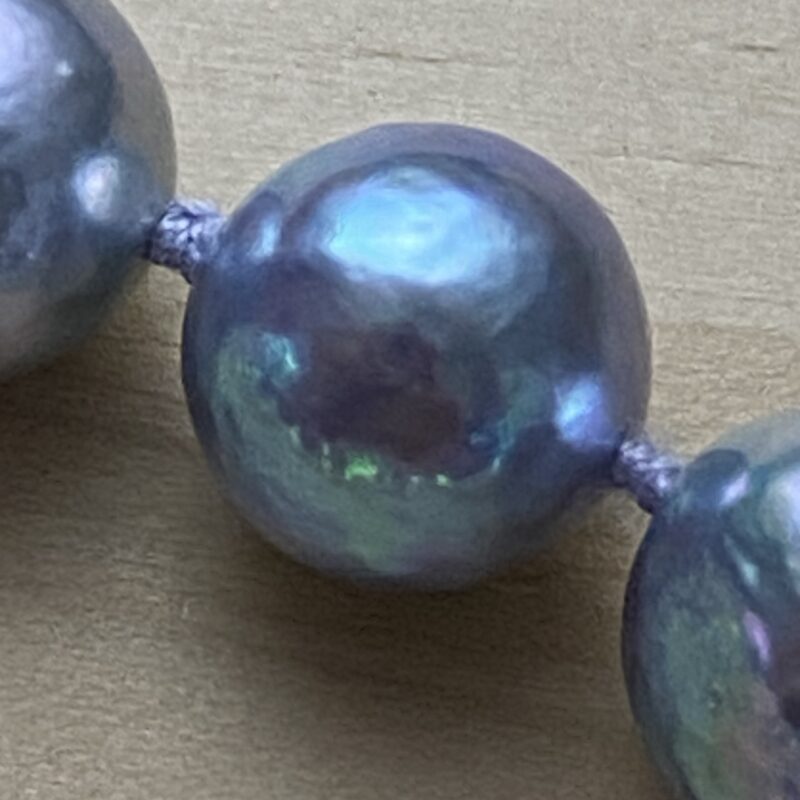
But at pearl auctions, blue pearls generally sold for considerably less than white-pink pearls.
Most blue pearls are also baroque in shape, which traditionally lowered their value even further.
That is why the farm manager called them embarrassing.
However, that was ten years ago.
Today, many farms are aware that beautiful blue baroque pearls can command surprisingly high prices.
Now I sometimes hear farm managers say:
“At least blue baroque pearls are appreciated these days.”
The difference in perspective is fascinating.
The very same pearl can be considered a rare treasure by a retailer and a failed product by a farmer.
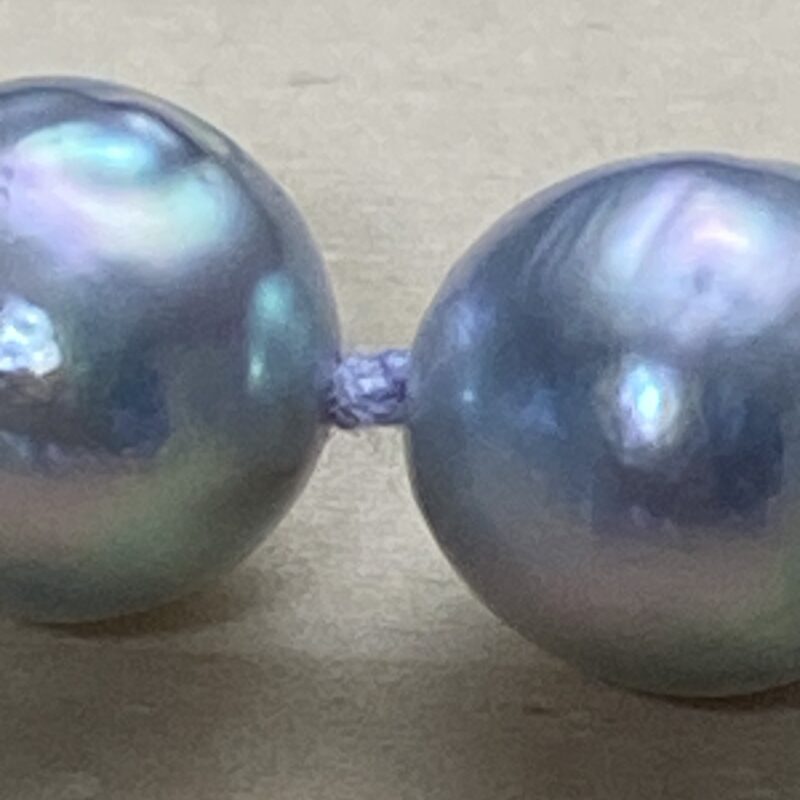
The pearl itself has not changed.
Only the viewpoint has changed.
Perhaps people are similar.
A calm and easygoing person may be described by one person as gentle and kind.
Another person may describe the very same individual as slow, incompetent, or lacking ambition.
The person has not changed.
Only the observer has.
That contrast has always interested me.
🌸🌸Why I Wrote Such a Long Description
As I write this article in Japanese, I plan to have it translated into English afterward.
The Japanese version has already exceeded 4,000 characters, and it will likely become even longer in English.
This article ended up being about both all-knotting and blue pearls.
There is still much more I would like to write.
However, whenever my articles become too long, AI reminds me that most people would never read something this lengthy.
If this necklace were ten dollars, I would probably write a much shorter, simpler, and catchier description.
Pearls, however, are not inexpensive.
I would like people to know at least a little about them.
When purchasing something valuable, many people spend a long time considering their decision.
They may compare pearls from several shops.
They may place different necklaces on a shortlist and spend days or weeks evaluating them.
If that is the case, I believe there is room for a longer article that can serve as one more piece of information during that process.
🌸🌸 About the YouTube Videos
This necklace was created from a lot of approximately 760 pearls measuring around 9 mm.
Those 760 pearls eventually became fourteen separate strands.
Each strand was then individually all-knotted and finished as a necklace.
The entire process was recorded and uploaded to YouTube as approximately twenty-one hours of video.
If you are interested in this necklace, I would be delighted if you watched some of those videos.
Of course, there is no need to watch everything.
This necklace carries the identification letter “F.”
If you locate the videos showing the production of strand F, you can evaluate the quality of these pearls for yourself in just a few minutes.
The pearl photographs shown on this sales page are, in a sense, the pearls on stage.
The pearls shown during production are the pearls in everyday life.
Personally, I would rather see pearls in their ordinary state than only after they have been carefully dressed up for photographs.
It feels more honest.
It feels more real.
🌸🌸Final Thoughts
Whether you purchase pearls from my shop or from another shop, I am happy.
If a pearl from some pearl farm somewhere in Japan is chosen by you, that alone makes me happy.
I hope this article can become a small part of the information you use when choosing those pearls.
Thank you very much for reading all the way to the end.
Pearl Bless You.
This space is not only for reviews. You are welcome to write freely about pearl jewelry, ask questions, or share what you feel when you see this piece. Member registration is required to submit your message.
Pearls & Stories
There are no stories yet.