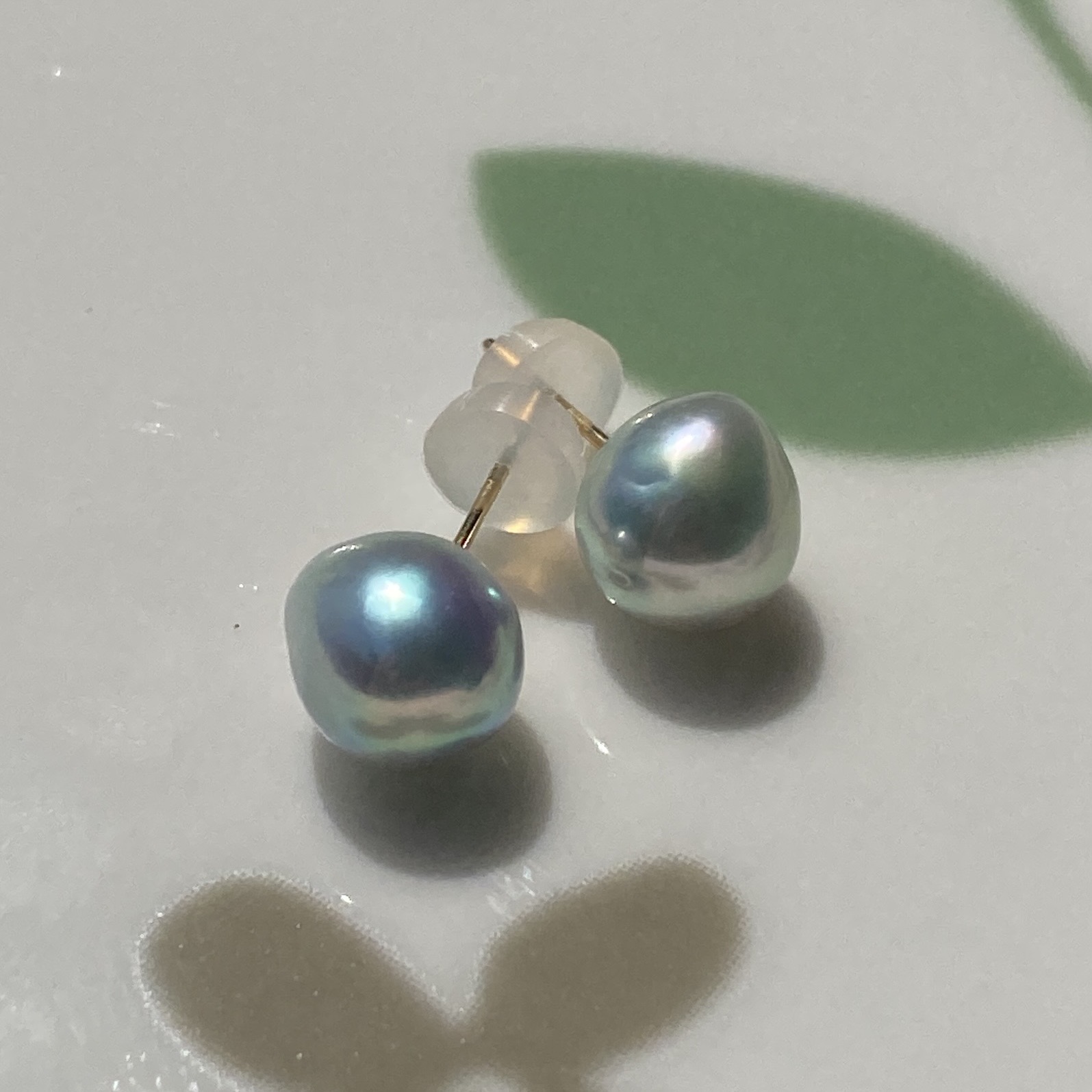
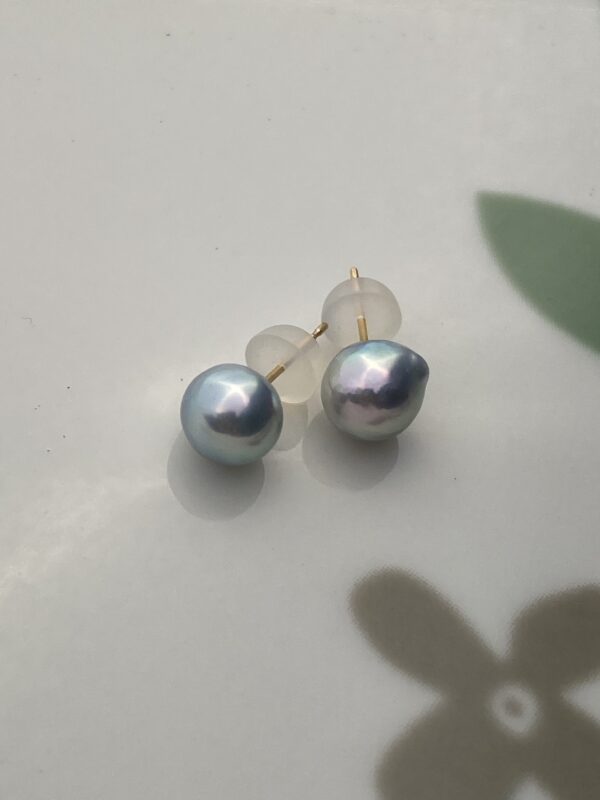
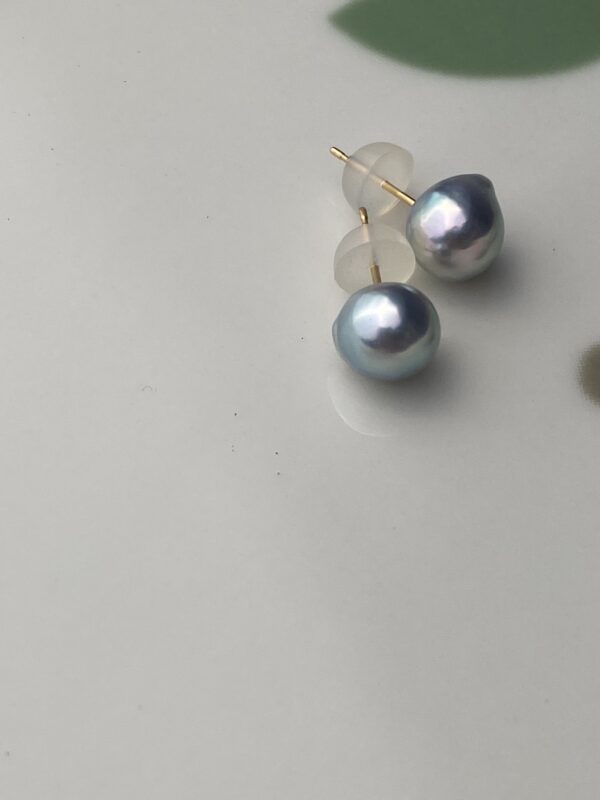
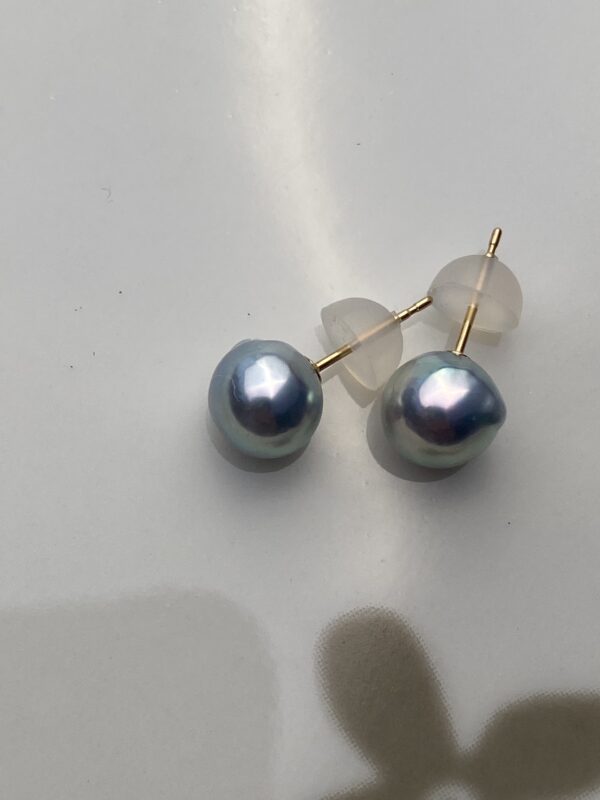
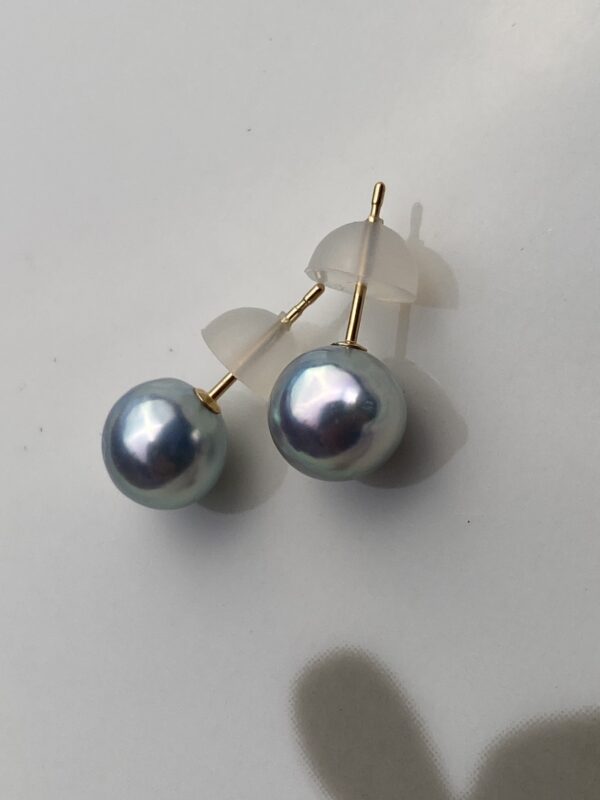
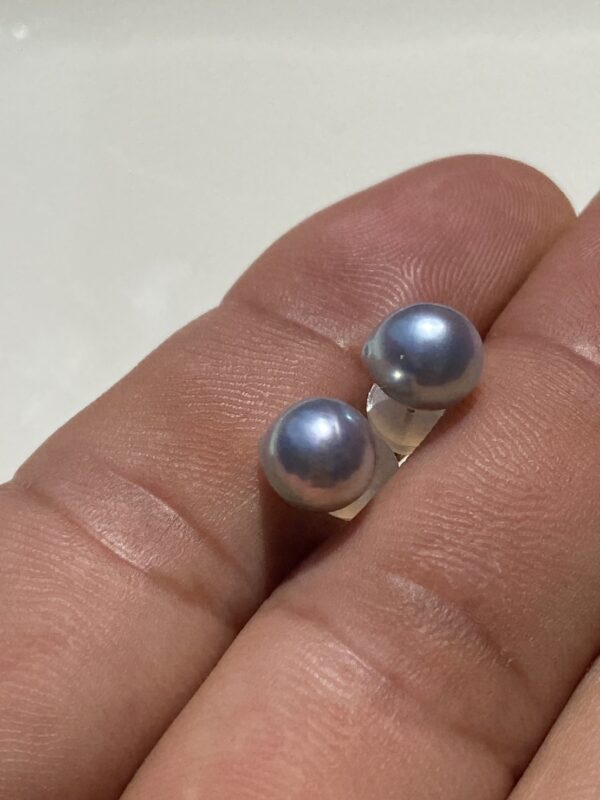
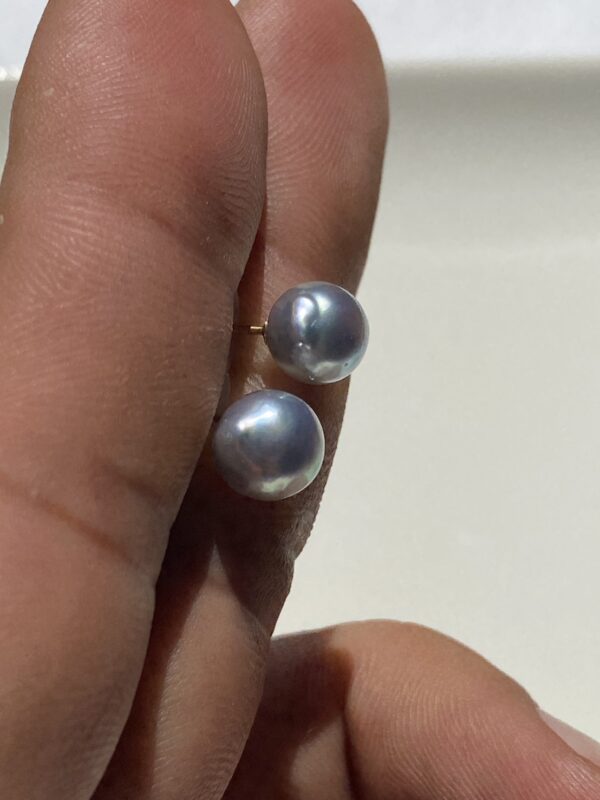
C. Akoya 7.48-7.18mm earrings, seawater pearl, natural blue color, not dyed, K18 gold fittings, not gold filled, from Japan.
Droplet
$202.84
1 in stock
This deep blue seems to have caught your eye.
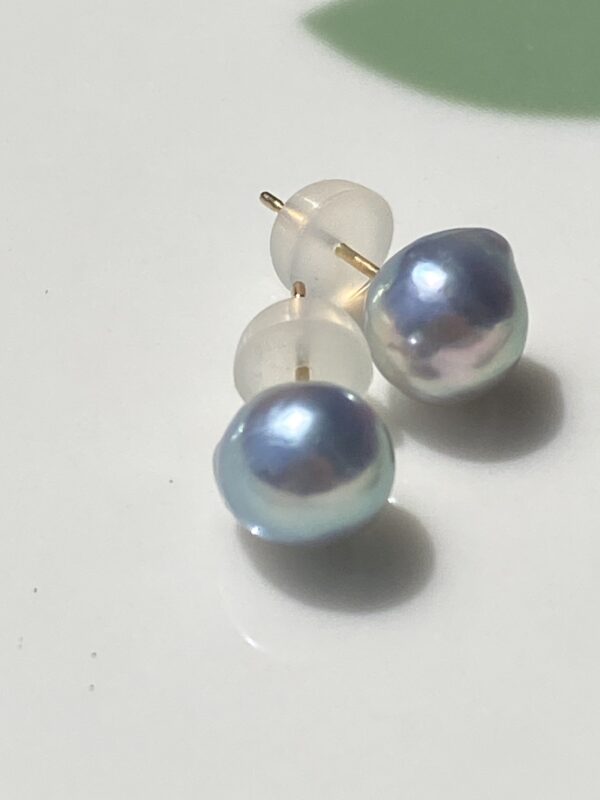
These pearls are on the slightly smaller side, measuring just over 7 mm, but they seem to have a remarkably strong color.
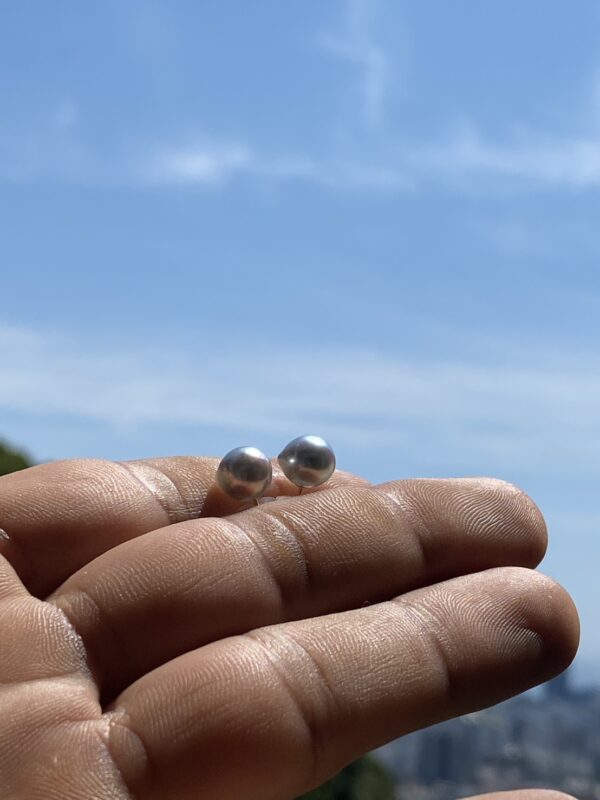
Many blue pearls appear lighter when exposed to strong light, but these pearls have a deep blue that does not lose its intensity even under bright light.
Deep blue pearls are sometimes highly valued, and many people prefer them. However, this is ultimately a matter of personal taste. The depth of the color itself has nothing to do with pearl quality.
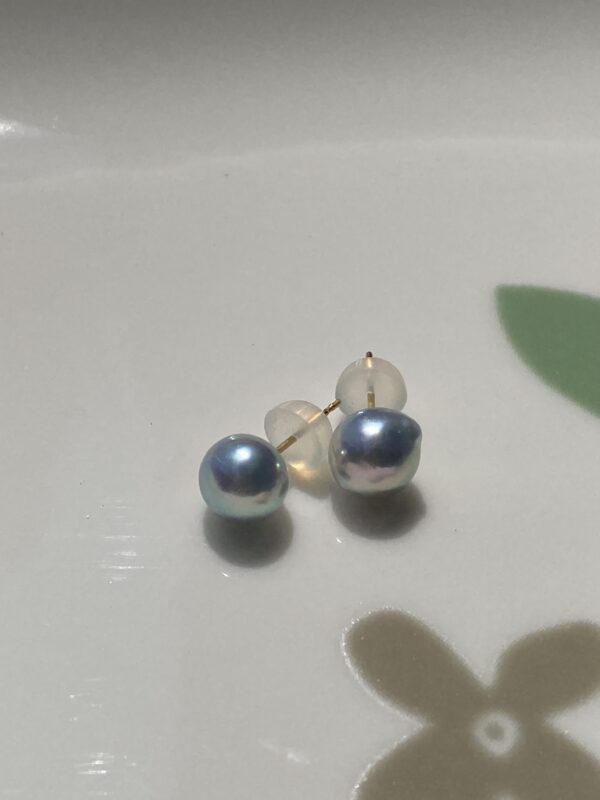
And yet, even though it has nothing to do with quality, deeply colored pearls can sometimes command higher prices.
The relationship between preference, quality, and price is quite interesting.
I wrote about this subject in more detail on the following page of my website:
How to Choose Pearls: The Six Factors That Determine Pearl Beauty
Yes, I wrote it myself.
When I worked for a Japanese pearl company, customers would often ask me:
“So, in the end, what exactly makes a pearl a good pearl? I really don’t understand.”
I wrote that article partly as an answer to that question.
The word “good” in “good pearl” can actually be separated into different meanings.
There is “good quality,” and then there is the pearl that each individual person thinks is “good.”
For example, round pearls are generally considered “good pearls.”
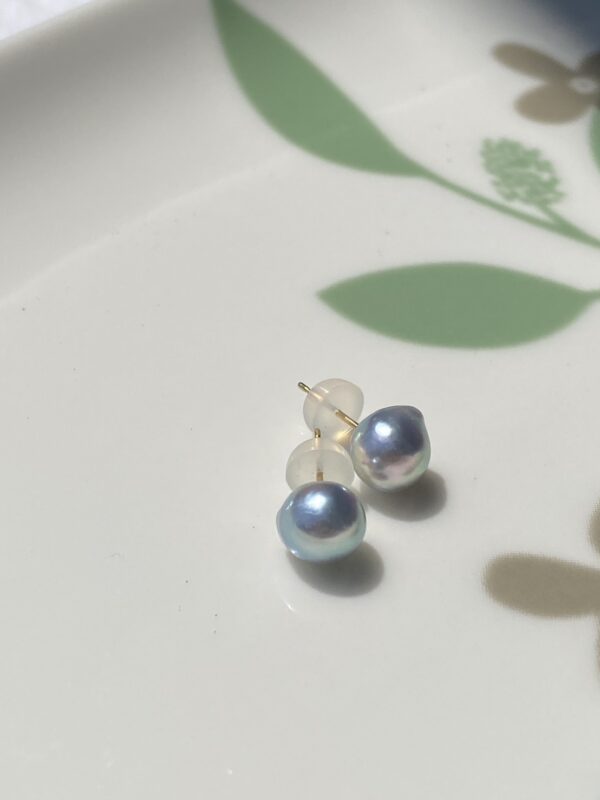
Round pearls are more expensive than baroque pearls, and they are popular not only within the pearl industry but also among the general public.
However, from the standpoint of quality, a pearl is not low quality simply because it is baroque.
The factors that determine quality are luster, surface blemishes, and the thickness of the nacre.
Other elements that contribute to the beauty of a pearl include color, shape, and size.
Color, shape, and size are matters of personal preference.
They are not, in themselves, measures of quality.
A white pearl is not higher quality simply because it is white rather than blue.
Luster, surface blemishes, and nacre thickness affect quality.
Color, shape, and size are matters of preference.
Naturally, the factors that affect quality also affect price.
The stronger the luster, for example, the more expensive the pearl will generally be.
At the same time, color, shape, and size—which are partly matters of preference—also influence price.
Shape and size in particular can have a major effect.
A round pearl will usually be more expensive than a baroque pearl of comparable quality.
And pearls are also traded by weight, so larger pearls become more expensive.
In that respect, they are a little like chicken or pork.
Another important factor is nacre thickness.
Nacre thickness has a major influence on pearl quality, but personally, I feel that it receives surprisingly little attention.
If we compare pearls to tomatoes, nacre thickness might be something like how well ripened the tomato is.
Even with tomatoes, the ones displayed in stores tend to have nice, regular shapes.
Apparently, roundness is justice in the tomato world too.
From the standpoint of price, baroque pearls are generally less expensive than round pearls.
But roundness or baroque shape itself has nothing to do with quality.
So, if you want a pearl that is high in quality but relatively affordable, one answer may be a baroque pearl with thick nacre.
When the nacre is thick, the luster gains depth.
Perhaps that is the pearl equivalent of sweetness and umami in a tomato.
Incidentally, this way of thinking is consistent with the definitions of pearl quality officially presented by the Japan Pearl Promotion Society.
Although almost nobody seems to know that.
In Japan, many people buy pearls because they need them for weddings, funerals, and other formal occasions, even though they do not really understand the value of pearls.
Many of these people have a vague idea that:
“Round pearls are the good ones, right?”
If someone buys round pearls within a limited budget, they may end up with pearls that are not particularly lustrous or that have relatively thin nacre.
But if that person was never especially interested in pearls to begin with, they may look at those pearls and simply think:
“Oh. They’re pretty.”
And then they continue using that pearl necklace as, in a sense, a piece of equipment for formal occasions.
Because the pearls themselves do not particularly fascinate them, they do not suddenly find themselves wanting more pearls.
When I worked for a pearl company, I met quite a few customers like this.
However, with a limited budget, if someone chooses a necklace that is not perfectly round—perhaps slightly near-round—or accepts pearls with somewhat more surface blemishes, there is a greater chance that they can buy pearls with stronger luster and thicker nacre for the same amount of money.
“They’re not perfectly round, and there are a few blemishes, but you can’t really see them from a little distance. And the luster is beautiful.”
More people begin to say things like that.
And that is when the thought,
“Pearls really are beautiful,”
is more likely to appear for the first time.
Of course, there were also customers who would listen to me talk about all of this and still say:
“No. I don’t mind if the luster is dull. I want perfectly round pearls.”
Having such a clearly defined preference may be a strength in itself.
The pearl company where I worked was primarily involved in Akoya pearl farming, with some wholesale business and only a small amount of retail.
So I did not actually have a huge amount of experience serving retail customers.
At most, I would sell pearls at department stores a few times a year.
But one thing I experienced there was that, in Japan, pearls were often treated as “equipment for formal occasions.”
That was a rather sad experience for me.
Of course, occasionally I met an absolutely passionate pearl fan.
There was even one enthusiastic pearl lover who looked as though they might faint when we let them put their hand into a bucket containing 12 kilograms of pearls.
But at least among the customers I personally met, people like that were rare.
Experiences like these are one reason I now communicate about pearls not primarily toward Japan, but toward people overseas.
At first, I was surprised to discover that there were far more people who genuinely loved pearls than I had imagined.
These people enjoy pearls in their everyday lives.
Meeting people like that genuinely excites me.
Wait.
What were we talking about again?
I seem to have lost track, so let me introduce these pearl earrings again.
These earrings were made sometime between August and September 2024.
At some point I took down the listing, and somehow they remained unlisted until I brought them back in August 2026.
This pair was one of 20 pairs of earrings that I made at the same time.
In 2024, I sent pearls that had only recently been harvested—in other words, essentially unprocessed pearls—for stain-removal processing.
When they came back in August, I began sorting through several hundred of them.
First, I selected the higher-quality pearls that were suitable for earrings.
Then, from those pearls, I tried to create as many matching pairs as possible.
In the end, I managed to make 20 pairs.
There is a YouTube playlist containing videos of the whole process: sorting through several hundred pearls, me apparently playing some kind of solitary card game while matching pairs, deciding where to drill the holes, drilling the pearls, attaching the fittings, and finally comparing all 20 finished pairs.
“You’re telling me to watch videos like that?”
No.
That is why I am not recommending them.
Although, having said that, I still believe there must be about 300 million people somewhere in the world who would happily watch them.
Anyway, back to these pearls.
Their blue—or perhaps greenish blue—is quite deep.
Whenever I see inexpensive, round pearls with an unusually deep blue color, my first suspicion is that they may not be natural blue pearls, but irradiated cobalt-blue pearls.
I am usually right.
These pearls, however, are not particularly round in the first place, so there would probably be little incentive for a processor to cobalt-treat them.
For a while, a category of pearls known as Madama became very popular.
These were round pearl necklaces with deep blue coloration.
If you asked a pearl farmer about pearls like that, the response might be something along the lines of:
“Pearls like that don’t exist.”
Well, they do exist—but only very rarely.
And they can become expensive enough to buy a car.
During the period when pearls like these were especially popular, I often saw supposedly natural blue pearl necklaces at product auctions that had actually been cobalt-treated through irradiation.
At first, I could not tell at all.
“What???? There are perfectly round pearl necklaces with blue this beautiful!?”
But then I looked at the price.
They were considerably cheaper than the normal market price.
So I traced their distribution route.
And by “traced,” I simply mean that I investigated where the companies offering those necklaces were sourcing them.
What I found was that some had undergone subtle dyeing that still fell within the standards accepted by gemological identification laboratories, while others had been cobalt-treated.
At least one company openly explained:
“These have undergone only a very slight degree of dyeing, within the level accepted by the identification laboratory, so we are allowed to describe them as natural.”
So I would not describe that company as malicious.
However, if someone genuinely intends to deceive people, distinguishing a natural blue pearl from a treated one can be difficult even for a professional.
You could find out by smashing the pearl open.
But that would be a rather unfortunate method of pearl identification.
Still, please don’t worry too much.
In places such as Kobe and Mie, major centers of the Japanese pearl industry, a dealer who deliberately behaved dishonestly would have a very difficult time surviving.
Trust is extremely important to the people working there.
Perhaps that is true in every industry.
But yes, it is certainly true in the pearl world.
In recent years, however, more pearl processing has also been carried out outside Japan.
So if you find inexpensive, perfectly round blue pearls, I would suggest being a little suspicious.
And then I would like you to tell me about them.
Anyway, once I start talking about pearls, there really is no end to it, so I will stop here.
Thank you for staying with me this far.
Next time, I would like to write something sufficiently ridiculous to make you spit out whatever coffee or tea you happen to be drinking.
Pearl bless you.
The Story Behind the Twenty Pairs
This pair was originally made as one of twenty pairs of Akoya pearl earrings.
If you would like to see how those twenty pairs were created—and what was happening at Flower Jem at the time—you may enjoy the original story below.
Subscribe for Pearl Stories🐾
Receive occasional letters from my workshop —
stories about pearls, silverwork, Lulu the little dog, and quiet life in Japan.
As a thank you, you’ll get a secret code for 30% off —
usable every time you order, only here, not on Etsy.
I don’t send spam. Just little notes filled with love and pearls 💫
You can read our privacy policy for details.
1 Pearl for Droplet
This space is not only for reviews. You are welcome to write freely about pearl jewelry, ask questions, or share what you feel when you see this piece. Member registration is required to submit your message.
Jem
Hi!