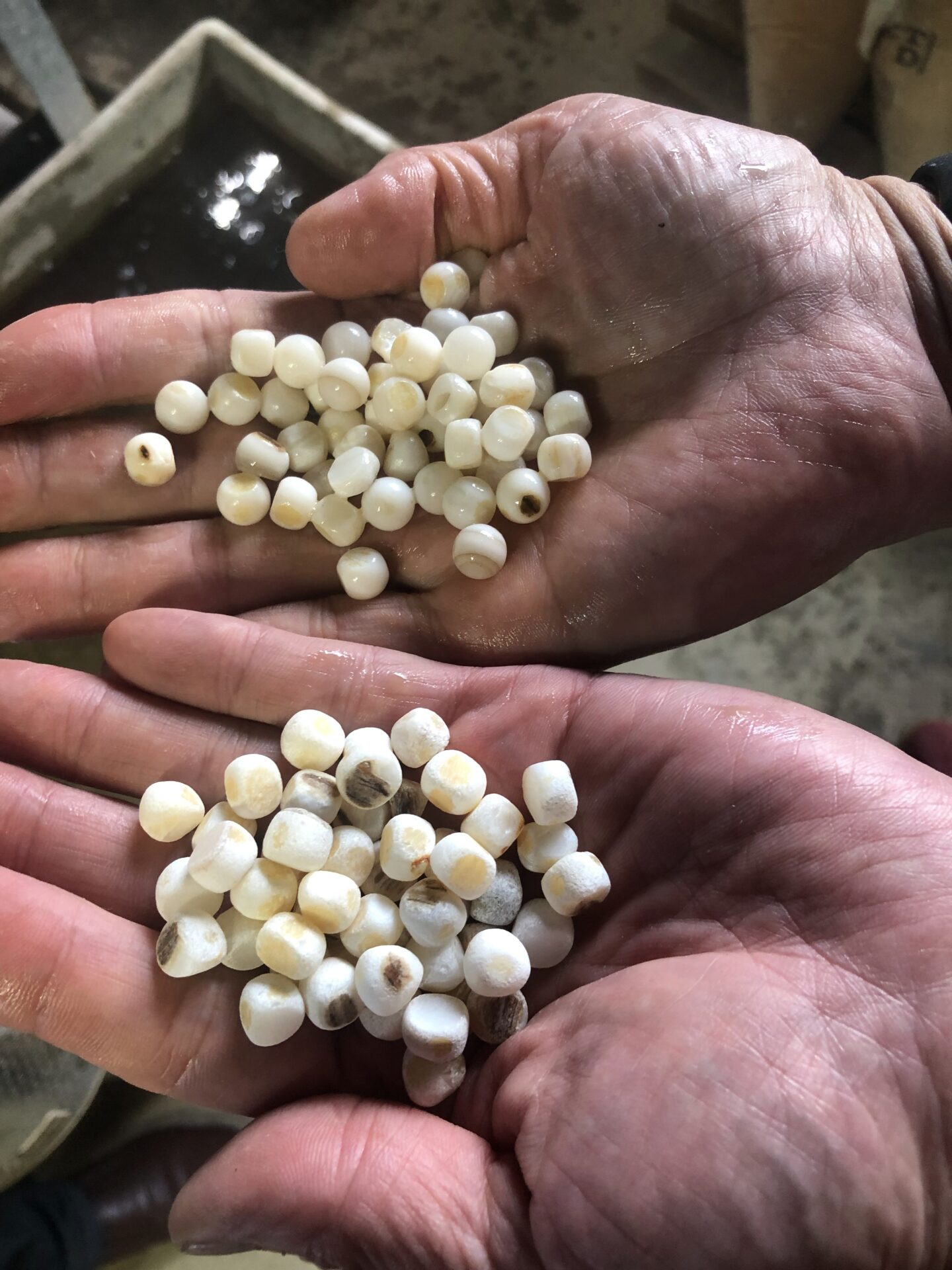
At the center of an Akoya pearl is a small round bead called a nucleus. In pearl cultivation, this nucleus and a small piece of mantle tissue are inserted, almost like a surgical procedure, into a precisely determined location inside the Akoya oyster. Layers of nacre then form around the nucleus.
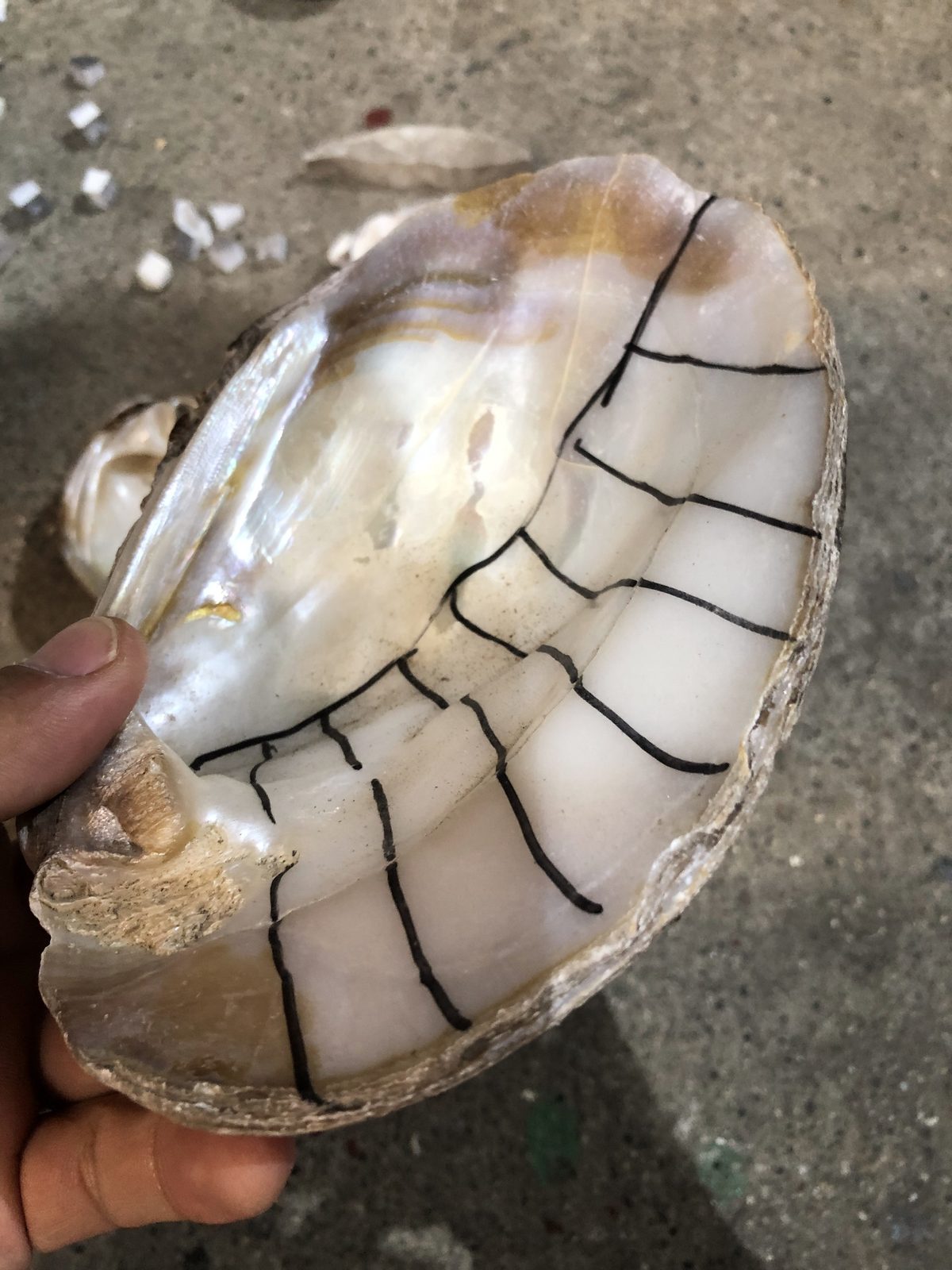
Knowing exactly where and how to cut the shell in order to produce even one more nucleus may be a skill that only an experienced craftsman can master.
When I worked for a pearl company, one of my responsibilities was to act as a liaison between the head office and the pearl farm. Part of that job involved purchasing nuclei in the sizes required by the farm from a nucleus manufacturer and supplying them to the farm.
Through this work, I learned a great deal about pearl cultivation and nuclei from the president of the nucleus factory. We have remained in contact even after I left the company.
I visited his factory several times, and during those visits I filmed parts of the nucleus manufacturing process. I would like to introduce some of that footage here.
A finished nucleus is a perfect sphere, but it begins as a piece of shell about the size of the palm of your hand.
First, the shell is cut lengthwise through the areas where as much thickness as possible can be obtained.
Those pieces are then cut crosswise into small cube-like shapes.
This part of the process was originally done by hand, with workers feeding the shells into the cutting machine one by one. He invented a device that uses vibration to feed the shells into the cutting machine automatically. In the video, he explains the following: “The shells need to be properly dried before they are fed into the machine. If they are not dry enough, they do not slide smoothly.” “Until now, this work was done by hand. Simply having the shells fed automatically has made the process much more efficient.” “Today, I’m cutting this kind of shell just for demonstration, but it is not very thick. With a shell like this, there is very little thickness available for making a nucleus. Once the corners are ground away, the finished nucleus will become very small.” “By the way, about 70 percent of each shell is discarded. The yield is very low.”
The cube-shaped pieces are placed in a drum-type polishing machine and polished for about eight hours. During this stage, their sharp corners are gradually worn away and the pieces begin to become rounded.
After that, they are polished several more times, from rough shaping to finishing, using a machine that looks somewhat like a record player. The nuclei are held between thick rotating discs, which grind their surfaces and gradually shape them into more precise spheres.
From here, the inspection process begins.
First, the nuclei are rolled across a flat disc. If a nucleus is not a perfect sphere, it moves unnaturally as it rolls. Such pieces are judged to be defective and are sent back for further polishing.
They are then inspected by human eyes as well. Each nucleus is checked for cracks, cloudiness, and other defects.
For this inspection, several hundred nuclei are placed inside something resembling a black picture frame, and the surrounding area is darkened so that only a small lamp illuminates them. I was told that using a single light in the darkness makes it easier to spot unusual reflections from imperfect nuclei.
This page does not yet contain videos or photographs of every stage of the process. In the future, I hope to document the entire process from the original shell all the way to the finished nucleus.
As with almost any product or object, a great deal of work and ingenuity takes place behind the scenes, beyond what we normally see.
A pearl nucleus is perhaps like a component hidden inside a car. Once the pearl is finished, the nucleus itself will never be seen again.
However, to produce a perfectly spherical pearl, the nucleus at its center must also be an extremely precise sphere.
And in terms of weight, a substantial portion of a pearl’s weight comes from its nucleus.
The nucleus maker once said to me, half seriously and half jokingly:
“People call it a pearl, but most of what’s inside is the nucleus.”
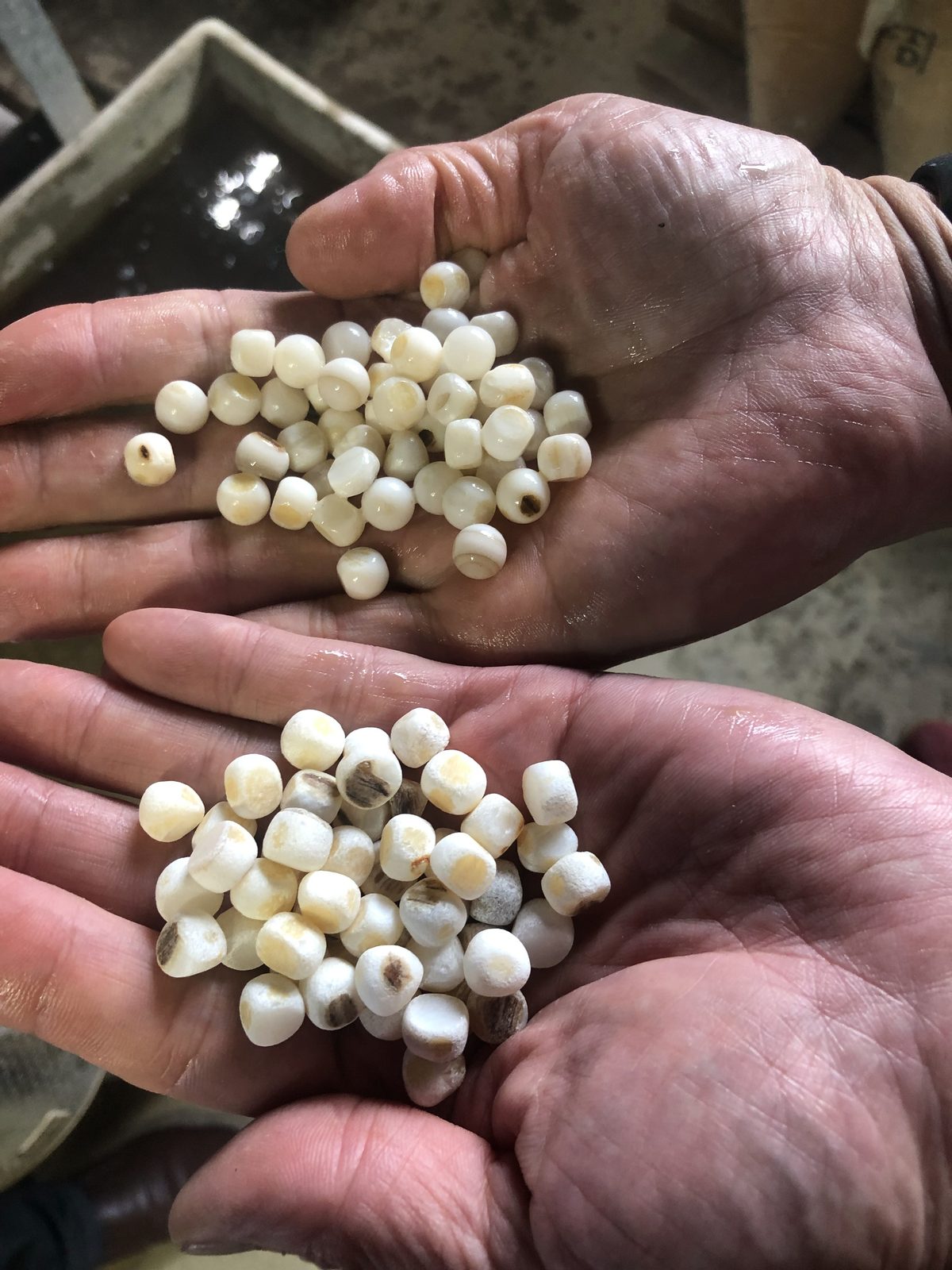
Related Articles
If you would like to see how these nuclei are actually used in Akoya pearl cultivation, you may also enjoy these articles.
Subscribe for Pearl Stories🐾
Receive occasional letters from my workshop —
stories about pearls, silverwork, Lulu the little dog, and quiet life in Japan.
As a thank you, you’ll get a secret code for 30% off —
usable every time you order, only here, not on Etsy.
I don’t send spam. Just little notes filled with love and pearls 💫 You can read our privacy policy for details.

Comment