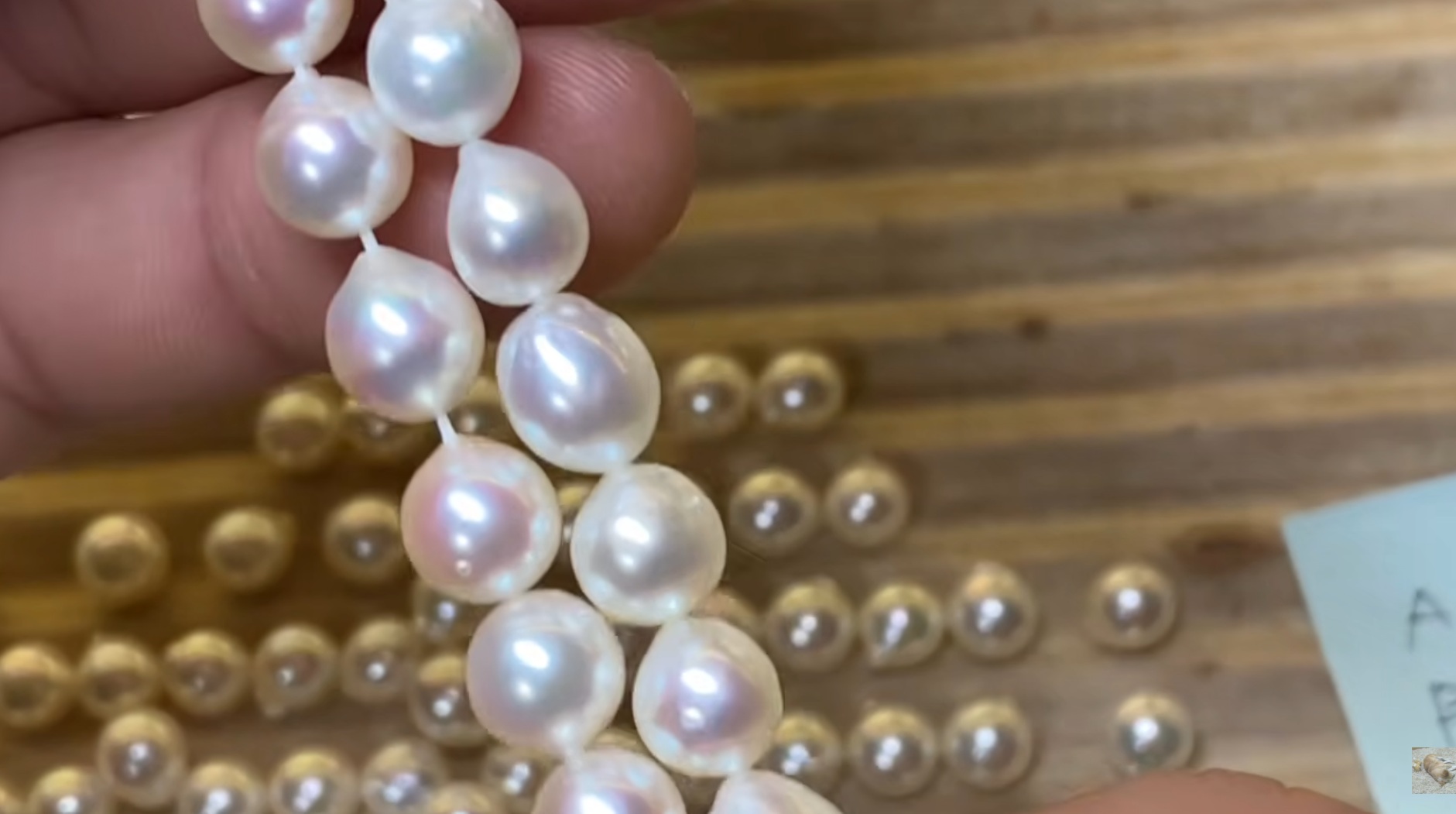
I compared three natural white Akoya pearl necklaces. The top two are from Tsushima, while the bottom strand comes from Yusu in Ehime Prefecture.
For a more detailed comparison of these three strands, including their origins, nacre, processing, and background, please read my full article on the Tsushima and Ehime pearls.
To my eyes, the Tsushima pearls have a slightly creamy tone and appear to have dense, thick nacre. The Yusu pearls look much whiter and clearer. They appear slightly cloudy in the video, but in person they are remarkably white.
This does not mean that Tsushima pearls are always creamy or that Ehime pearls are always white. Color and nacre vary even within the same growing area.
In the Japanese pearl industry, even no-toned pearls generally undergo pre-treatment. I think of this process as washing your face: it removes impurities and helps reveal the pearl’s natural brightness rather than changing its original color.
The appearance of a pearl is shaped not only by processing, but also by the sea, the oyster, the farming environment, and the skill of the people who cultivate it.
If these three strands have caught your eye, view the Akoya pearl necklaces currently available at Flower Jem.
Related Articles
If you would like to learn more about how I evaluate Akoya pearls and how pearl processing affects their appearance, you may also enjoy these articles.
Subscribe for Pearl Stories🐾
Receive occasional letters from my workshop —
stories about pearls, silverwork, Lulu the little dog, and quiet life in Japan.
As a thank you, you’ll get a secret code for 30% off —
usable every time you order, only here, not on Etsy.
I don’t send spam. Just little notes filled with love and pearls 💫 You can read our privacy policy for details.

Comment