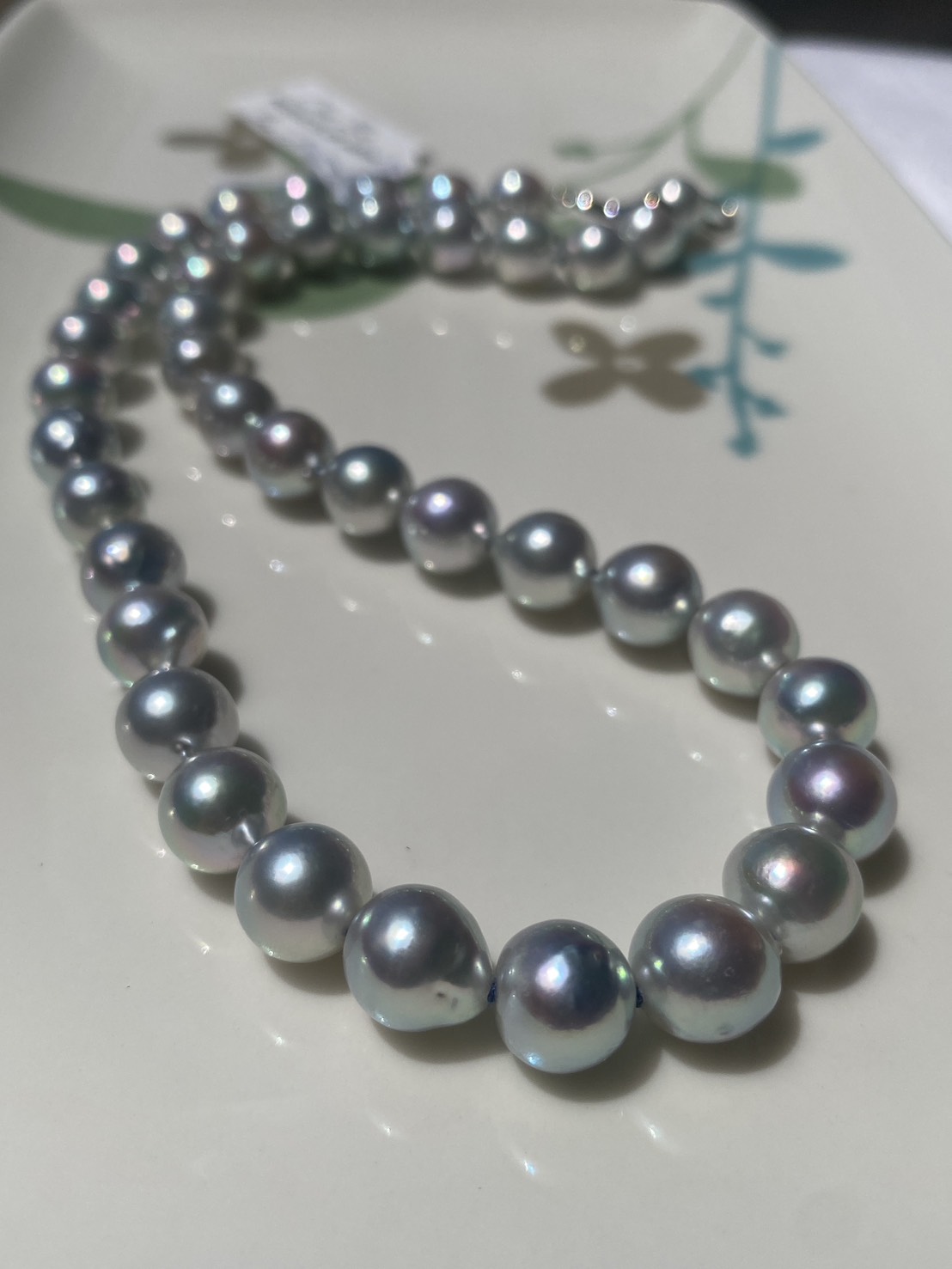
#A Clear Blue
$2,857.00
1 in stock
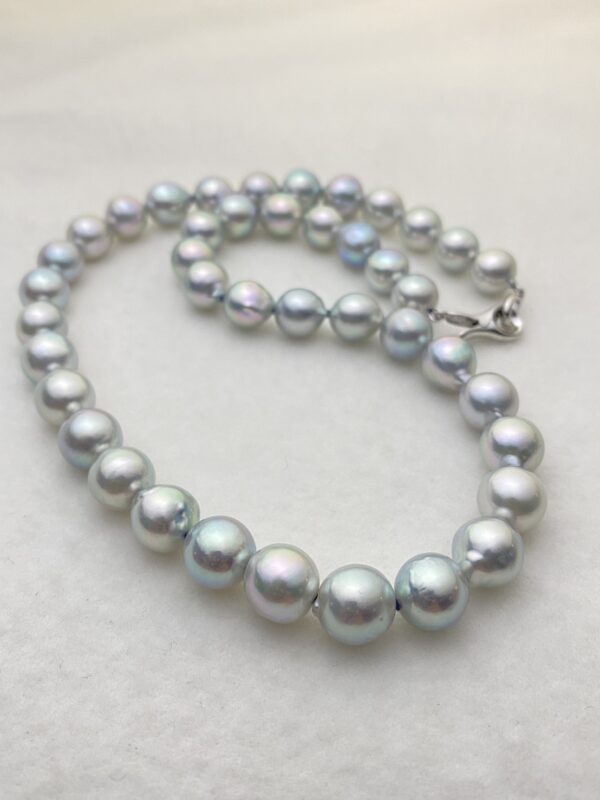
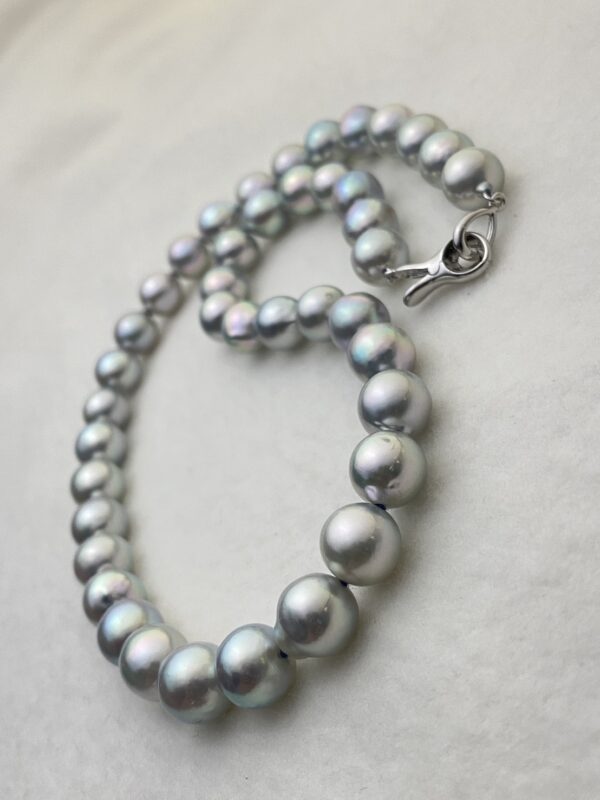
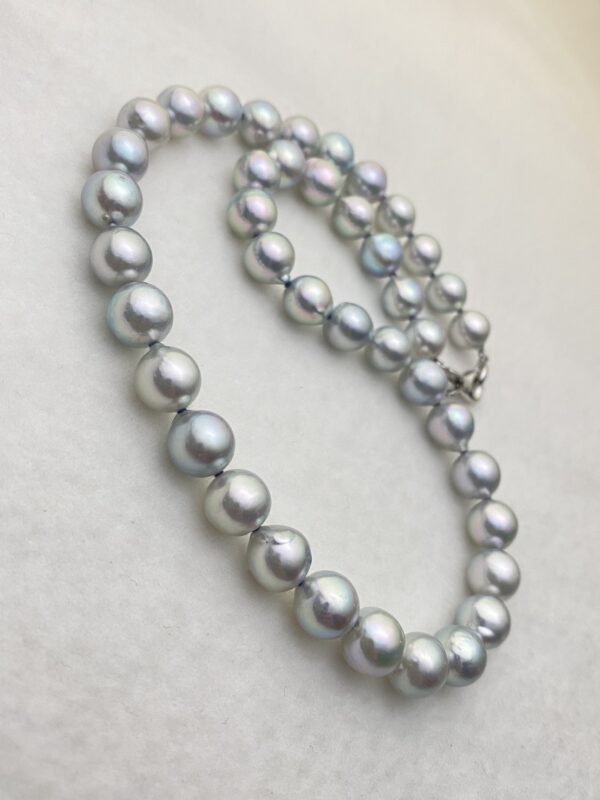
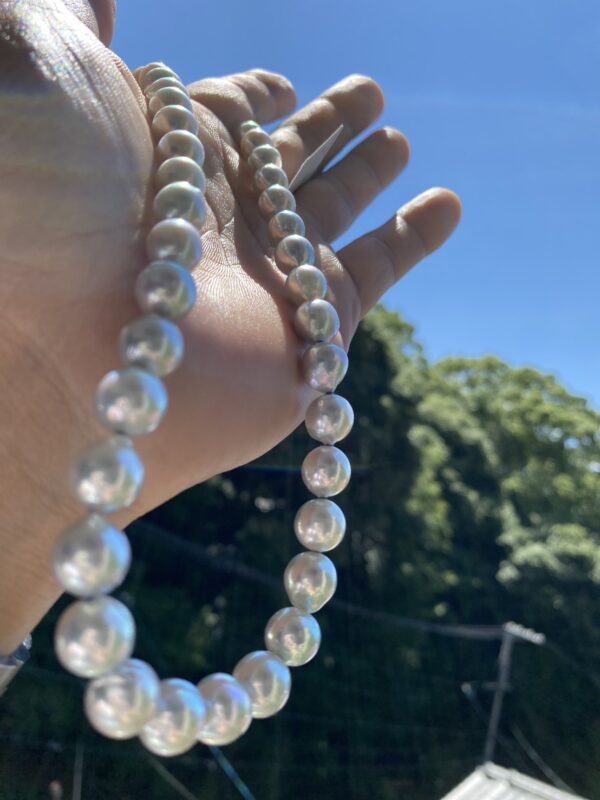
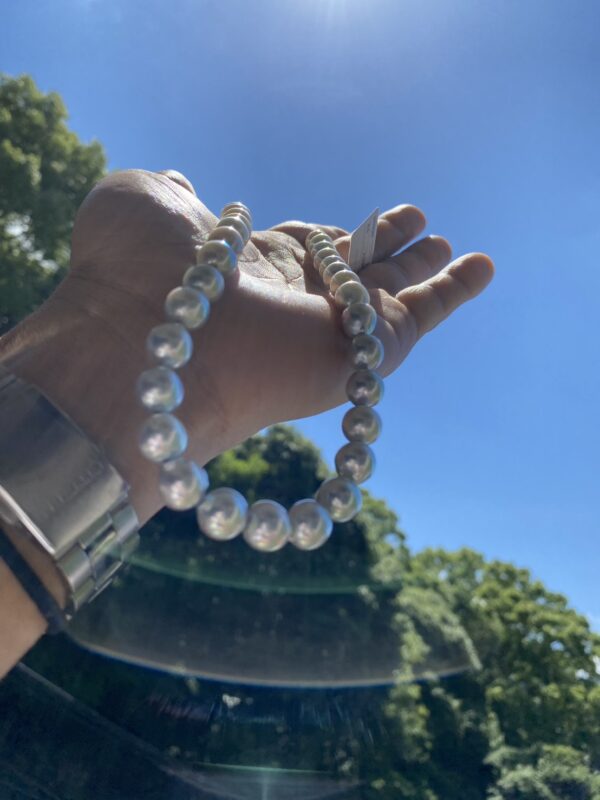
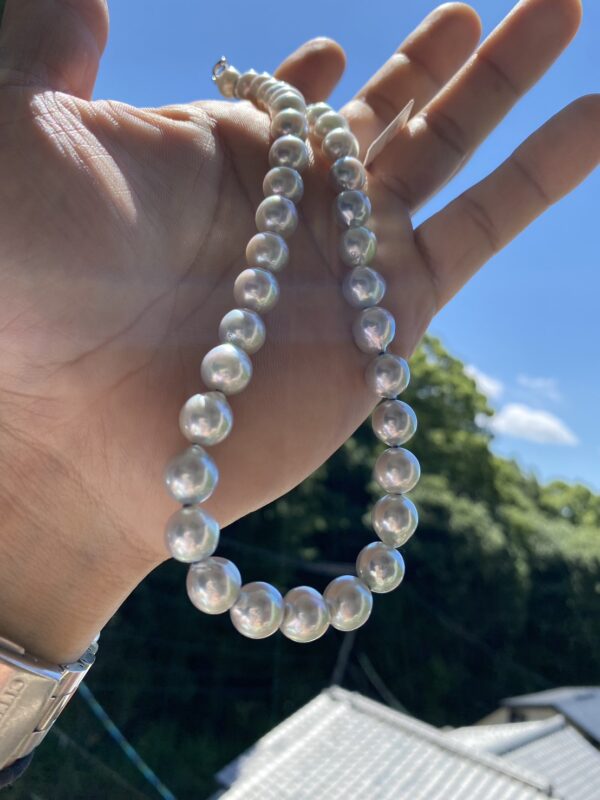
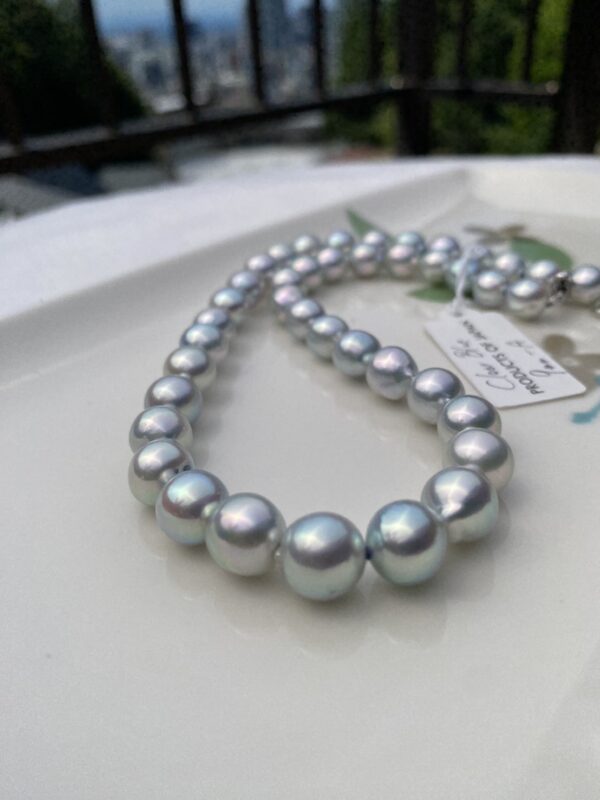
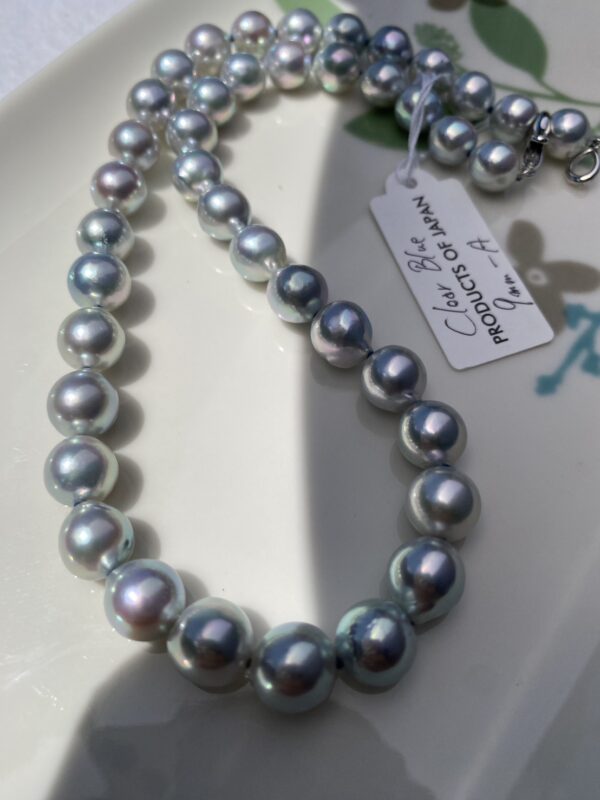
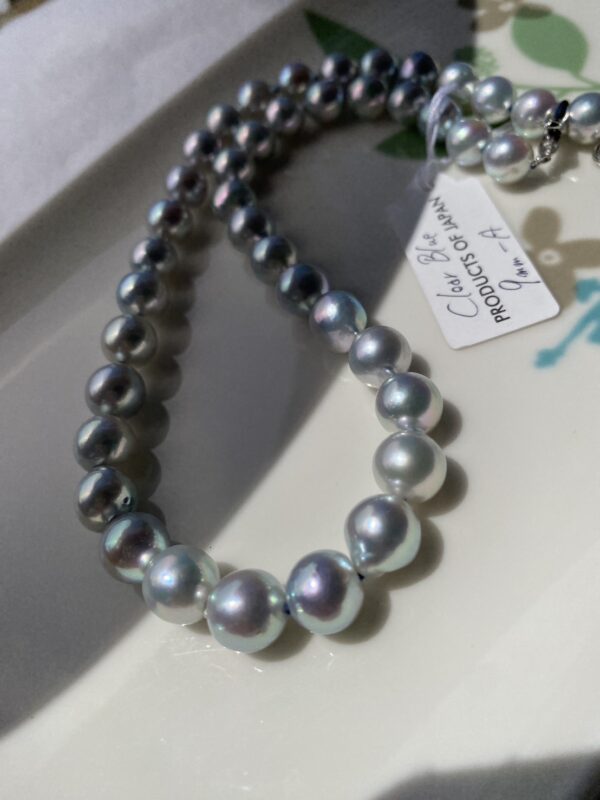
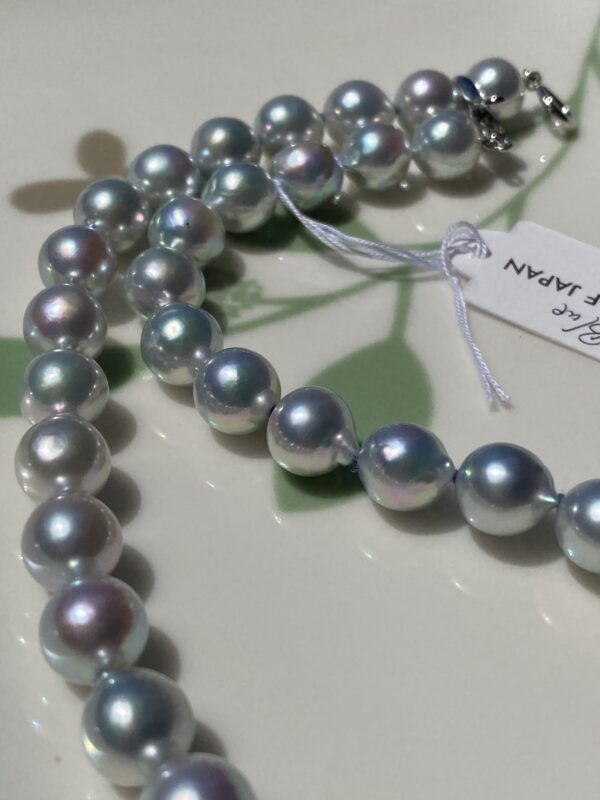
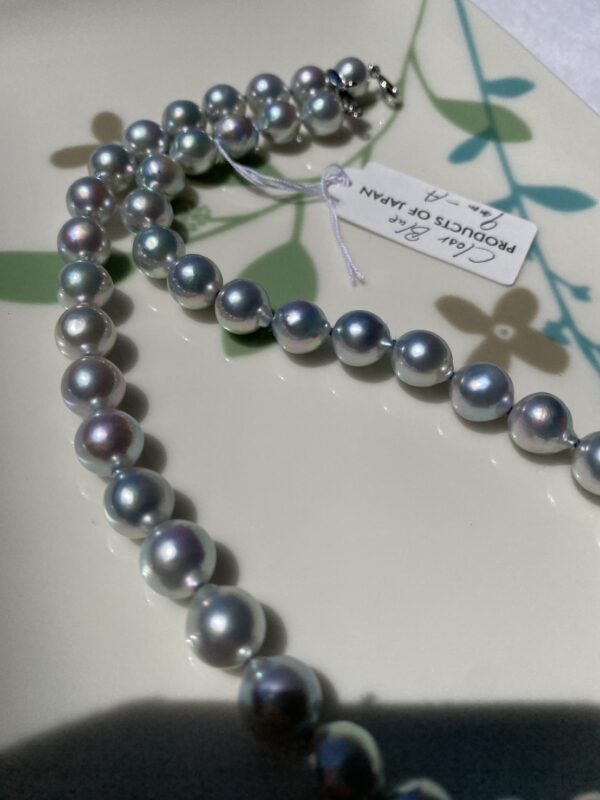
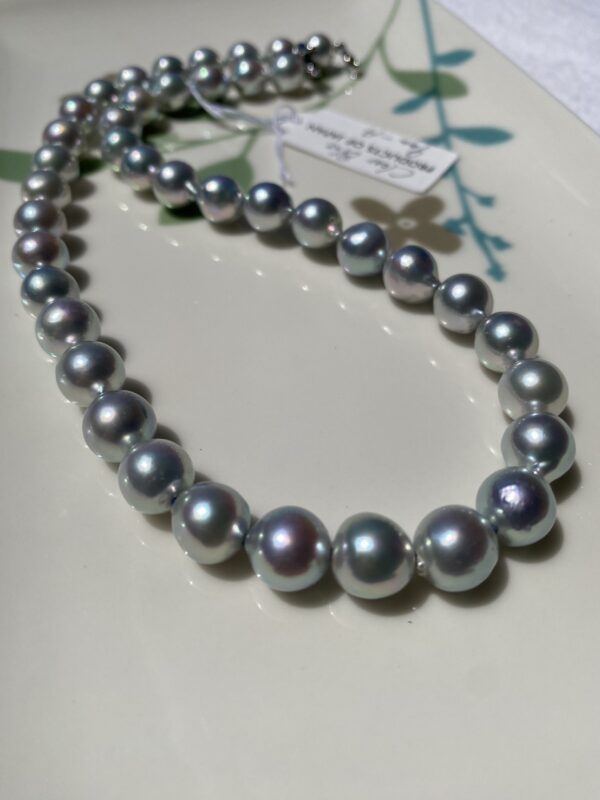
This is an Akoya pearl necklace.
As you may already know, Akoya pearls are produced by the Akoya oyster. Compared to black-lipped and white-lipped oysters, Akoya oysters are smaller. As a result, the pearls they produce are also generally smaller.
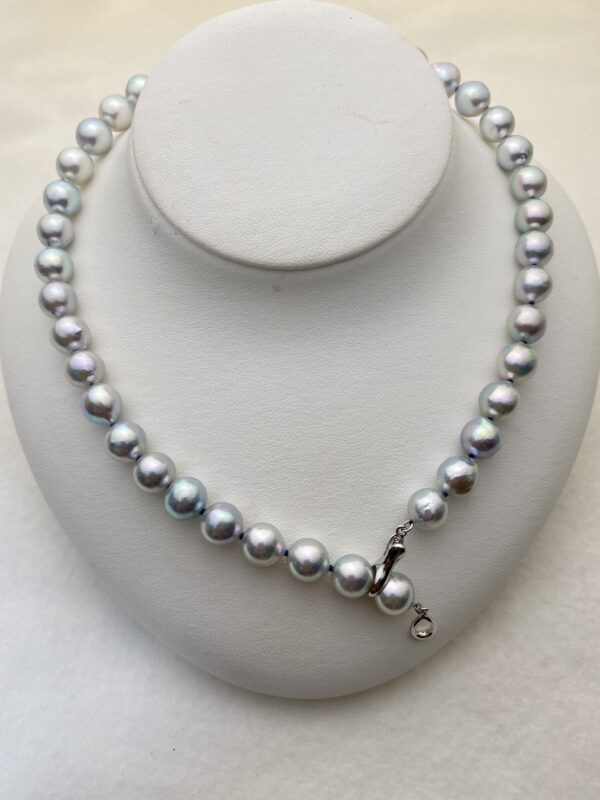
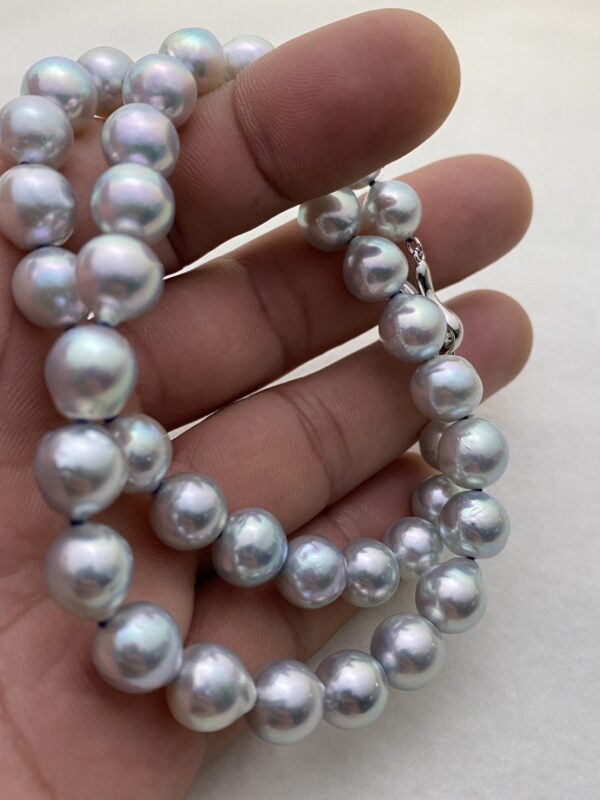
The standard size for Akoya pearls is around 7mm. Pearls of 8mm are considered relatively large, so the 9mm pearls introduced here fall into a significantly large category.
At the pearl farm where I previously worked, the recent poor growth of Akoya oysters made it difficult even to cultivate oysters capable of producing 6mm pearls. There were periods when we had no choice but to produce 5mm pearls. Of course, some farms specialize in cultivating larger oysters aiming for 9mm pearls, but considering the overall production, such pearls are quite rare.
In recent years, the growth of Akoya oysters has been generally poor across Japan. Regions that once focused on 8mm pearls are now shifting toward 7mm, and areas that produced mainly 7mm pearls are seeing an increase in 6mm production.
These regional differences are influenced by the nutritional condition of the sea. Factors such as oxygen levels and plankton availability significantly affect the growth rate of Akoya oysters.
Fundamentally, the size of a pearl is determined by the size of the oyster. Pearls are formed by inserting a nucleus into the oyster, around which nacre layers are deposited. A small oyster cannot accommodate a large nucleus.
For this reason, pearl farmers take great care to grow the oysters as large as possible. However, no matter how much effort humans put in, nature ultimately has the greater influence. Weather conditions and the nutritional state of the sea play a major role in oyster growth.
There are several methods farmers use to promote growth. Akoya oysters are kept in mesh baskets suspended in the sea. As they grow, the oysters begin to crowd the basket.
Before overcrowding occurs, farmers sort young oysters—often around 100 per basket—by size into large, medium, and small groups. They then redistribute them into new baskets, adjusting the number in each so they have enough space to grow comfortably.
Faster-growing oysters are also selected to receive nucleus insertion earlier than others.
The key idea is to ensure that each oyster has enough space to access the limited nutrients available in the sea. If the oysters are overcrowded, they cannot obtain sufficient nourishment, and their growth slows.
This process may be similar to farming crops. After planting seeds, farmers may thin out slower-growing sprouts to allow stronger ones to grow better. In the case of Akoya oysters, the smaller ones are not discarded but moved to separate baskets.
Even with such careful and labor-intensive work, raising oysters large enough to produce 7mm or 8mm pearls is already difficult. Naturally, cultivating oysters capable of producing 9mm pearls is even more challenging.
Around two to three years ago, there was a serious nationwide issue in Japan where many Akoya oysters died, and their growth was significantly stunted. Recently, these conditions have begun to improve slightly.
From another perspective, pearls are also valued by weight. Even a high-quality 3mm pearl is priced based on its weight. In extreme cases, a medium-quality 8mm pearl may be more valuable than a high-quality 3mm pearl.
Larger pearls tend to command higher prices due to their weight, even if their quality is not exceptional. In contrast, smaller pearls must have higher quality to maintain value.
Importantly, whether a pearl is 3mm or 9mm, each is produced by inserting a single nucleus into one oyster. The labor required is essentially the same regardless of size.
If large oysters cannot be cultivated, only small nuclei can be inserted, resulting in smaller pearls with lower overall value.
A technician performing nucleus insertion typically handles around 800 oysters per day. The effort required does not change with pearl size, yet the final value varies greatly depending on weight.
Pearl weight is measured in a traditional unit called “monme,” where 1 monme equals 3.75 grams. A 6mm pearl is approximately 0.1 monme, 7mm is 0.15 monme, 8mm is 0.2 monme, and 9mm is about 0.35 monme.
This means that, at the same quality level, a 9mm pearl can be about 3.5 times more valuable than a 6mm pearl.
In recent market conditions, top-grade Akoya pearls have reached prices of around 20,000 yen per monme. Under such conditions, a 6mm pearl might be valued at around 2,000 yen, while a 9mm pearl could reach around 7,000 yen.
Even so, the difficulty of cultivating 9mm pearls is so high that farms are often forced to produce smaller sizes like 6mm.
Now, returning to this necklace.
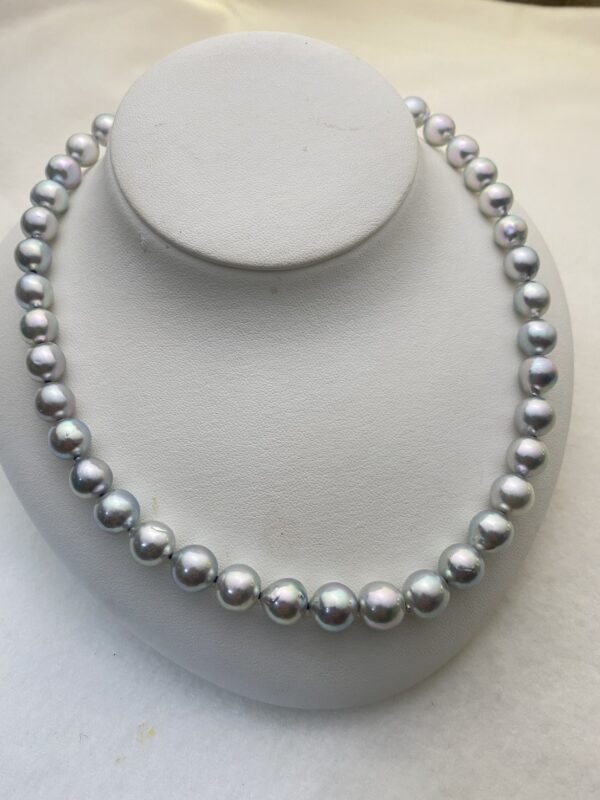
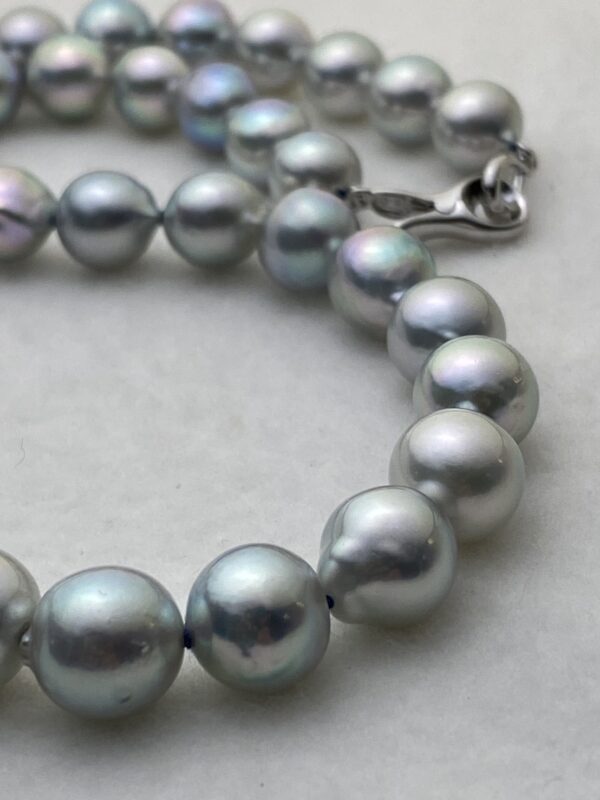
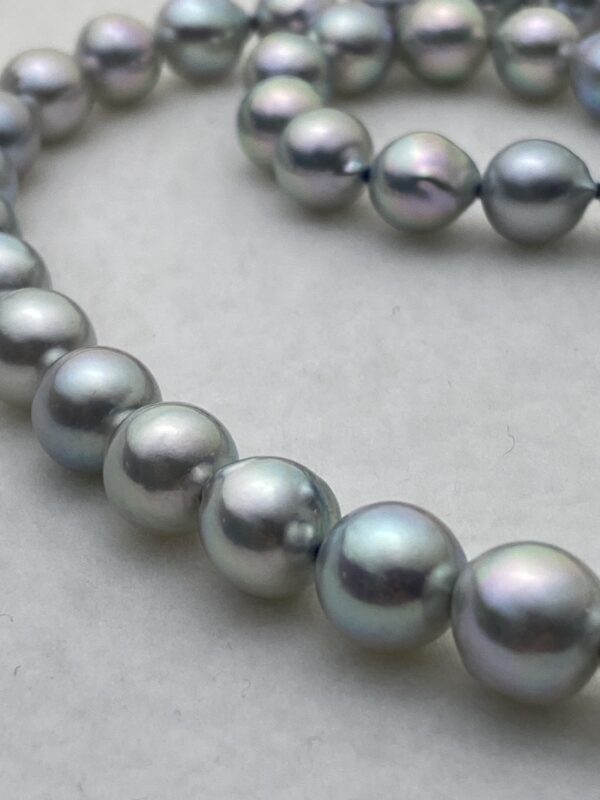
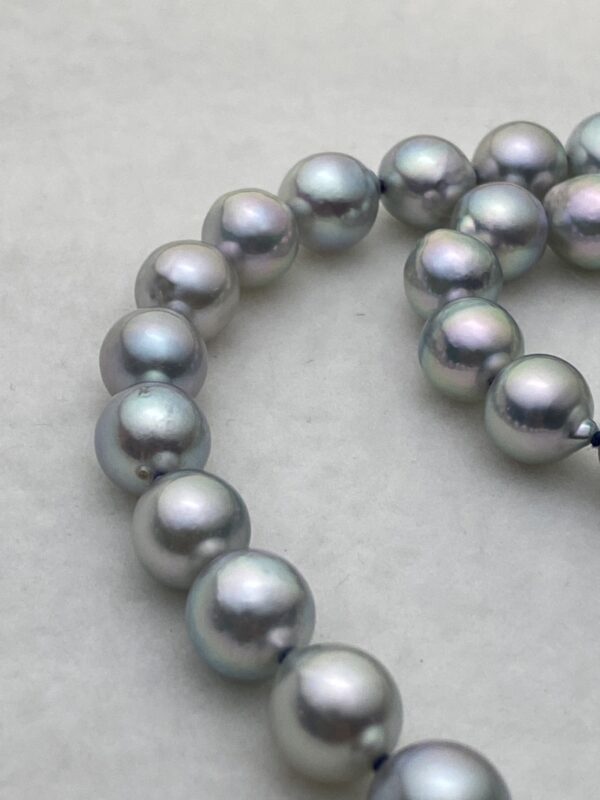
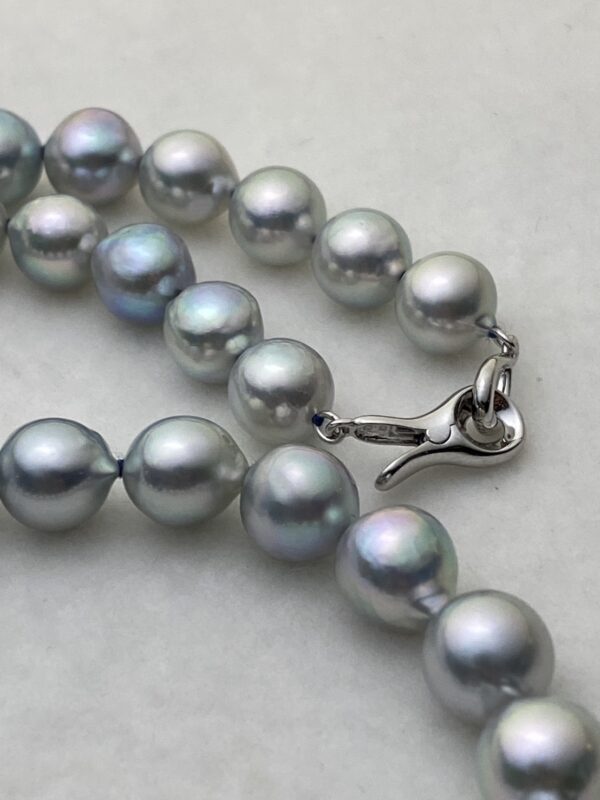
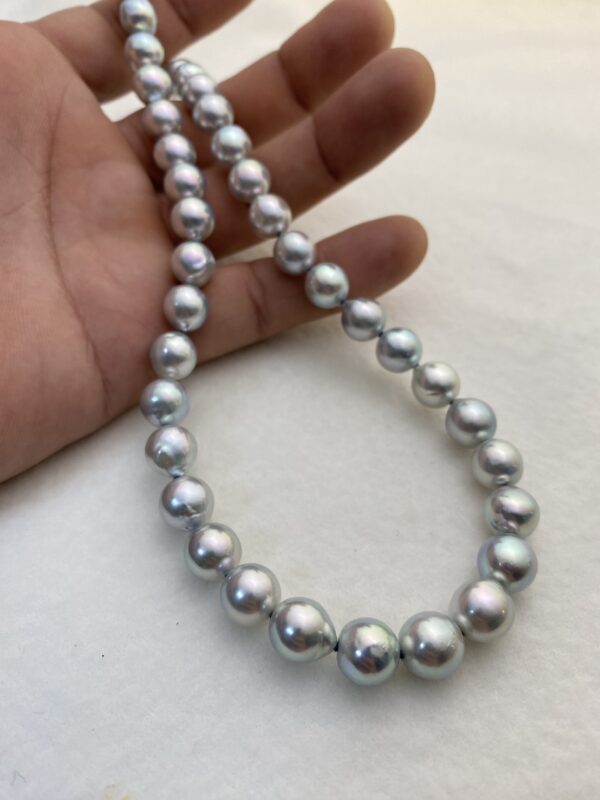
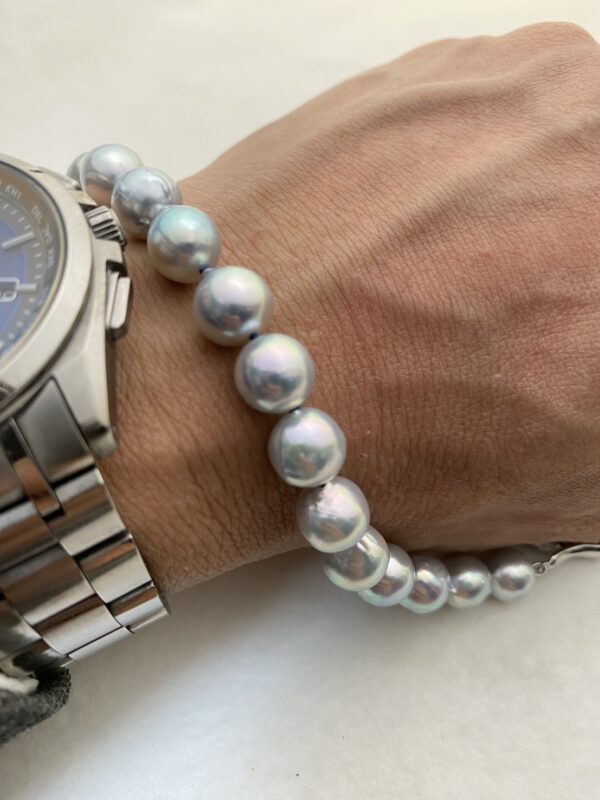
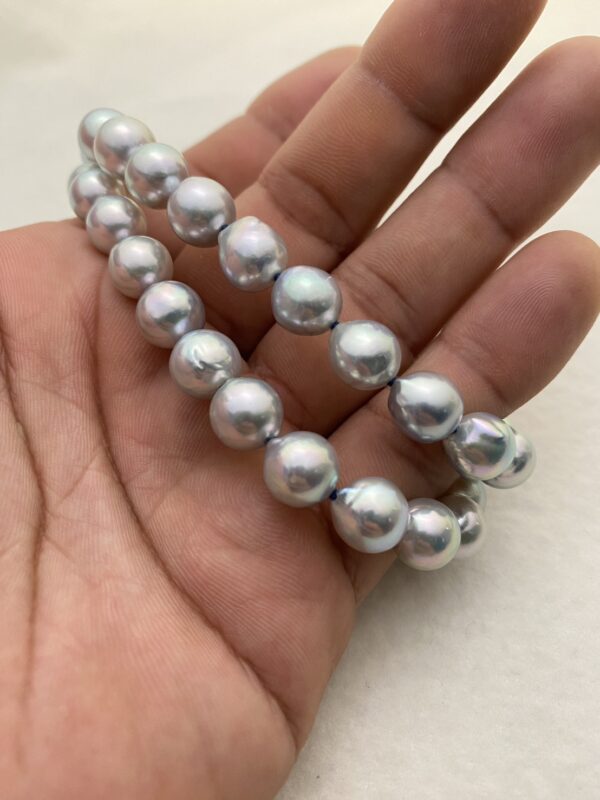
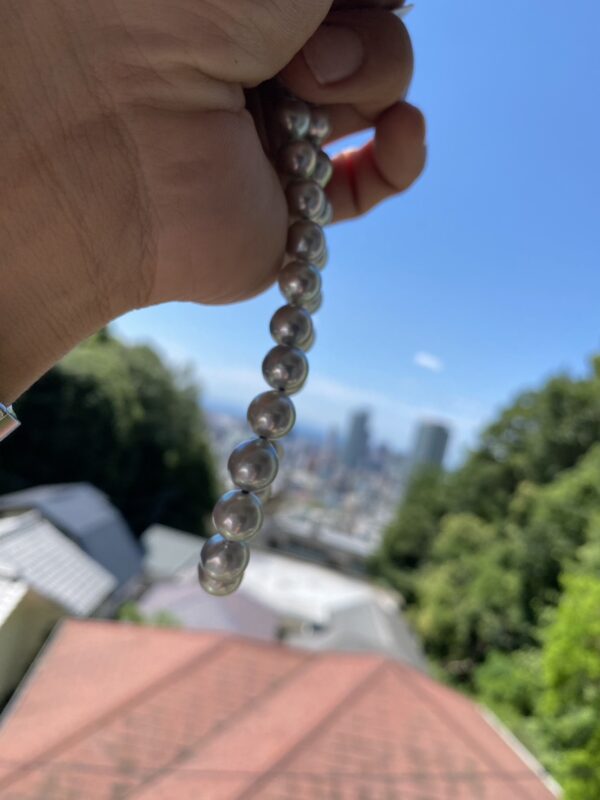
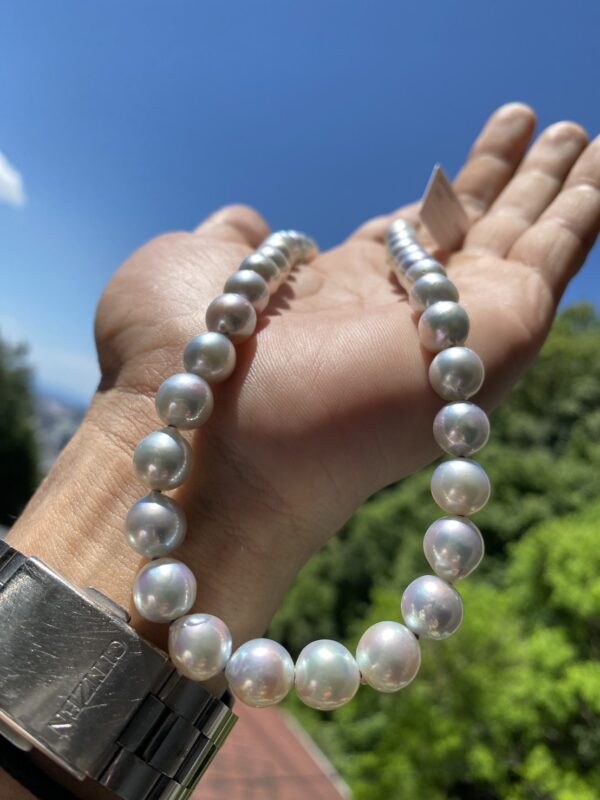
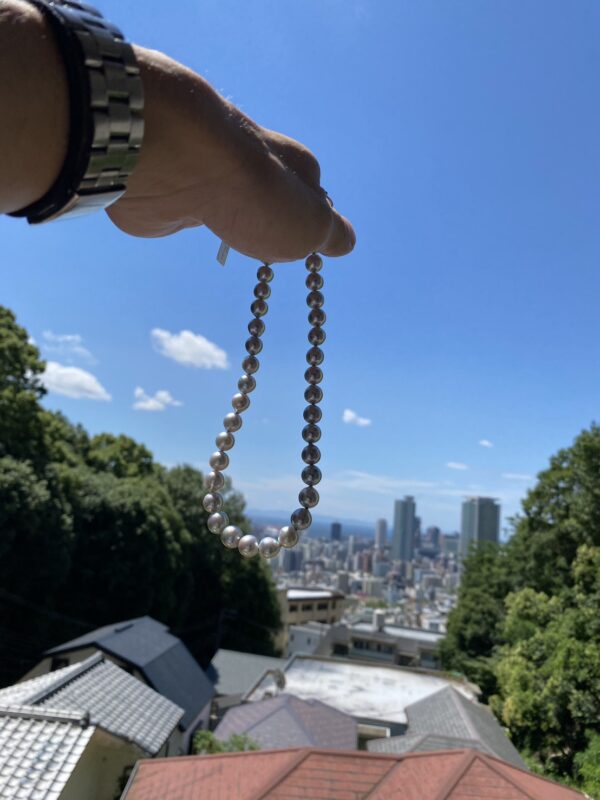
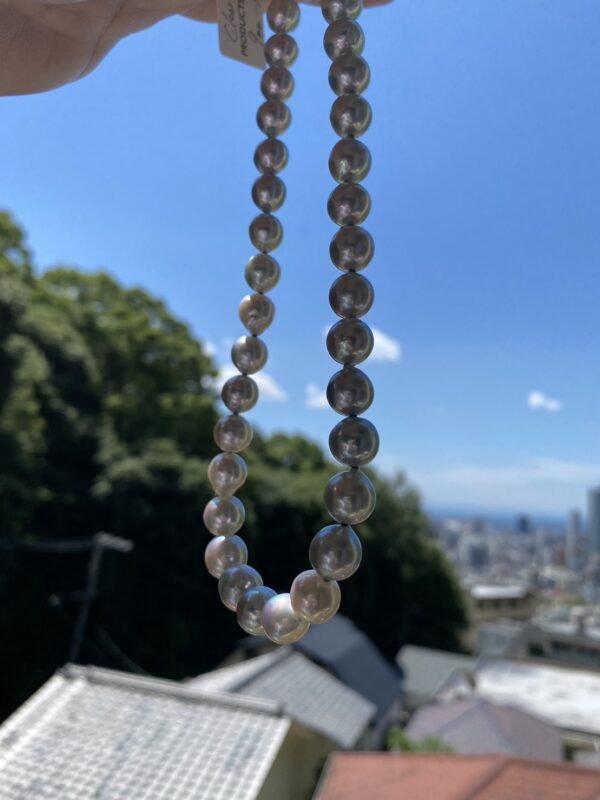
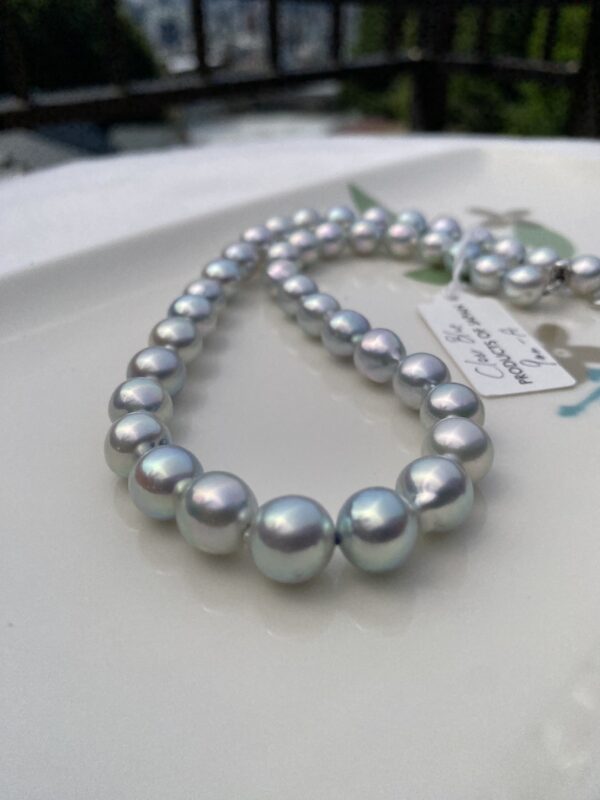
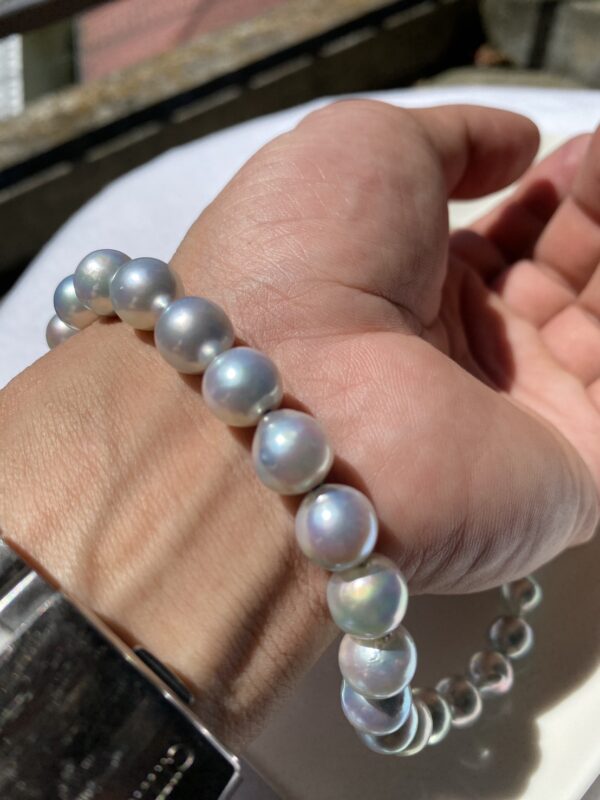
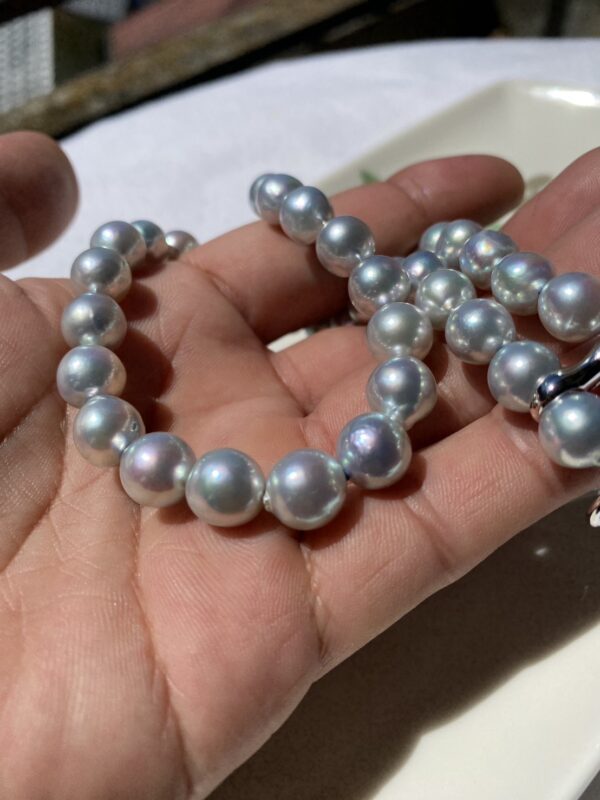
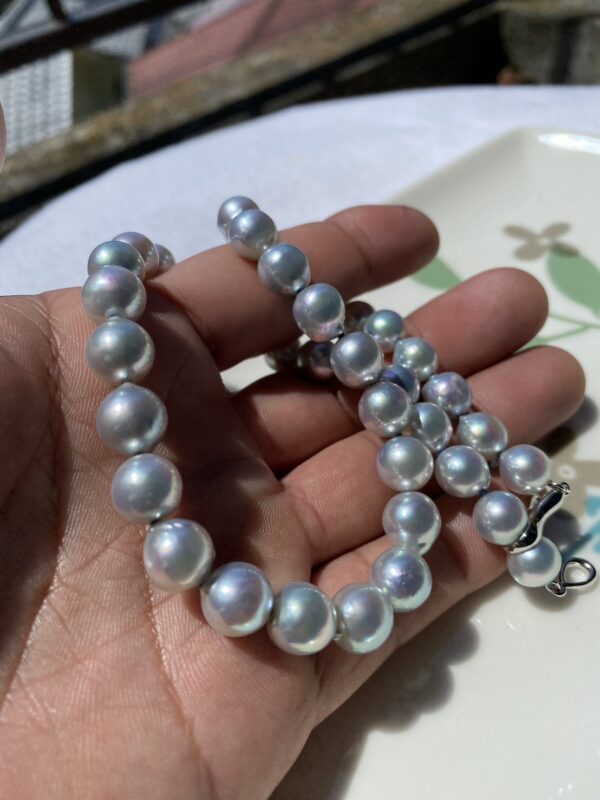
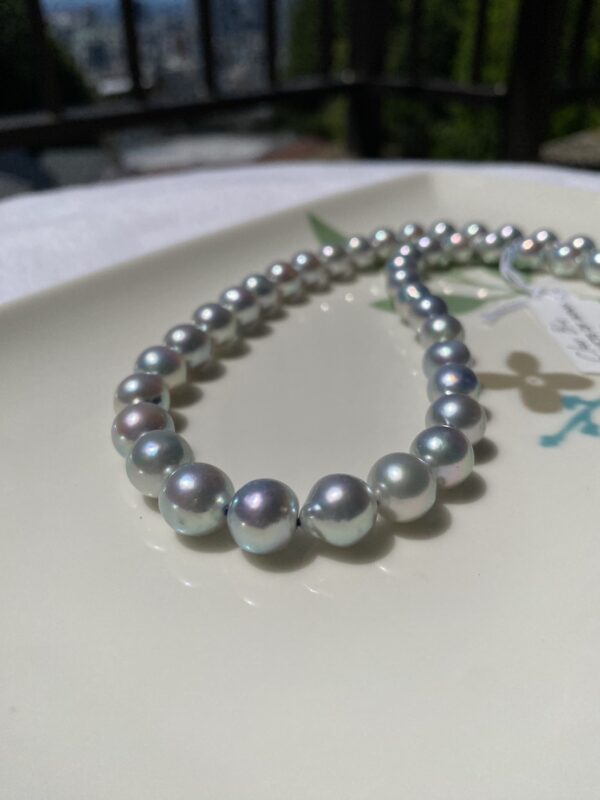
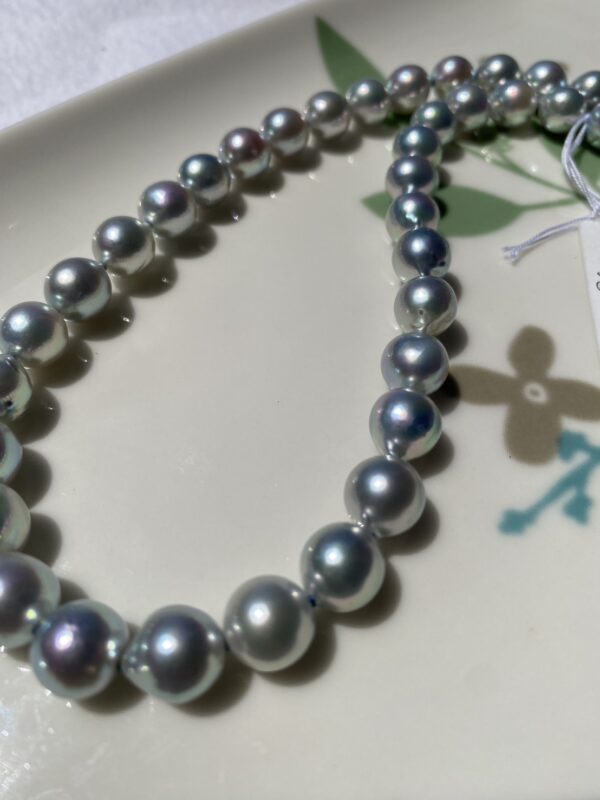
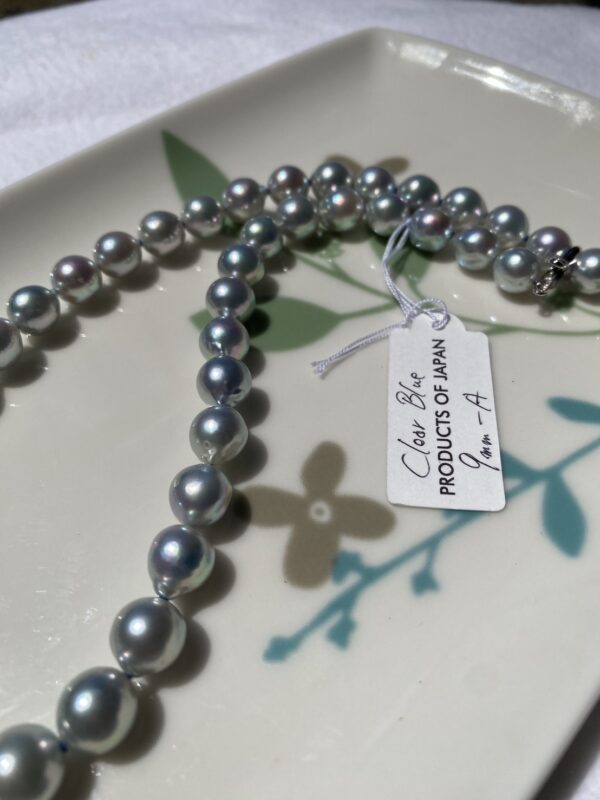
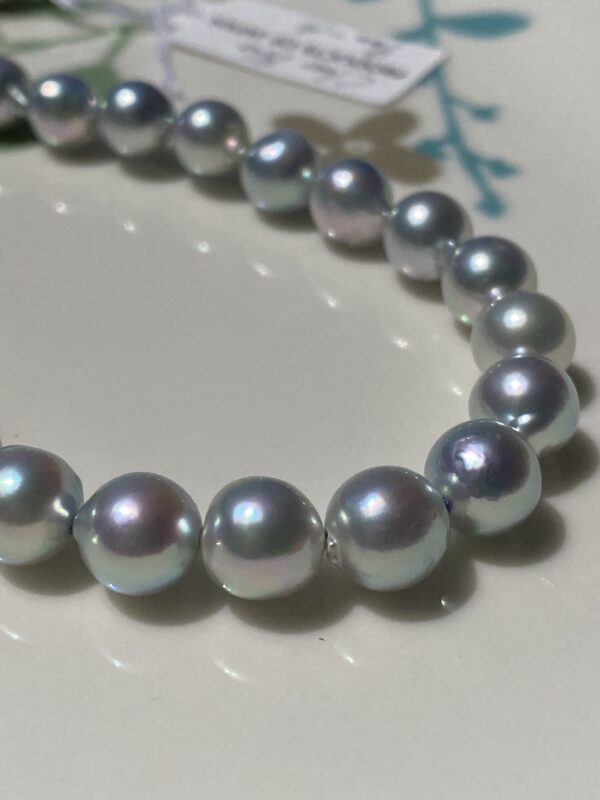
As shown in the images, these pearls are beautifully formed. They are all baroque pearls, so their surfaces are not perfectly smooth, but they are still very pleasing. What stands out most is the rich coloration—deep blues and greens, with subtle hints of red—created by thick nacre layers.
These pearls were cultivated in a region of Japan known for pearl farming. It is likely that they were originally intended to be 8mm pearls, meaning the nacre layers developed more thickly than expected.
In recent years, nacre thickness has often been overlooked. However, I believe it is one of the most important factors that allows pearls to truly be called gemstones. There are many pearls with strong luster but thin nacre. However, such luster lacks depth. It is the depth created by thick nacre that gives pearls their true beauty.
This necklace was selected from 762 individual 9mm pearls. From these, fourteen strands of approximately 40cm were created. Among those fourteen, this is the highest-quality strand.
The entire selection and stringing process has been recorded on video. There are about fifteen videos in total, with a combined length of approximately 21 hours.
If you are interested, please search for Flower Jem.
Thank you for reading this far.
For you, who took the time—
Pearl bless you.
Flower Jem
This space is not only for reviews. You are welcome to write freely about pearl jewelry, ask questions, or share what you feel when you see this piece. Member registration is required to submit your message.
Pearls & Stories
There are no stories yet.