Midnight Lake – 9-10mm Japanese Akoya Natural Blue Baroque Pearl Necklace, 18 inches, All-Knotted, Silver Clip Clasp, Saltwater Pearl
#E Midnight Lake
$2,200.00
Sold Out
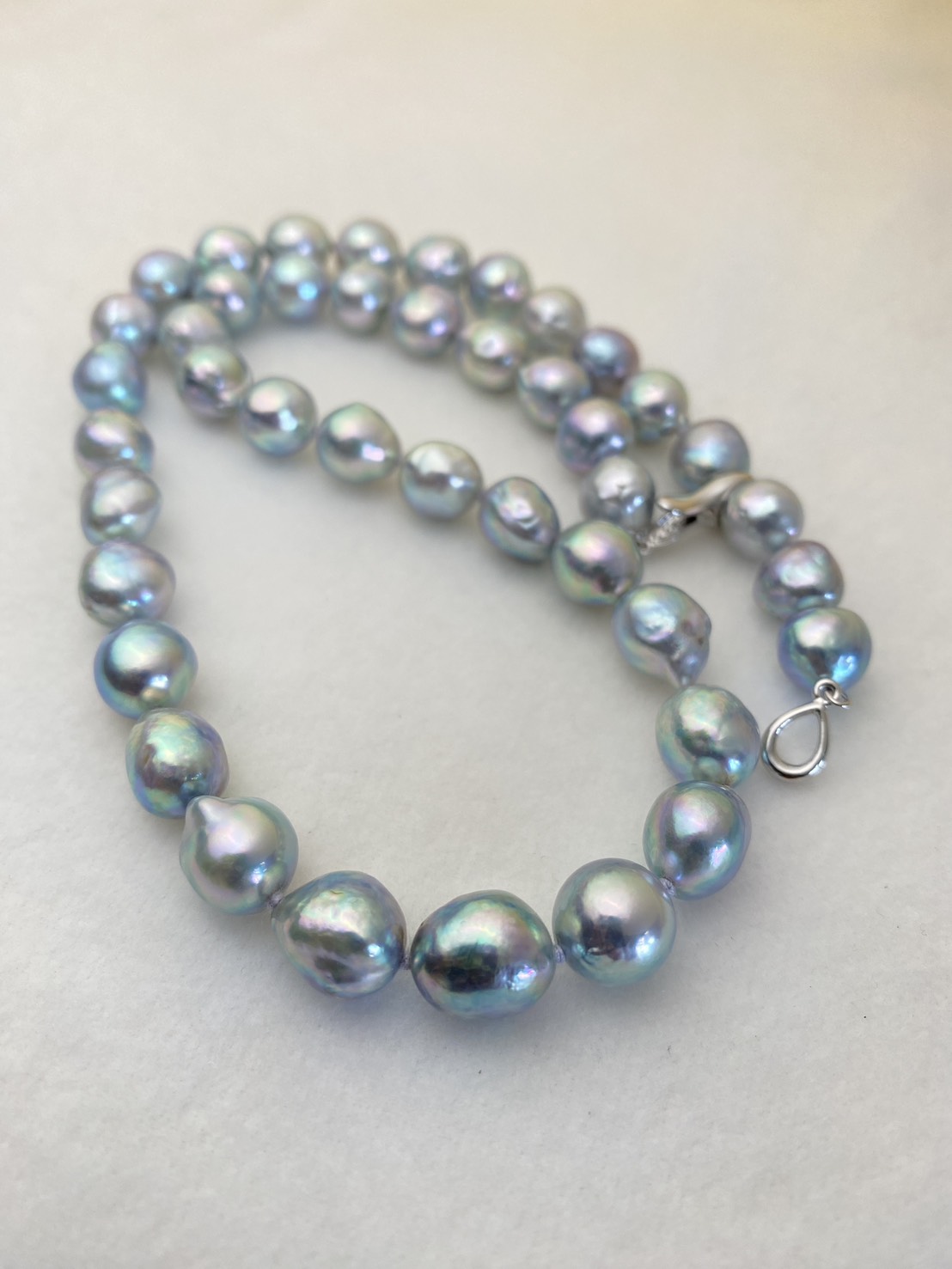
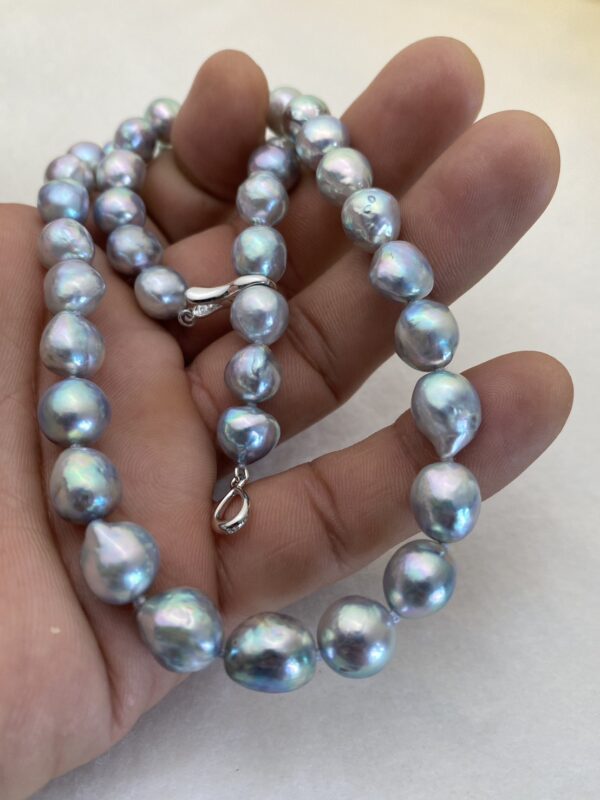
This is an Akoya pearl necklace.
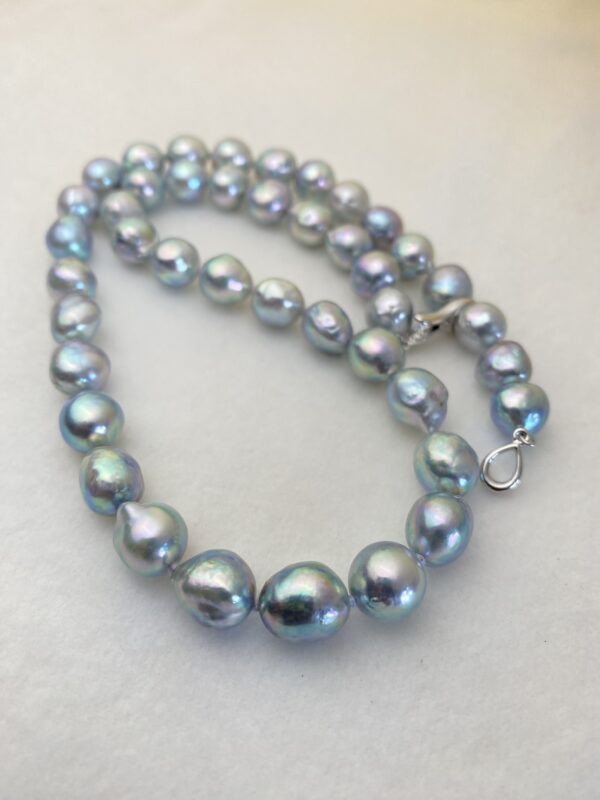
Among harvested pearls, a small portion naturally develops a blue color like the pearls used in this necklace.
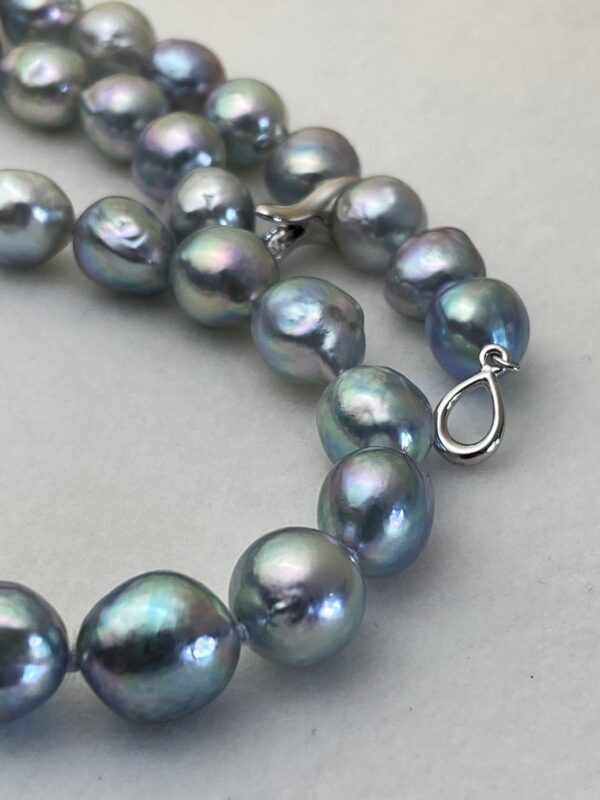
This necklace is made from naturally blue Akoya pearls with strong baroque shapes.
Incidentally, these pearls originally came from a lot of 763 pearls.
A pearl dealer I have a close relationship with once told me, “Flower Jem is a rare shop specializing in Akoya blue pearls.”
Whenever he obtains high-quality blue pearls, he immediately contacts me.
By the way, he purchases pearls either through auctions limited to harvested pearls and approved dealers, or directly from pearl farms.
I first sorted these 763 pearls by color depth, then by shape, and then repeatedly by luster and the amount of wounds and surface imperfections, eventually creating fourteen strands.
Every part of that process was recorded on YouTube.
The total production process took approximately twenty-one hours and twenty minutes, spread across around sixteen videos.
If you are interested, I hope you will take a look.
Rather than carefully polished commercial presentations of pearls, you will be able to see the natural and unembellished expressions of the pearls as they truly are.
Among the fourteen strands, this necklace belongs to the darker blue group.
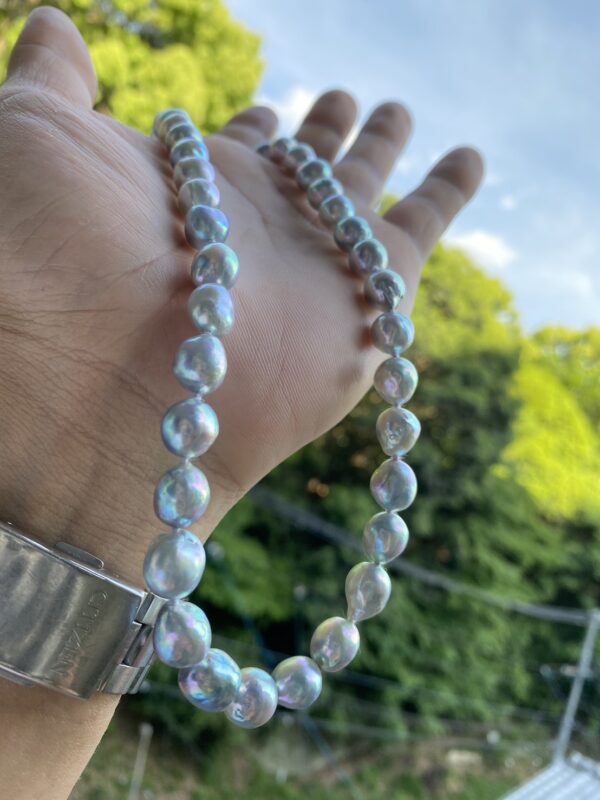
The lighter blue group tended to have gentler baroque shapes and pearls closer to near-round forms, while the deeper blue group developed much stronger baroque characteristics.
Of course, color depth and the intensity of baroque shape are matters of personal preference, but this strand possesses not only deep blue tones, but also mesmerizing interference colors mixed with green and red.
Combined with its strong luster, these pearls feel almost like blue gemstones with strong green overtones.
I have handled many blue pearls over the years, but these 9mm strands feel different to me.
Rather than simply appearing blue on the surface, they seem blue from their very core.
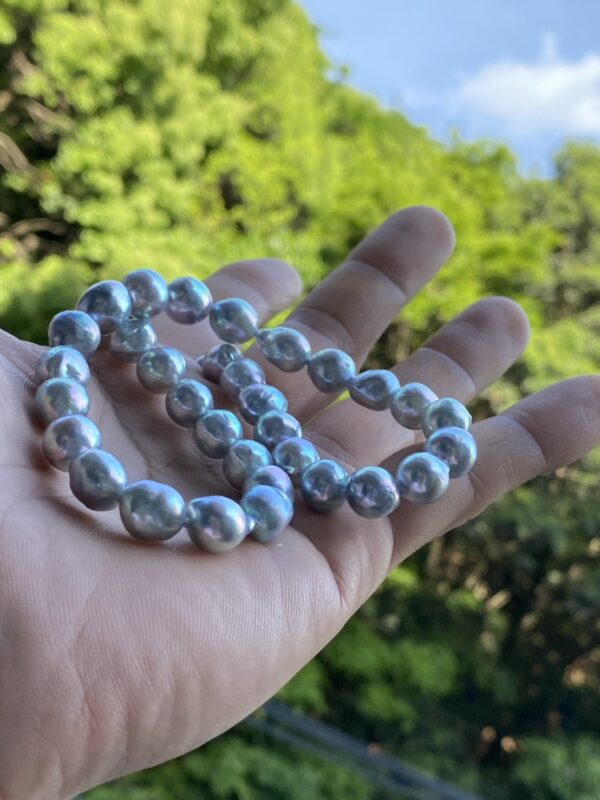
Many blue pearls lose their blue color under strong lighting.
This is natural.
For example, people appearing on television are illuminated by strong studio lighting to make them appear more beautiful.
This may be a slightly forced comparison, but it is somewhat similar.
If the blue color of a pearl is shallow, strong light can wash the blue away completely.
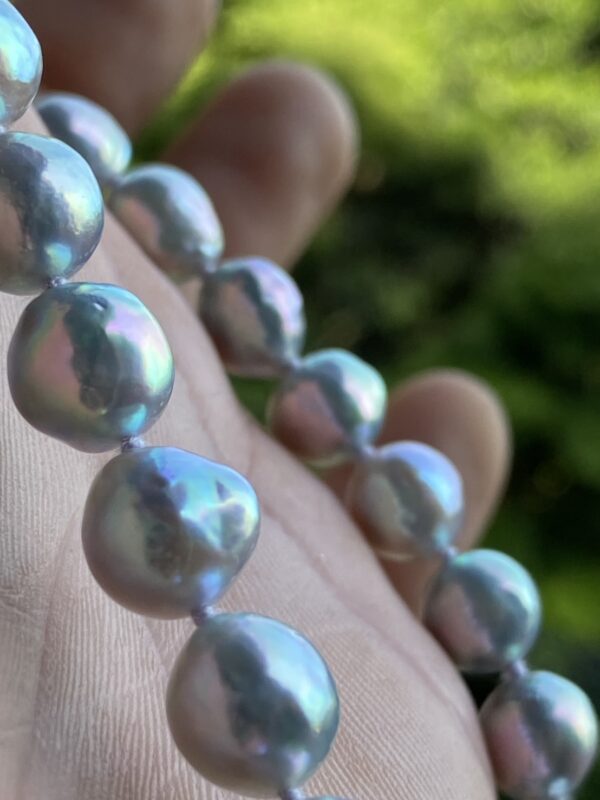
These pearls also lose some blue under strong sunlight, but comparatively speaking, they seem to retain their blue color quite well.
One possible reason may be their thick and densely formed nacre.
Pearl nacre is formed somewhat like a brick wall.
If Akoya oysters weaken during cultivation, impurities can enter between the layers, causing the nacre to form unevenly.
Instead of becoming a strong wall, it becomes rough and unstable, almost like a poorly built wall made by an amateur.
In such nacre, the density and cohesion become weak, resulting in weak luster and weaker color as well.
The difference becomes especially obvious when drilling pearls.
When drilling pearls purchased from dealers who care little about nacre thickness and prioritize only round shape, the drill bit passes through almost as easily as a snack cracker.
On the other hand, pearls purchased from pearl farmers who value thick nacre cannot easily be drilled unless the drill bit is properly sharpened.
Strong nacre means the nacre layers are neatly and orderly arranged.
Because of that, when light enters the nacre, beautiful interference colors are produced.
On the other hand, if the nacre is irregularly layered like a poorly made wall built by an amateur such as myself, the light scatters instead of producing beautiful interference colors.
For these reasons, pearls with thick and beautifully formed nacre emit strong light and strong presence, while pearls without such nacre produce weaker and less impressive light.
Even within the pearl industry, I feel that nacre thickness is becoming increasingly undervalued year by year.
Of course, shape is important for pearls to function as gemstones, but I believe nacre thickness is equally important.
Thick nacre can sometimes create cloudiness, and it also requires more time for pearl processors when removing stains or dyeing pearls.
Some dealers even tell pearl farmers, “The nacre does not need to be that thick. We simply want round pearls.”
For pearl farmers who spend every day caring for Akoya oysters specifically to create thick nacre, this is somewhat ironic.
In particular, pearl farmers themselves tend to value nacre thickness very highly.
That is why many of them cannot fully accept the idea that “as long as pearls are round, nacre thickness does not matter very much.”
Many pearl farmers believe that truly beautiful pearls are pearls whose beauty comes from thick nacre.
One pearl farmer who was also my former supervisor even said that pearls with thin nacre are not gemstones.
Of course, thick nacre alone does not automatically create attractive pearls.
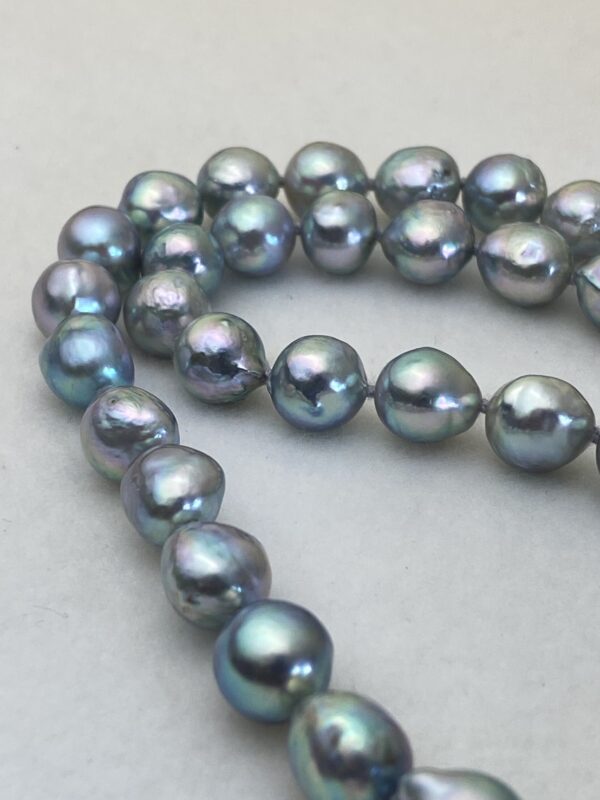
Strong luster and smooth surfaces are also necessary.
The difference in nacre thickness becomes easier to understand when comparing pearls side by side.
If you ever visit a jewelry store in the future, perhaps you could ask the staff to show you such comparisons.
Although that may require a bit of courage.
Now then, this necklace is all-knotted using lavender-colored thread.
The thread is barely noticeable, but between the deep blue pearls, it seems to stand quietly and elegantly without disturbing them.
Please take your time and enjoy your visit.
This space is not only for reviews. You are welcome to write freely about pearl jewelry, ask questions, or share what you feel when you see this piece. Member registration is required to submit your message.
Pearls & Stories
There are no stories yet.