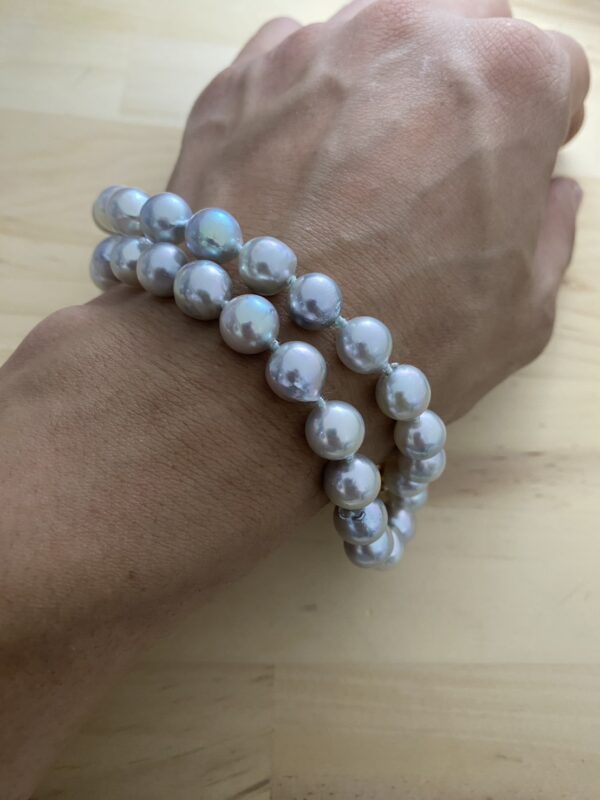
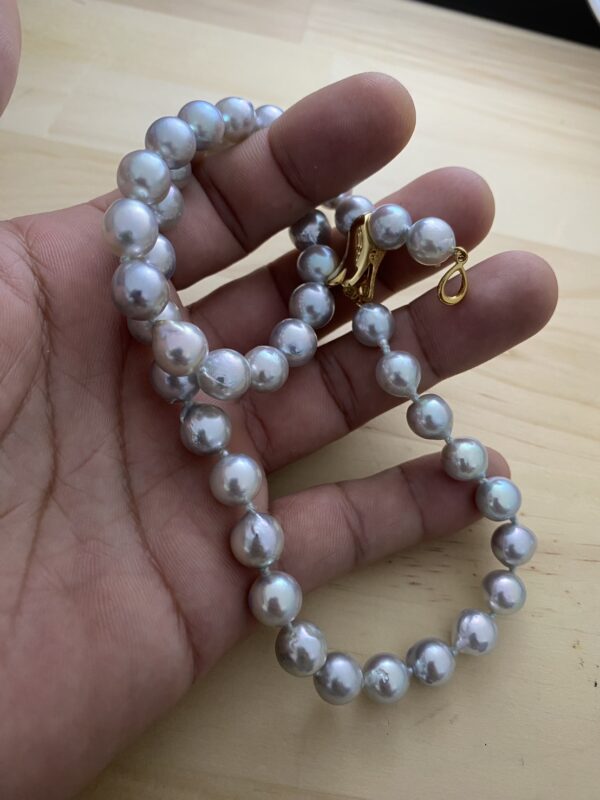
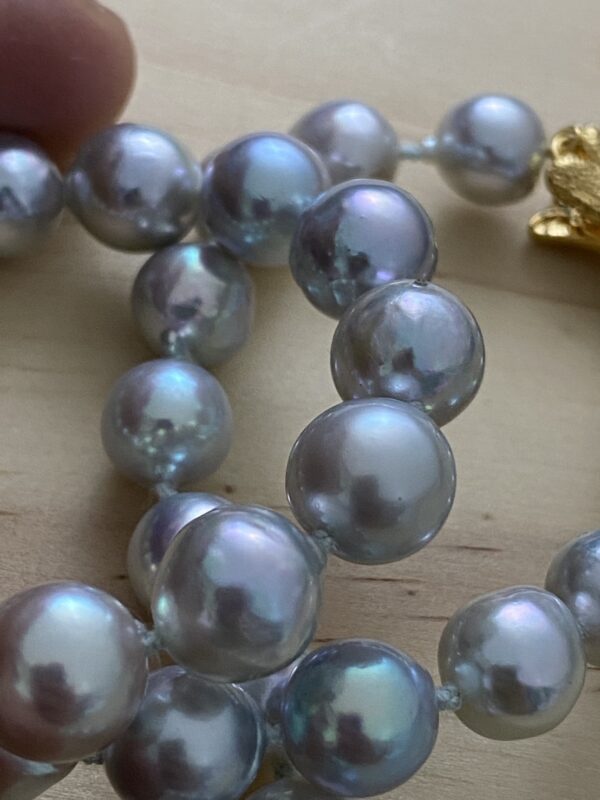
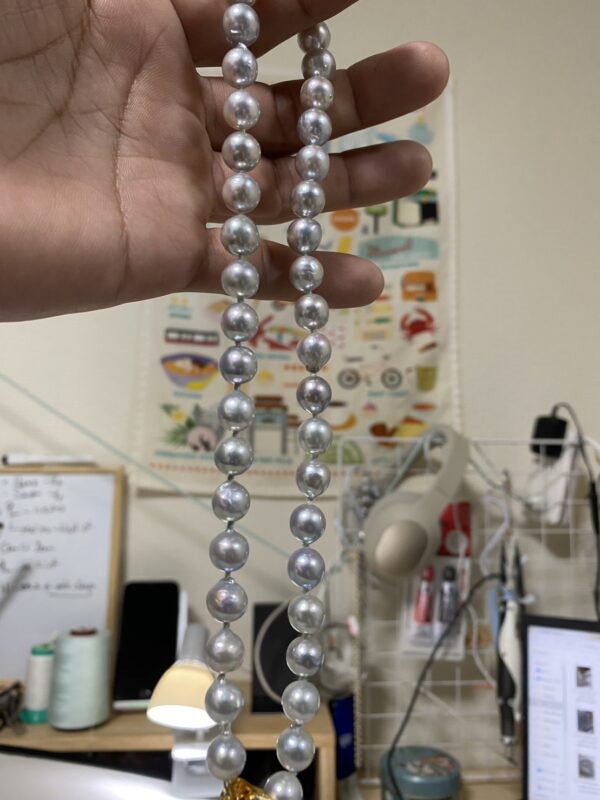
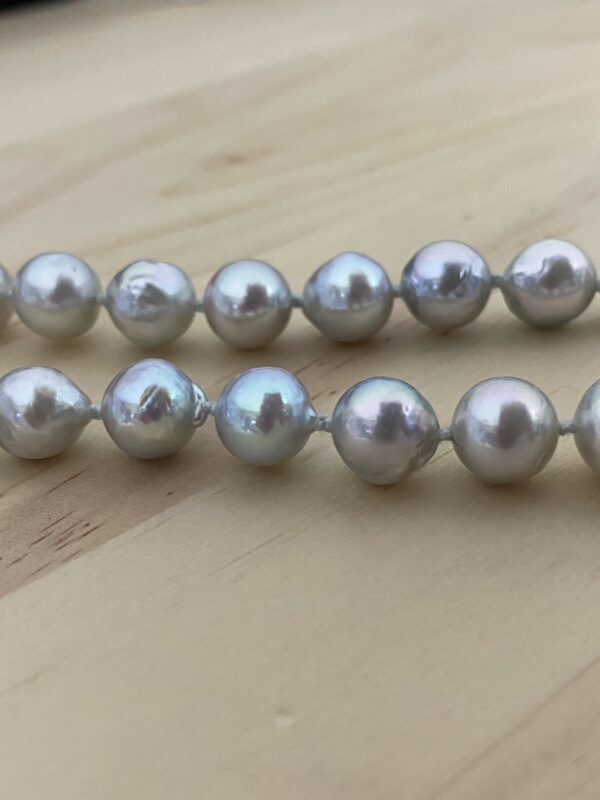
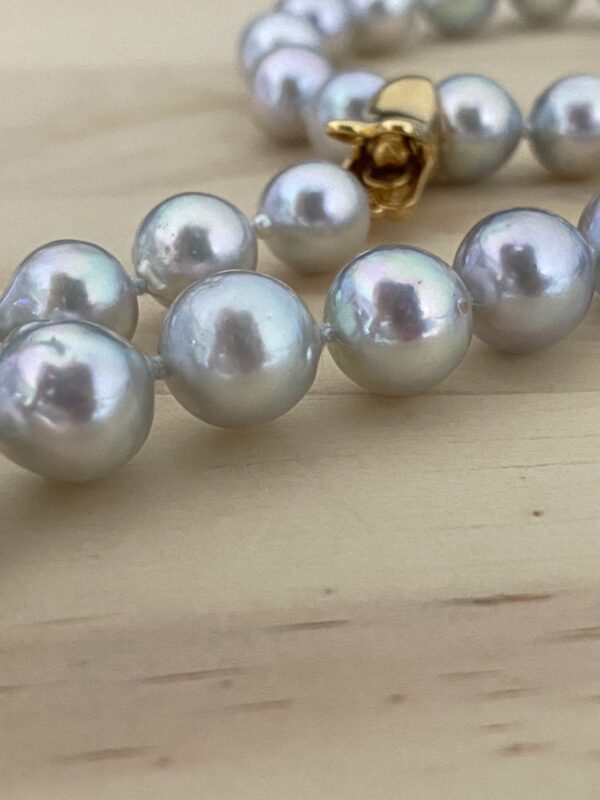
June – 9–10mm Japanese Akoya Natural Blue Baroque Pearl Necklace, 19.3 Inches, All-Knotted, Gold-Plated Silver Clip Clasp, Saltwater Pearl
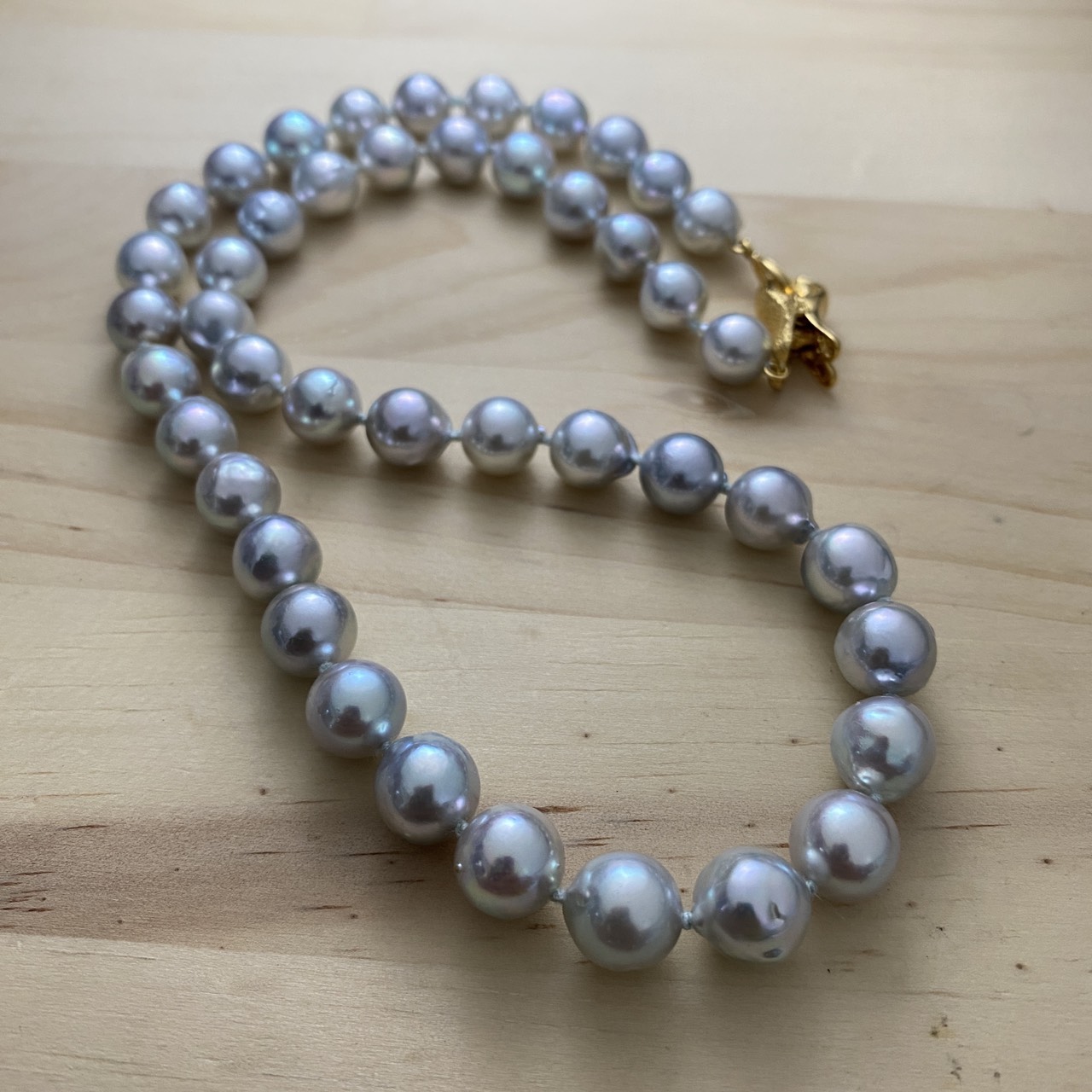
#M June
$1,300.00
1 in stock
Hello.
Did this necklace catch your eye?
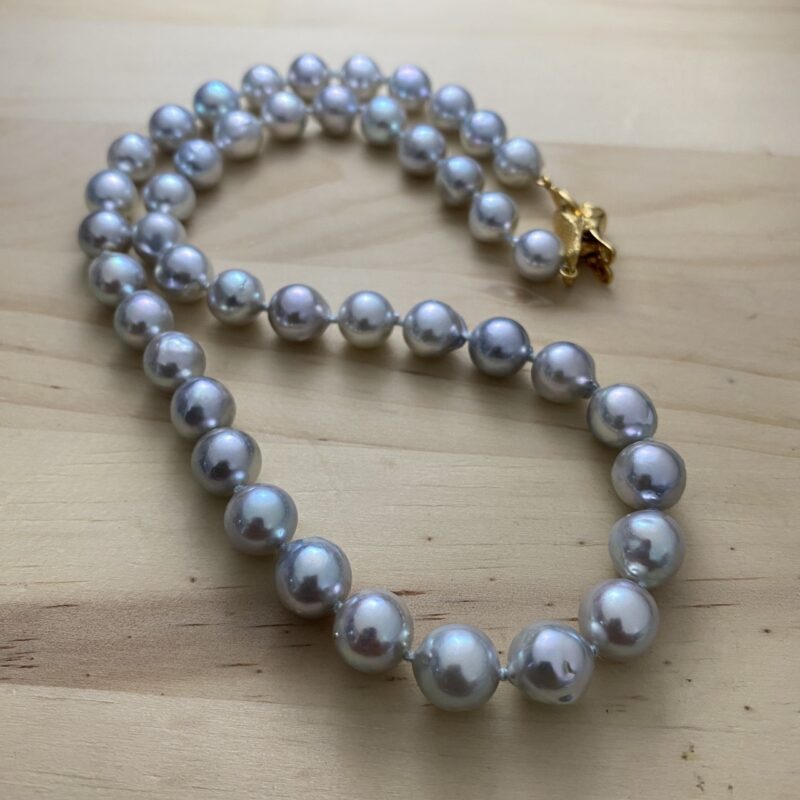
As you may know, this necklace is made from 764 carefully selected 9mm pearls, made into 14 strands.
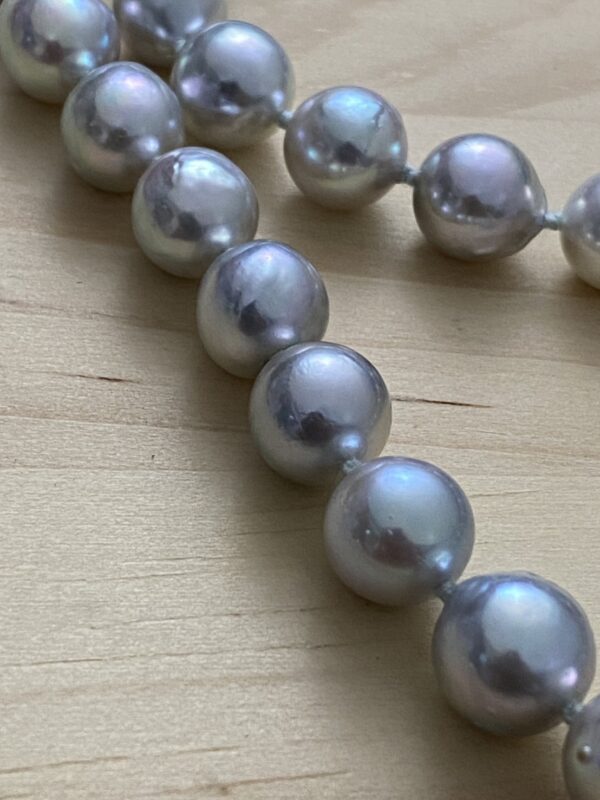
The higher-end necklaces are crafted to a high standard in many aspects, including color, shape, and luster.
This necklace is of mid-range quality.
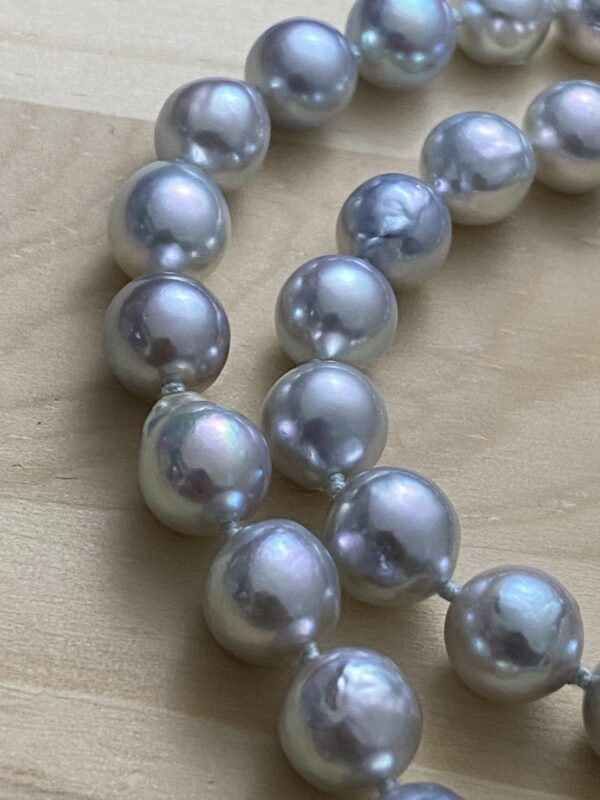
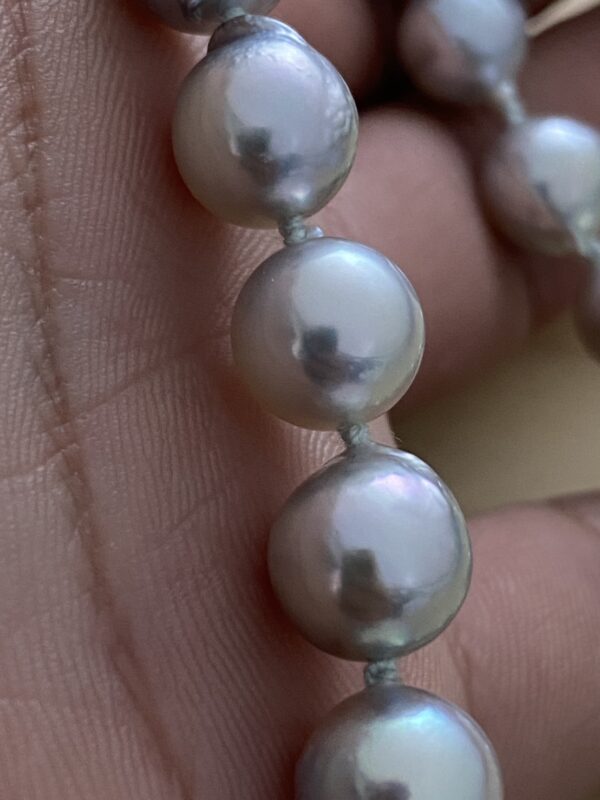
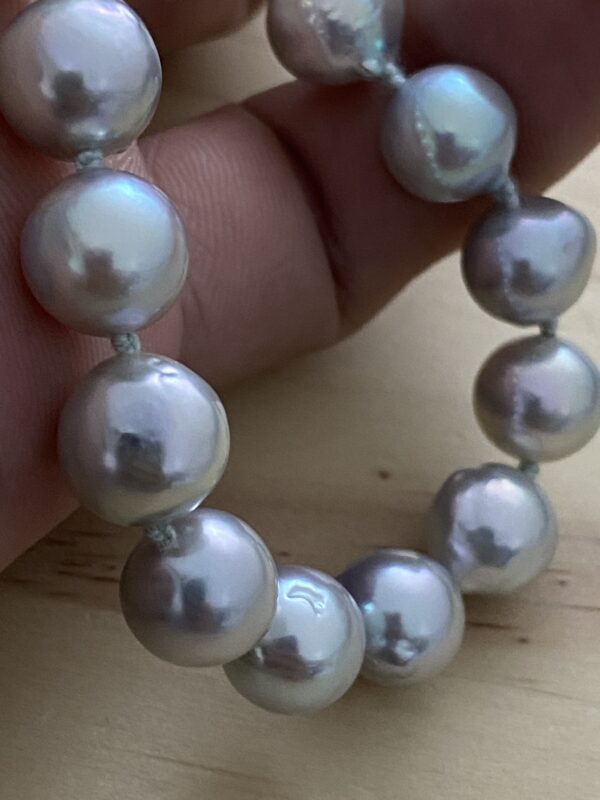
Therefore, there are slight variations in the color of the pearls used in this necklace. “Why didn’t you use pearls of the same color? Are you an amateur?”
I understand that feeling completely.
I prioritized matching the luster to a high level rather than matching the color.
Or rather, I did match it.
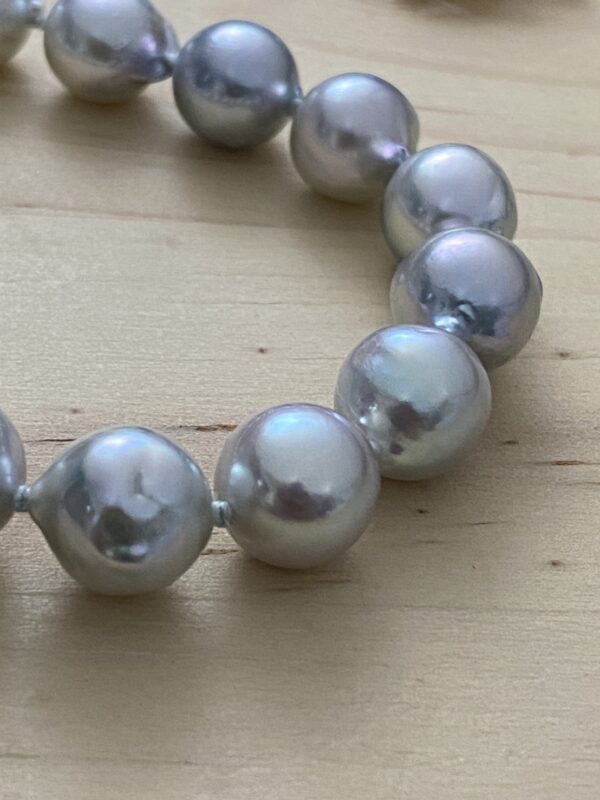
Personally, while matching the color of each pearl in a necklace is important, I feel that matching the luster results in a more beautiful and unified shine.
Even if the colors match, differences in luster can look jarring.
This necklace is of mid-range quality, but it possesses a sufficiently attractive luster.
There are slight color differences, but it still looks like a stylish necklace.
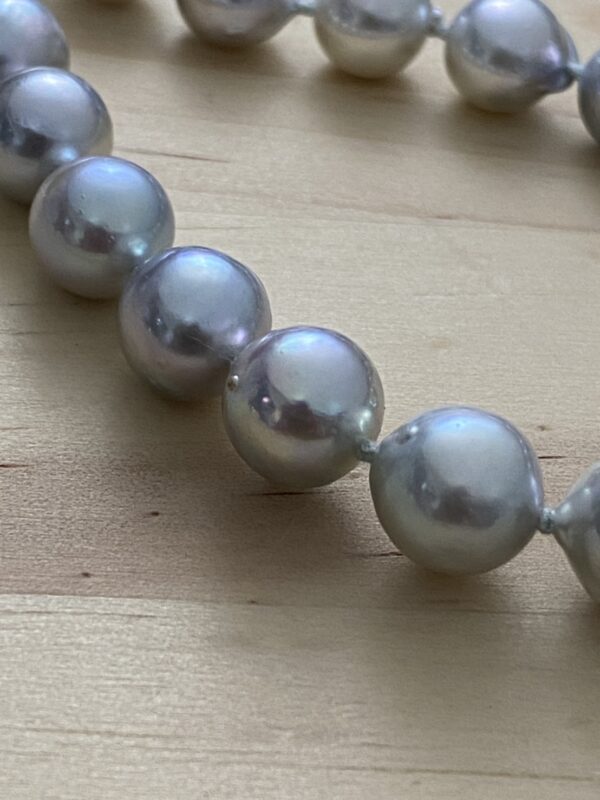
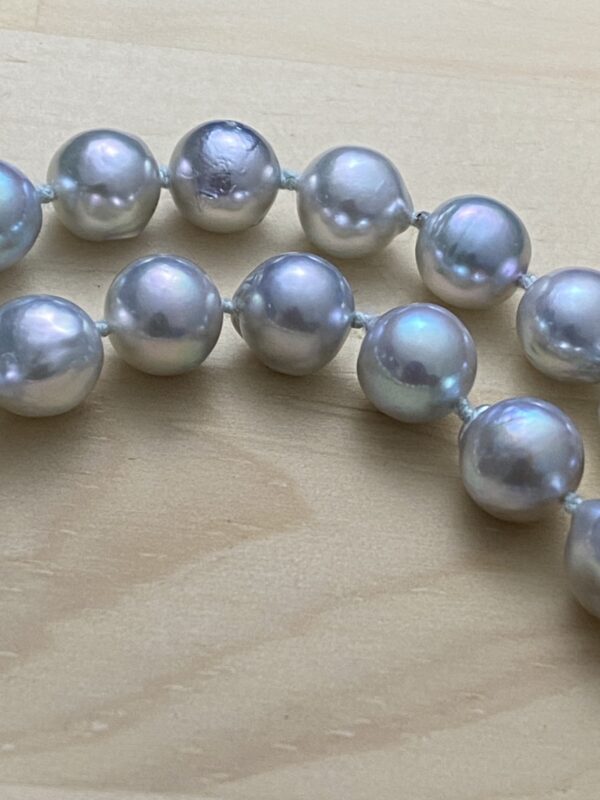
And this necklace, too, is finished with all-knot tying using light mint green thread.
The pearls are the main star, and I, the thread, play a supporting role.
While the color is inconspicuous and doesn’t assert itself, it still makes the entire necklace look lovely and elegant.
It almost looks as if the blue color has seeped from the pearls, infusing the white thread with light mint green.
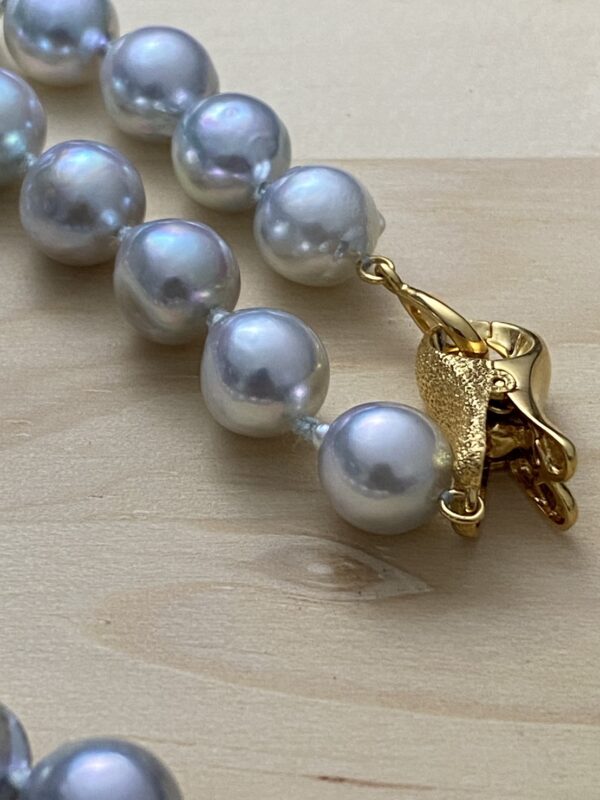
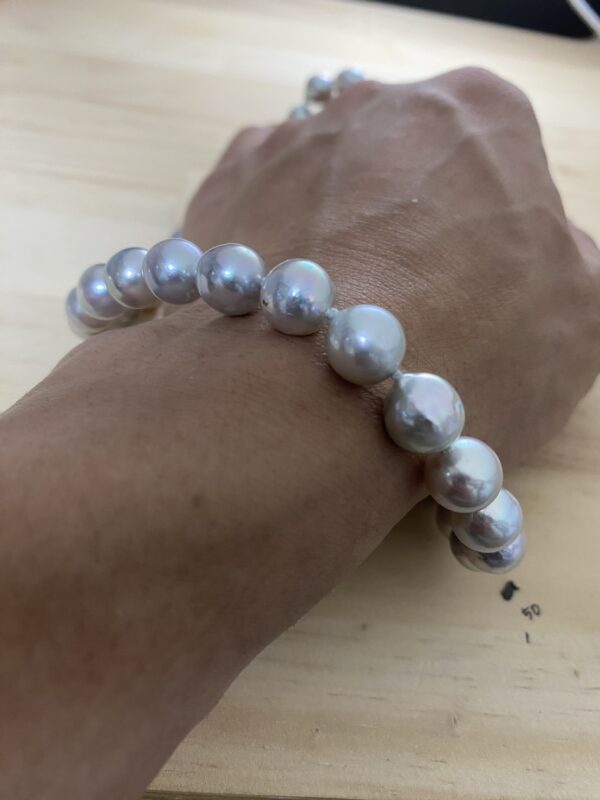
And I know this might sound like I’m rambling, but the clasp on this necklace is a clip type that can be fastened anywhere.
I like to fasten it a little towards the front of the necklace, creating a Y-shape at the chest.
The clasp is in the front.
Of course, I think it also looks good with the clasp at the back.
In any case, I absolutely love this clasp because not only can it be fastened anywhere, but it’s also very easy to put on and take off.
When I was working at a pearl company, I became a pearl enthusiast around my third year there, and started making pearl bracelets myself.
I used about six different types of clasps at that time.
I quickly gave up on typical spring ring clasps because they were difficult to fasten and unfasten.
Next, I tried larger spring ring clasps, but I stopped using those because they ruined the design. Then I looked for magnetic clasps.
I went through about three different types of magnetic clasps, searching for one with stronger magnetic force.
However, no matter how strong the magnet, it would easily come undone with even a slight bump.
At the time, I wanted to eventually create bracelets that my company could officially sell, but to do that, I felt I needed to find a nice clasp that I could use for at least six months without any problems.
And finally, I found the clasp used in this necklace.
It doesn’t come undone even when playing golf or tennis. It’s very easy to fasten and unfasten, and the design isn’t bad either. With this necklace, it can even be worn as a double bracelet. It’s made of silver, but it’s rhodium-plated, which prevents tarnishing and makes it scratch-resistant, so it will remain beautiful for several years.
The price of clasps has doubled compared to when I started using them 10 years ago, but so far, I haven’t found a better clasp. “Huh? This time you’re introducing a clasp, not a necklace?”
I just wanted to properly introduce this clasp this time. The main star is, of course, the pearl necklace.
I’ve given this main necklace a name, as usual.
This time it’s June.
That’s right, because I was born in June.
June is said to be the month of pearls, but many pearl dealers in Kobe aren’t very interested in that.
Their clients are wholesalers.
Retailers might be more enthusiastic about promoting June as the month of pearls.
However, the rules for birthstones seem to be quite old.
It’s said that the roots lie in the “12 gemstones” that adorned the breastplate of a high priest in the Old Testament, approximately 3500 years ago.
Then, around the 18th century (spread by jewelers), jewelers in Poland and other countries created a business model where “wearing your birthstone brings happiness,” and this spread throughout the world. However, at this point, the stones chosen varied from country to country and region to region. There was probably no internet back then, so it couldn’t be helped.
In 1870, Tiffany & Co., a major jeweler, published a pamphlet featuring “The Poem of Birthstones” as a promotional tool. It seems the pearl was introduced as the June stone, and its image began to solidify. In 1912 (official decision), an American association created a globally standardized list, and the pearl was selected as the first birthstone for June.
Tiffany & Co. is truly impressive.
However, looking at the roots of birthstones reminds me of Valentine’s Day in Japan.
The chocolate industry’s mantra of “Eat more chocolate!” has transformed into a marketing strategy, and in recent years, they’ve even succeeded in developing the inexplicable market of “self-chocolate.”
While June being the month of pearls might boost pearl sales, it’s hard not to feel a little cynical when viewed purely as a marketing ploy.
Firstly, pearl fans might want to say, “June is the month of pearls? No, it’s every month, right? No, it’s every day!”
“Well, if that’s the case, then your birthday would be every day. Don’t be greedy.” “We should just accept that June is the month of pearls,”
and so on, leading to arguments, so let’s drop this topic.
Now, changing the subject, pearl farming work is very demanding in June.
Akoya pearls are produced by inserting a nucleus into an Akoya oyster.
At that time, it is essential that the Akoya oyster is free of eggs.
From April to June, in preparation for the nucleus insertion process which begins in April, Akoya oysters that have been kept free of eggs since the previous autumn are used.
However, these oysters are consumed during the nucleus insertion process and run out around June. After that, the next step is to get the egg-bearing Akoya oysters to release their eggs.
Akoya oysters will release their eggs when they feel comfortable.
Therefore, pearl farms immerse the oysters in an artificial bath-like environment called an ozone machine. The temperature is usually around 25 degrees Celsius or higher. The seawater temperature in May and June is a bit lower, around 19 to 23 degrees Celsius.
The Akoya oysters, feeling comfortable in the warm bath, will release their eggs readily.
However, some oysters readily release their eggs, while others are hesitant to do so. There are also cases where this happens.
In severe cases, the manager of a pearl farm will turn the bath’s power on and off until around 11 PM, waiting for the Akoya oysters to release their eggs.
Separately, there is also a technique called shallow fishing.
Normally, Akoya oysters are suspended from rafts at a depth of about 3 meters above the sea surface, but to make it easier for them to release their eggs, they are raised to about 1.5 meters and suspended from the raft. It’s called shallow fishing because they are suspended at a shallow depth.
The seawater temperature is slightly higher at a depth of 1.5 meters than at 3 meters, so they use that water temperature to release their eggs. This makes it easier for the eggs to be expelled.
Another method is to leave the Akoya oysters on the ground for several hours on a sunny day.
Sunlight also makes it easier for the Akoya oysters to expel their eggs.
June pearl farming involves trying to control the large number of Akoya oyster eggs using various methods.
If a nucleus is inserted while eggs are still present, the pearl will be blemished.
If successful, it might become a beautiful blue pearl, but
in many cases, it simply becomes a pearl covered in blemishes.
However, before that, the nucleus insertion worker inserts a nucleus into the Akoya oysters that have eggs. I can’t do that, though.
By the way, from the latter half of July, the seawater temperature will reach nearly 30 degrees Celsius or even higher, so they will release their eggs without any intervention.
How to get them to release their eggs, or prevent them from releasing them, is where each pearl farmer’s skill comes into play.
Anyway, I hope you’ve gotten a sense of how much work goes into caring for Akoya pearls and producing them.
Beautiful pearls and less beautiful pearls alike require the same amount of effort and care.
At the very least, the pearl you have has also received a lot of care, love, and effort. So please cherish it.
It’s kind of like us humans, isn’t it?
We grow big and strong with lots of love and care.
And there are people who are round and beautiful like pearls, and there are people like me with baroque shapes.
And no matter what shape they are, each one has its own inner luster.
I think I managed to wrap things up nicely, if I do say so myself.
This space is not only for reviews. You are welcome to write freely about pearl jewelry, ask questions, or share what you feel when you see this piece. Member registration is required to submit your message.
Pearls & Stories
There are no stories yet.