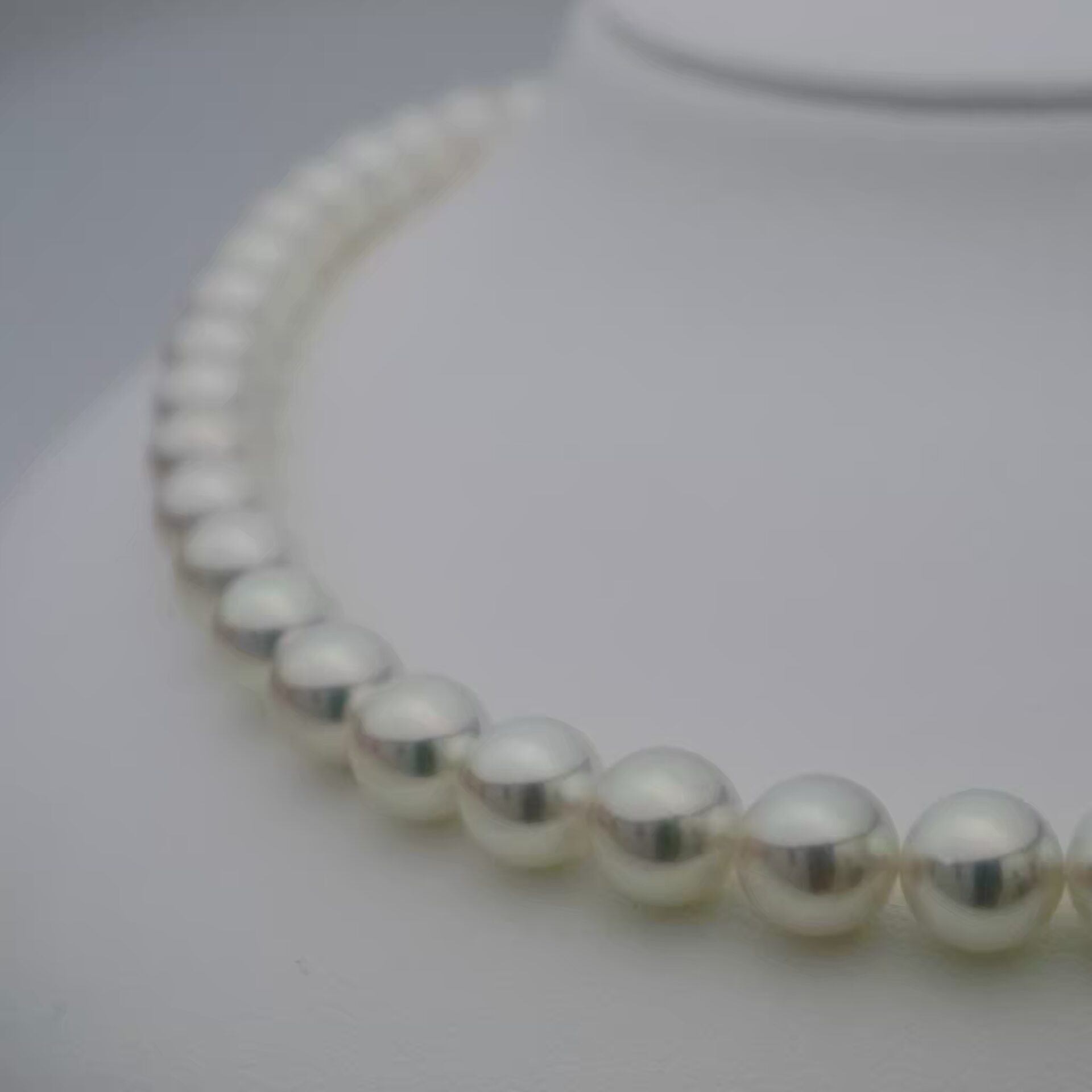
“I don’t know how to tell if a pearl is good.”
“I’m not a pearl expert, so I don’t know how to judge pearls.”
Having worked with pearls for many years, I have heard these concerns from customers many times.
In this article, I will explain six elements that can help you understand and choose pearls: luster, nacre thickness, surface blemishes, color, shape, and size.
These six elements do not all mean the same thing. Luster, nacre thickness, and surface blemishes are related to pearl quality, while color, shape, and size are largely matters of personal preference and value.
I explore the relationship between pearl quality, personal preference, and price in more detail in this article.

The beauty of a pearl can be understood through six main factors: luster, nacre thickness, surface blemishes, color, shape, and size.
However, these six factors do not all mean the same thing when judging a pearl. I divide them into two groups.
Luster, nacre thickness, and surface blemishes are related to pearl quality. Color, shape, and size, on the other hand, are largely matters of personal preference and value.
This distinction is one of the most important things I learned through years of working with pearls.
Pearl Luster: What Makes a Pearl Shine?
A round pearl is not necessarily a good pearl.
A perfectly round pearl may be more valuable because of its shape, but if it has weak luster and thin nacre, I would hesitate to call it a high-quality pearl.
Even a perfectly round pearl can feel lifeless when its luster is weak. On the other hand, a baroque pearl with strong luster can be remarkably beautiful.
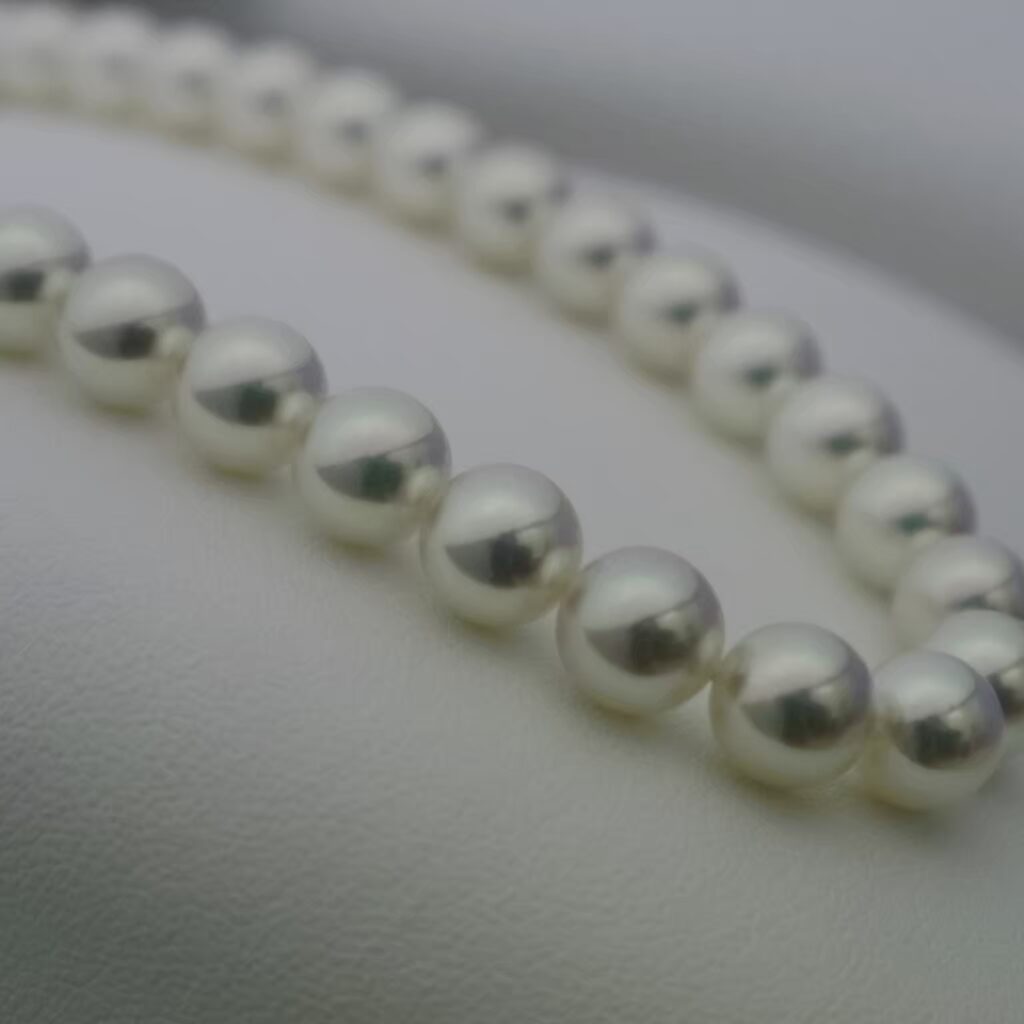
For me, luster is one of the first things to look at when judging a pearl.
How Should You Choose Pearls on a Limited Budget?
And in my case, my budget ceiling is so low that I cannot even stand up beneath it. I have to remain seated.
Let’s use a simple example. Suppose you have a budget of $1,000 for a 7.5 mm Akoya pearl necklace. Pearl prices change with the market, so this figure is only an example. Luxury brands such as Mikimoto and TASAKI also have different pricing structures.
With a limited budget, it can be difficult to find a necklace that has everything—strong luster, thick nacre, a clean surface, and a beautiful round shape.
So what should we prioritize?
I would first look for luster and nacre thickness.
Among the necklaces within your budget, first choose the ones with the strongest luster. Then, among those, look for pearls with good nacre thickness.
The necklace you eventually choose may have some visible surface blemishes.
I think that is often the right compromise.
A pearl with strong luster and good nacre thickness can still be beautiful even when its surface is not perfect. Surface blemishes also become much less noticeable once you move even a short distance away from the pearl.
Luster is different. Strong or weak luster can be noticeable from several meters away.
This is why, when the budget is limited, surface blemishes are the factor I am most willing to compromise on.
I came to this conclusion through years of working throughout the Akoya pearl industry—from harvesting and sorting pearls to participating in pearl auctions and seeing how pearls move from farms to wholesalers and retailers.
Of course, if there is no budget limit, I would prefer pearls with strong luster, thick nacre, and very few blemishes.
But most of us do have a budget.
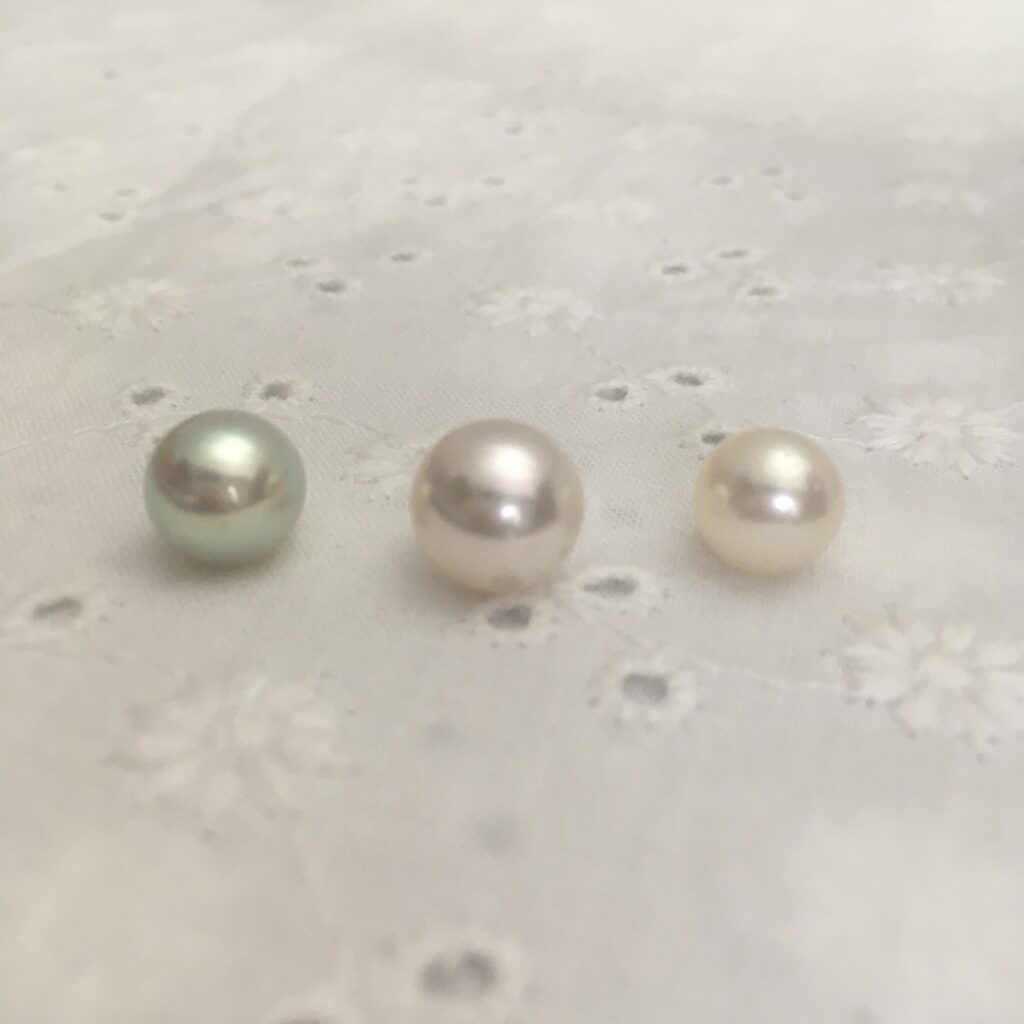
In other words, accepting some surface blemishes can allow you to get better overall quality within the same budget.
When comparing pearl necklaces of the same price and size, I would rather choose stronger luster and thicker nacre, even if that means accepting more surface blemishes.
If you prioritize a perfectly clean surface, you may have to compromise on luster or nacre thickness to stay within the same budget. If you accept some blemishes, on the other hand, you may be able to choose pearls with stronger luster and thicker nacre.
This is also how I choose pearls for myself and for Flower Jem.
Of course, this does not mean that every blemished pearl has strong luster or thick nacre. The point is simply that, when several quality factors must be balanced within a limited budget, surface blemishes are the factor I am most willing to compromise on.
In my experience, pearl retailers have increasingly begun to explain pearls in this way. However, I have also encountered many situations in Japan where customers are guided primarily toward pearls that are round and have very clean surfaces, without much explanation of luster or nacre thickness.
This is not necessarily the fault of individual salespeople. Pearls are surprisingly specialized, and learning how to evaluate them takes time and experience.
Pearl industry organizations in Japan also provide educational opportunities for retailers to improve their knowledge. Study sessions allow people from across Japan to learn more about pearl quality and evaluation, and online participation has made this kind of education more accessible.
Pearl Nacre Thickness: Why Does It Matter?
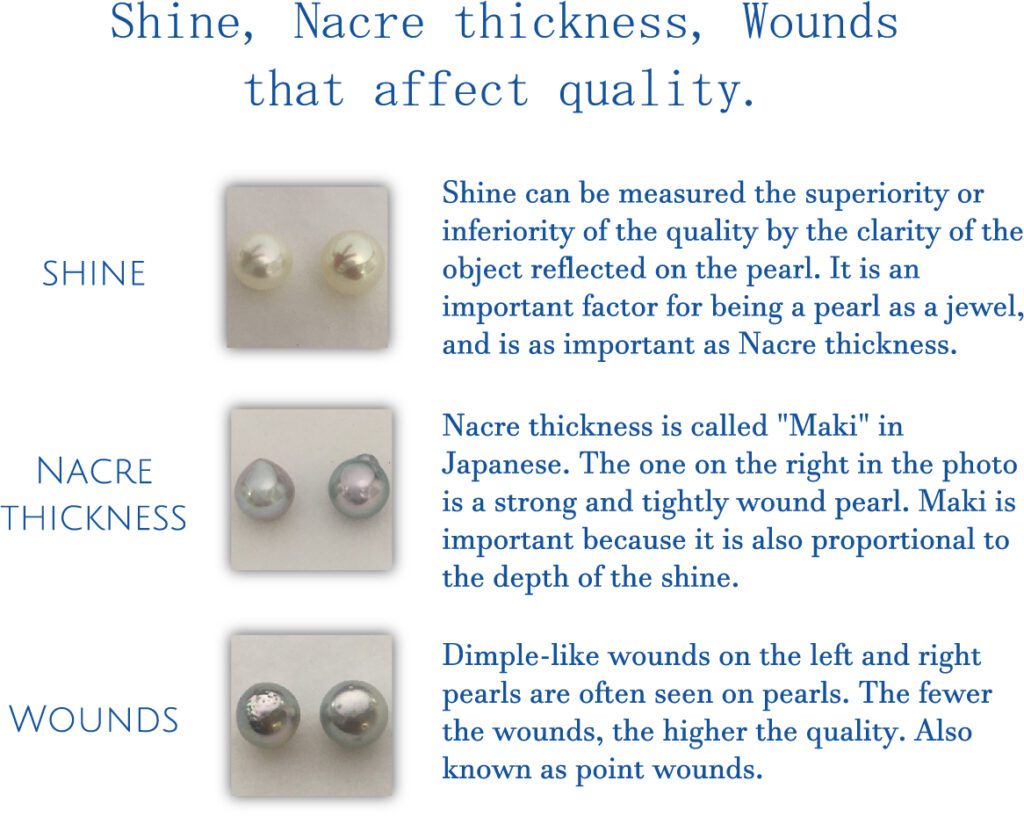
Luster is relatively easy to understand. A pearl with strong luster reflects its surroundings clearly, almost like a mirror.
Nacre thickness is more difficult to see and explain. In Japanese, we call it “maki” (巻き). It refers to the thickness and character of the nacre that has formed around the nucleus.
Over the years, I have used several rather strange comparisons to explain what thick nacre looks and feels like.
Think of a Roll of Plastic Wrap
Imagine a new roll of transparent plastic wrap. Because many layers are wrapped around the core, the roll has a visual sense of depth.
Now imagine a roll that is almost empty. Only a few layers remain, and the core underneath appears much more clearly and sharply. That sense of depth is gone.
This is one way I sometimes explain the visual difference between thick and thin nacre. It is not a scientifically exact comparison, of course, but it can help you imagine what I mean by “depth.”
Think of Hot Water in a Bathtub
Imagine looking into a bathtub with only a little hot water in it, and then one filled to the top.
You can also think of the difference between looking into shallow water near the shore and looking into the deep sea. The deeper the water becomes, the more difficult it is to see what lies beneath it. And somehow, that depth can draw us in.
I sometimes feel something similar when looking at a pearl with thick nacre. Its luster does not seem to exist only on the surface. There appears to be something deeper beneath it.
A pearl with thin nacre can still be bright and beautiful. But to my eyes, its brilliance can sometimes feel shallower. With thick nacre, the luster can have a depth that makes me want to keep looking into the pearl.
When I look at pearls with thick nacre, I sometimes feel something similar to looking into deep water. There is a sense of depth that draws the eye inward.
This may not be a scientifically precise way to describe nacre, but it is the closest comparison I have found to what I actually see in pearls.
It reminds me of other things that somehow draw us in because we cannot immediately see everything—the deep sea, a mysterious person whose thoughts are difficult to read, or even, strangely enough, looking into a washing machine as it turns.
I am not sure how well these comparisons communicate what I see, but perhaps that is part of the difficulty of explaining nacre thickness in words.
In any case, the point I want to emphasize is simple: luster and nacre thickness are two of the most important things I look for when judging pearls.
Pearl Surface Blemishes: How Do They Affect Quality?
Surface blemishes are probably the easiest of these three quality factors to recognize. We can usually see them simply by looking at the pearl.
Blemishes can develop for many reasons while a pearl is growing inside an Akoya oyster. When the oyster is under stress or its condition deteriorates, the formation of nacre may also become less uniform.
I sometimes compare the structure of nacre to a brick wall.
Imagine a wall in which every brick has been carefully and regularly stacked. Now imagine another wall where the bricks have become uneven and disordered. A pearl is obviously much more complicated than a brick wall, but this is one way I picture the difference between well-formed and irregular nacre.
Nacre is made of countless microscopic layers, and the way these layers are formed affects how light interacts with the pearl. Well-formed nacre can produce the sharp luster and beautiful optical effects that we associate with a fine pearl. When the nacre structure becomes irregular, the reflected light can appear softer or less distinct.
Here is another comparison I sometimes use.
Imagine stacking 100 sheets of perfectly clean, transparent glass. Even with so many layers, you may still be able to see surprisingly deep into them.
Now imagine stacking only 10 sheets of dirty or cloudy glass. Even though there are far fewer layers, it becomes difficult to see through them.
Of course, nacre is not actually a stack of glass sheets. But this comparison helps explain something important: thickness alone does not determine how beautiful a pearl will be. The quality and structure of the nacre matter too.
When Do Akoya Oysters Struggle?
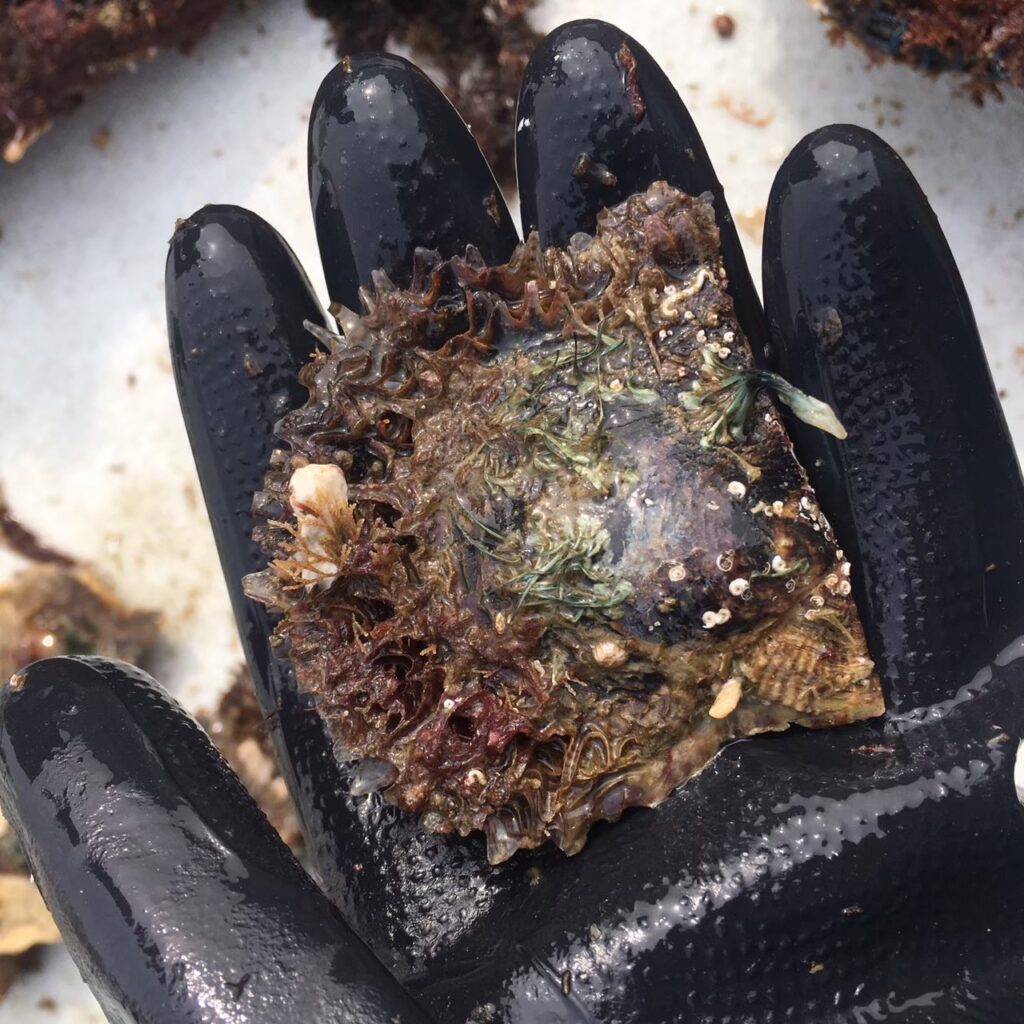
My beloved Akoya oyster.
Akoya oysters are most comfortable at water temperatures of around 20–25°C (68–77°F). When the water temperature drops to around 10°C (50°F), their activity decreases greatly, and they can survive for long periods while feeding very little.
But what happens when the water temperature becomes very high in midsummer?
Sometimes, they simply have to endure it.
High water temperatures can place considerable stress on Akoya oysters. In recent years, selective breeding has also produced oysters that are better able to tolerate the high water temperatures of midsummer.
But that is another interesting subject in itself, so I will save it for another article.
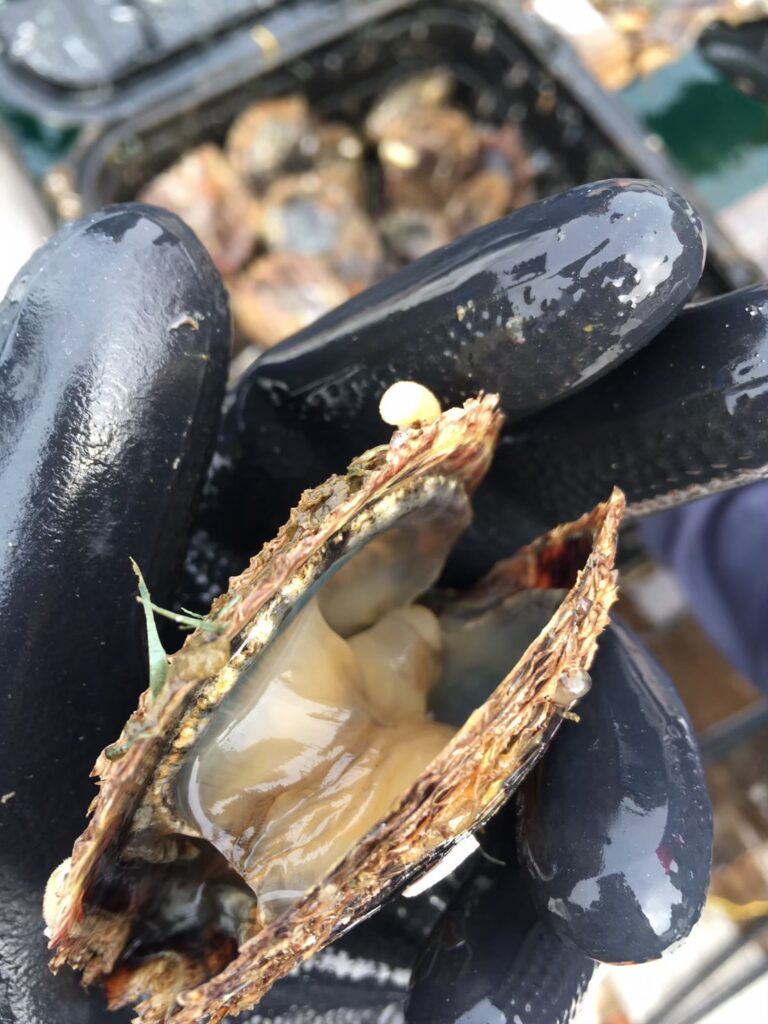
In the future, I would like to write more about the ecology of Akoya oysters—when we insert the spherical nucleus that eventually becomes the center of a pearl, how many oysters we operate on in a day, and what kind of preparation is needed before that work begins.
In this article, I have focused on things that I hope will be useful when choosing pearls. But there are still many other ways to look at pearls, and I would like to continue talking about them from different perspectives and with different ways of explaining them.
I want as many people as possible to understand the beauty of pearls and how to choose them.
Every day at Akoya pearl farms, many people take care of the oysters in conditions that are not always comfortable for the people doing the work, whether in the heat of summer or the cold of winter.
Pearls, like other products of agriculture, forestry, and fisheries, are by no means easy to produce.
If we can help more people understand this, I think those of us who work with pearls will be able to work a little harder too.
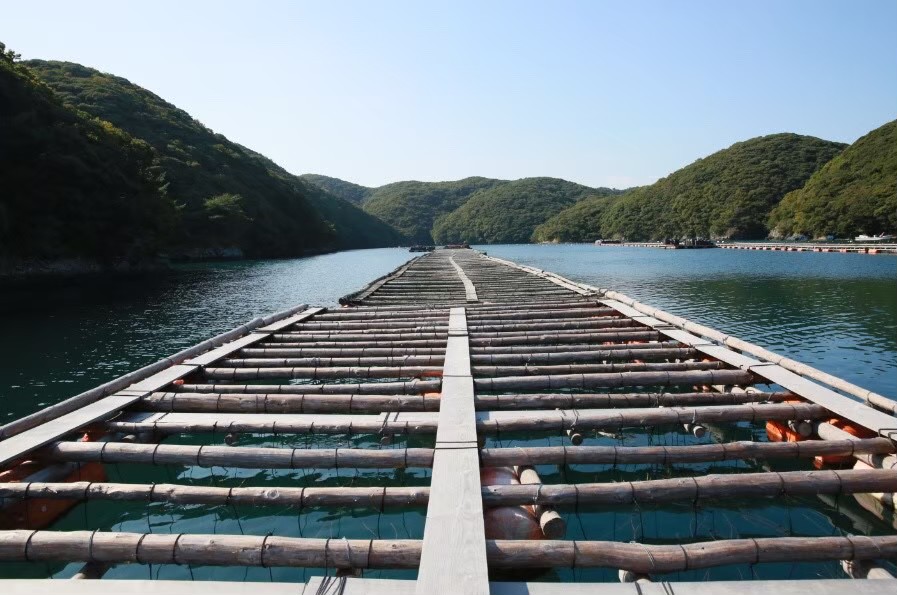
When you are ready to see these qualities in individual pieces, explore currently available Akoya pearl jewelry.
Read Next
Pearls can be understood from many different perspectives—not only through luster and nacre thickness, but also through shape, certification, and how they are worn in everyday life.
If you would like to continue exploring how pearls are judged and appreciated, you may enjoy the following articles.
Subscribe for Pearl Stories🐾
Receive occasional letters from my workshop —
stories about pearls, silverwork, Lulu the little dog, and quiet life in Japan.
As a thank you, you’ll get a secret code for 30% off —
usable every time you order, only here, not on Etsy.
I don’t send spam. Just little notes filled with love and pearls 💫
You can read our privacy policy for details.

Comment