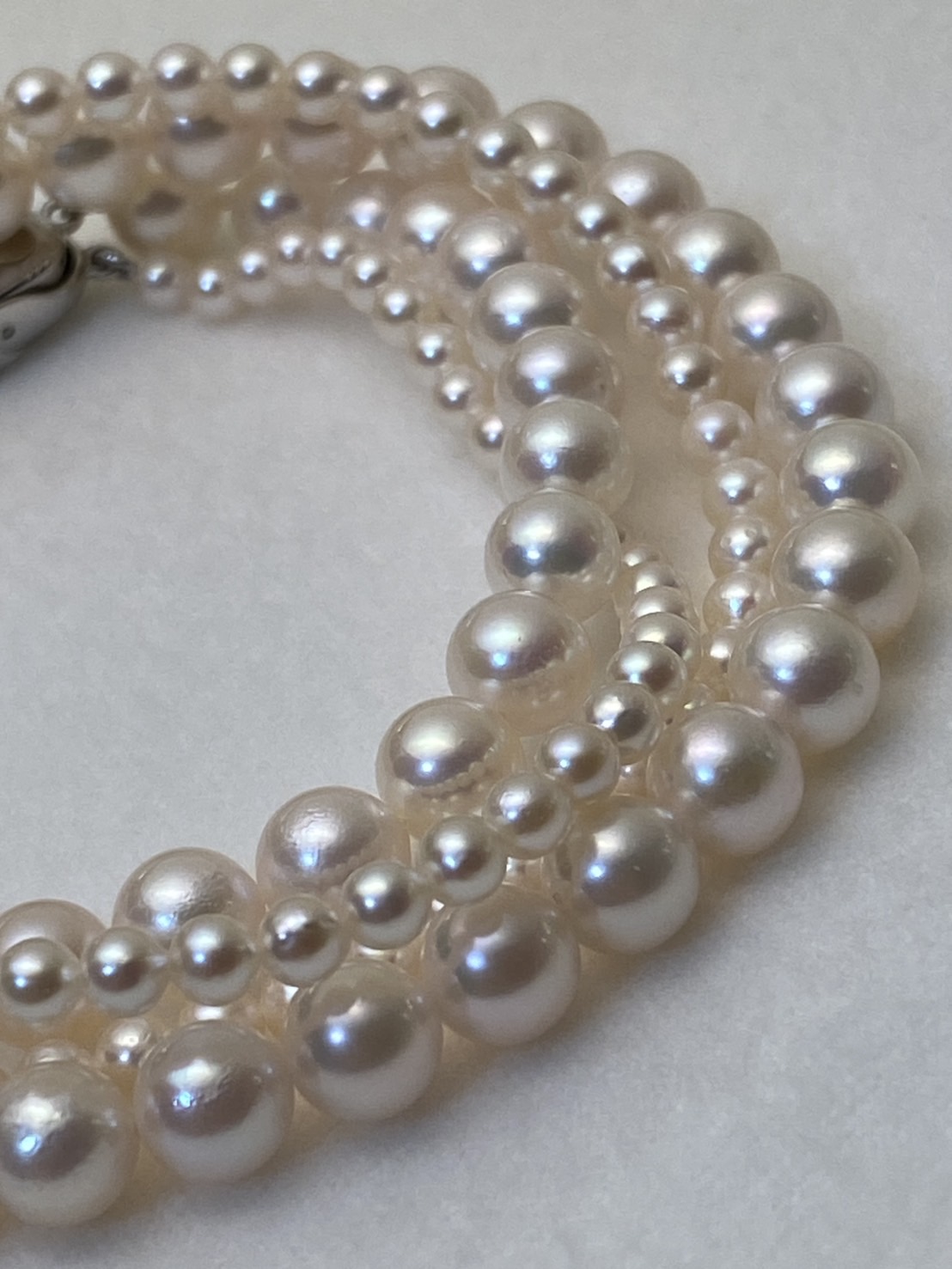
In this article, I would like to compare three strands of Akoya pearls shown in the video below.
The top two strands are from Tsushima, while the bottom strand is from Yusu in Ehime Prefecture. What interests me here is not simply the difference in color, but how differently pearls can appear even when they are all Japanese Akoya pearls.
Before going any further, I should make one thing clear. These three strands do not represent all pearls from Tsushima or Ehime. Pearl appearance can be influenced by many factors, including the oysters, the farm, cultivation methods, the environment, processing, and individual variation. Please see this comparison simply as one example.
Pearl farms in the Yusu area are well known within the pearl industry for their skill in what we call “two-nucleus insertion,” a technique in which two nuclei are inserted into a single Akoya oyster.
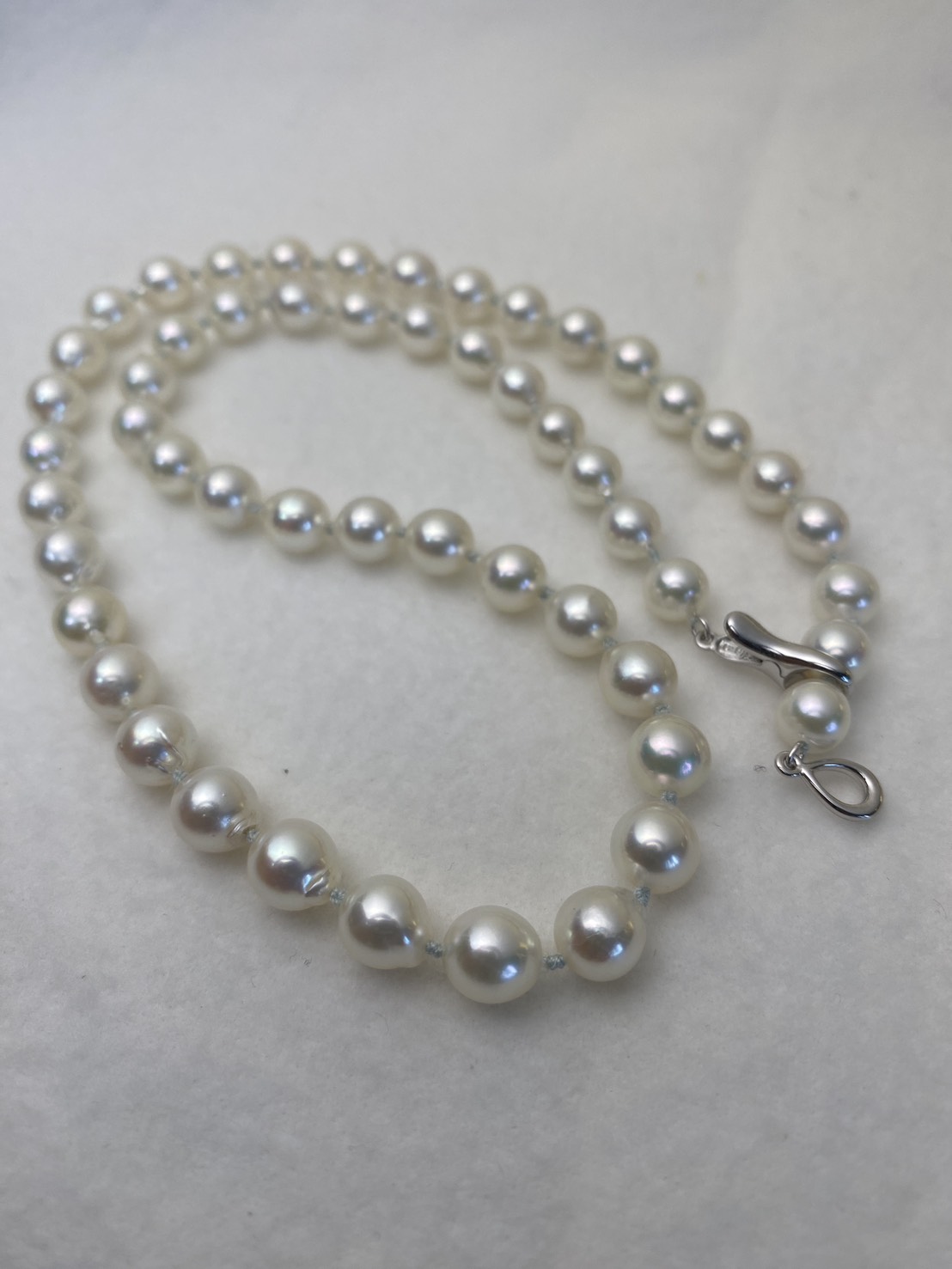
Personally, the top two strands look as though the nacre is very dense.
They are not pure white. They have a slightly creamy tone, and to my eyes this gives the pearls a sense of depth and density, almost as though many layers of nacre have been tightly built up.
I personally like this kind of color because it gives me the impression of densely formed nacre.
The bottom strand, on the other hand, is extremely white.
In the video it appears slightly cloudy, but in reality the white has quite a lot of transparency and clarity.
When I worked for a pearl company, I rarely saw pearls that were this white.
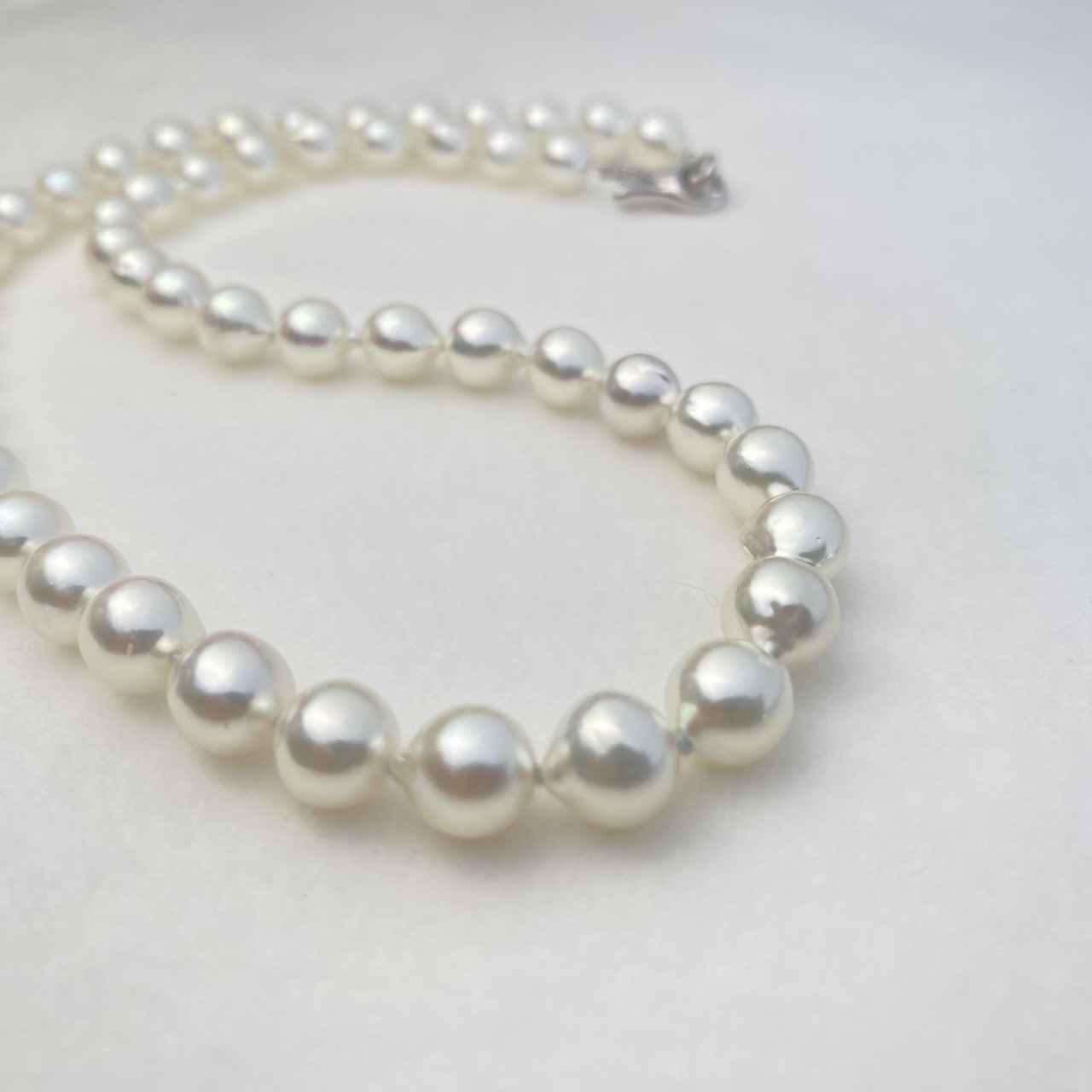
The pearls produced at the farms owned by the company where I worked tended to look more like the top two strands in this video, with the kind of color that made the nacre appear very dense.
In fact, the pearls in the top two strands were produced at the pearl farm where I used to work.
After leaving the company, I began to see pearls from many other farms more often, and I also started buying pearls from Yusu, including pearls similar to the bottom strand in this video.
To be completely frank, when I first saw them, I thought, “They are incredibly white. Maybe the nacre has not formed very thickly.”
However, a pearl dealer who buys these Yusu pearls directly from the farm told me,
“They are very white, but the nacre is thick.”
He also said,
“Pearls from Tsushima tend to have a slightly cloudy appearance, don’t they?”
That comment surprised me quite a lot.
From my point of view, that slightly cloudy or creamy appearance can come from nacre that has formed strongly and thickly. In other words, I had always considered that appearance to be one possible sign of substantial nacre.
When I worked for the pearl company, I often did something almost like research.
I would first estimate the thickness of the nacre from the appearance of a pearl. Then I would polish the pearl and actually examine how thick the nacre was.
So my understanding was not based only on visual impressions. I repeatedly checked what I saw against the actual nacre inside the pearl.
Still, what this dealer told me is also the opinion of someone who has worked with pearls for many years.
A pearl can be very white and still have thick nacre.
That made me think about this from another angle as well.
When pearl dealers buy pearls from farms, the pearls are generally processed before being sold.
Even pearls that are described as “no-toned” or untreated in terms of color enhancement still usually undergo a process known in the Japanese pearl trade as pre-treatment.
During this process, a small amount of impurity contained in or around the nacre can be removed, and the luster may become slightly brighter.
I sometimes think of it as washing your face in the morning.
A slightly dull-looking face becomes a little brighter after washing.
Of course, just as washing your face cannot remove a natural spot or blemish in the skin, pre-treatment cannot simply erase marks or stains that are part of the pearl itself.
Pearl dealers also tend to work with particular processing companies.
The Tsushima pearls and the Yusu pearls shown in this video were pre-treated by different processors.
And processing companies naturally have their own preferences.
Some may say, “I don’t like making pearls look too white.”
Others may prefer a much whiter finish.
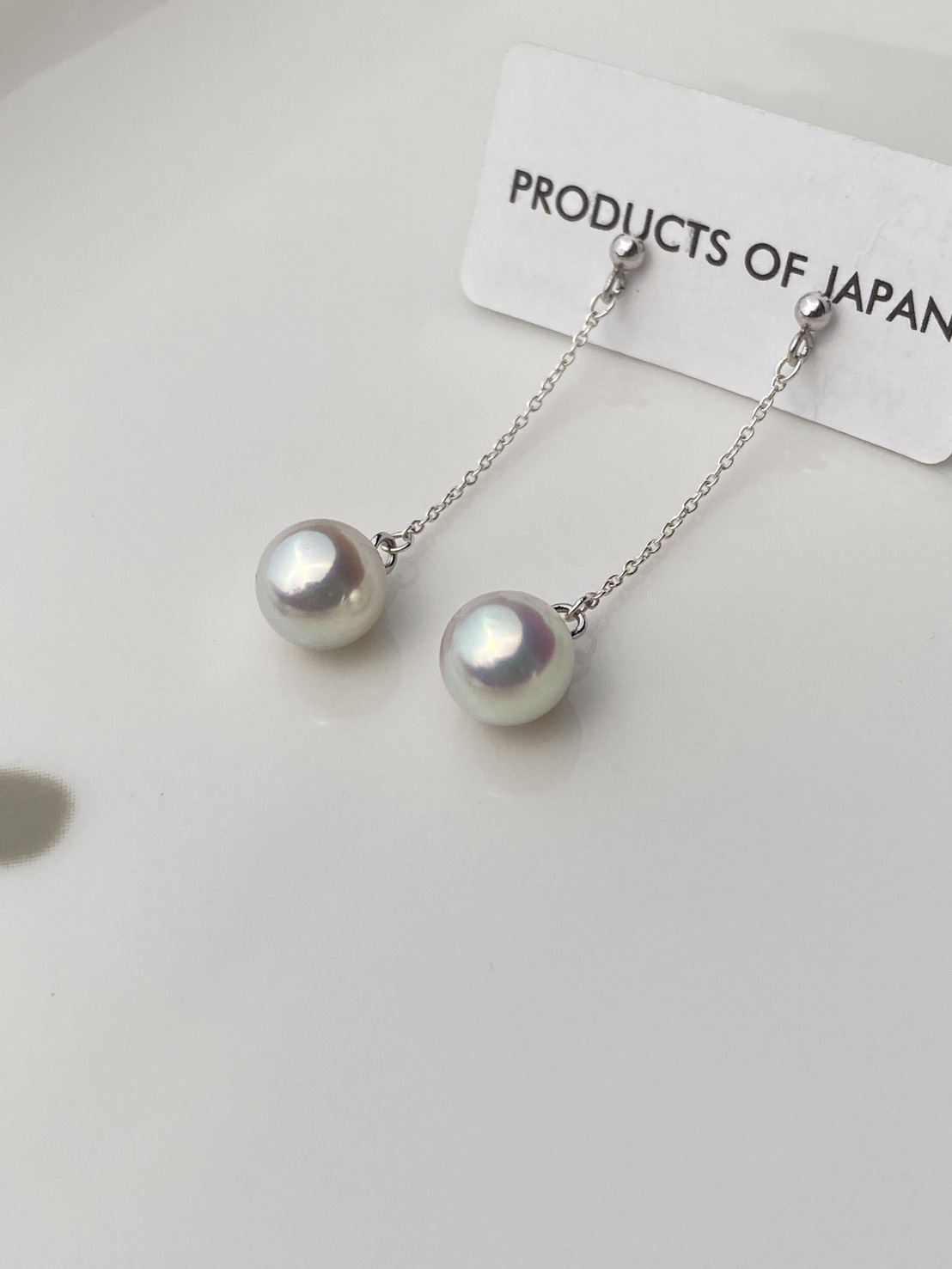
Even so, I believe that before processing is taken into account, the cultivation method, the farming environment, the oysters themselves, and the skill of the pearl farm probably have the greatest influence.
Even among Akoya oysters, there are many different strains and characteristics.
I do not know much about wine, but perhaps it is somewhat similar to grapes.
Even if they are all grapes, there are differences between grapes grown in California, Tuscany, and many other regions.
Akoya oysters are also not all exactly the same.
Depending on the oyster, there can be tendencies toward stronger reddish tones, whiter nacre, or other visual characteristics.
In the end, whether you prefer a very white pearl or a pearl with a slightly creamy tone is a matter of personal taste.
I hope you have the chance to encounter many different pearls and eventually find the kind of pearl that truly speaks to you.
It does not necessarily have to feel extraordinary.
Perhaps the best pearl is simply one that feels completely natural beside you, like someone whose presence is so comfortable that you do not even need to keep talking.
If you would like to explore finished strands, view currently available Akoya pearl necklaces.
If this comparison made you curious about how Akoya pearls differ in color, nacre, and appearance, you may also enjoy these related Flower Jem articles.
For more on how pearl processing affects appearance, see The Secrets of Pearl Processing: Crafting My Akoya Pearl Earrings.
Subscribe for Pearl Stories🐾
Receive occasional letters from my workshop —
stories about pearls, silverwork, Lulu the little dog, and quiet life in Japan.
As a thank you, you’ll get a secret code for 30% off —
usable every time you order, only here, not on Etsy.
I don’t send spam. Just little notes filled with love and pearls 💫 You can read our privacy policy for details.

Comment