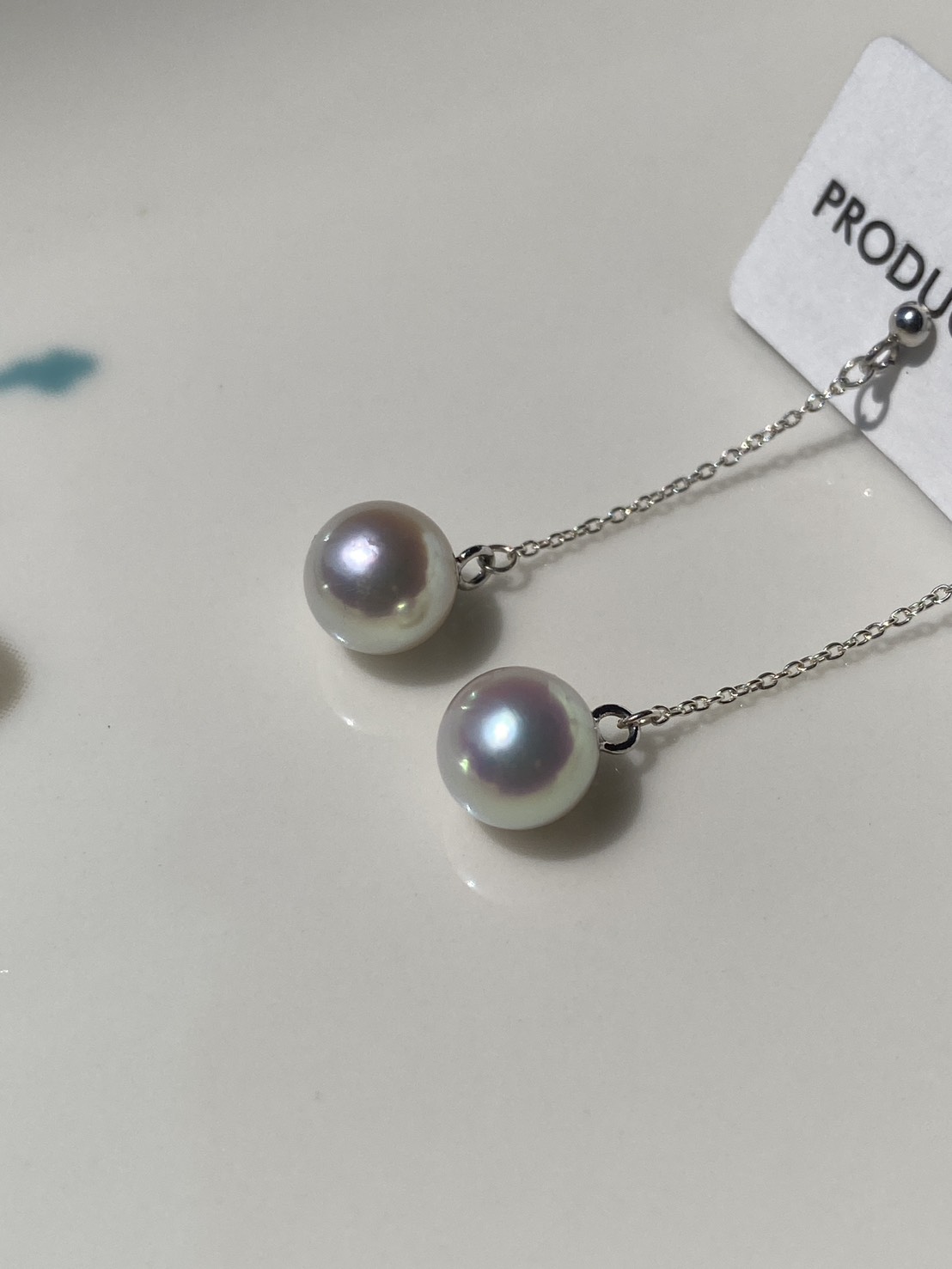
Pendulum
$250.00
Sold Out
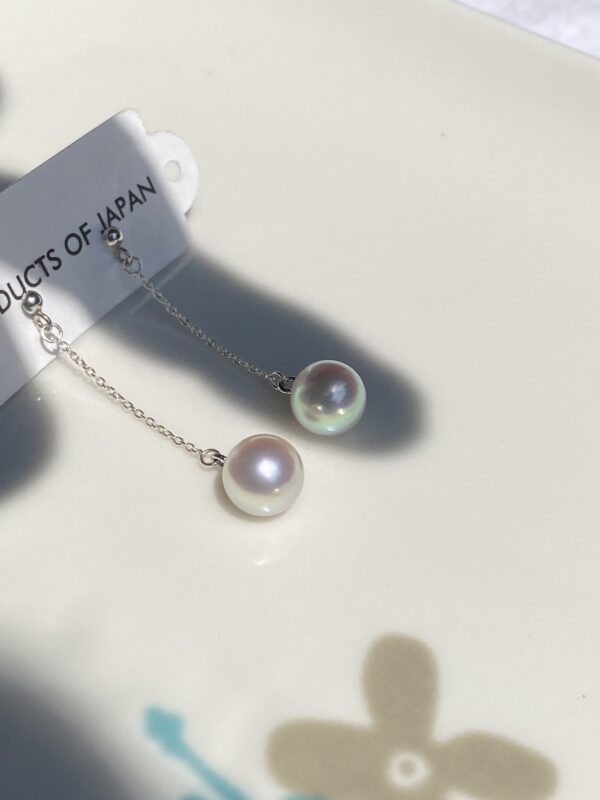
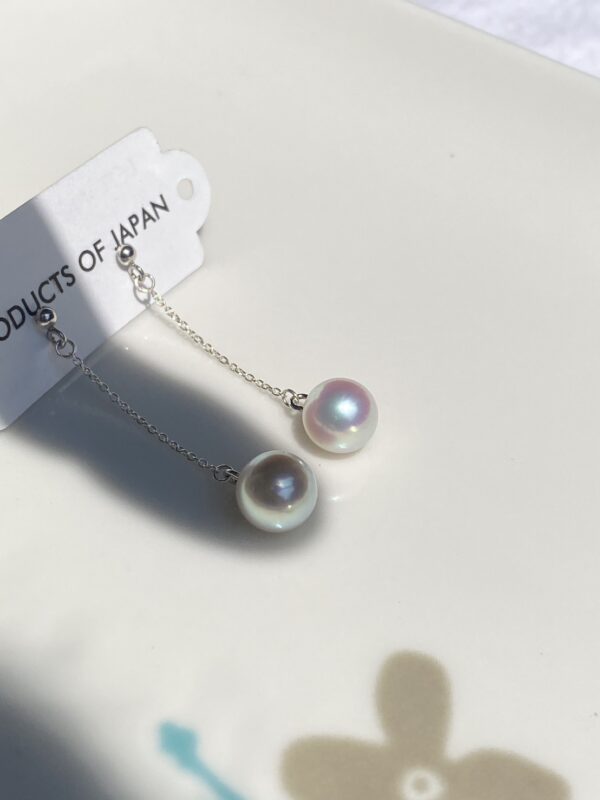
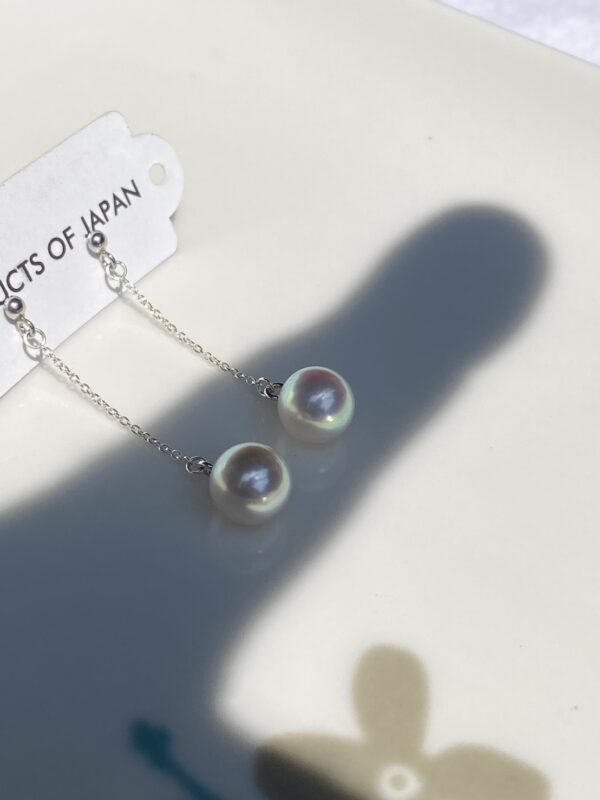
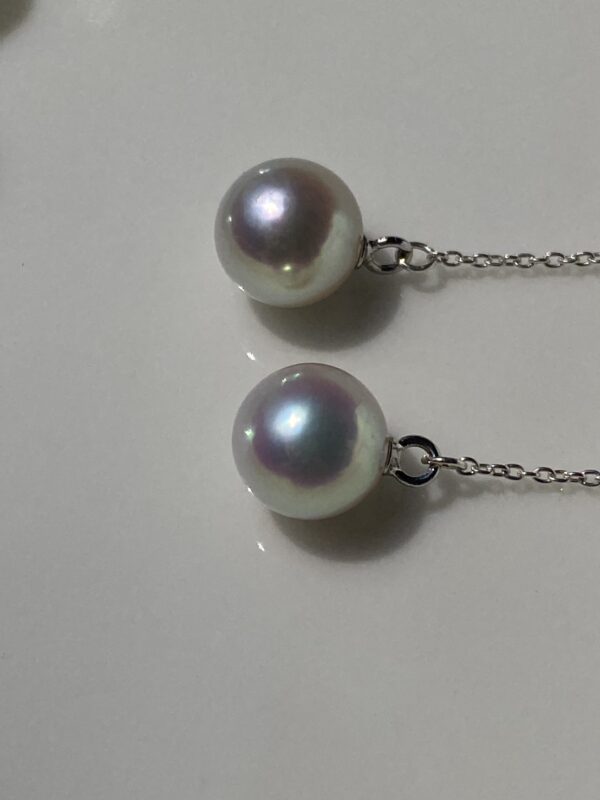
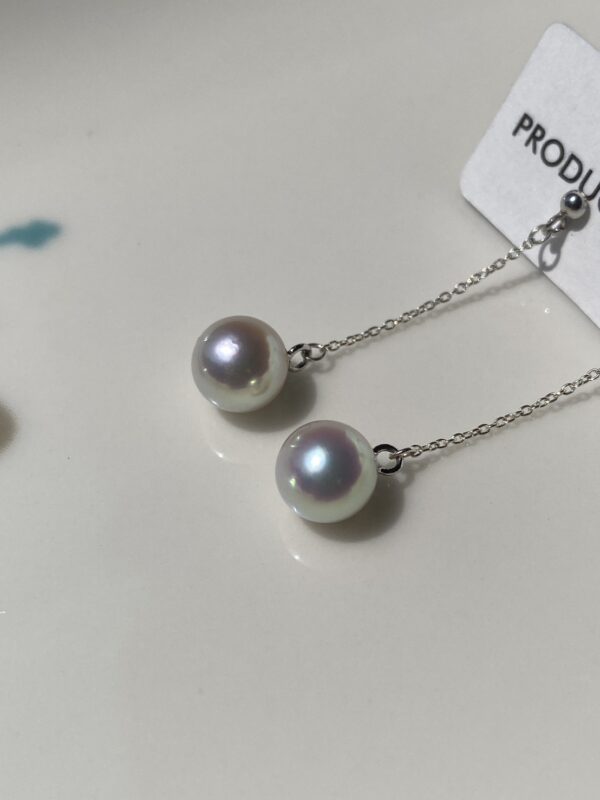
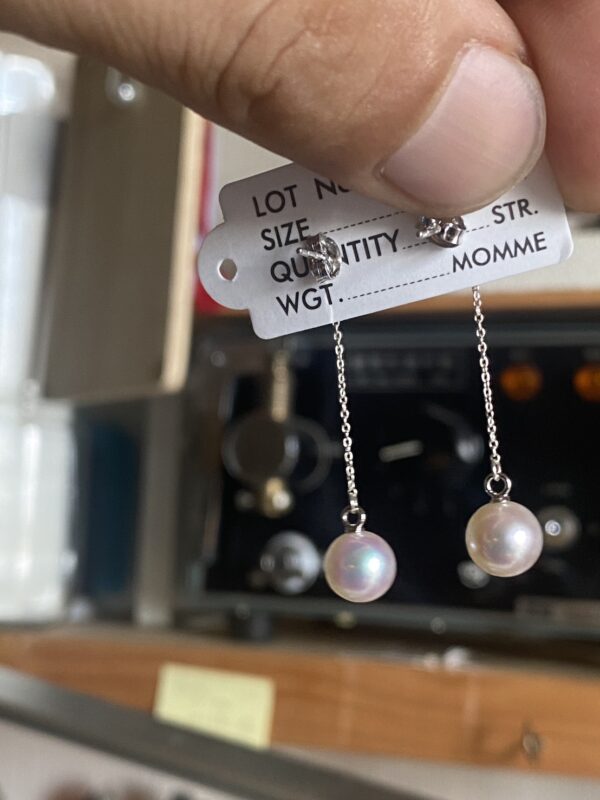
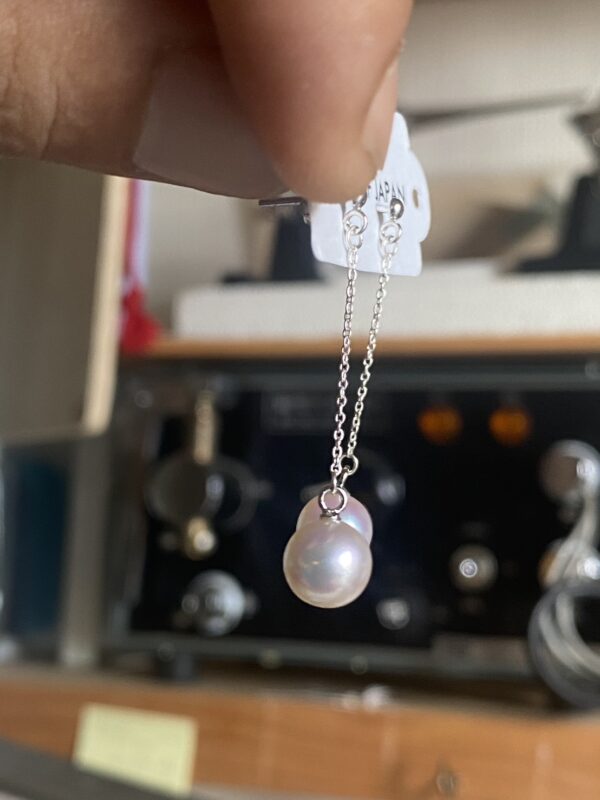
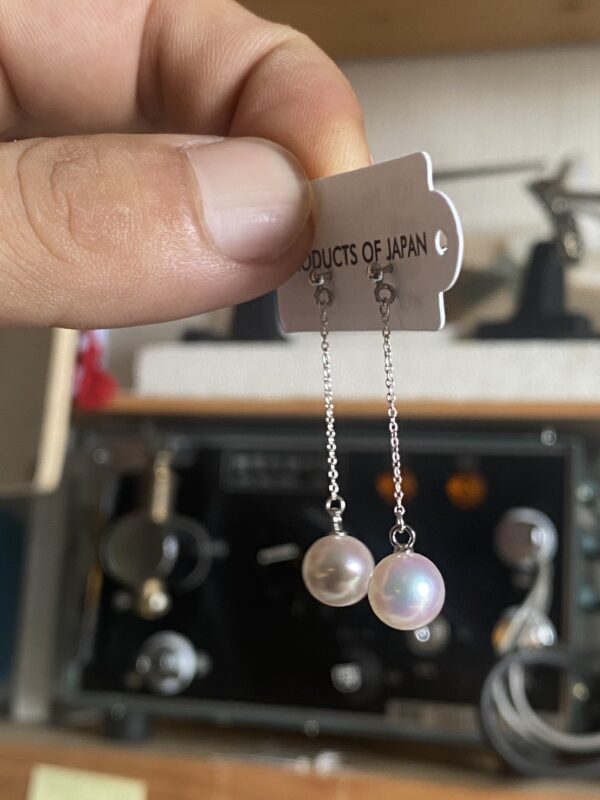
These earrings feature Akoya pearls with a strong, almost metallic luster.
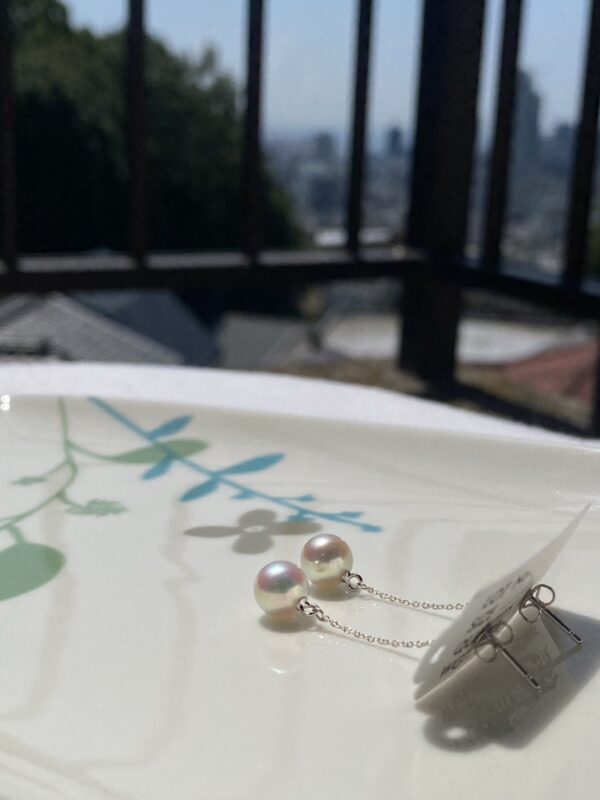
The length from the earring fitting to the pearl is approximately 1.18 inches (about 3 cm).
Because the pearls swing back and forth almost like pendulums, I simply named these earrings “Pendulum.”
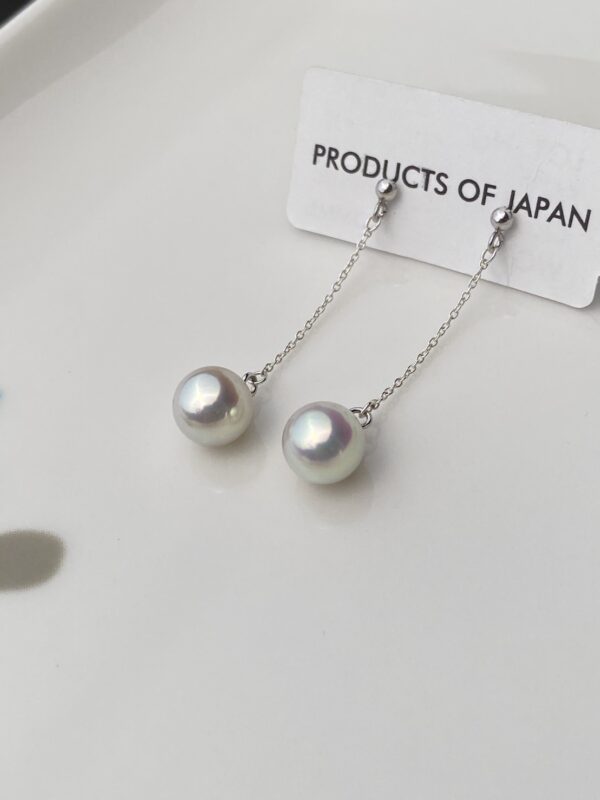
The findings are made of sterling silver (Silver 925).
These earrings are actually one of several pairs I made in March 2026 to show pearls in person to customers visiting Japan from overseas.
Nearly six months have passed since then, and I am finally listing this pair.
The surfaces of these pearls are not perfectly smooth, but their strong, metallic-looking luster makes them especially beautiful.
Today is August 31, 2026.
Yesterday, I met with a pearl nucleus manufacturer for the first time in quite a while.
A nucleus is inserted into an Akoya oyster, and the oyster gradually coats that nucleus with layers of nacre. That is how a cultured pearl is formed.
His family has been manufacturing these nuclei for two generations.
We talked about many things, and I would like to share one of those stories here.
From time to time, you may see star-shaped pearls on Instagram or elsewhere.
In those pearls, the nucleus itself is not the usual round shape. It is shaped like a star.
He once received a request to manufacture star-shaped nuclei like these.
He immediately declined.
Unlike ordinary round nuclei, producing a special shape such as a star would simply not make economic sense for him.
An ordinary pearl nucleus costs only around a dozen yen or so per piece, but a normal order involves hundreds of thousands of nuclei at a time.
The customer requesting the star-shaped nuclei, however, needed only about 1,000 pieces.
That was what he meant when he said the cost simply would not work.
The customer later asked another manufacturer to make them, and apparently my acquaintance continued to hear reports about how the project was progressing.
During those conversations, it became apparent that the company ordering the star-shaped nuclei seemed to assume that every nucleus inserted into an Akoya oyster would eventually become a pearl.
In other words, they seemed to believe that if they inserted 1,000 star-shaped nuclei into 1,000 oysters, they would harvest 1,000 star-shaped pearls.
But what do the actual numbers look like?
In one particular year, nuclei were inserted into 26,000 Akoya oysters in early July.
By the end of January the following year, only 10,800 oysters were still alive.
About 40% of the oysters had died.
By the end of July, only 9,800 remained, bringing the mortality rate to 62%.
And when the pearls were finally harvested in November, only 9,100 oysters remained.
That means a mortality rate of about 65%.
This particular batch appears to have performed quite poorly.
Even looking at the operation as a whole, however, the mortality rate for overwintered pearls that year was 49%.
Writing this now reminds me that, around that period, the Japanese pearl farming industry was being shaken by serious problems involving mass mortality among Akoya oysters.
When there are no such extraordinary problems, the mortality rate for pearls cultured over roughly two years is still around 40%, while for one-year pearls it is around 30%.
In other words, even after a nucleus is inserted, around 40% of Akoya oysters may die—and in a particularly bad year, the figure can rise to 60%.
And of course, not every pearl harvested from the surviving oysters will be high quality.
Out of 100 harvested pearls, perhaps 30 will be round pearls of what the trade might call first grade or near-first grade—high-quality pearls and those close to that level.
Around 60 of the remaining pearls may have noticeable stains or wounds, or may simply not be perfectly round.
The final 10 may be so low in quality that they are difficult to sell at all. The nacre may be cracked or broken, parts of the surface may be poorly formed, or the pearl may even have turned almost completely black.
To put it another way, you might begin with around 166 Akoya oysters and eventually harvest pearls from only about 100 of them. The others will have died.
Of those 100 surviving oysters, perhaps only around 30 will produce nicely formed round pearls.
The rest will be somewhat misshapen or will become baroque pearls.
The company I mentioned earlier wanted 1,000 star-shaped pearls, so apparently they asked for only 1,000 star-shaped nuclei.
In reality, they would need considerably more.
If about 40% of the oysters die before harvest, only around 60% will survive.
And if only around 30% of the pearls from those surviving oysters retain the intended shape without significant deformation, then obtaining 1,000 properly formed star-shaped pearls would require inserting approximately 5,555 nuclei.
That would leave around 3,333 surviving oysters at harvest, and roughly 30% of those—about 1,000 pearls—might retain a properly formed star shape.
In reality, I suspect inserting a star-shaped nucleus into an Akoya oyster would itself be considerably more difficult.
With an ordinary round nucleus, a small incision is made in the oyster’s body and the nucleus is inserted through that opening.
A star-shaped nucleus, however, seems much more likely to catch on the tissue during insertion.
Once those additional uncertainties are taken into account, preparing something closer to 10,000 nuclei might be more realistic.
That was one of the things I talked about yesterday with the nucleus manufacturer.
Of course, because both of us already understand the survival rates of Akoya oysters, the actual conversation lasted only about three seconds.
“You want 1,000 pearls, so you ordered 1,000 nuclei?”
“Even with ten times that many, who knows if you’d get enough.”
That was about it.
This has become a rather long story, but the point is that pearls are not easy to produce.
And it is not only pearls.
The same is true of tomatoes, cucumbers, rice, and almost everything else we consume.
Sometimes a child complains because they do not like what was served for dinner.
But before that meal appears on the table, someone had to buy the ingredients, cook the food, and take care of countless other household tasks as well.
After spending all that time preparing a meal, it would be sad to hear, “I don’t like this.”
For people who work with pearls, hearing, “If you put in 1,000 nuclei, you get 1,000 pearls, right?” feels a little like the same thing.
So every now and then, when you look at a pearl, perhaps spare a thought for the survival rate of the Akoya oysters behind it.
If you would like to know more about what happens before an Akoya pearl is finally harvested, these three articles explore the process in more detail—from nucleus insertion and oyster survival to the balance between pearl size and quality.
The Hidden Cycle of Akoya Pearl Cultivation: From Eggs to Luster
Pearl Cultivation Chronicles: Balancing Size and Quality in Akoya Oysters
Nucleus Insertion in Akoya Pearl Farming Begins This Fiscal Year
Subscribe for Pearl Stories🐾
Receive occasional letters from my workshop —
stories about pearls, silverwork, Lulu the little dog, and quiet life in Japan.
As a thank you, you’ll get a secret code for 30% off —
usable every time you order, only here, not on Etsy.
I don’t send spam. Just little notes filled with love and pearls 💫
You can read our privacy policy for details.
This space is not only for reviews. You are welcome to write freely about pearl jewelry, ask questions, or share what you feel when you see this piece. Member registration is required to submit your message.
Pearls & Stories
There are no stories yet.