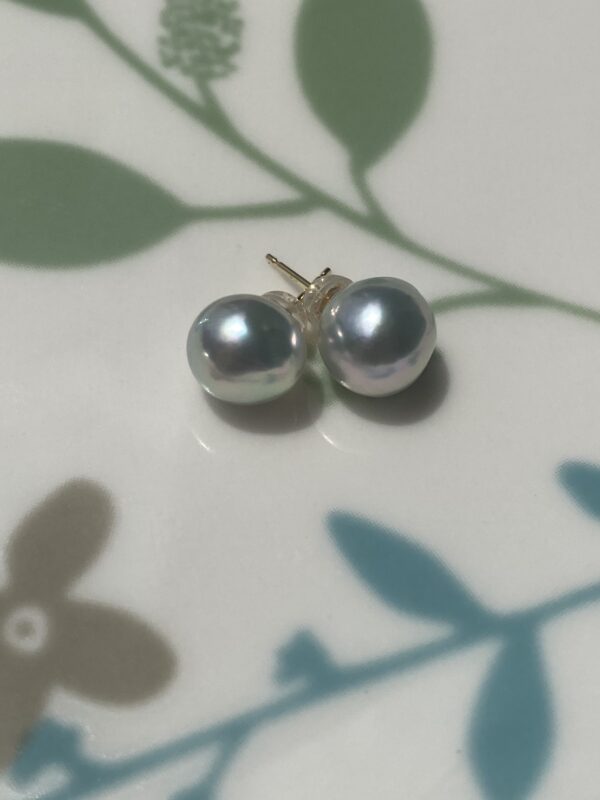
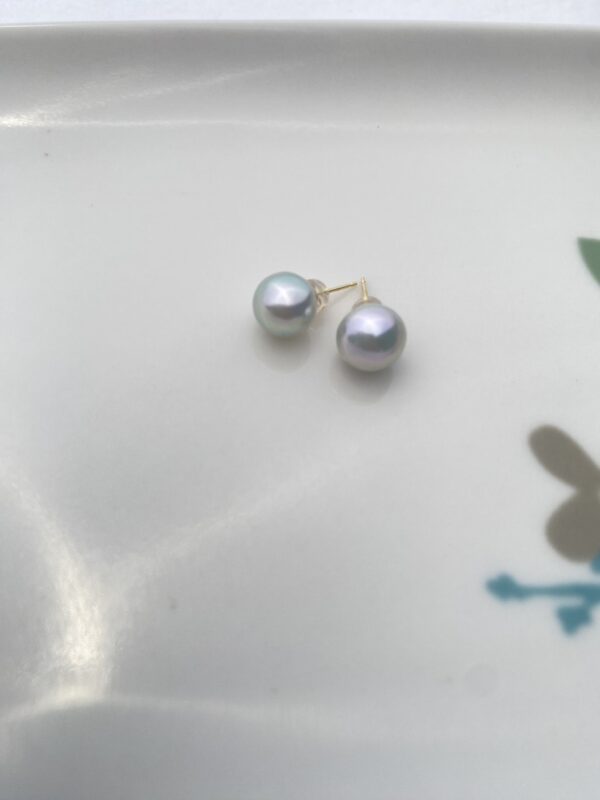
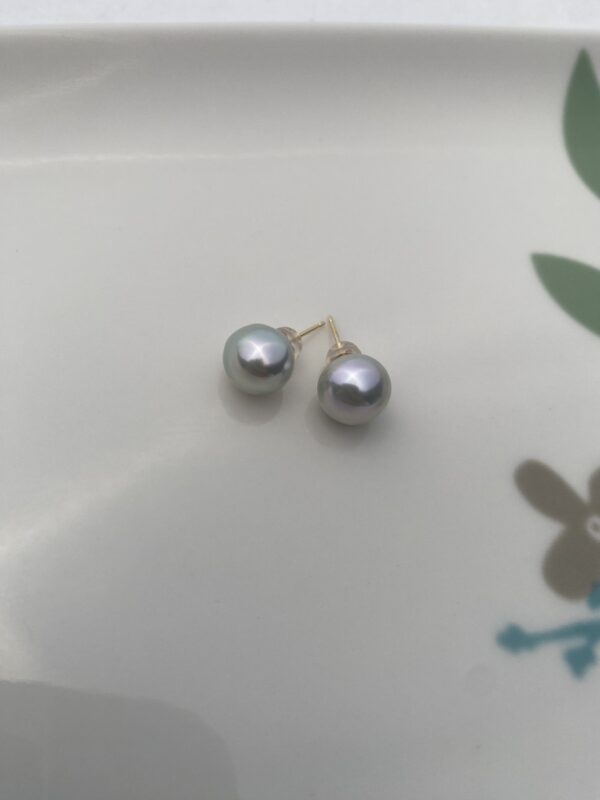
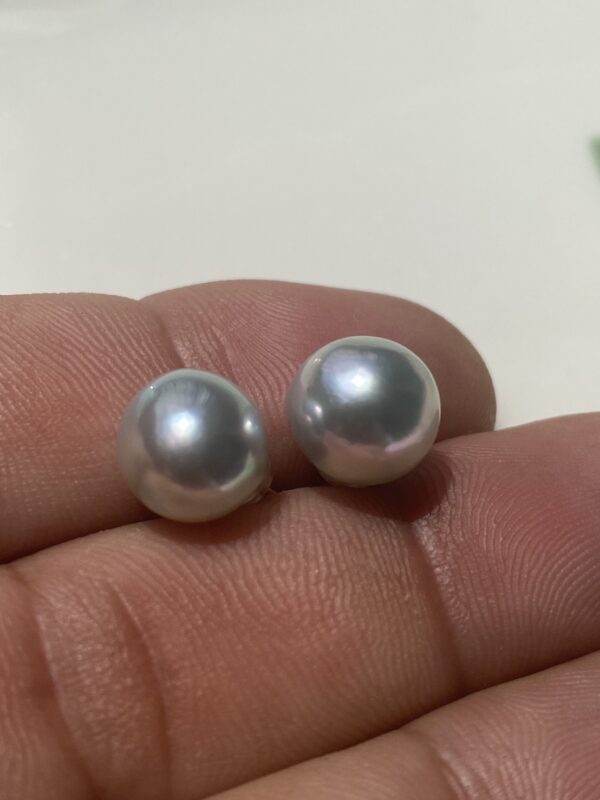
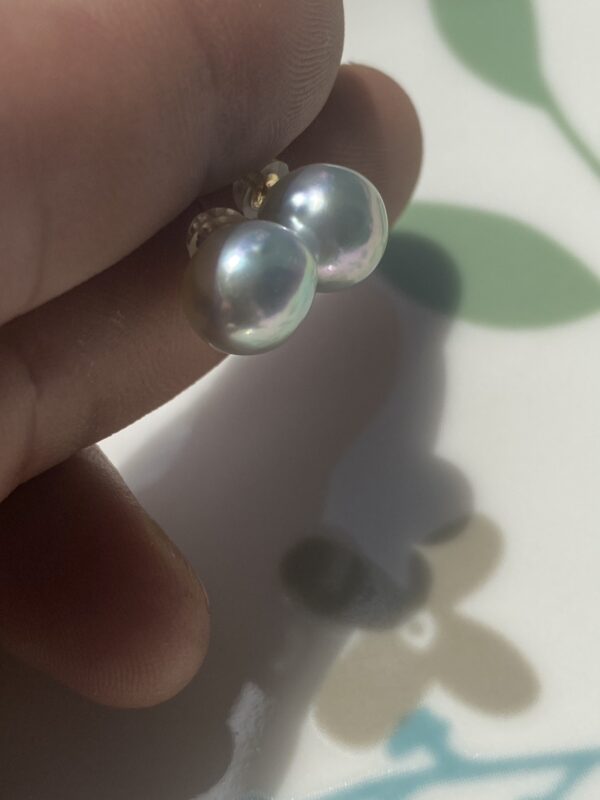
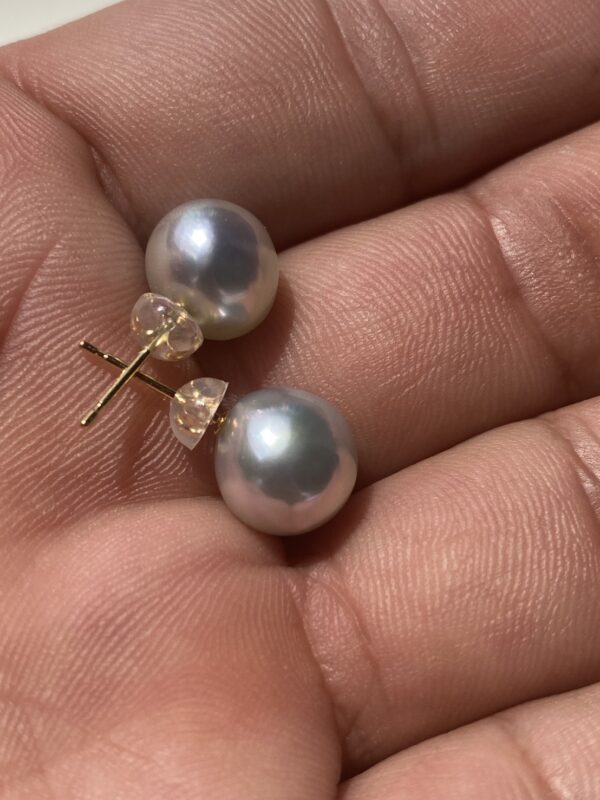
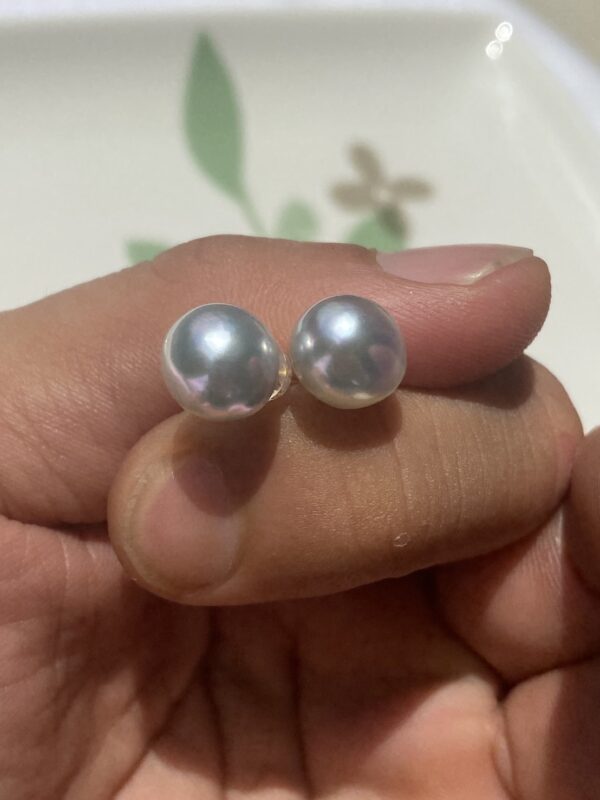
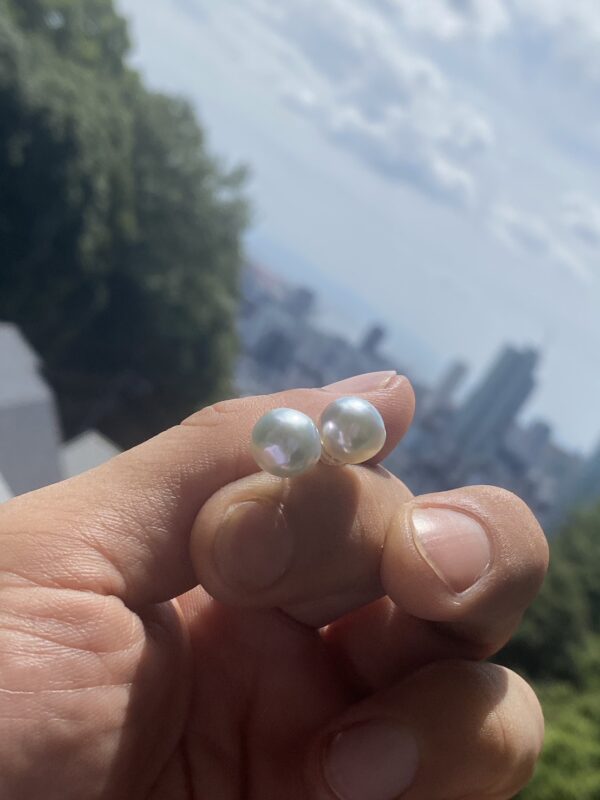
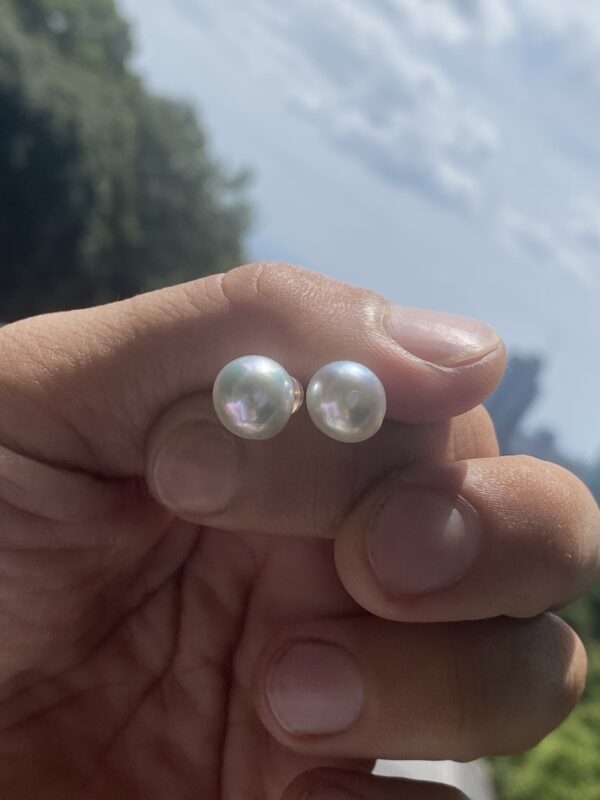
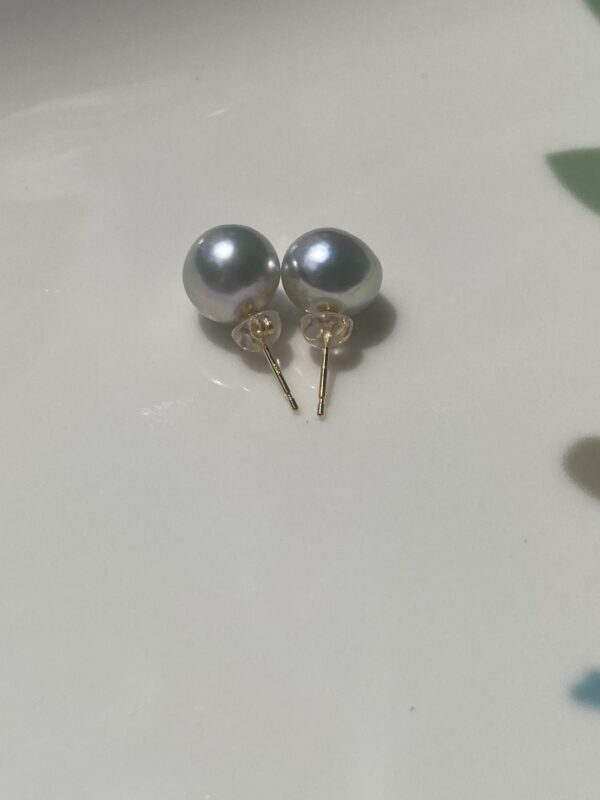
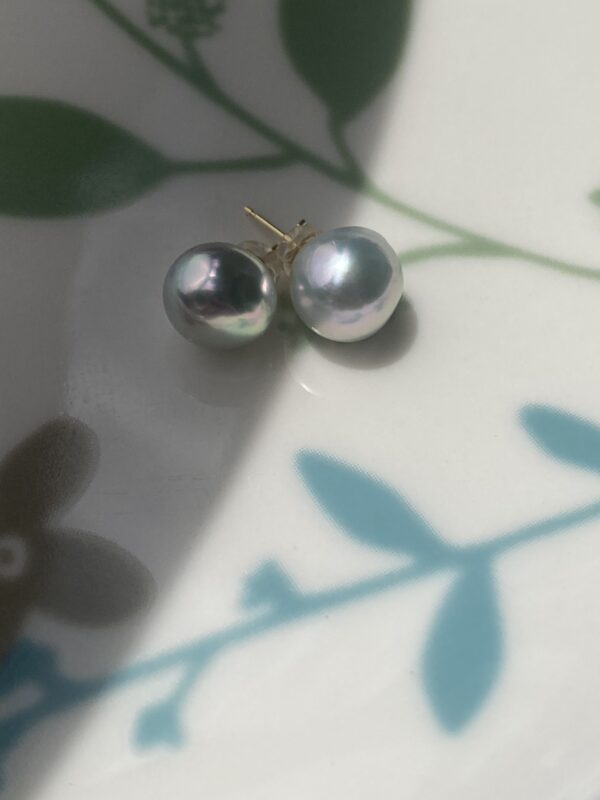
Natural Blue Akoya Pearl Earrings, K18 Gold, Baroque Pearls, 9.5mm / 9.2mm, Fine Luster, Japanese Akoya Pearls
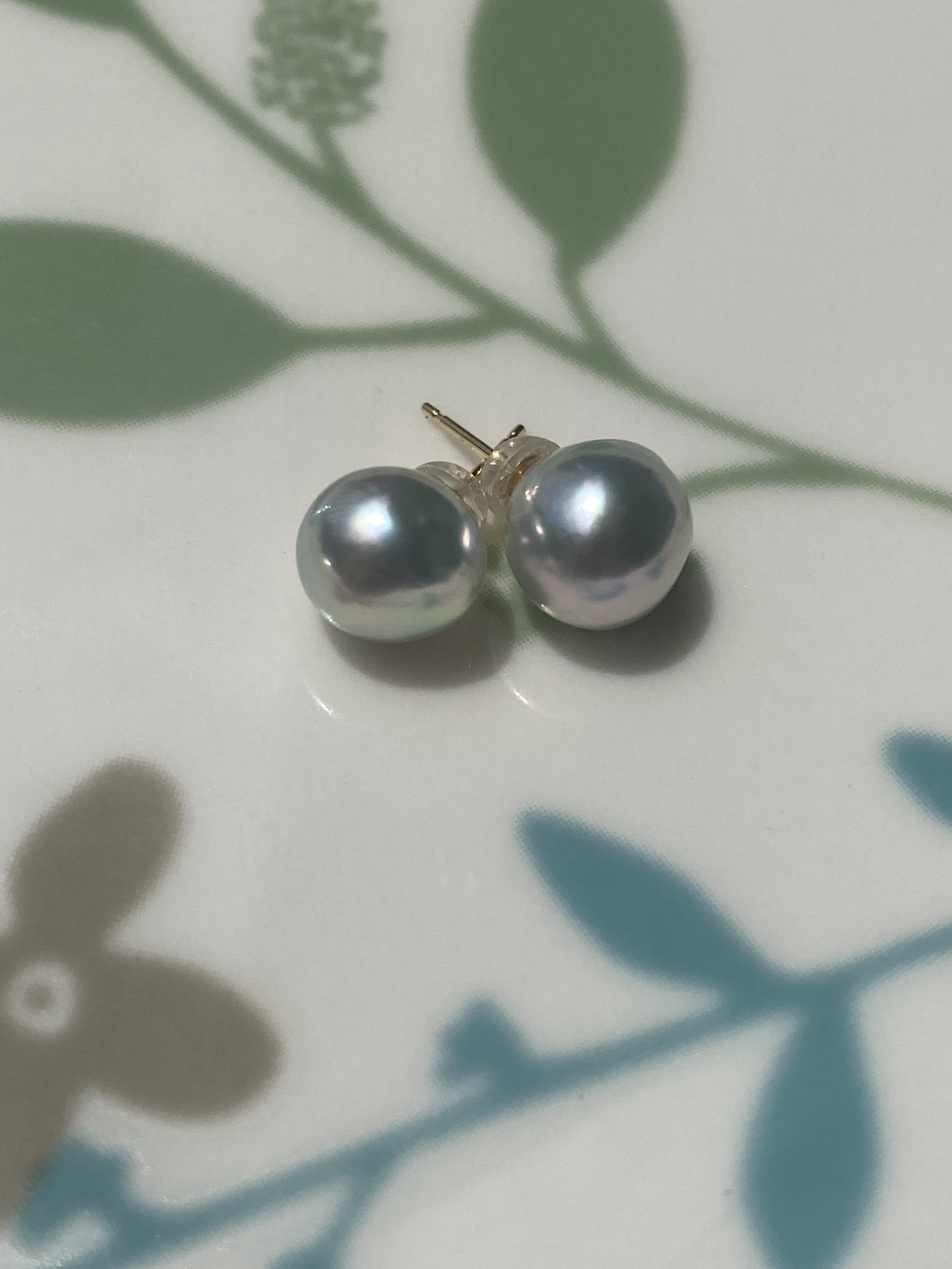
Obon-01
$330.00
1 in stock
Welcome.
It seems that you are interested in these vivid natural blue baroque pearl earrings.
If your eyes are drawn not to round pearls but to baroque pearls, perhaps you are already quite an advanced pearl enthusiast.
Then, do you know why pearls become baroque in shape?
………………….
Yes, exactly.
At a pearl farm, a round nucleus is inserted into an Akoya oyster, and layers of nacre are formed around that nucleus, eventually creating a round pearl.
However, if the person performing the nucleation is not very skilled, there is a greater tendency for the pearl to become baroque.
Also, if an Akoya oyster that has just had a nucleus inserted is thrown around or handled carelessly, even a nucleus that was originally placed in the correct position can move inside the oyster’s body.
This can also increase the possibility of producing a baroque pearl.
Another possibility is that the Akoya oyster is simply too energetic and continues secreting a large amount of nacre.
That too can increase the likelihood of the pearl becoming baroque.
I am writing this article on August 10, 2026.
During this kind of summer season, when the seawater temperature is high, Akoya oysters become more active and secrete larger amounts of nacre.
Pearls during this period often have rather rough surfaces.
Then autumn and winter arrive.
As the seawater temperature falls, the activity of the Akoya oysters becomes calmer, and the amount of nacre they secrete also decreases.
Because only a very small amount of nacre is being deposited, it becomes something delicate, almost like applying makeup.
During summer, the nacre may have been formed around the nucleus almost as though someone were roughly painting it with a brush.
But during winter, the surface gradually becomes beautifully refined, almost as though makeup were being carefully applied.
At pearl farms, this final winter period before harvest, when the surface of the pearl receives its finishing layers of nacre, is actually called kesho-maki — literally, the “makeup coating” period.
During this period, the Akoya oysters are kept as quiet as possible so that they are not unnecessarily stimulated.
More specifically, for a period of about one or two months, the oysters are no longer subjected to the strong shower cleaning that would normally be carried out every one or two weeks.
The reason is that strong stimulation can cause the Akoya oysters to secrete a large amount of nacre, which may make the pearl surface rough or cause the pearl to become baroque.
Even people who have worked at pearl farms for several decades can sometimes misjudge the timing of this kesho-maki period and struggle with achieving the final surface finish of the pearls.
From time to time, I have also met some extremely enthusiastic baroque pearl lovers who have said to me,
“Why don’t you just make baroque pearls?”
But if a pearl farm produced nothing but baroque pearls, it would go bankrupt.
Round pearls still command overwhelmingly higher prices in the pearl market.
No matter how beautiful a pearl may be, simply being baroque lowers its market value.
Imagine an elementary school student who helps their mother every day, does the laundry and cleaning, helps with cooking, reaches out to people in need on the way to and from school, stays beside a sad friend and shares their sadness, and even gives part of their own snack to an abandoned dog they find in a park.
That child might be a truly wonderful person.
But if the child is not good at studying, their school grades will still be low.
And having poor school grades has nothing to do with that child’s value as a human being.
A child like that would probably still be highly regarded by their parents, teachers, and friends.
And I imagine that child would go on to live a wonderful life.
If I interpret baroque pearls rather loosely, they are a little like that elementary school student.
Of course, I think someone who is good at studying, good at sports, handsome or beautiful, and kind and considerate to everyone is wonderful.
But I tend to feel even more affection toward people who have some kind of weakness or flaw.
Someone may not be able to read an analog clock.
Someone may always get lost.
Comparison Video of the Obon Series, No. 1–7
But if that person has a warm heart, I find them charming.
Now, the title of these earrings is “Obon.”
Obon is an event in Japan that could perhaps be compared, very loosely, to Halloween.
On August 13, there is Mukae-bon, when we welcome our ancestors back.
On August 14 and 15, our ancestors are believed to return to their respective family homes.
Then, on August 16, there is Okuri-bon, when we see our ancestors off again.
People sometimes place an eggplant in front of the family Buddhist altar with four disposable wooden chopsticks stuck into it, making it look like an animal.
When I was an elementary school student, I once saw my mother sticking four chopsticks into an eggplant and said to her,
“You shouldn’t play with food.”
She looked at me with an expression that seemed to say,
“How can my own child be this foolish?”
Then she gently explained,
“This is so our ancestors can ride it when they come home.”
Even as an elementary school student, I remember thinking,
“What an adorable idea.”
At the time, I had just read a picture book or something similar that included a pumpkin carriage.
So I thought of it as an “eggplant carriage.”
And the idea that our ancestors would ride home on it was charming to me.
I was also strangely moved by the contrast between this lovely idea and my mother, who seemed to spend most of her time scolding me.
Incidentally, when I was a child, all of our relatives used to gather during Obon.
There were only two occasions each year when the extended family gathered together: New Year and Obon.
My father had three siblings.
Their children numbered three, two, and two respectively.
I also have an older brother and a younger brother.
At New Year and Obon, all of us cousins would play together for hours.
Meanwhile, the adults would sit around endlessly repeating the same stories, while my mother was busy from morning until night preparing food and alcohol almost like a servant.
I was not a particularly thoughtful child, so it was only much later that I came to understand how exhausting those occasions were for her.
My mother later told me with a bitter smile,
“New Year and Obon were really hell. Back then, shops weren’t open during New Year and Obon the way they are now, so I had to cook everything myself. Everyone arrived around lunchtime, and I worked nonstop until night. I used to think I wanted to go to the other world together with the ancestors.”
For us children, those days were like a dream.
For my mother, apparently, they were hell.
These days, during New Year and Obon, my mother only cooks the dishes that she personally feels like making.
Everything else she orders online or buys from a shop.
She laughs and says,
“The world has become so convenient. But why do young women nowadays still say they are so busy when everything has become this convenient? Although I probably shouldn’t say something like that. Even if life has become more convenient, perhaps the type of busyness has simply changed.”
And that is why I named these earrings “Obon.”
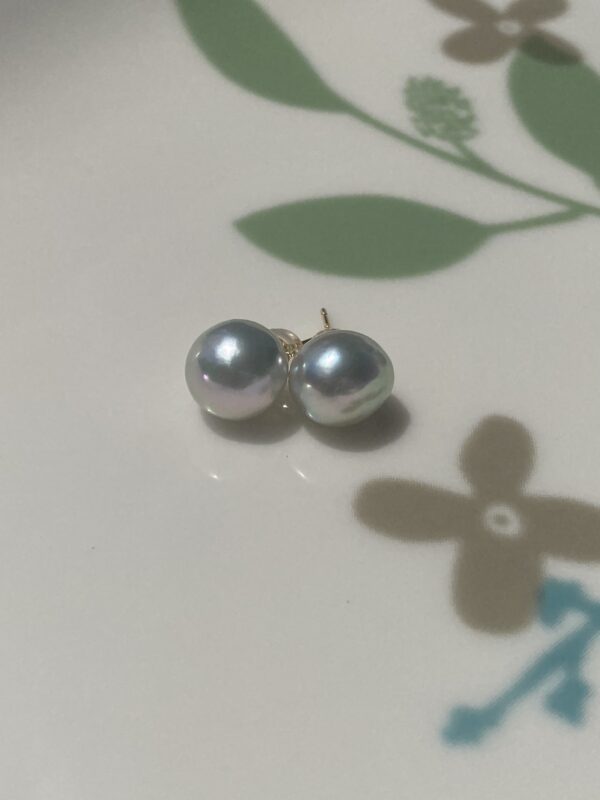
They were made during the Obon season.
I should also add that another reason is simply that I made seven pairs of earrings this time, and thinking of a different name for each one felt like too much trouble.
Incidentally, August 15 is not only part of the Obon period.
In Japan, it is also the day commemorating the end of World War II.
The fact that the day our ancestors are believed to return happens to fall on the same date as the anniversary of the end of the war is apparently only a coincidence.
But somehow, I find that coincidence thought-provoking.
Through pearls, I exchange messages with customers from many different countries.
And I have learned that even when countries, regions, and religions are different, many people have traditions that resemble Obon in some way.
Everyone has different values, preferences, and ways of thinking.
But I like the fact that when it comes to remembering and thinking about our ancestors, there seems to be something that many of us share.
So this time, I hope you will remember a little bit about Japanese Obon as one more small piece of knowledge.
If you ever travel to Japan during the summer, try asking someone,
“Did you have to work during Obon?”
That alone might allow you to have a surprisingly intimate conversation with a Japanese person.
🌸 Next in the Obon Series 🌸
Subscribe for Pearl Stories🐾
Receive occasional letters from my workshop —
stories about pearls, silverwork, Lulu the little dog, and quiet life in Japan.
As a thank you, you’ll get a secret code for 30% off —
usable every time you order, only here, not on Etsy.
I don’t send spam. Just little notes filled with love and pearls 💫
You can read our privacy policy for details.
This space is not only for reviews. You are welcome to write freely about pearl jewelry, ask questions, or share what you feel when you see this piece. Member registration is required to submit your message.
Pearls & Stories
There are no stories yet.