SAKURA– 3.5–4.0mm Japanese Akoya Pearl Necklace & Bracelet Set, Sterling Silver Chain, 50cm Necklace, 20cm Bracelet
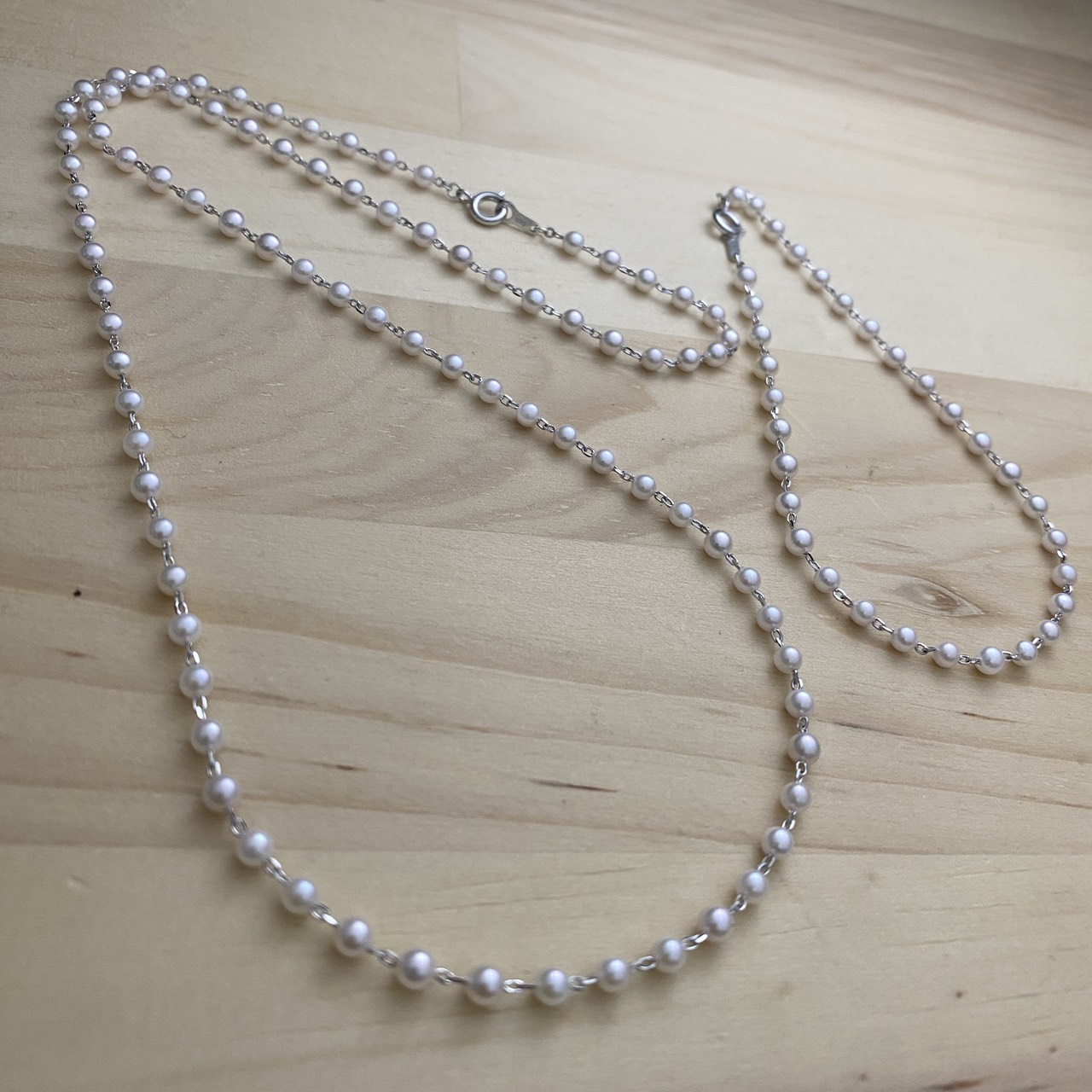
SAKURA
$750.00
1 in stock
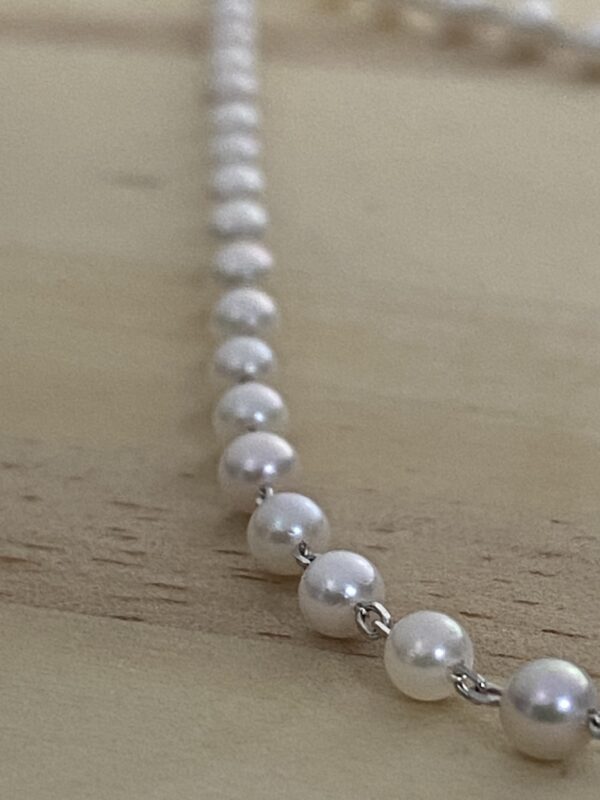
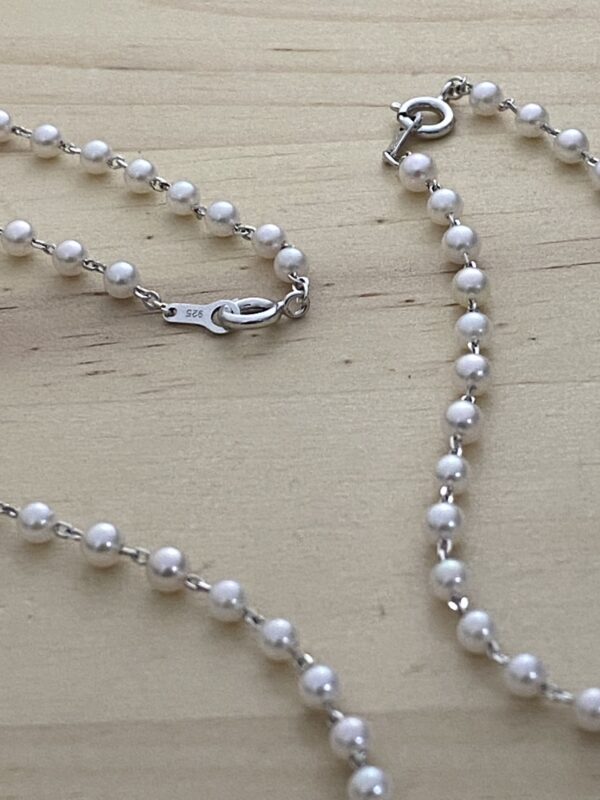
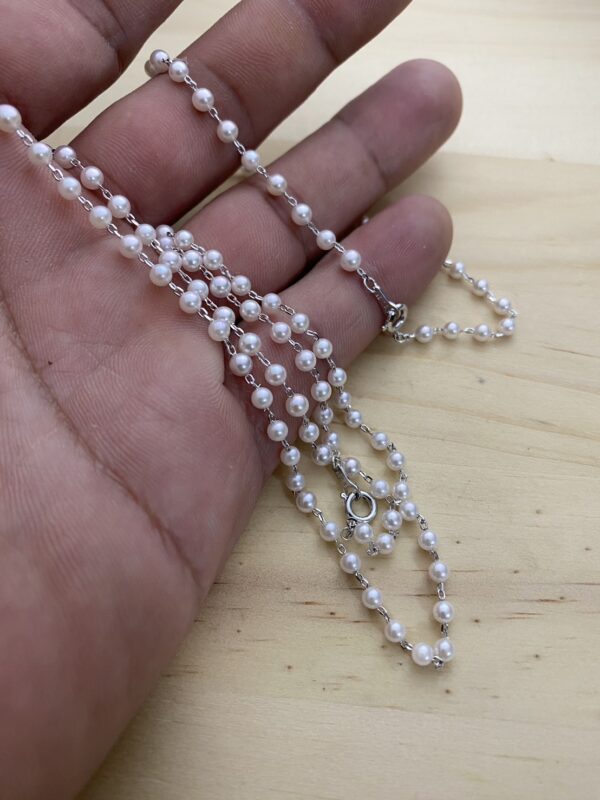
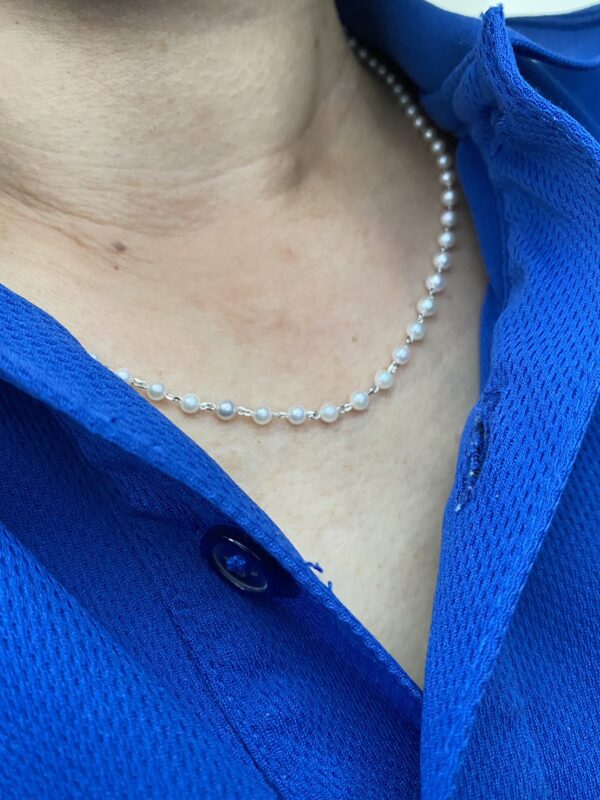
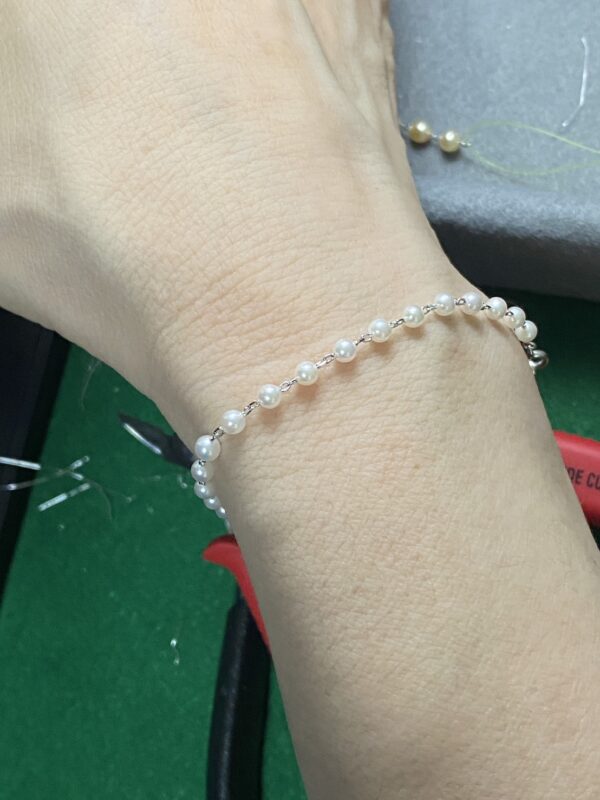
This is a set of Akoya pearl necklace and bracelet.
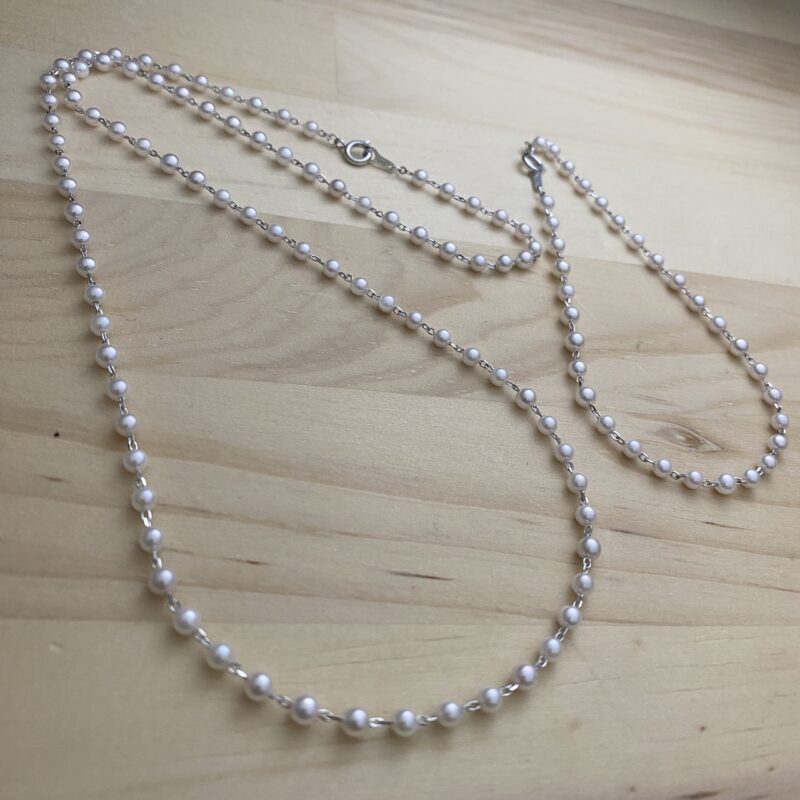
The pearls are 3.5-4.0mm in size. The necklace is approximately 50cm long, and the bracelet is 20cm long.
Both the necklace and bracelet can be shortened upon request.
This necklace and bracelet are made from the same 40cm strand of pearls.
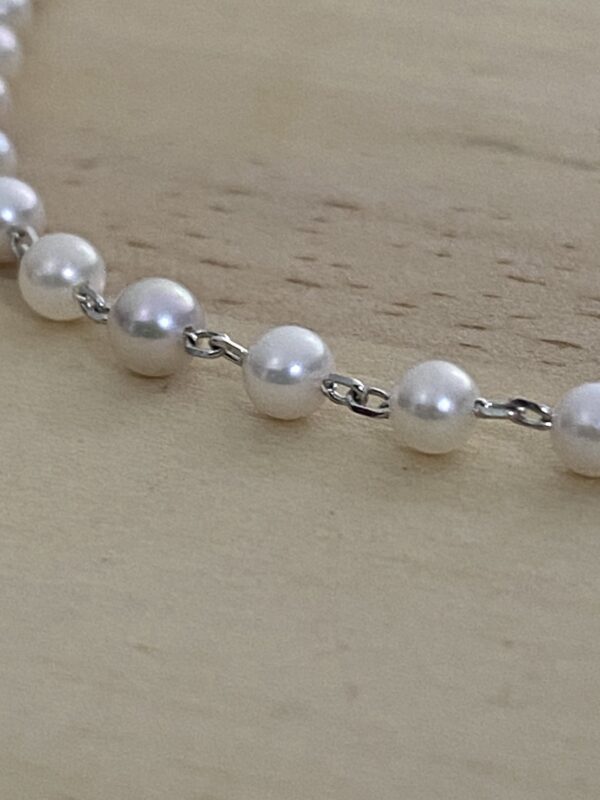
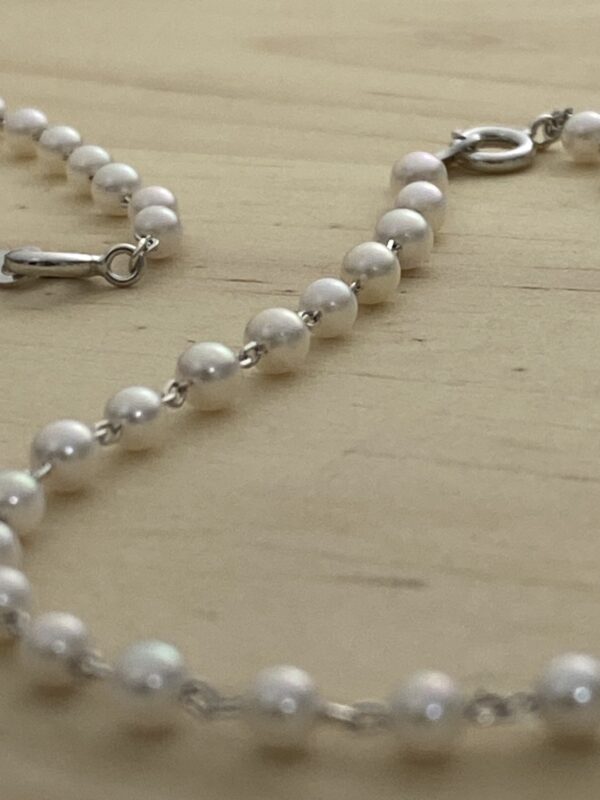
Two links of a disassembled silver chain are used between the pearls.
The chain does not pass through the pearls; the pearls and chain are connected by wire.
Initially, 0.16mm wire was used, but this was changed to 0.20mm wire for increased strength.
The hole size of the pearl is approximately 0.7mm.
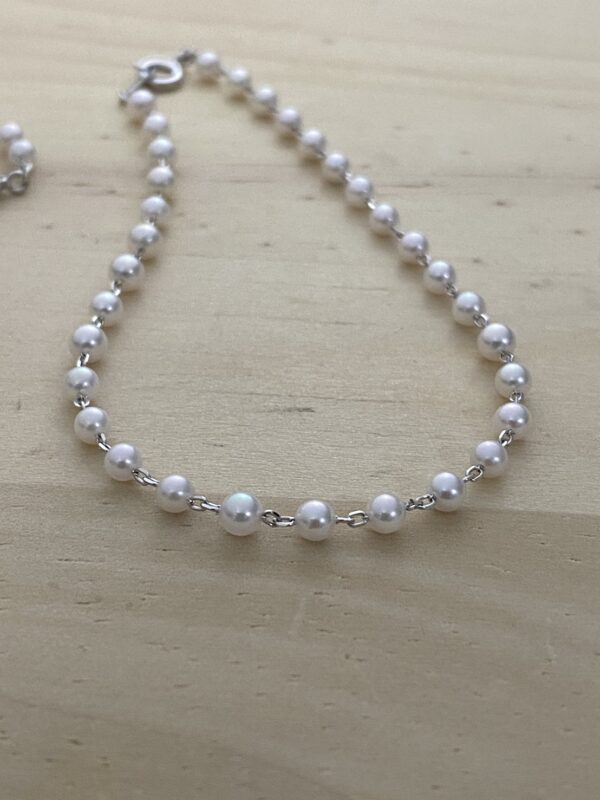
The wire passes through the pearl’s hole three times. We use wire thick enough to pass through the pearl as much as possible, and to prevent the wire from slipping out.
Furthermore, the wire is twisted twice before being threaded and tied to further increase its strength.
During the prototyping phase, I repeatedly conducted strength tests, but the pearls and chain came apart several times in several places.
I was quite worried that I couldn’t sell such a necklace in this state.
However, by using thicker wire and twisting the wire, the strength increased dramatically.
That’s when I was finally able to start selling it.
And, regarding this necklace and bracelet, I didn’t make them myself; they were made by Hiromi, Flower Jem’s first ever collaborator.
She originally made accessories as a hobby, and she agreed to help with Flower Jem’s products this time.
Originally, I intended to make a necklace using 3.5-4.0mm pearls with all knots, but the knots were too large for the pearls, so that strand was left unused.
Then, about six months ago, a customer suggested a station-type necklace design like this one.
When I saw that necklace, I thought it was very cute.
That necklace is made by threading the chain through the pearls, so it’s not particularly difficult to make.
However, to thread the chain through the pearl, the hole in the pearl needs to be enlarged.
Personally, I absolutely cannot tolerate the idea of the pearl’s hole being enlarged.
The pearl’s hole should be kept as hidden as possible.
This kind of lesson seems to have been ingrained in me unconsciously during my time at my previous pearl company.
Therefore, I thought about using wire wrapping (a term I recently learned).
However, the process of attaching over 100 pearls to the chain one by one with wire would take a considerable amount of time.
Flower Jem is basically run by me alone.
I have Lulu, but she’s a pampered dog and doesn’t work.
Therefore, if I receive custom order requests from even a few people, my capacity is immediately full.
It became a matter of “I’ll make it someday when I have time.”
To put it bluntly, “I simply don’t have the time to make it.”
Time passed like that.
A turning point came around March 2026.
I’m in Osaka on weekdays and Kobe on weekends.
I work a job unrelated to pearls during the week, and I work with pearls in Kobe on weekends.
However, I gradually found that the time I had on weekends wasn’t enough to dedicate to my pearl work.
So, in March, when my work had calmed down a bit, I decided to create a proper pearl workshop in my apartment in Osaka.
To create this workshop, I needed to prepare tables, shelves, and other furniture, which Yuya, a colleague I met at work, kindly provided.
He enjoys DIY, so when I told him I was going to build a workshop at home, he happily offered to help.
During that process, Yuya’s acquaintance, Hiromi, came up in conversation.
The conversation quickly expanded and took off.
As a result, we decided to create an environment where Yuya, Hiromi, and I could all work together.
Yuya and Hiromi would each make their own preferred accessories.
For me, having Yuya and Hiromi come to my home a few times a week meant that after finishing my weekday work and returning home, I could stay awake and dedicate myself to pearl work.
In reality, my weekday job involved a considerable amount of physical labor, so even if I had work I wanted to do, I often ended up dozing off when I got home.
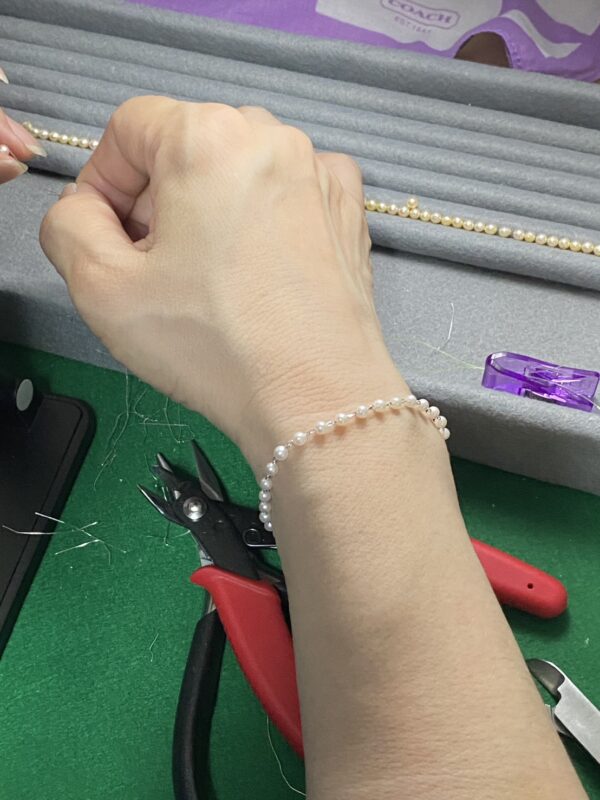
Then, starting in April 2026, when the environment was finally set up, the three of us began gathering in my small room two or three days a week, each working on our own projects.
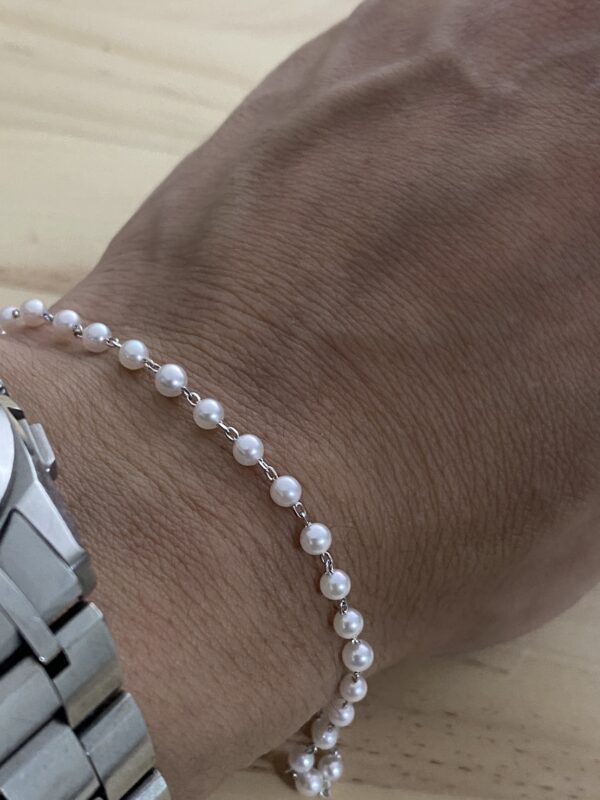
Yuya and Hiromi enjoyed making bracelets with natural stones, and with them around, I was able to stay awake and concentrate on my pearl work.
Soon after, Hiromi asked, “Is there anything I can help with your pearl work? I don’t need to make so many bracelets, so I’ll help if there’s anything.”
So, I asked her to make this necklace, which I had been thinking of making someday when I had more time.
I was the first to teach her the wire wrapping technique, and she quickly mastered it.
She loves meticulous work, so she happily took on the task.
She started making the necklace in late April 2026 and completed it in early May.
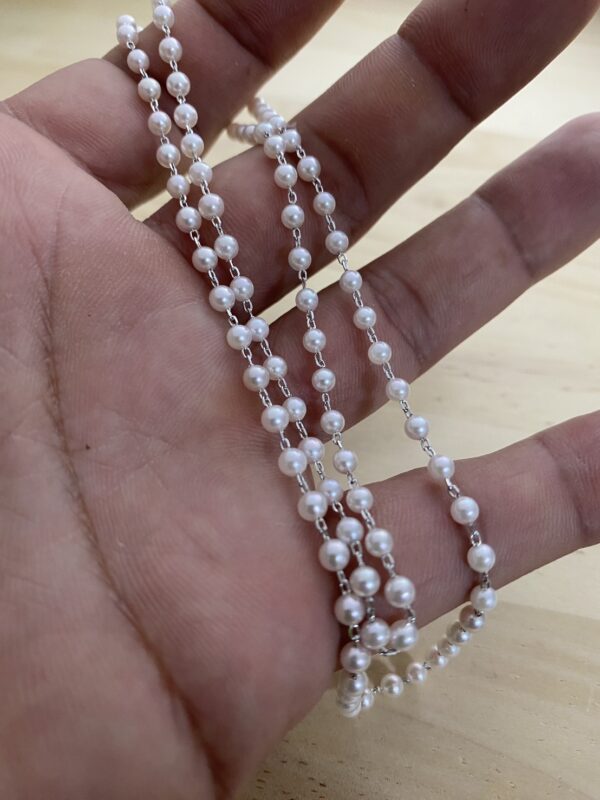
However, as mentioned earlier, a problem arose where the pearls and chains came apart.
It was Hiromi who came up with the solution.
Using thicker wire, twisting the wire—looking back now, it seems simple, but at the time, I just couldn’t think of it.
When this necklace was in its strand form, the pearls had a somewhat thin nacreous layer; while the quality wasn’t bad, it wasn’t a particularly attractive strand.
However, the moment the chains were attached between the pearls, it instantly became an elegant and lovely necklace.
Hiromi often said, “If it’s this cute, I want one for myself,” as she made it.
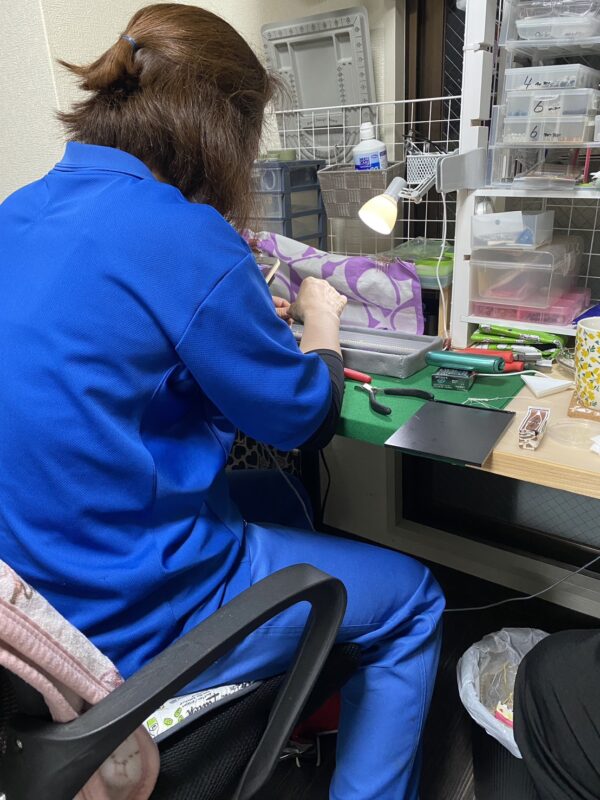
After completing the initial production of the necklaces, we spent about a month on trial and error, improvements, and strength tests before finally being able to offer it for sale.
“I’d like to make this someday when I have time.”
While I was working on other pearls, Hiromi diligently made this necklace for me, something I’d always thought about.
Incidentally, Yuya helped by cutting the silver chains into two-link sections.
I plan to have Yuya help me with metalworking instruction in the future.
They come to my house to work every Monday and Tuesday evening from around 6 to 9 pm.
They are generally focused on their work, but sometimes they chat happily, and when I’m live streaming,
they quietly say “See you tomorrow” and wave goodbye.
I received the necklace that Hiromi had made, and I cut the 70cm necklace into 20cm and 50cm pieces,
and attached clasps to each.
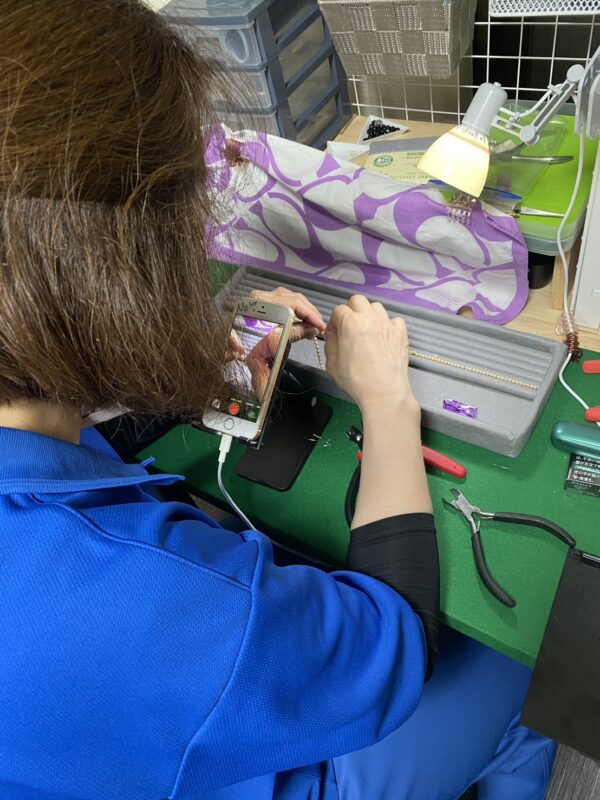
Hiromi murmured, “This is cute.”
However, she had a somewhat sad look on her face.
“I wonder who will wear this necklace? I hope they cherish it. Because I painstakingly attached each pearl and chain myself.”
She initially made it with thin wire, and then remade it from scratch with thicker wire.
She seems to have grown quite attached to this necklace.
Thanks to her continued work on this necklace, her work pace has increased considerably. She has already completed her second necklace and started on her third.
Simply put, we’ve named her pearl products the “Hiromi Collection.”
Hiromi named this first necklace and bracelet “SAKURA.”
She seems to love flowers, and has decided to name all her pearl products after flowers.
Since the shop’s name is Flower Jem, I thought flower-themed product names were a perfect fit.
That concludes the description of the pearl products.
This seems to have turned into more of a description of the process leading up to the completion of this necklace and bracelet than a product description.
As mentioned earlier, Flower Jem is still a small shop that cannot stand on its own.
It’s a very slow process, but I aim to make Flower Jem self-sufficient.
That’s probably why the product description turned out this way.
Furthermore, for better or worse, Flower Jem’s pearl products lack a defined characteristic or concept, and it seems unlikely that one will ever be established.
Many of our pearl products are created based on customer requests and custom orders.
To borrow the words of a customer who has recently become like a friend, Flower Jem is a “shop where you can participate in the creation process.”
And as in this case, the person actually making the product is not me.
It seems that whoever designs and conceives the product, or who makes the pearl product, is not important to Flower Jem.
“Don’t you have any ambition or conviction?”
Hmm, do I have such a thing?
If I do, it would be to introduce beautiful pearls.
I want people who love pearls as much as I do to see the pearls that I find beautiful and lovely.
I often see women passing by on street corners happily chatting about flowers planted in people’s gardens, saying things like, “Oh, what pretty flowers,” and “They really are. They’re so well cared for.”
They are mostly women over 50.
However, to me, their expressions look like they’re in their 20s.
The way they appreciate beauty and share their feelings is truly beautiful.
Yes, the feeling is like arranging beautiful pearls in the garden of a house called Flower Jem, and having pearl lovers passing by stop and admire them,
If it becomes an opportunity for them to feel a little good, saying, “Oh, what beautiful pearls,” that would be a happy thing.
Of course, we’d also be delighted if someone said, “These pearls are so lovely, maybe I’ll buy the whole house!”
Perhaps I’ve summarized things a little too neatly this time.
“No, no, it’s not neatly summarized at all,”
I can almost hear someone saying that, but these are just my personal impressions.
Although these are facts, I feel like I’ve written a bit too much idealistically,
so let me write something realistic here.
If this set, Hiromi’s first work, sells well,
“The three of us will go out for Yakiniku (Japanese barbecue) to celebrate.”
So, Pearl Bless You
This space is not only for reviews. You are welcome to write freely about pearl jewelry, ask questions, or share what you feel when you see this piece. Member registration is required to submit your message.
Pearls & Stories
There are no stories yet.