Japanese Akoya Natural Color Pearl Stud Earrings, 9.2–9.7mm, Sterling Silver 925
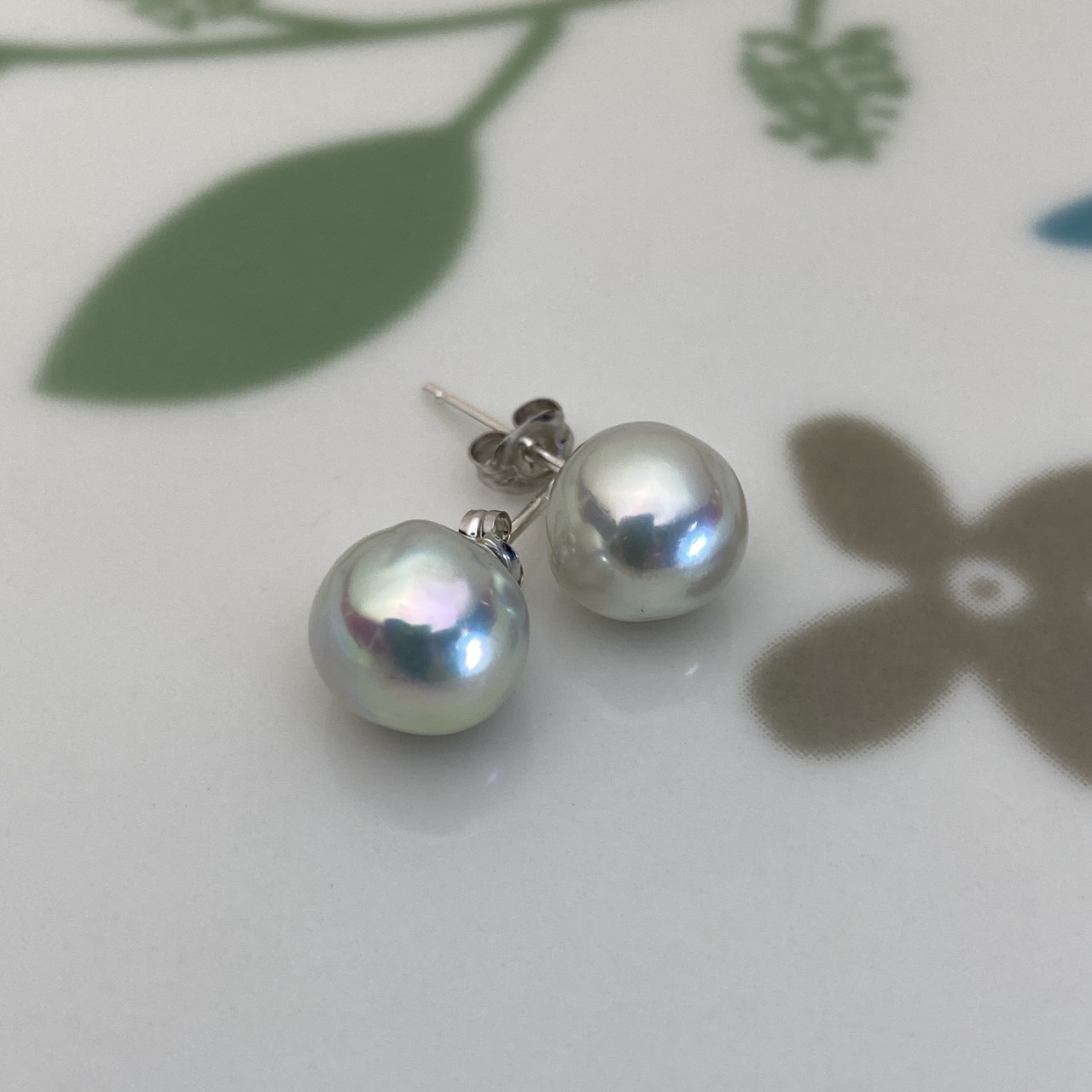
Dawn
$170.00
1 in stock
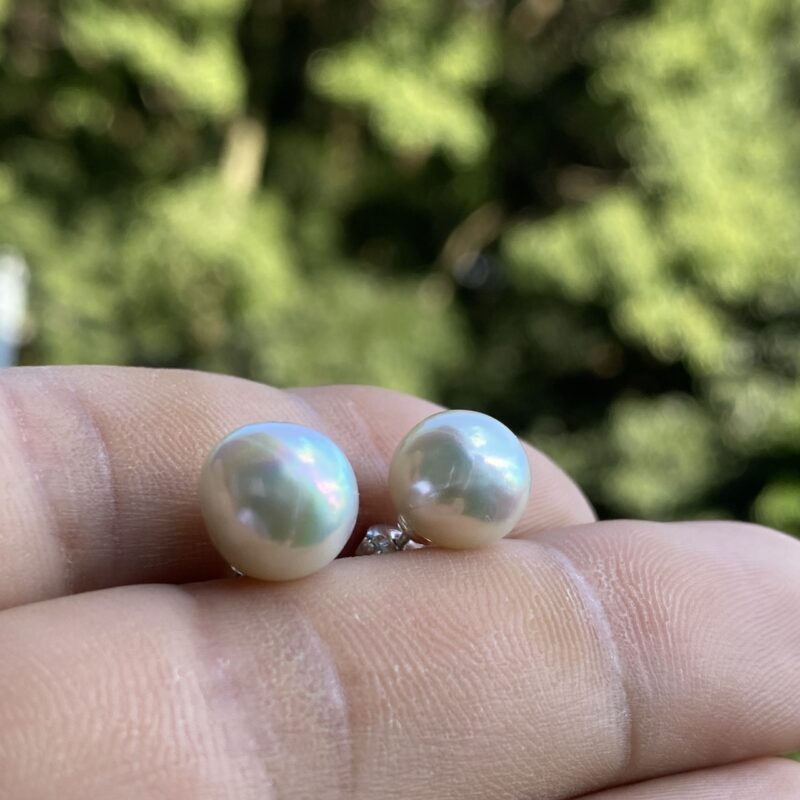
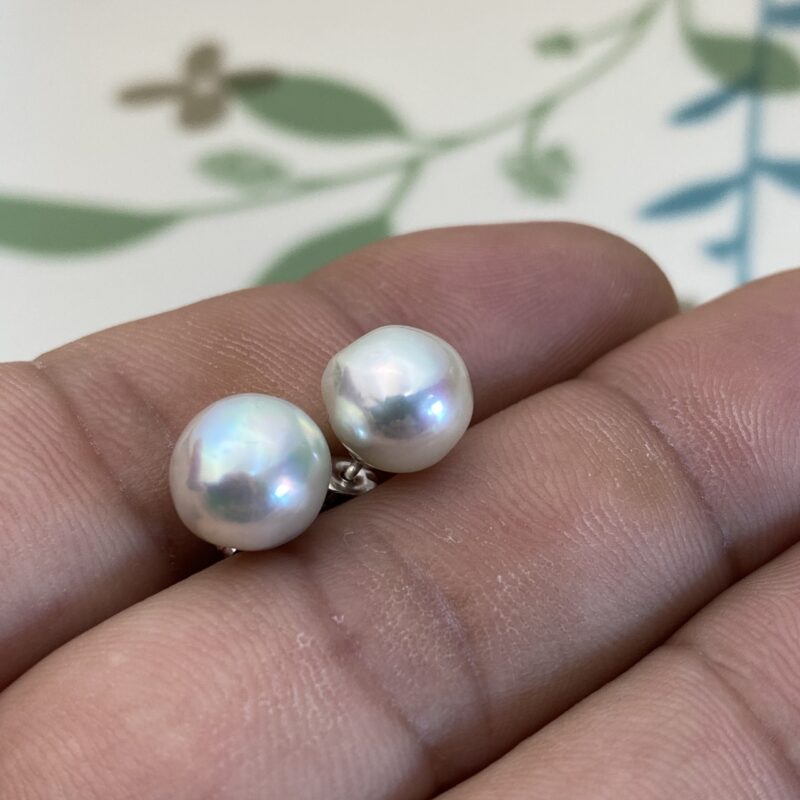
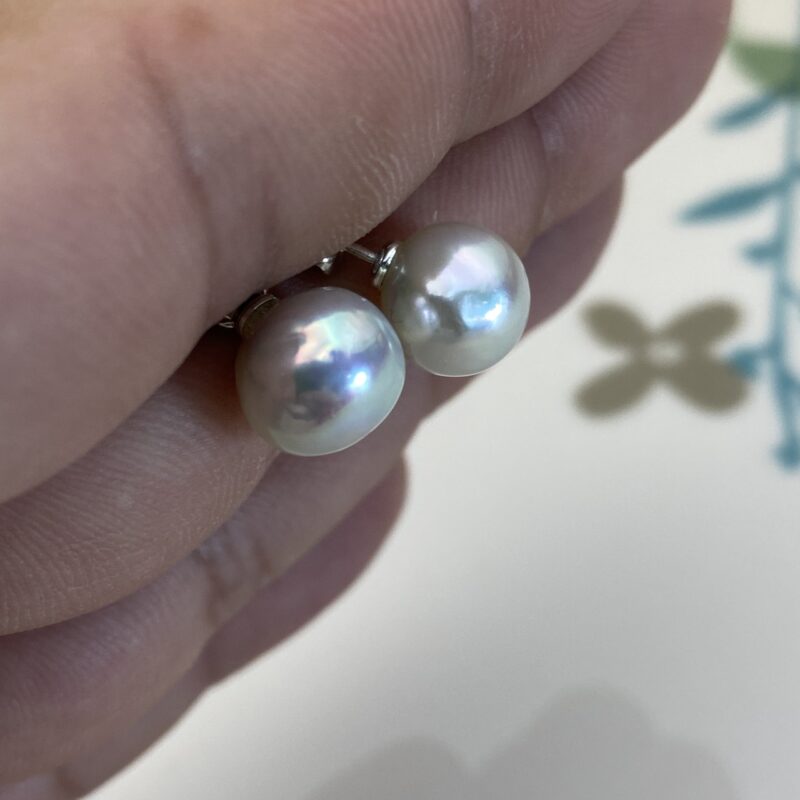
Dawn – What Color Are These Akoya Pearls?
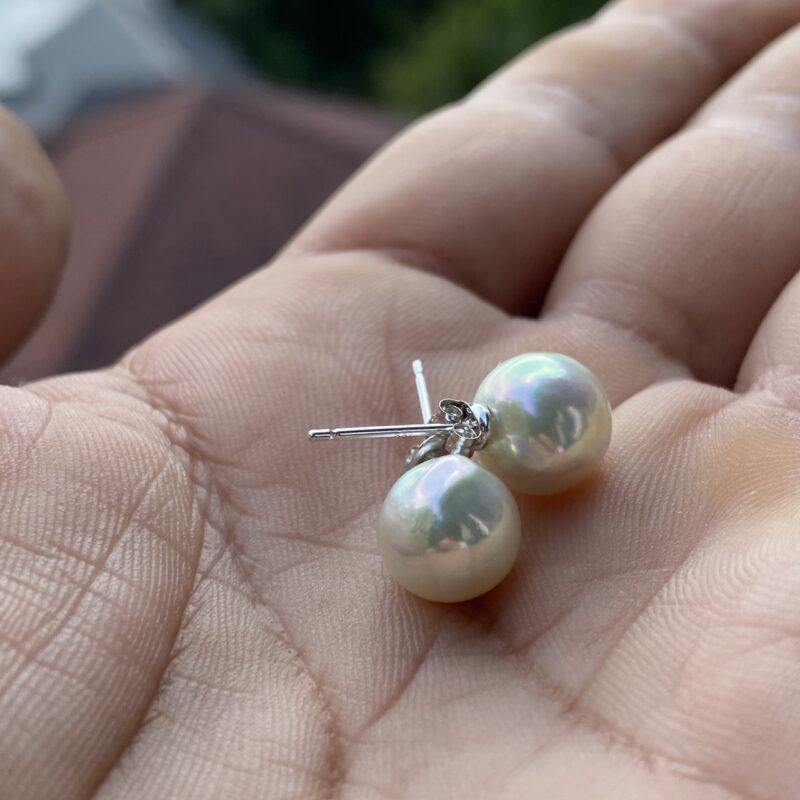
What color would you say these pearls are?
At pearl farms, we spend every year from December until early February sorting the pearls that have been harvested.
This is done to prepare them for auctions exclusively for pearls harvested that season.
In recent years, I have begun to wonder whether the auctions are scheduled around the harvest, or whether the harvest is scheduled around the auctions.
Anyway, pearls are sorted according to their luster, shape, and color.
Pearls with stains or blemishes are removed, as are pearls with colors other than white, such as cream, brown, red, or blue.
Strictly speaking, freshly harvested, completely untreated pearls tend to have a slightly yellowish appearance. But for convenience, I will refer to them as white pearls here.
Round pearls are divided into more than a dozen different lots and graded from approximately Grade 1 to Grade 7.
Naturally, they are also separated by size, usually from around 5 mm to 9 mm.
Baroque pearls are graded in much the same way.
Pearls with thin nacre are also collected and sorted separately.
Even within this thin-nacre group, the pearls are subdivided into lots with relatively thick nacre, medium nacre, and extremely thin nacre.
Some have so little nacre that they are practically nuclei rather than pearls.
Each of these groups is then graded separately.
Colored pearls undergo the same process.
Among the colored pearls gathered from various lots are my beloved blue pearls.
The darkest blue pearls were classified as “Black,” while the next lighter blue pearls were called “Silver.”
Even within the Black category, the pearls were divided into Black 1, Black 2, and Black 3, according to the depth of their color.
Each group was then graded from approximately Grade 1 to Grade 4.
Because colored pearls represent a relatively small proportion of the total harvest, they were generally divided into fewer grades.
Now, let me explain how the actual sorting process works.
Strictly speaking, pearl sorting is not about actively picking out the most beautiful pearls.
It is more about removing pearls that do not meet a particular standard.
For example, when creating a first-grade lot, we begin with pearls that should have the strongest possible luster, no blemishes, and perfectly round shapes.
We then examine the pearls one by one, removing those that fail to meet these standards.
A pearl might have wonderful luster but a slightly irregular shape.
Another might be perfectly round but have a small blemish.
These pearls are removed from the first-grade group.
The pearls that remain eventually form a relatively uniform lot of the highest quality.
Then we take the pearls that were removed and repeat the process using slightly less demanding standards.
This creates the second-grade lot.
We continue repeating this process to create the third grade, fourth grade, and so on.
You might wonder how we decide when to stop.
Actually, it is quite simple.
“If we remove a few more pearls from this lot, the remaining pearls will become an even more beautiful and uniform group.”
Whenever we think that, we continue sorting.
But eventually, we reach the point where we think:
“There’s really nothing more we can do by sorting these pearls again.”
And that is when we stop.
Let me explain with an example.
Imagine there are 100 students.
Our goal is to create a group of outstanding students.
The making of all six pairs of earrings, including this pair, was livestreamed. Feel free to watch if you’re interested in seeing how they were made.
Rather than searching for the 10 best students and picking them out, we begin by removing everyone who does not meet the highest academic standard.
Suppose 90 students are removed.
The 10 students who remain form our first group of outstanding students.
Now we turn our attention to the 90 students who were removed.
Among them, there are still students who may not be at the very top but are nevertheless quite talented.
So once again, we remove those who do not meet the next standard.
This time, 15 students remain.
They become our second group.
Now 75 students are left.
This video compares these earrings with five other pairs of earrings made at the same time.
Looking at them, we can still find students who are not exceptional but are above average.
So we repeat the same process, removing students who do not meet the next standard.
Eventually, we end up with groups of students whose academic abilities are relatively similar.
After repeating the selection several times, suppose we are left with around 20 students.
By this point, we might have a group of students who cannot read an analog clock, cannot do multiplication, or cannot read a map.
In other words, a group of students who are absolutely hopeless at schoolwork.
At that point, we would say:
“There’s really no point in sorting them any further.”
And that would be the end of the selection process for that particular lot.
Of course, not being able to read a clock or a map does not necessarily mean there is anything wrong with someone as a person.
When I was in junior high school, I fell in love at first sight with a girl one year older than me.
After three years of pursuing her, I finally managed to start dating her.
She was in her second year of high school at the time.
Even at the age of 16, she couldn’t read an analog clock.
When I discovered this, I remember thinking:
“This person is a genius.”
Anyway, that was quite a long introduction.
What I really wanted to talk about was the sorting of pearls by color.
When separating pearls into categories such as Black and Silver, there are inevitably pearls that fall somewhere along the boundaries.
Some lie between Silver and White.
Others fall between Brown and Red.
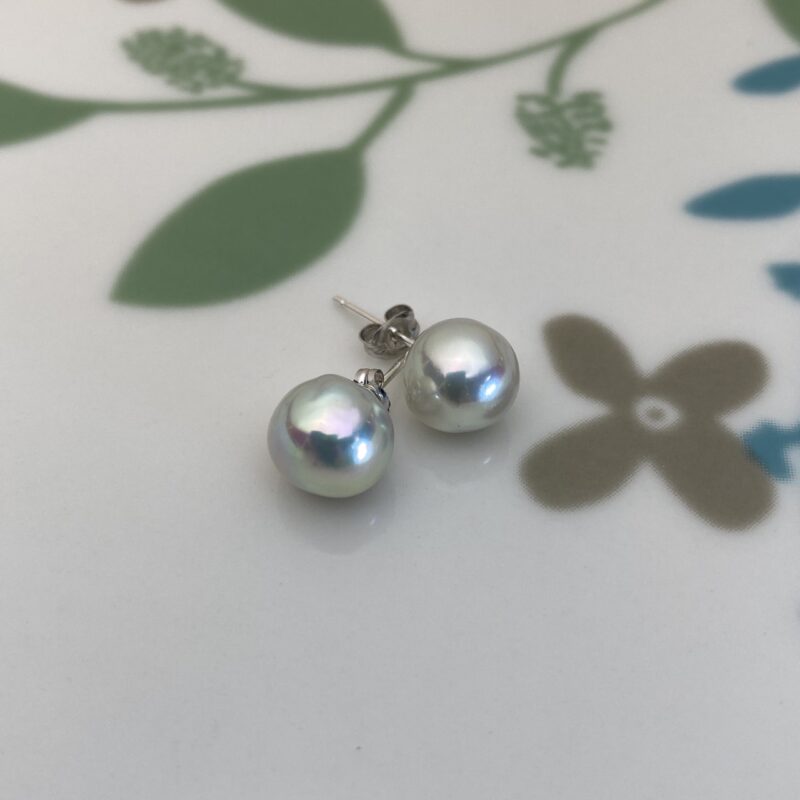
Their colors are so subtle that they could reasonably belong to either category.
When I first joined the pearl farm and was assigned to this kind of sorting, I found it extremely difficult.
The pearls looked completely different in the morning, at noon, at 2 p.m., and again at 5 p.m.
Pearl sorting is generally done using natural sunlight.
Not direct sunlight, of course, but in a bright room with plenty of windows.
In the morning, when the light is weak, the pearls look rather quiet and subdued.
But by around 2 p.m., they suddenly come alive.
The Dawn earrings were labeled “C” during the making process. Enjoy watching how they were made in the livestream video!
Their appearance improves so dramatically that you might think their quality has increased by two whole grades.
Then, as 5 p.m. approaches, the pearls begin to look a little dull and tired.
Rather like those of us who have spent the entire day sorting them.
With the light changing constantly throughout the day, sorting colored pearls can be extraordinarily difficult.
Eventually, even my supervisor would say:
“Oh, just sort them however you think is fine! Haha.”
Looking at the pearls in these earrings reminded me of those days.
“What color are you supposed to be?”
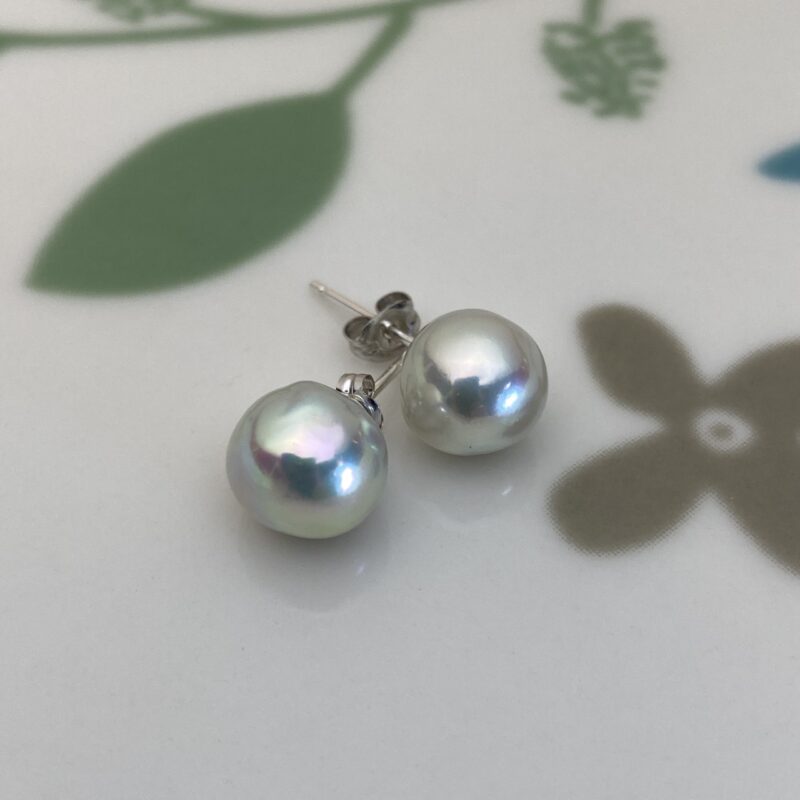
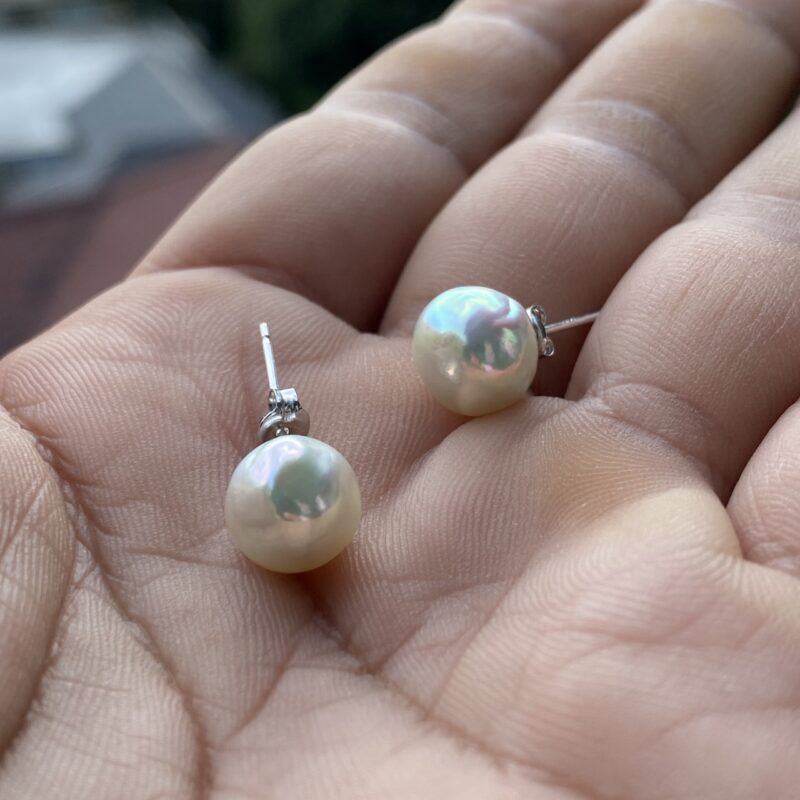
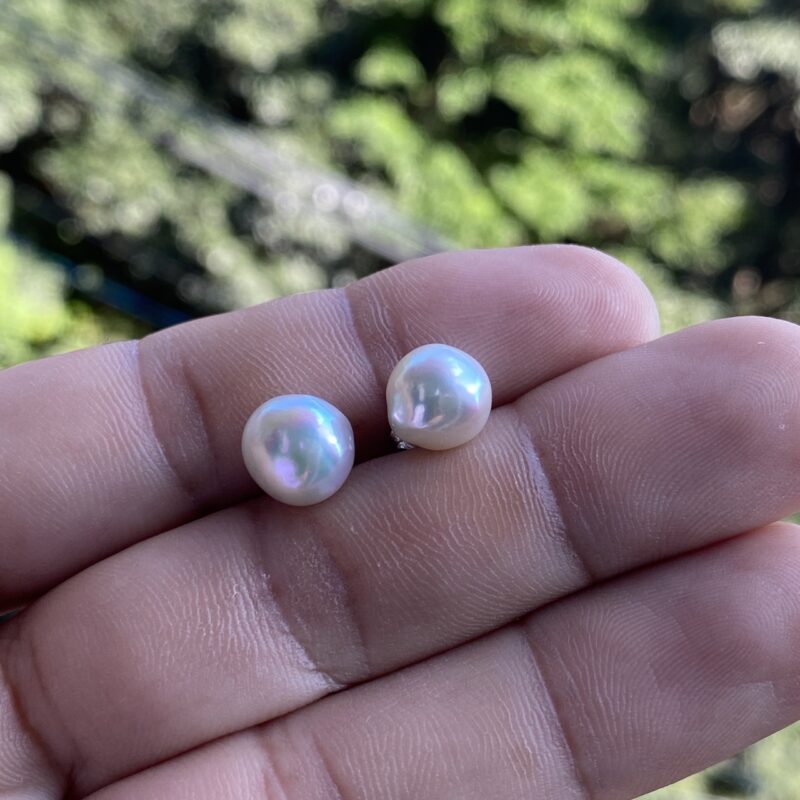
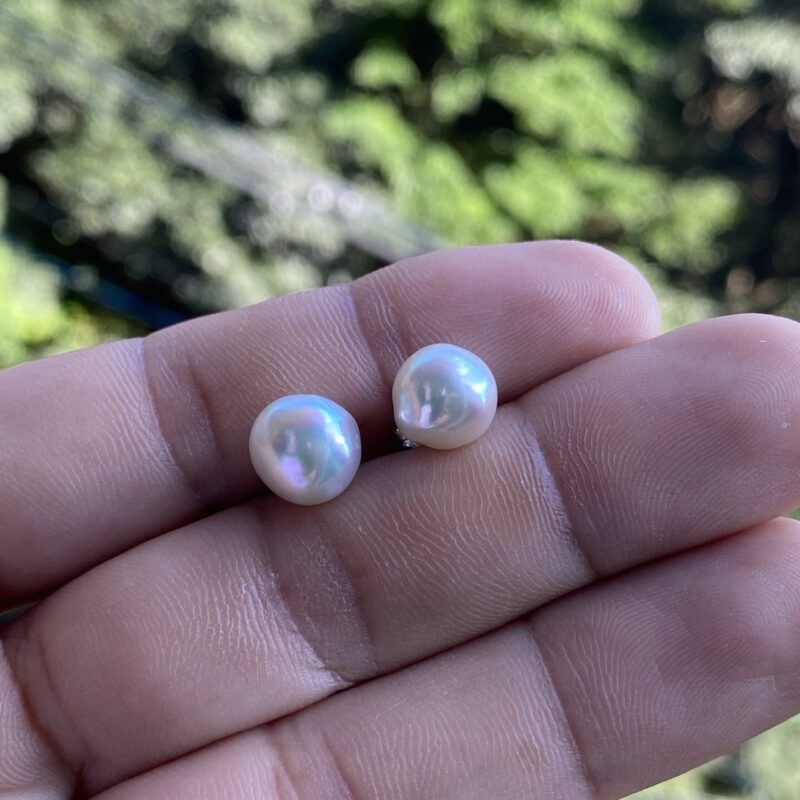
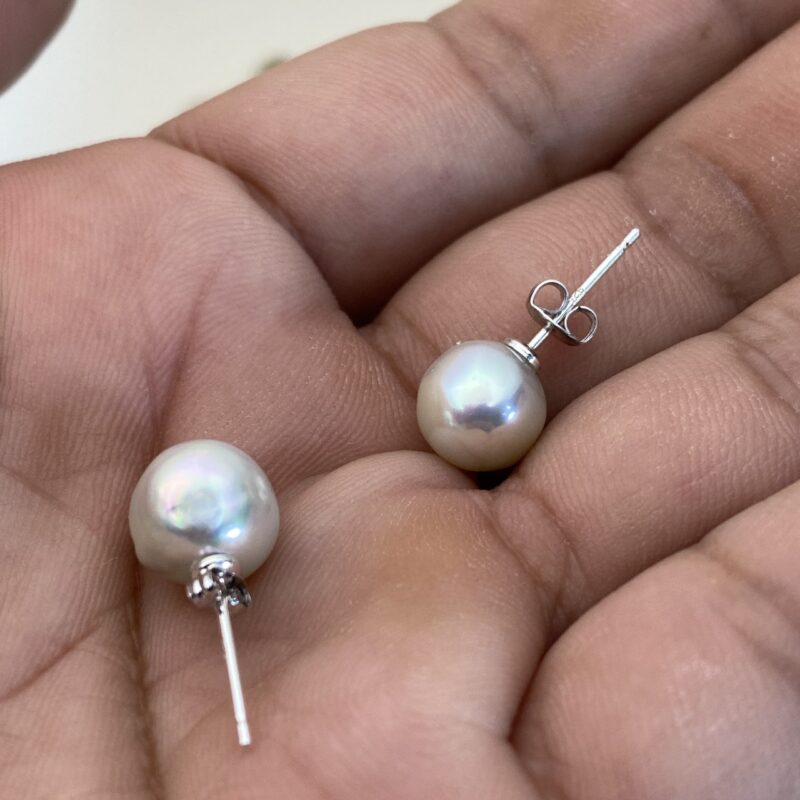
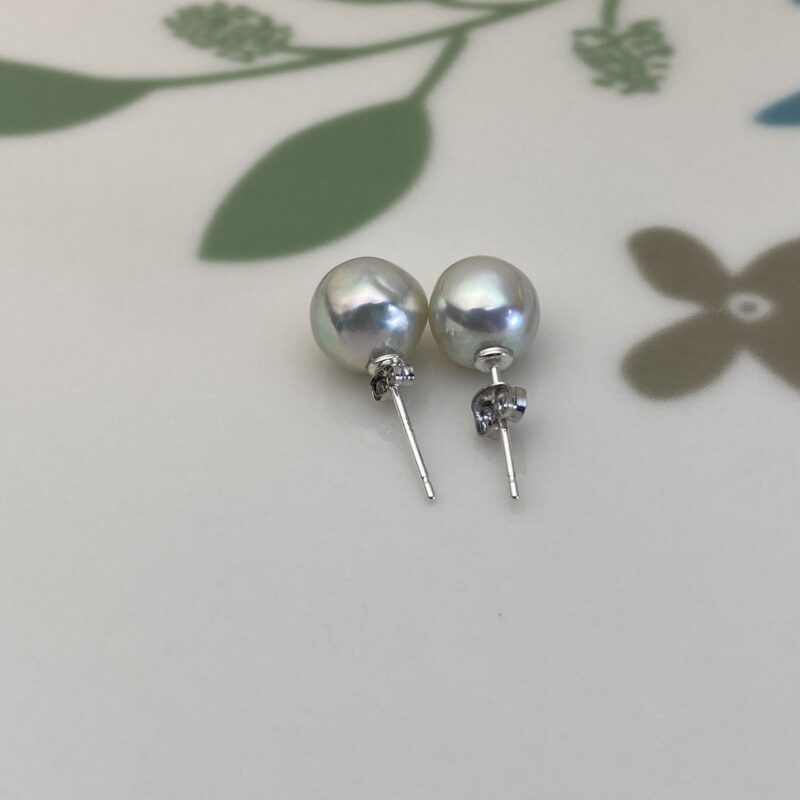
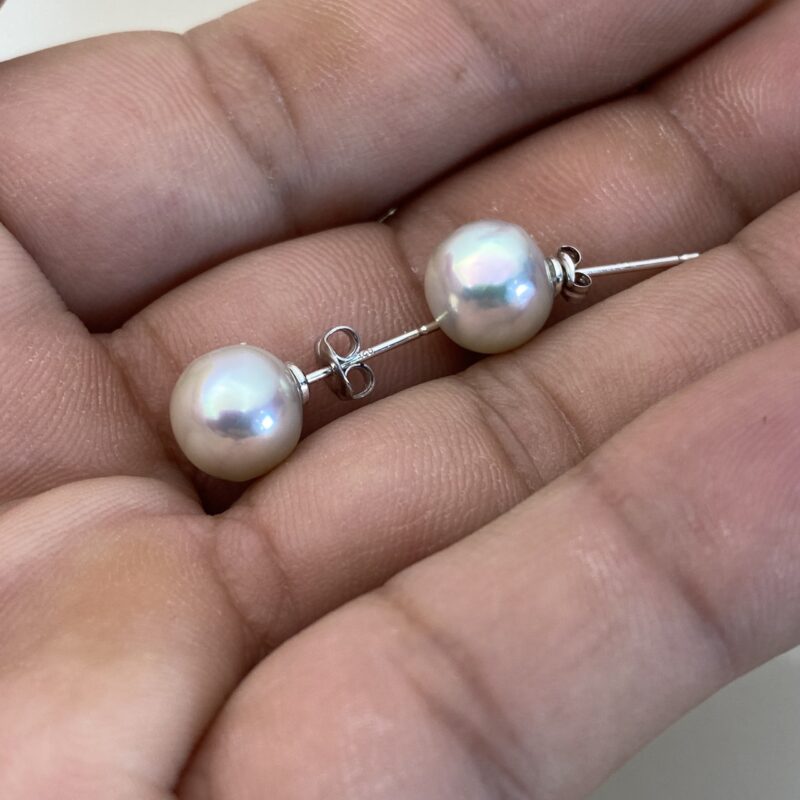
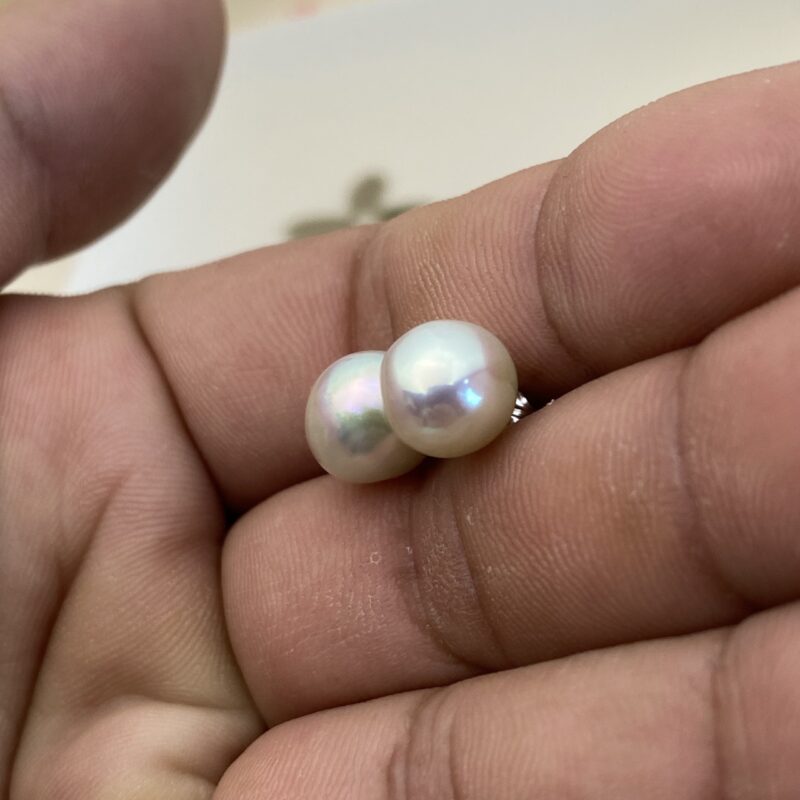
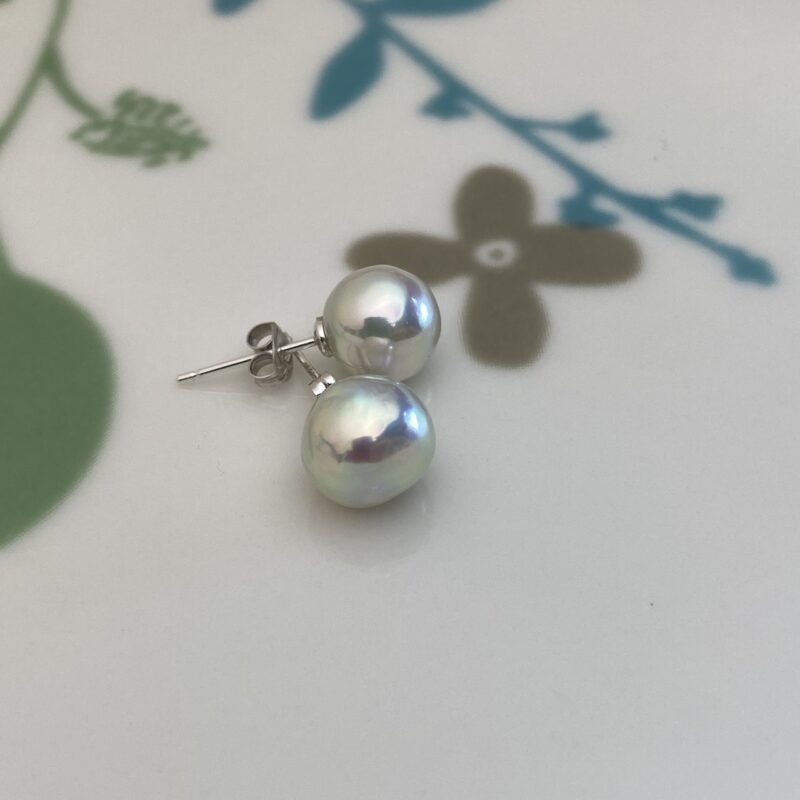
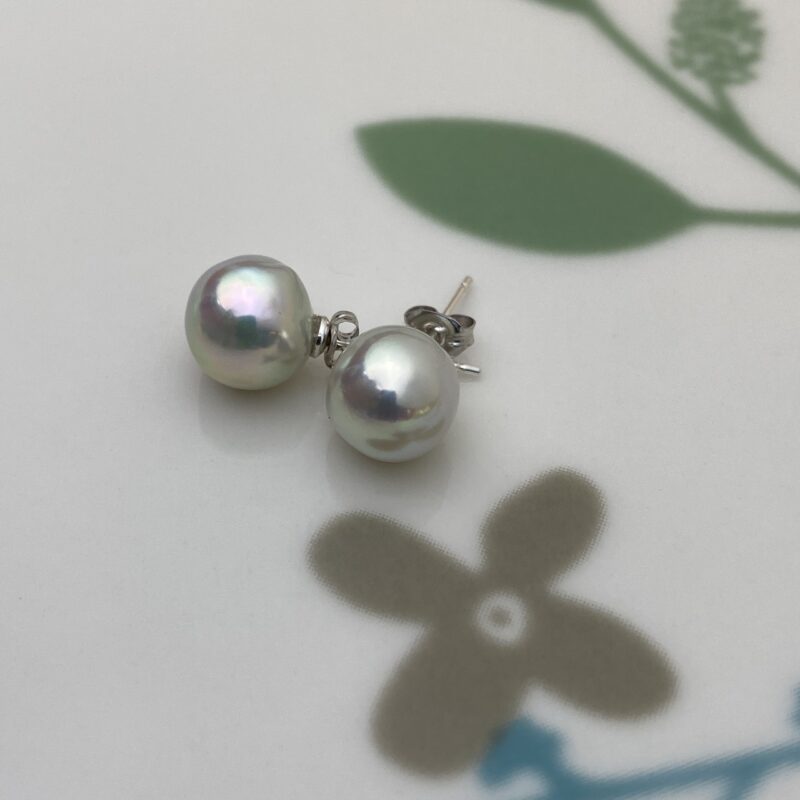
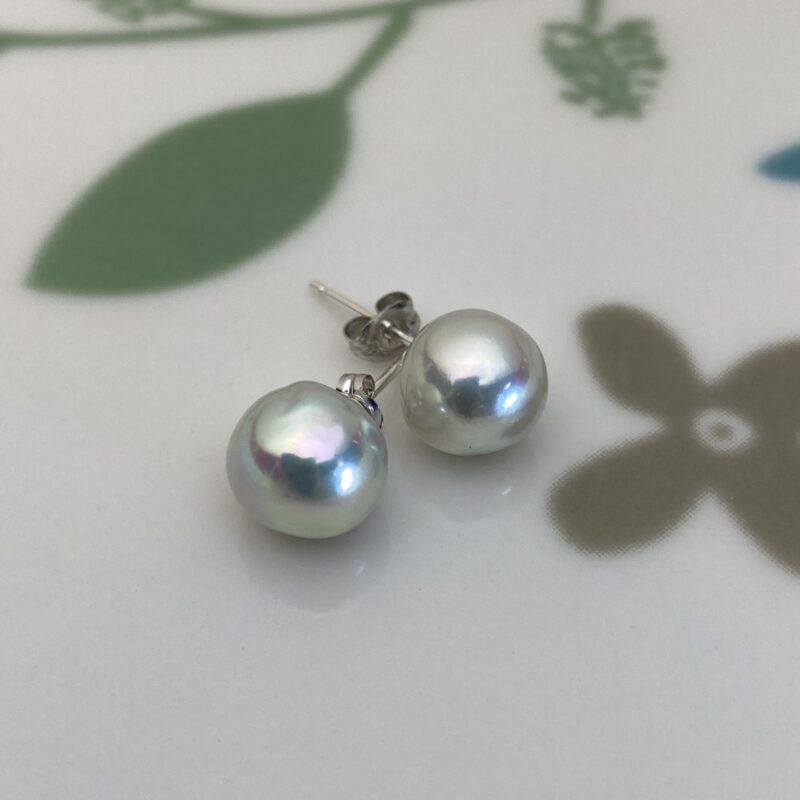
Their shapes are somewhat irregular, with little bumps and uneven surfaces.
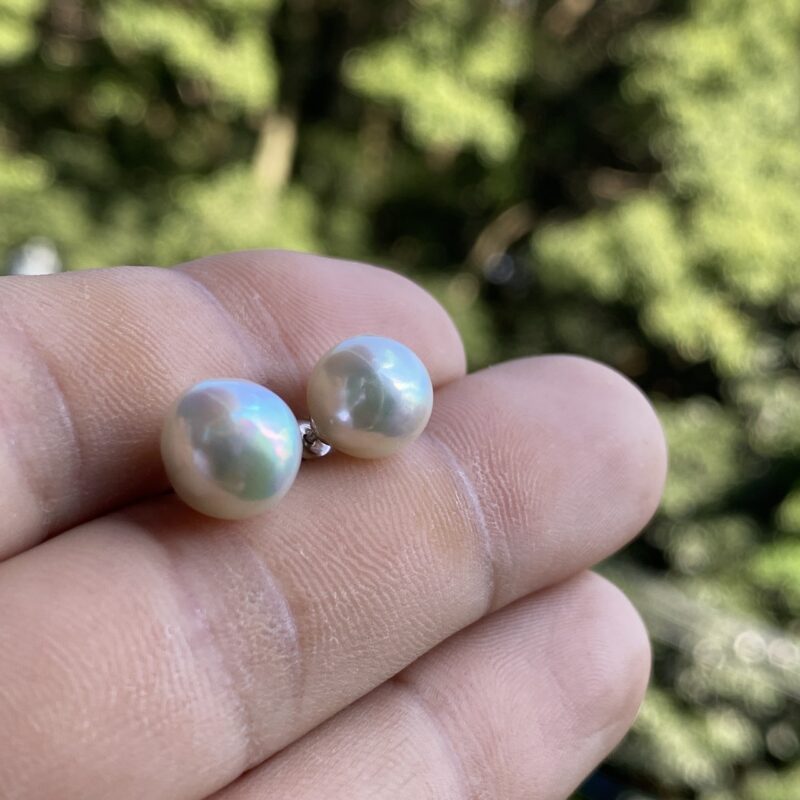
And yet, their surfaces are smooth, and they actually look a little more beautiful in person than they do in the photographs.
Perhaps I could describe their color as white-pink pearls gently draped in a delicate lace curtain of pale green or yellow-green.
It is such a difficult color to describe.
But it reminds me of the atmosphere just before sunrise, when the darkness of night gradually gives way to the faintest light of morning.
That is why I decided to call these earrings “Dawn.”
This video shows the photography process for each pair of earrings, as well as the video editing process. You probably don’t really need to watch this one, though. Haha.
🌸Pearl: Japanese Akoya Natural Color Pearl
Size: 9.2–9.7 mm
Color: Natural White-Pink with Subtle Green and Yellow-Green Overtones
Shape: Irregular, Near-Round
Surface: Smooth with Slight Irregularities
Treatment: Naturally Colored, Untreated
Metal: Sterling Silver 925 (SV925)
Style: Stud Earrings
🌸If you enjoyed this story, here are three more articles exploring pearl sorting, the subtle differences in Akoya pearl colors, and some fascinating behind-the-scenes stories from Japanese pearl farms.
Comparing Natural White Akoya Pearls from Tsushima and Ehime
Subscribe for Pearl Stories🐾
Receive occasional letters from my workshop —
stories about pearls, silverwork, Lulu the little dog, and quiet life in Japan.
As a thank you, you’ll get a secret code for 30% off —
usable every time you order, only here, not on Etsy.
I don’t send spam. Just little notes filled with love and pearls 💫
You can read our privacy policy for details.
This space is not only for reviews. You are welcome to write freely about pearl jewelry, ask questions, or share what you feel when you see this piece. Member registration is required to submit your message.
Pearls & Stories
There are no stories yet.