#I One More Turn
$2,100.00
1 in stock
8,928 characters.
One accidental revolution.
Approximately 12 minutes of your life.
’One More Turn’
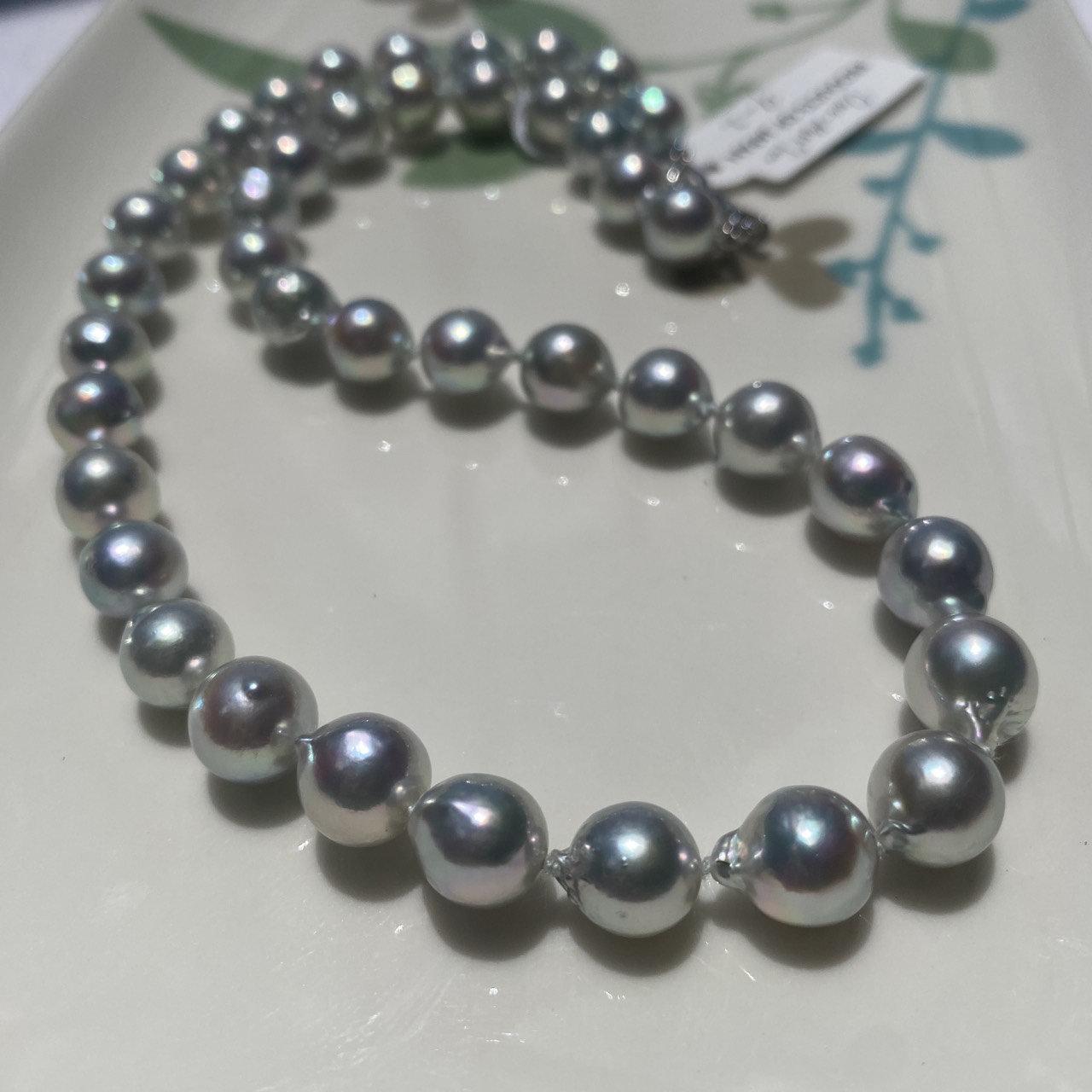
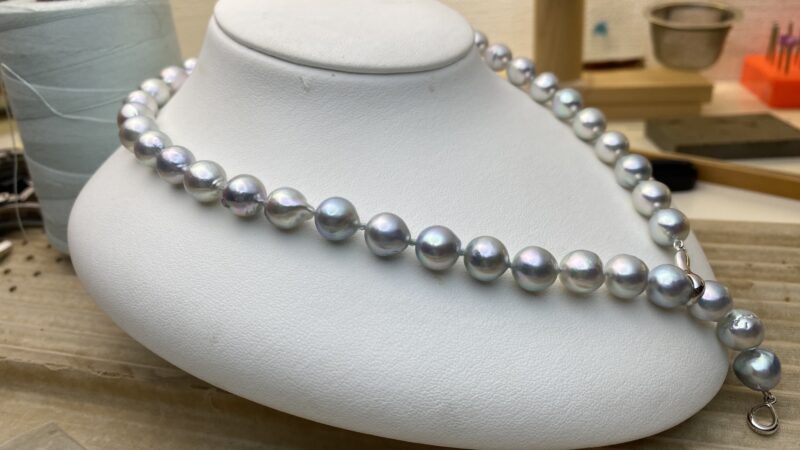
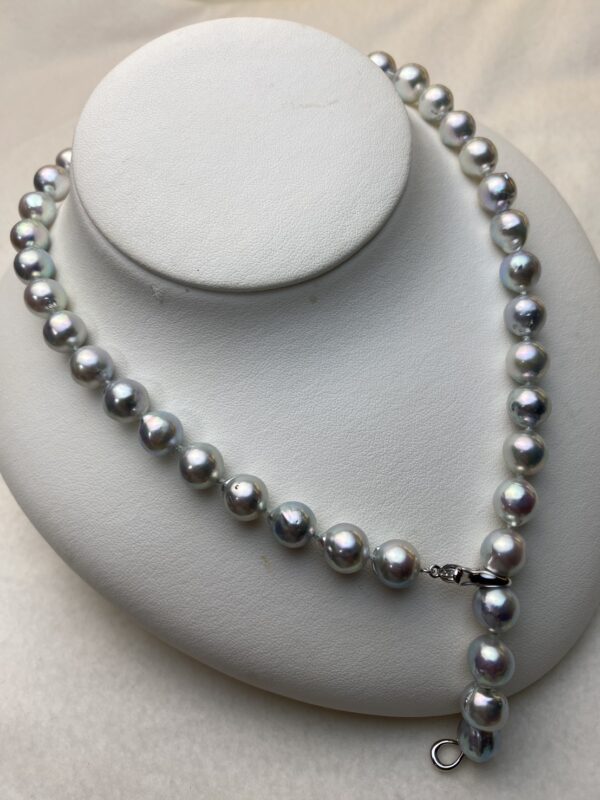
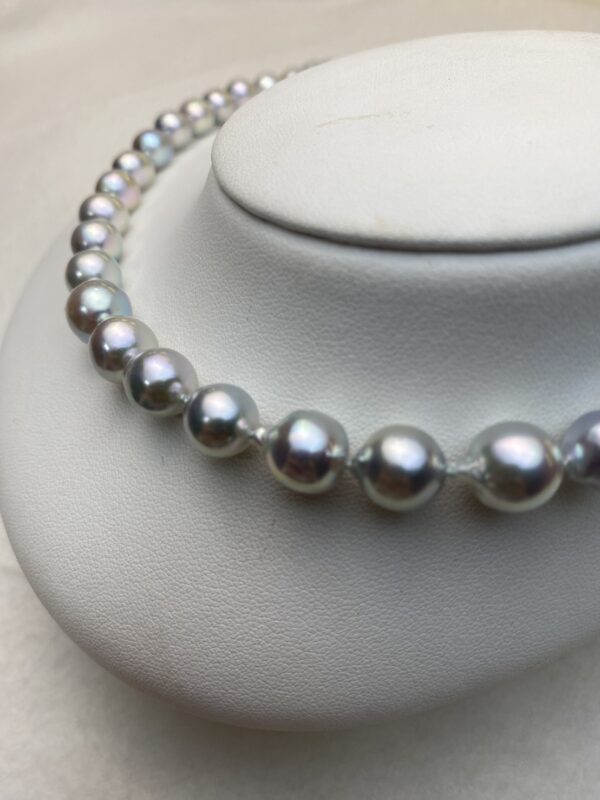
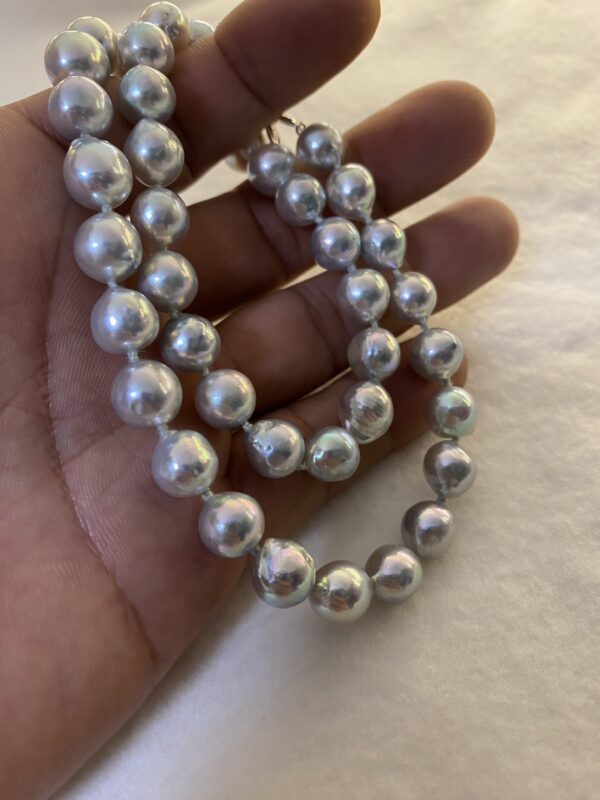
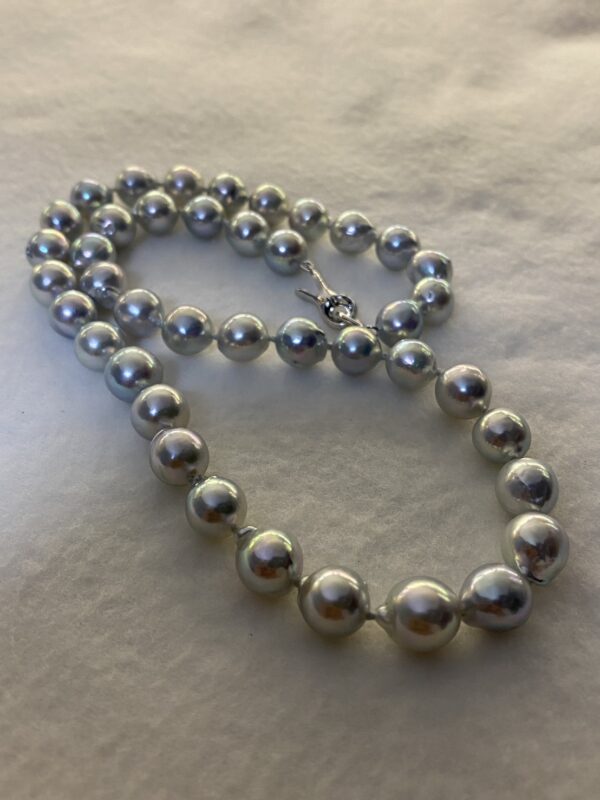
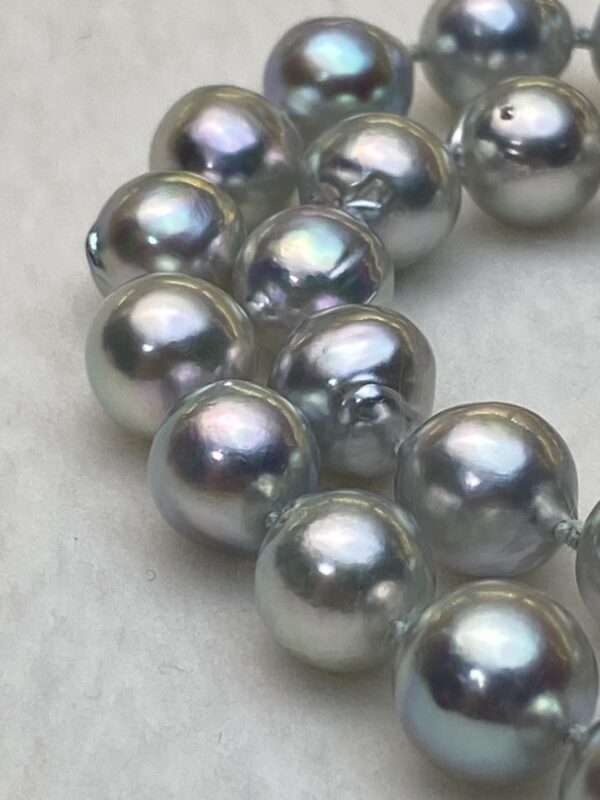
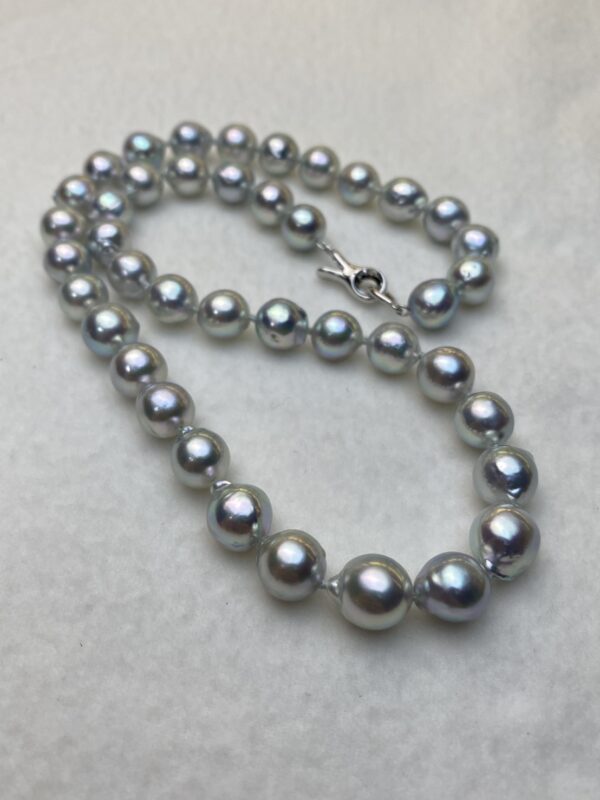
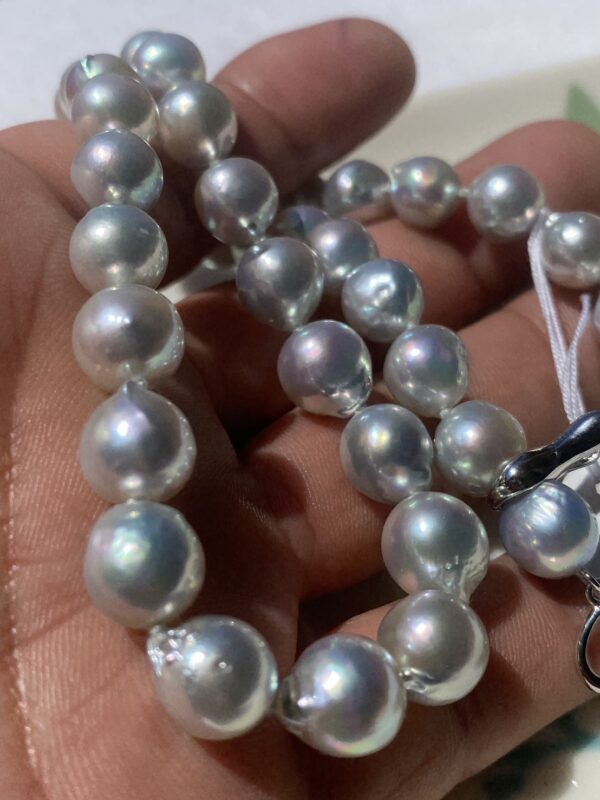
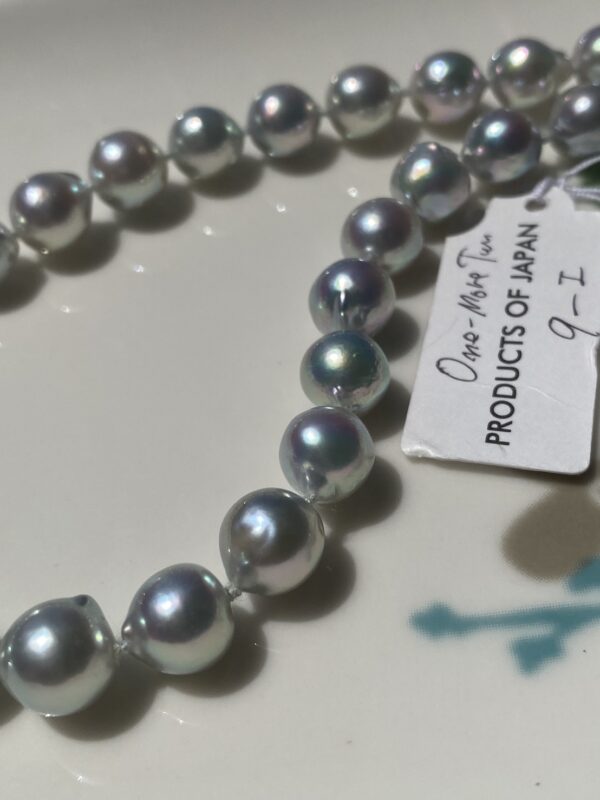
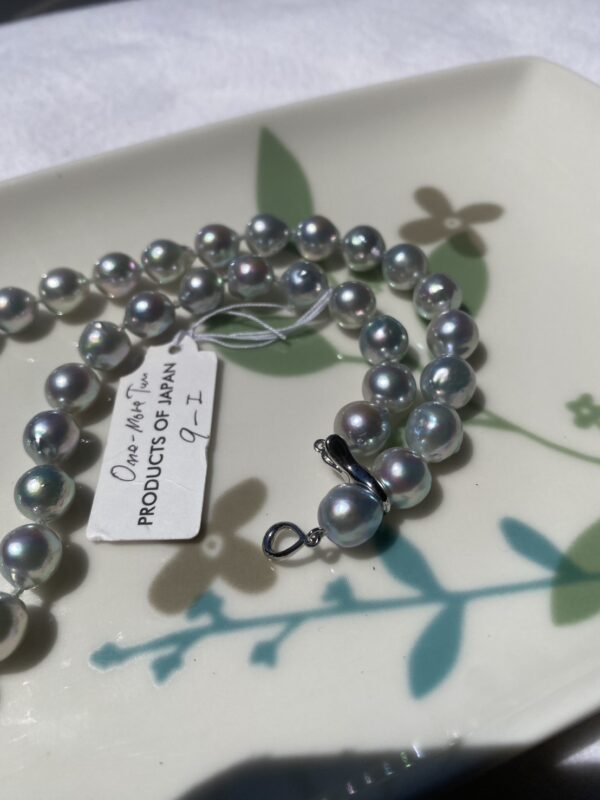
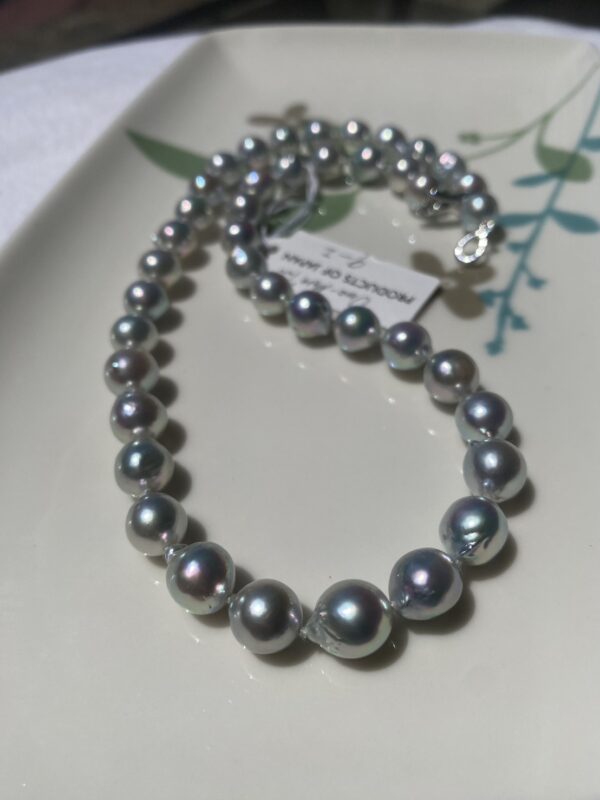
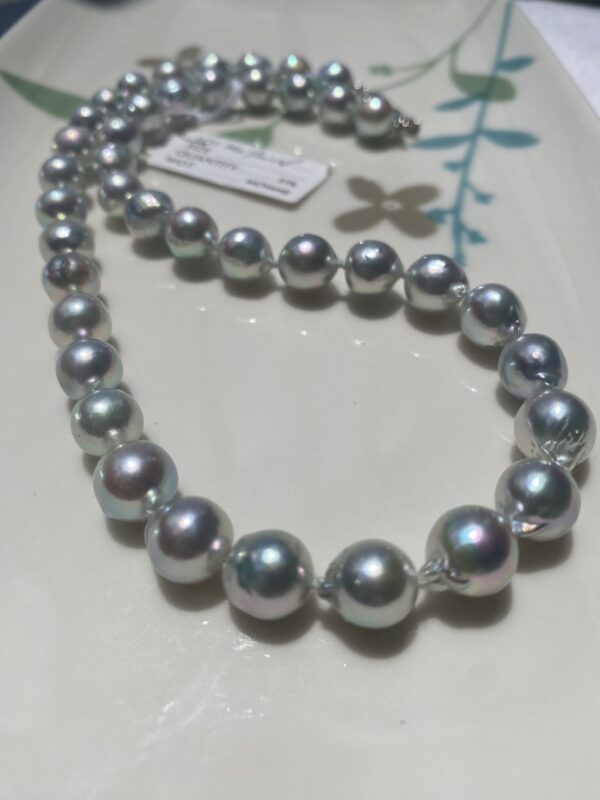
Akoya pearl necklace.
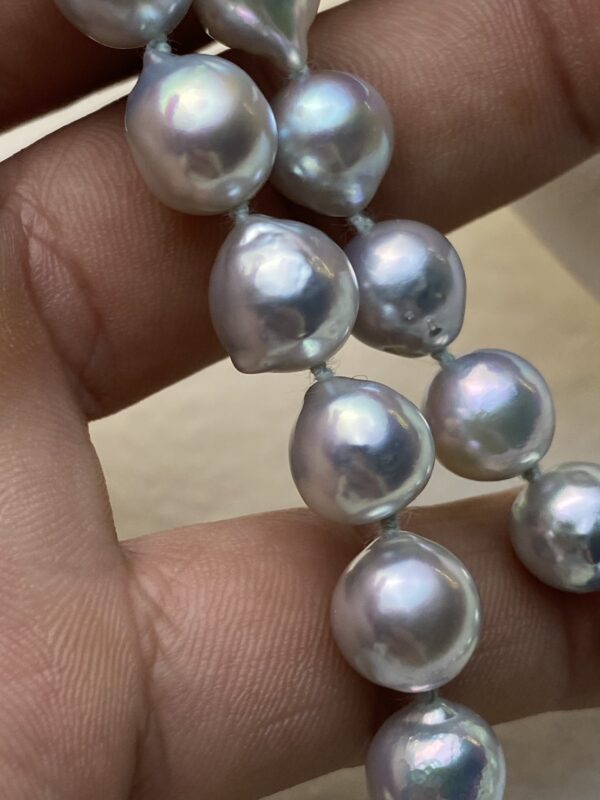
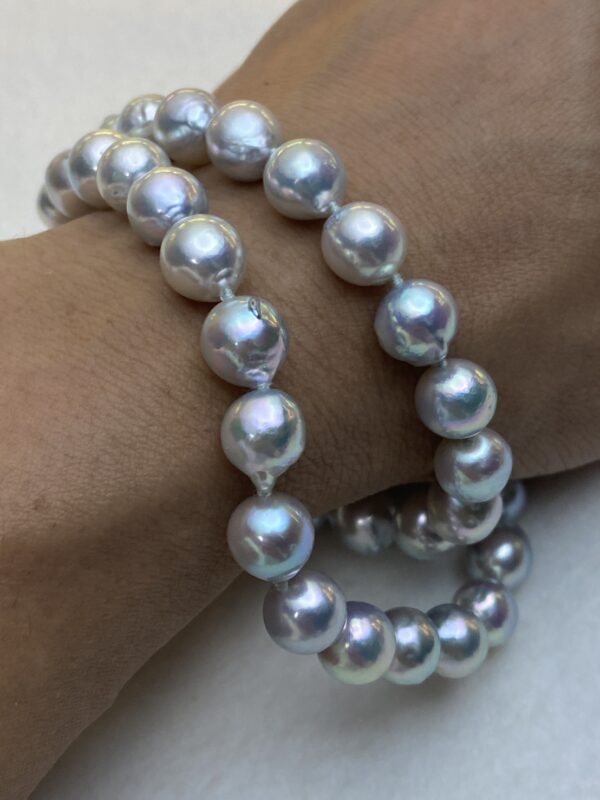
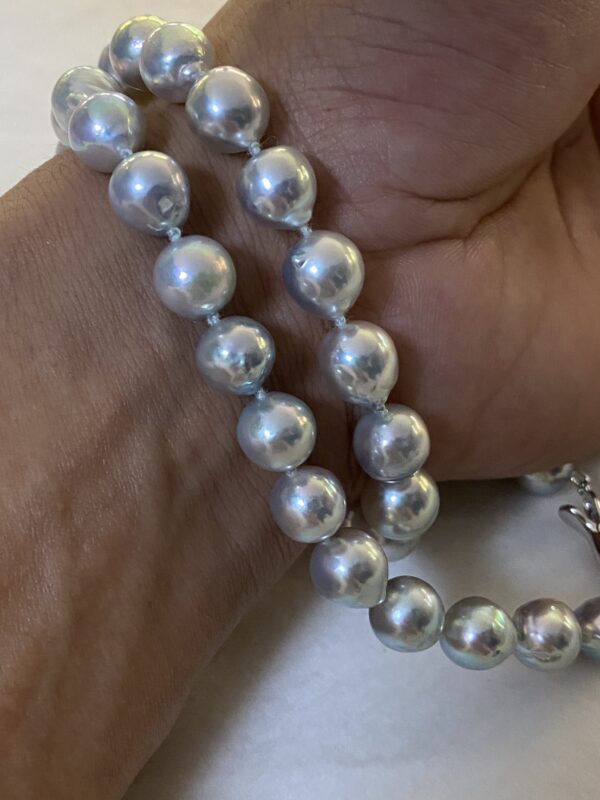
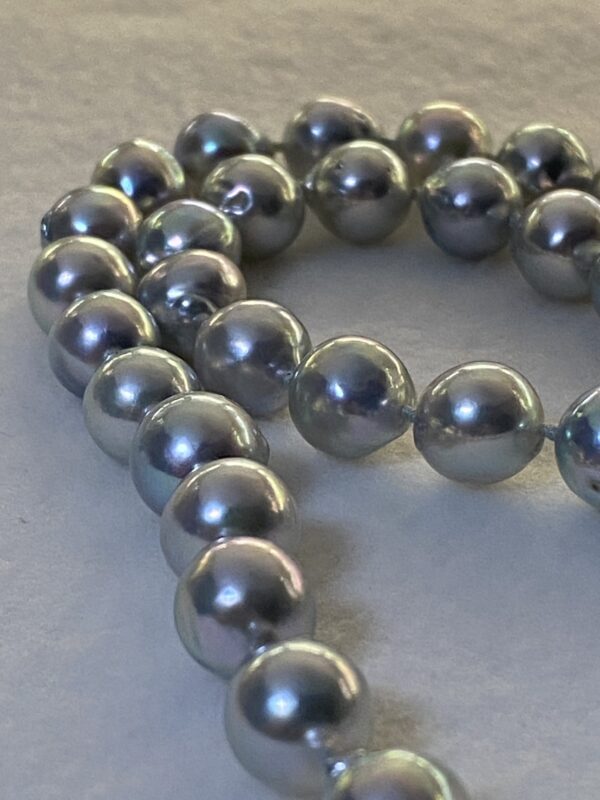
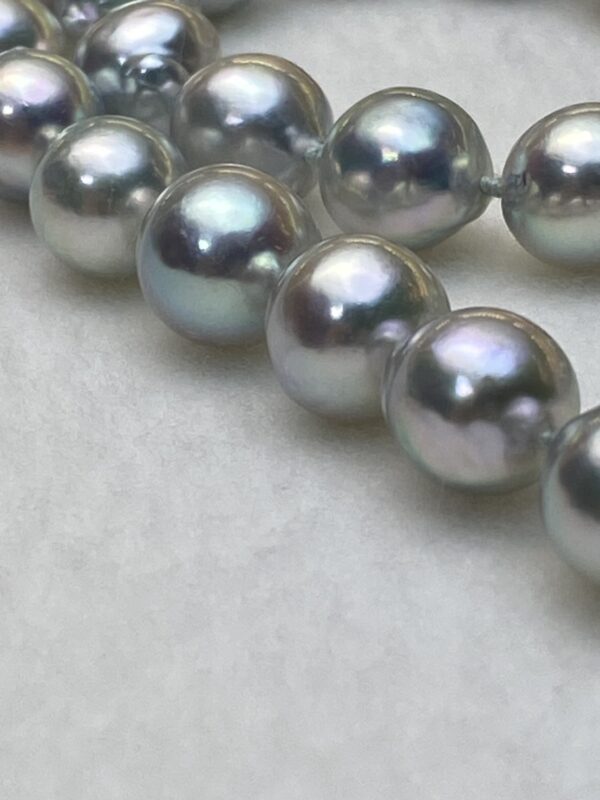
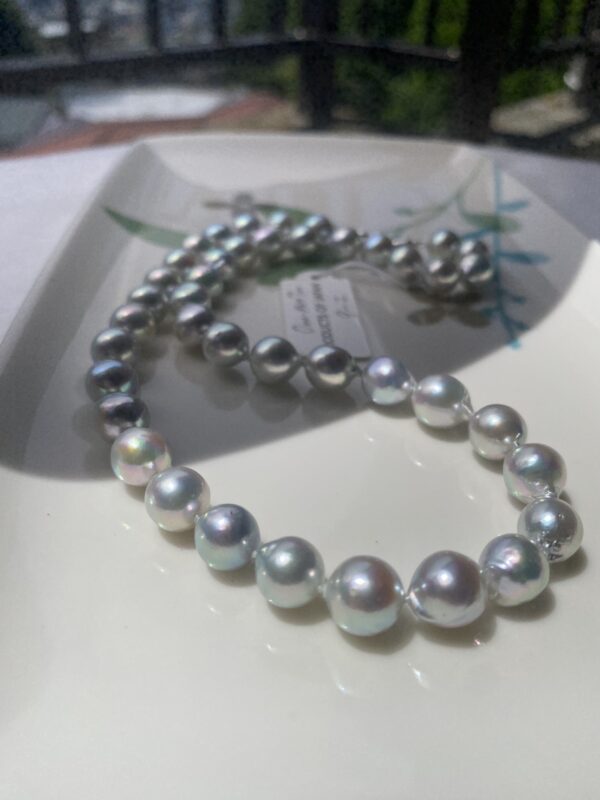
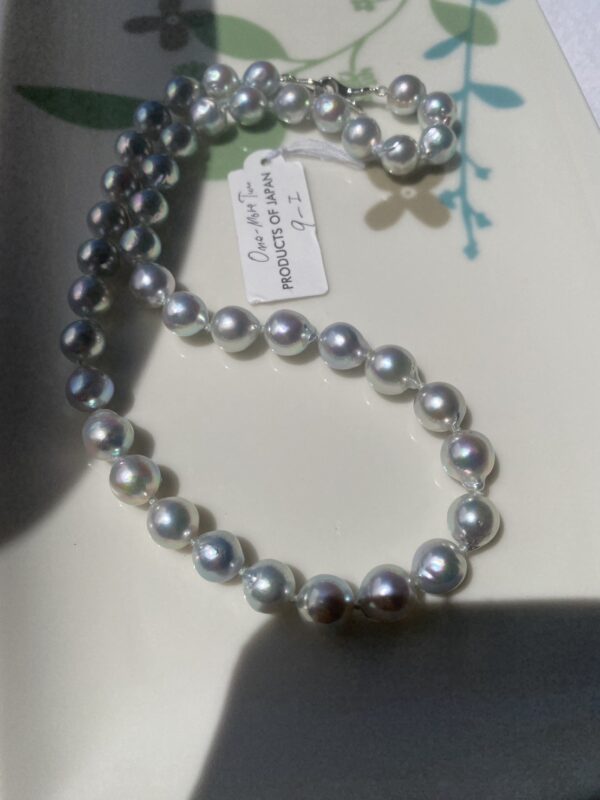
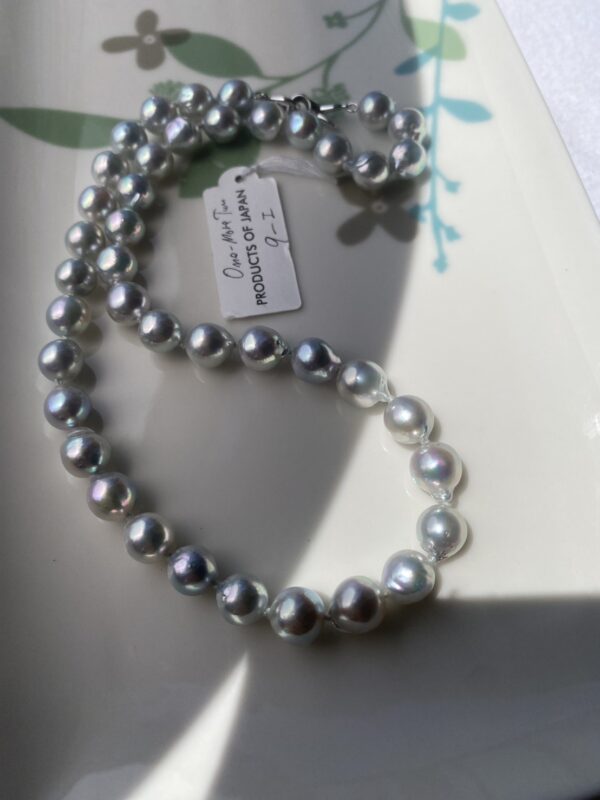
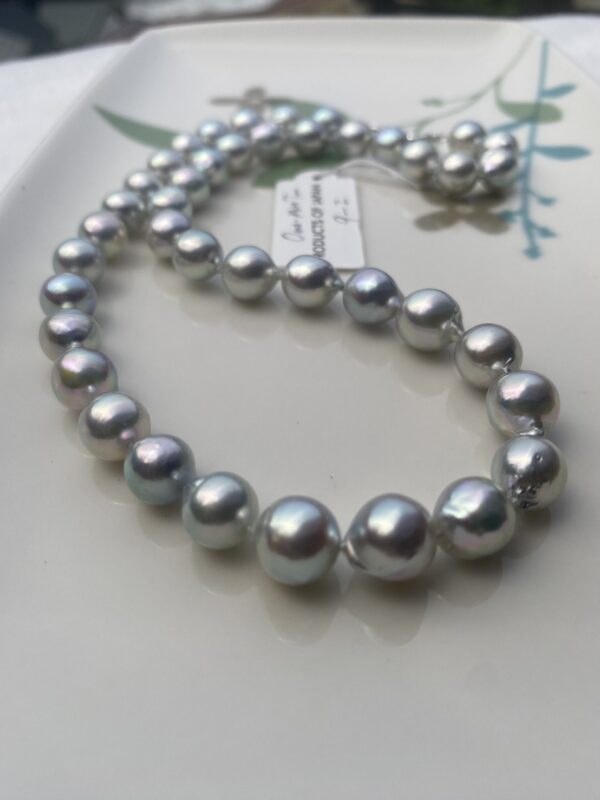
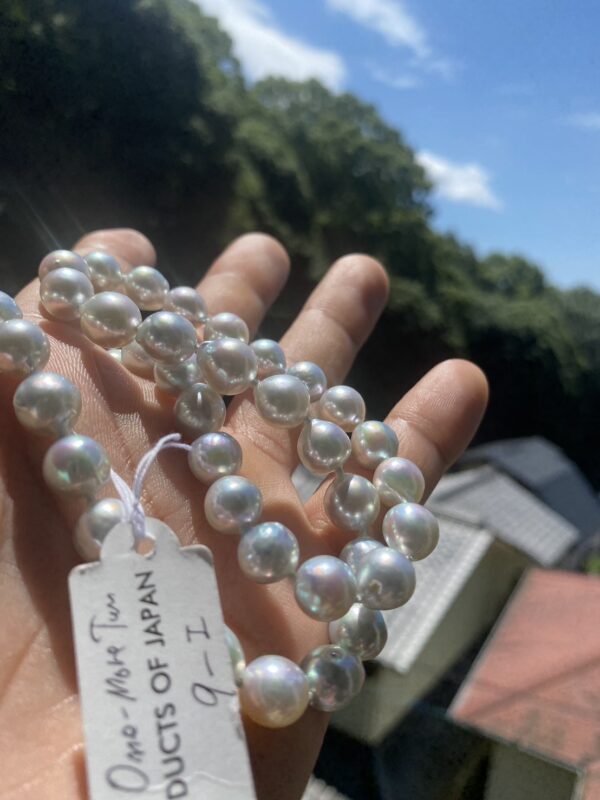
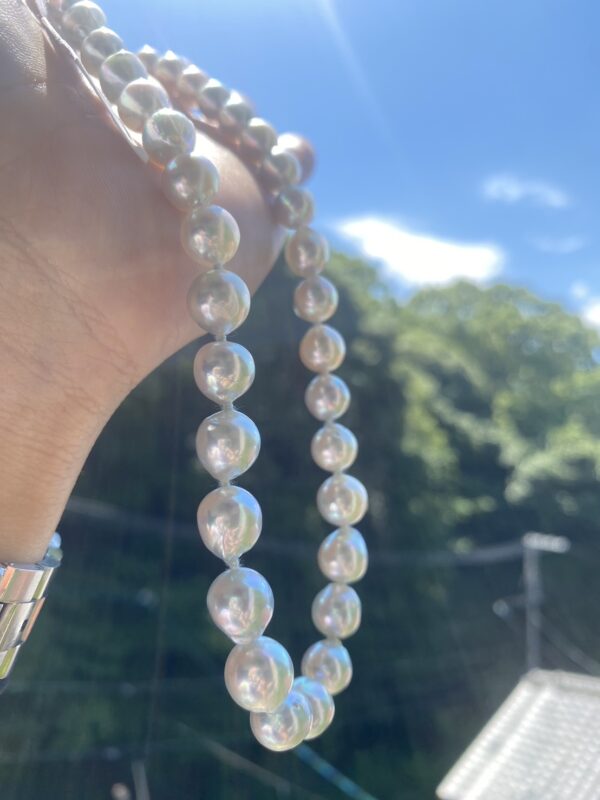
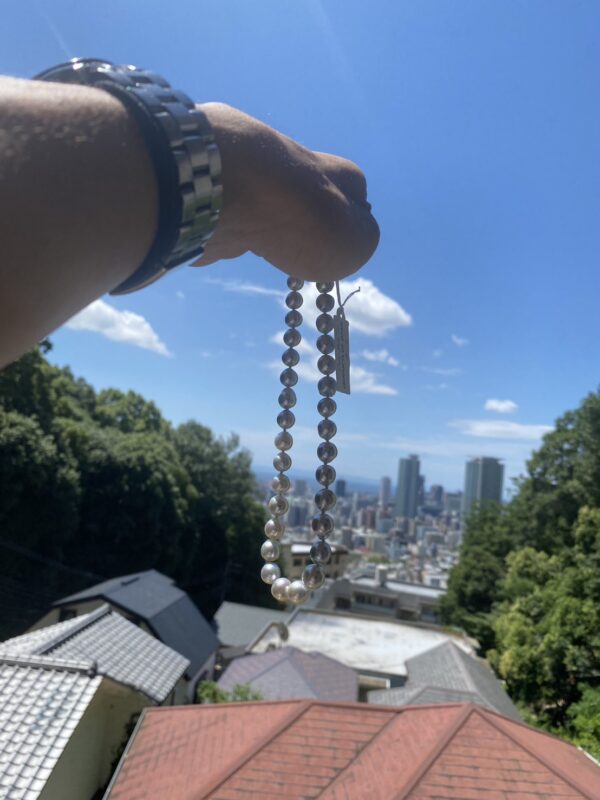
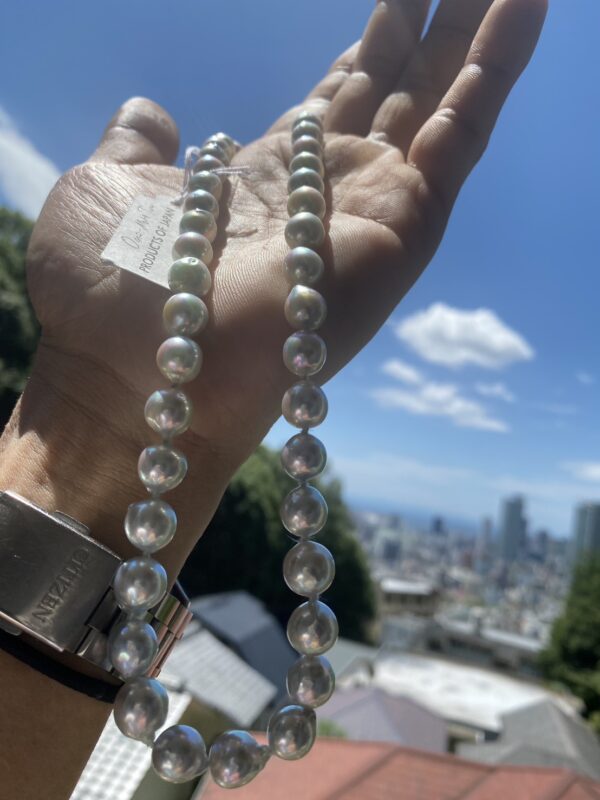
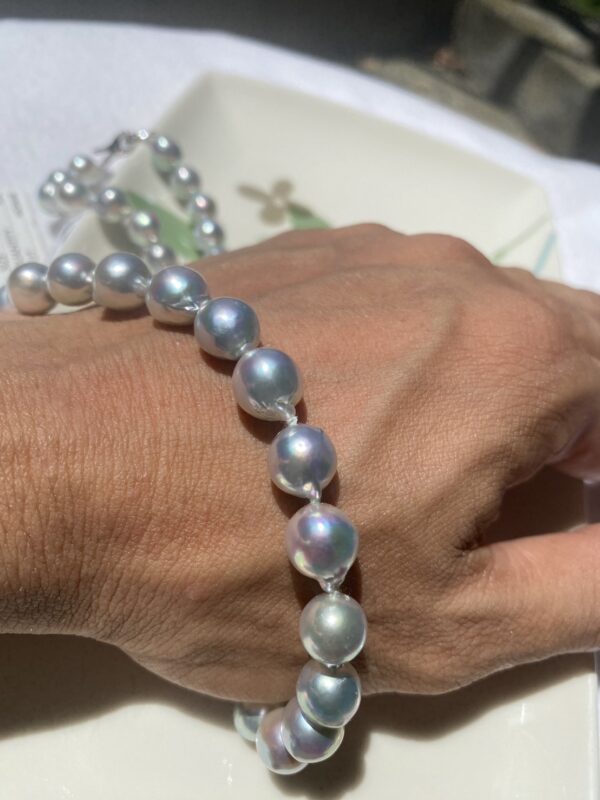
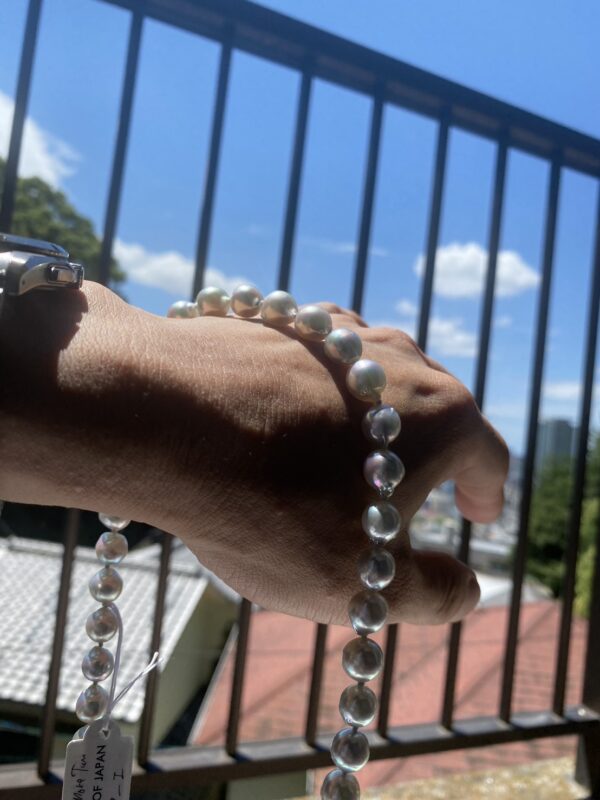
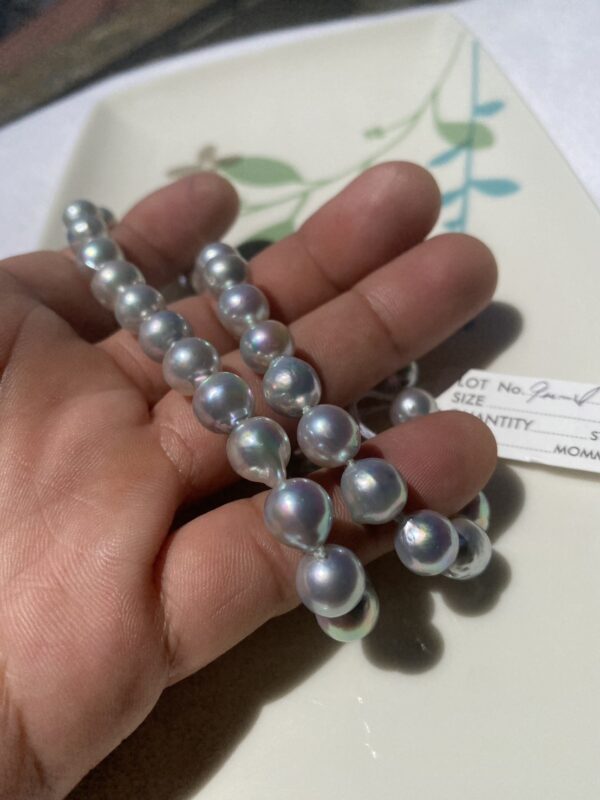
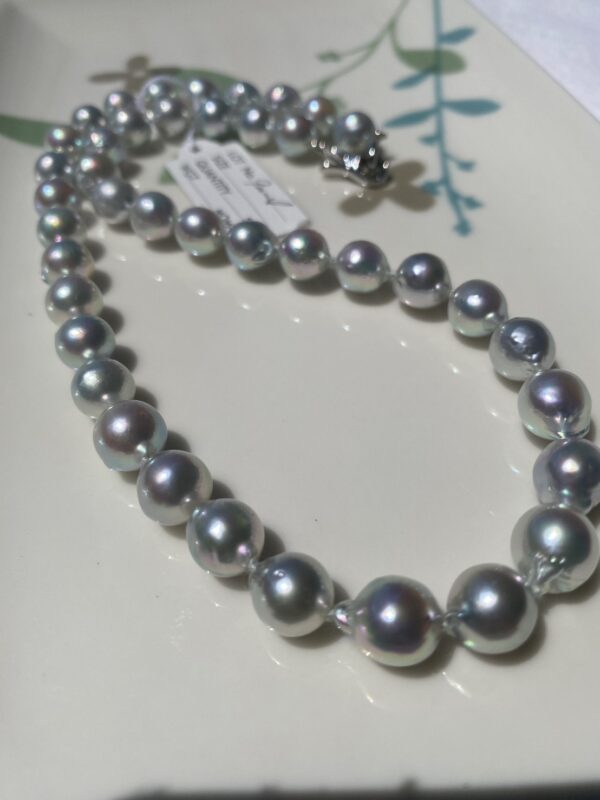
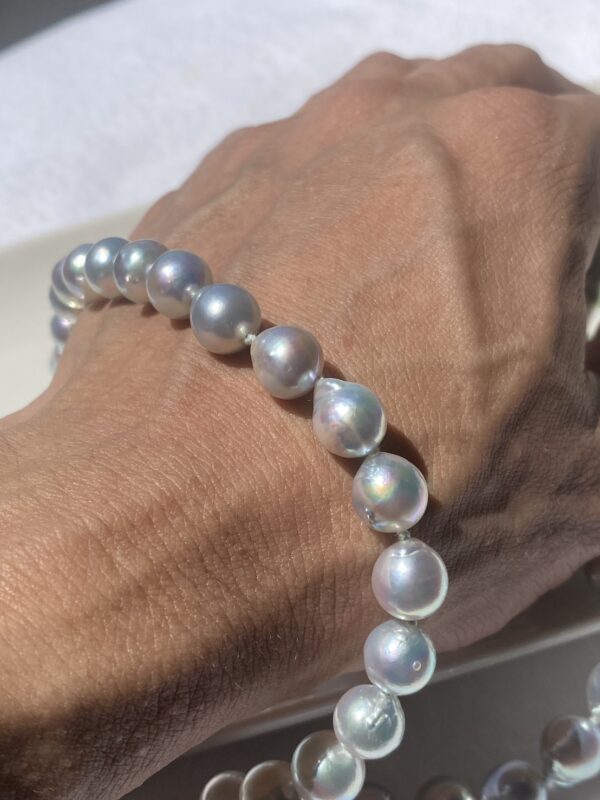
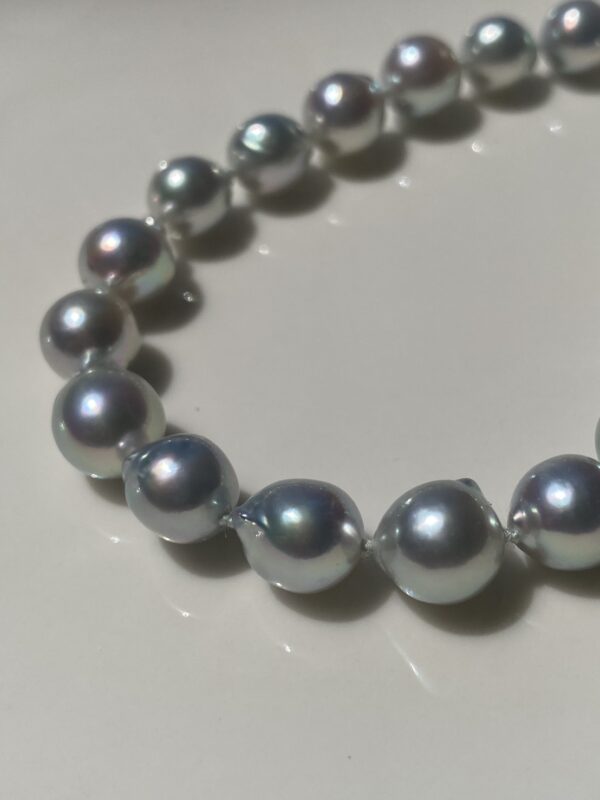
9mm natural blue baroque pearls.
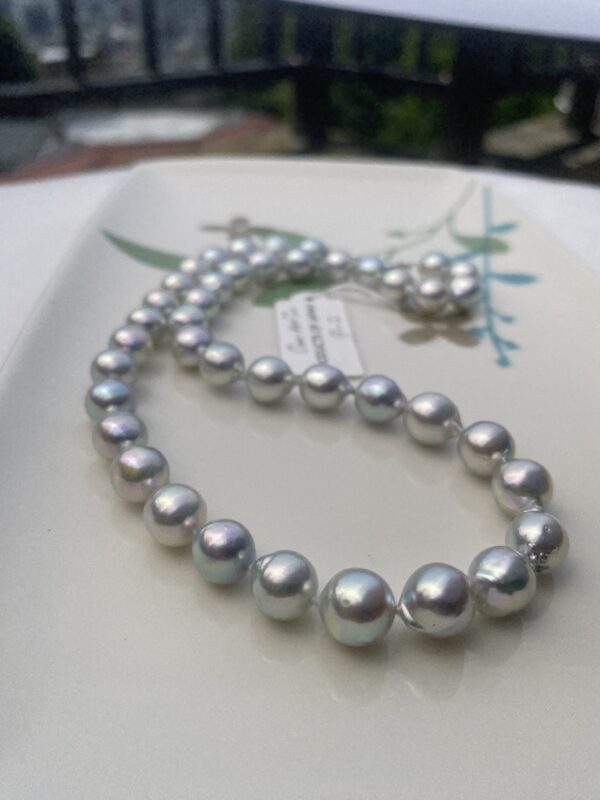
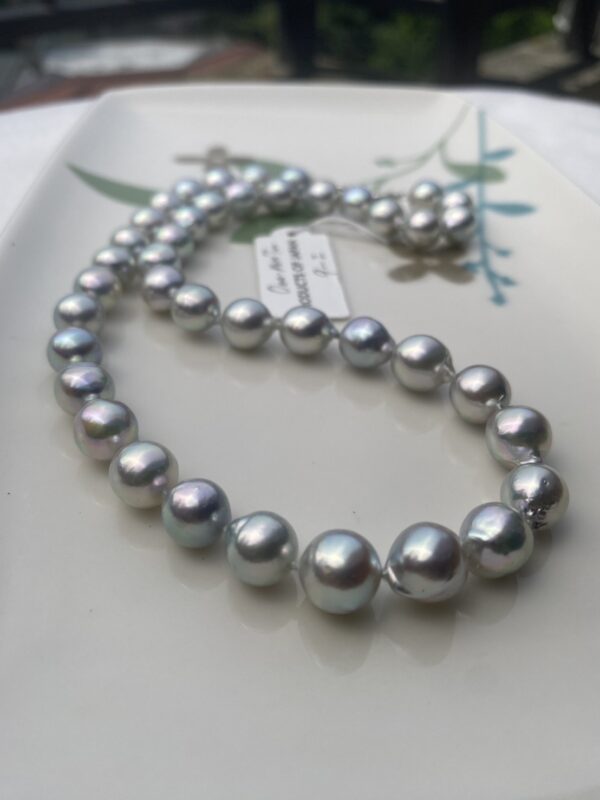
One necklace among 14 strands selected from approximately 764 pearls. The 14 strands were divided into deeper blue tones and lighter blue tones. The deeper blue pearls tended to have stronger baroque characteristics, while the lighter-colored pearls tended to be closer to near-round shapes.
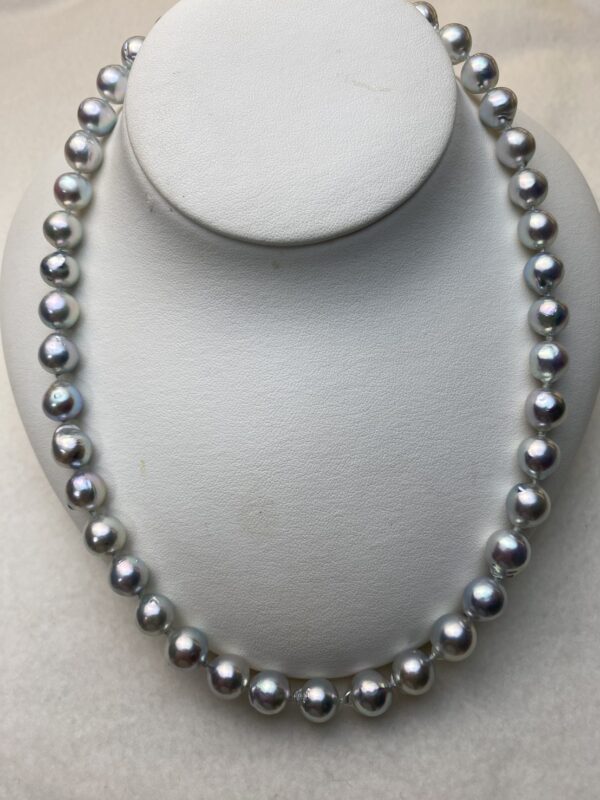
Strictly speaking, however, the color of these pearls is more of a whitish silver-blue. Some people may look at them and say, “These aren’t really blue, are they?”
So let me make an excuse for that.
Among pearl dealers, pearls are often first divided into two broad categories: “white round” and “blue.”
For example, this is roughly how a phone call between pearl dealers sounds.
“Hello?”
“Yes?”
“I’m looking for pearls.”
“White round?”
“No, blue.”
“Natural?”
“Yes.”
Something like that.
Basically, most pearl transactions between dealers revolve around white round pearls.
Within white round pearls, they are further classified by things such as whether they come with a certificate. If they do not have a certificate, they are often called “certificate-fail.” These are pearls that narrowly failed certification but are still fairly good quality.
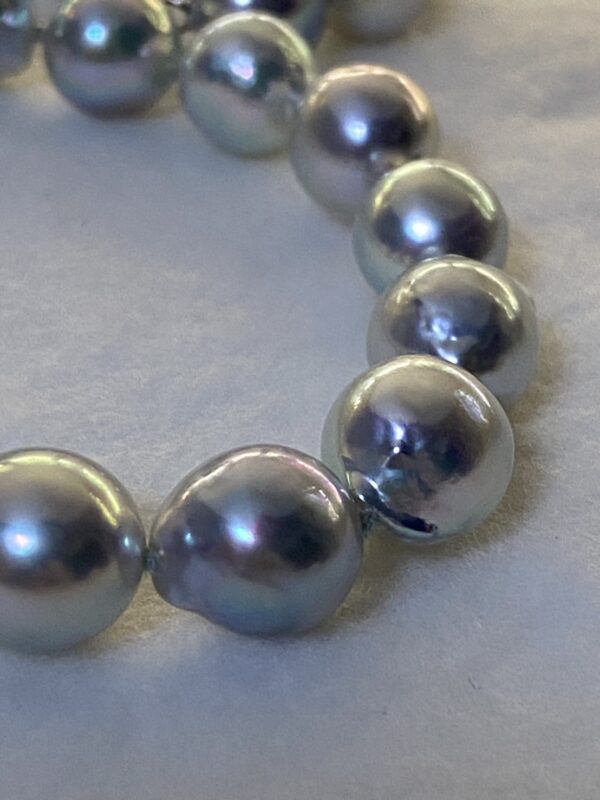
Below that level come pearls with slightly distorted shapes, somewhat heavier wounds, weaker luster, and so on. If you insist on perfectly round pearls, you often end up sacrificing luster or accepting more wounds. If you prioritize luster, then the pearls may become slightly distorted or show more surface characteristics.
In other words, when distinguishing pearls, dealers simply use the terms “white” or “blue.”
That is why even pale silver-blue pearls like these are still called “blue” among pearl dealers.
About ten years ago, when I visited a pearl farm in Tsushima, I accidentally left behind a natural blue baroque pearl bracelet at a restaurant.
I called the restaurant and said, “I think I forgot a blue pearl bracelet there.”
The restaurant staff replied, “Uh… please wait a moment… we do have a bracelet here, but it isn’t blue.”
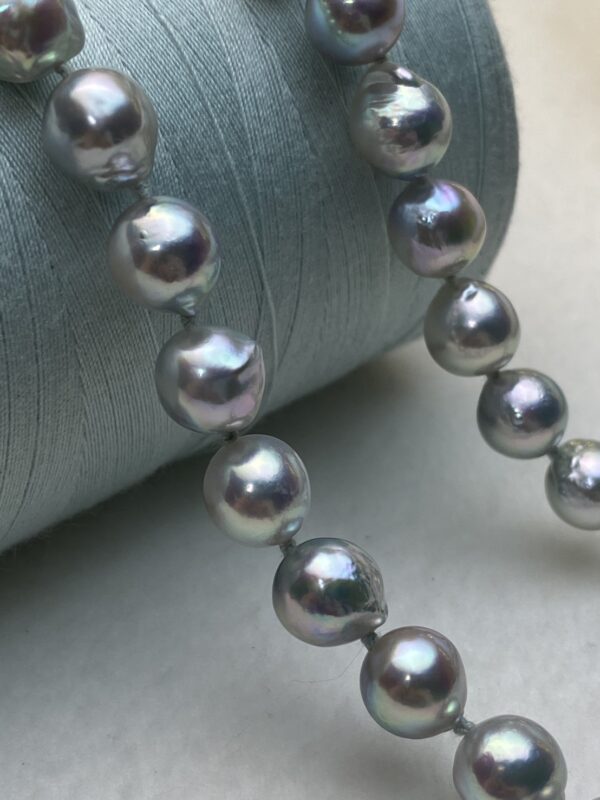
When I went to pick it up, it was indeed my bracelet. But the staff member still said, “I’m glad you found it, but… this isn’t really blue, right?”
For example, traffic lights are described in Japan as blue, yellow, and red.
But strictly speaking, the “blue” signal is actually green.
“The blue means go.”
“But it’s green?”
Something like that.
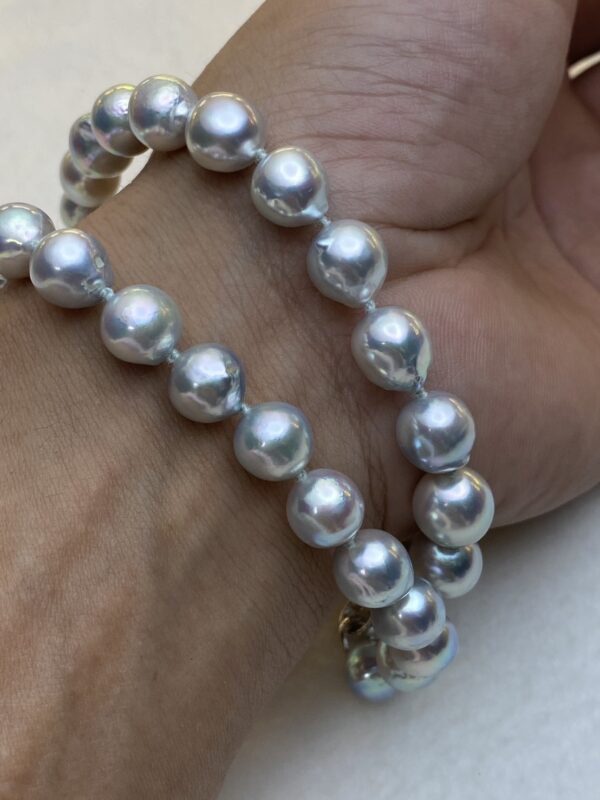
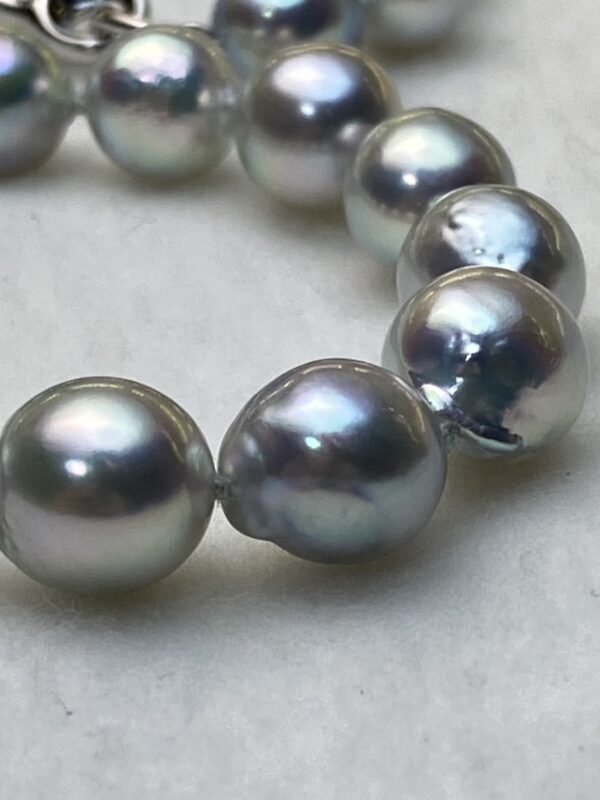
So in that sense, this necklace is not really blue. It is more silver. At the same time, the luster is strong, and although the surface has some roughness, it still shines beautifully when worn on the chest.
At Flower Jem, I continue endlessly making all-knot pearl necklaces without getting tired of it.
Because I like the knots themselves to be slightly larger and more visible, unless requested otherwise, I have traditionally passed the thread through a single loop three times when making each knot.
Pearl thread is fairly thick, so if the knots become too dense, the necklace gradually loses its softness and starts behaving almost like wire.
There are also several other ways to knot pearls.
Pass the thread once through a loop ×1
Pass the thread once through a loop ×2
Pass the thread once through a loop ×3
Pass the thread twice through a loop ×1
Pass the thread three times through a loop ×1
Pass the thread twice through a loop ×1+Pass the thread once through a loop ×1
Until now, I have switched between these methods depending on the type of thread I was using.
Strictly speaking, I usually decide after knotting the first one or two pearls. If the knot appears too large, I reduce it. If it feels too small, I increase it.
And this time, for some reason, my hands unconsciously performed:
Pass the thread twice through a loop ×2
Until now, when I wanted to enlarge the knot beyond the “twice-through” method, I would pass the thread four times through a single loop. But when the thread passes through four times, the necklace becomes significantly stiffer.
So apparently my hands chose “twice-through, twice.”
This is a method I had never used before.
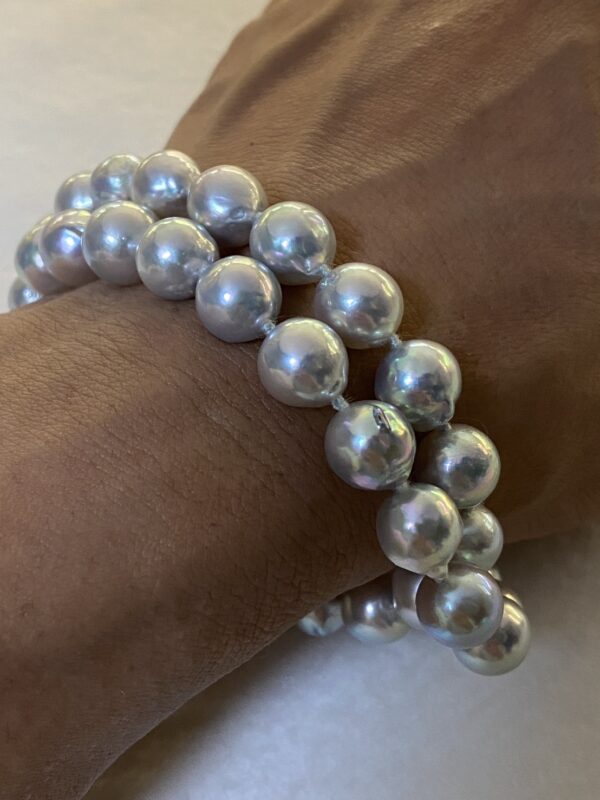
As a result, the knots became larger while the necklace still retained proper softness and flexibility. Personally, I think this became the best finish I have ever achieved.
“What exactly have you been talking about this whole time?”
I hope the explanation about knotting translated properly into English, but honestly, this description may already be difficult to understand even in the original Japanese.
If you have no idea what I am explaining, please simply think:
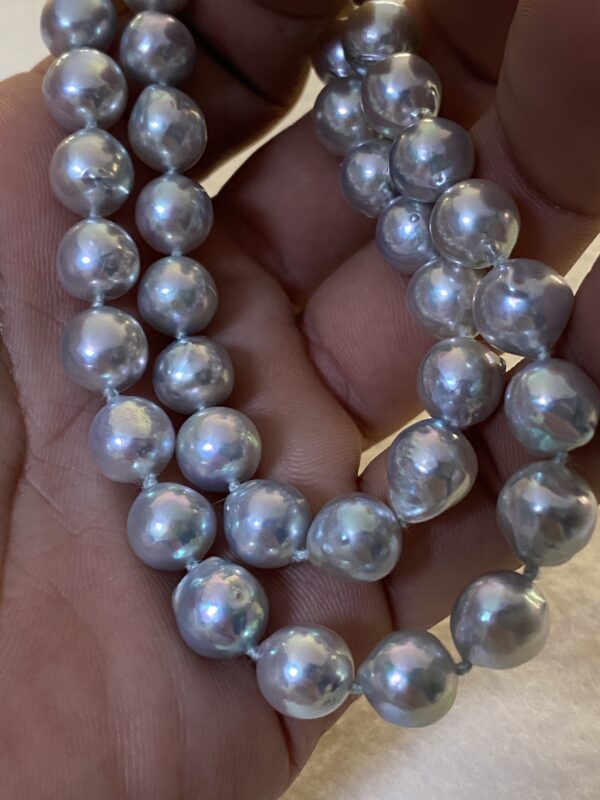
“I don’t really understand it, but apparently he discovered some new method.”
This new method was discovered more by accident than intention. My hands simply moved on their own.
On the day I made this necklace, I woke up at 6:30 in the morning. I immediately received an order, so I began selecting pearls for a bracelet.
At noon, I visited a pearl dealer in Kobe. By the way, my home is also in Kobe. The district where pearl dealers are concentrated is only about a 30-minute walk from my house.
The dealer showed me some beautiful 9mm pearls. They were not even drilled yet.
Honestly… they were so beautiful that I almost started drooling.
I wanted them desperately, but only 3 of the 14 new 9mm necklaces had been listed so far, so I resisted temptation.
“I’ll come back for these soon, so wait for me,” I told the pearls before leaving for the Kobe International Jewelry Exhibition. From the pearl dealer district to the exhibition hall takes around 10 minutes by motorcycle. I once rode there by bicycle, and it took 18 minutes.
There are many traffic lights, so it takes a little time.
Incidentally, the area where I grew up is deep countryside. The distance from my parents’ house to my high school was about 7 kilometers, but there were only three traffic lights along the way.
I used to ride my bicycle to school every day, and it took me about 20 minutes.
At this point I became worried about my memory, so I checked Google Maps.
From Kitano, the pearl dealer district, to the exhibition hall is about 5 kilometers. From my parents’ house to my high school was 7 kilometers.
Apparently my memory was mostly correct, though the difference was only 2 kilometers.
Anyway, I spent time at the exhibition looking at pearls and other gemstones while speaking with several pearl dealers.
One Chinese pearl dealer told me, “Because relations between Japan and China have worsened, far fewer Chinese buyers are coming, so sales have been bad.” Then he looked at me and asked, “You lost weight. Did your diet succeed?”
I am 171 cm tall and weigh 56 kilograms.
I would actually like to gain more weight, but perhaps because of my physically demanding weekday job unrelated to pearls, I cannot gain any.
At that weekday job, I eat between 1.3 and 1.5 kilograms of rice every single day.
But on Fridays and Saturdays, when I return to my Kobe workspace, I often barely eat anything.
Meanwhile, my parents in their seventies apparently consume only 150 grams of rice over two days.
Though to be fair, my mother cooks many side dishes, while my own meals contain very few.
Wait… what was I talking about?
Right.
I returned home from the exhibition around 3 PM.
After that, I selected some 8mm pearls for another order. By around 5 PM, overwhelming exhaustion and sleepiness defeated me, and I went to sleep.
I woke up around 7 PM and began all-knot work.
I was still half asleep and my body felt heavy.
Perhaps because of that state, my hands moved on their own and created the “twice-through ×2” method.
As a result, Flower Jem experienced what may be considered a revolutionary discovery six years in the making. I am thinking of keeping this as a trade secret.
And that is why this necklace was named:
“One More Turn”
Incidentally, I once again asked ChatGPT for possible name ideas.
After Silence
Thin Air
Fading Light
Half Awake
Passing Weather
Between Tides
Soft Remains
Pale Memory
Last Reflection
Slow Morning
Hushed Glass
Before Evening
Empty Harbor
Distant Weather
Low Light
I ask every time, but none of the suggestions ever truly resonate with me, so in the end I always choose the name myself. “Between Tides” had already been used before, and even when I specifically instructed him not to reuse words, he used them anyway.
By the way, I used mint green thread again this time.
I like this color, and because the thread is slightly thinner, the knots used to remain rather subtle. But thanks to this new discovery, I can now create larger knots even with this thread, so I expect I will continue using it frequently.
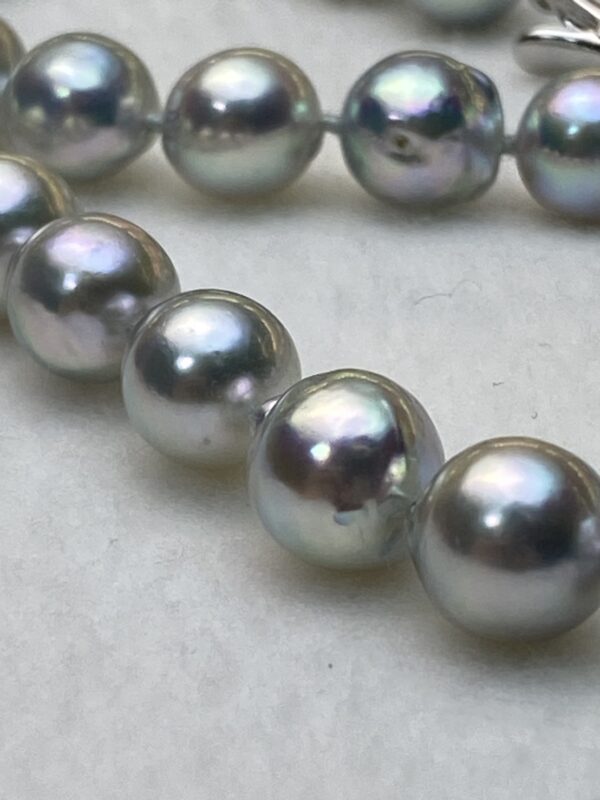
Of course, if someone requests “Please use blue thread,” I will immediately cut the necklace apart and redo it.
Some people like natto.
Some people hate natto.
Natto itself has committed no crime. It is simply a difference in personal taste.
Thank you again for reading this far.
Pearl Bless You
This video series documents the process of selecting approximately 764 pearls from scratch and turning them into strands.
There are around 16 videos in total, with a combined runtime of 21 hours and 20 minutes.
Yes, I know.
Don’t worry — it’s definitely too long.
This video introduces the 14 finished strands.
It is still about one hour long, but it may help as a reference.
Timestamps for each necklace, organized by their letter designation, are included in the video description.
As requested by the customer, I have added additional photos taken in natural sunlight below.
This space is not only for reviews. You are welcome to write freely about pearl jewelry, ask questions, or share what you feel when you see this piece. Member registration is required to submit your message.
Pearls & Stories
There are no stories yet.