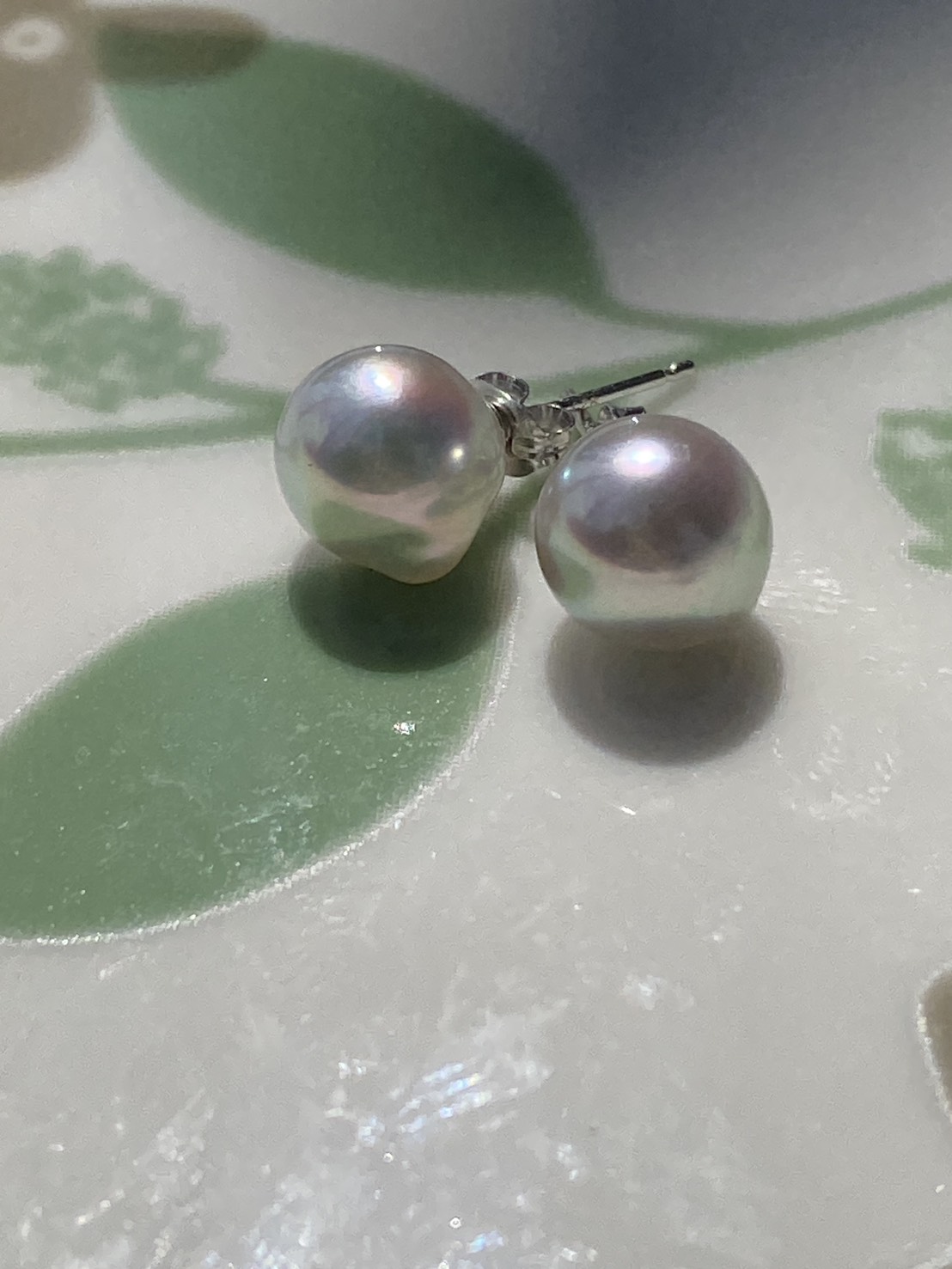
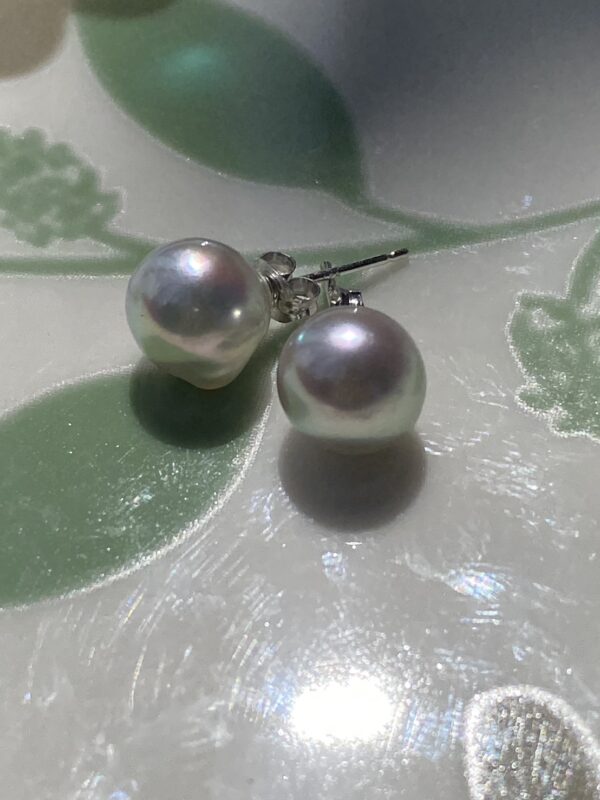
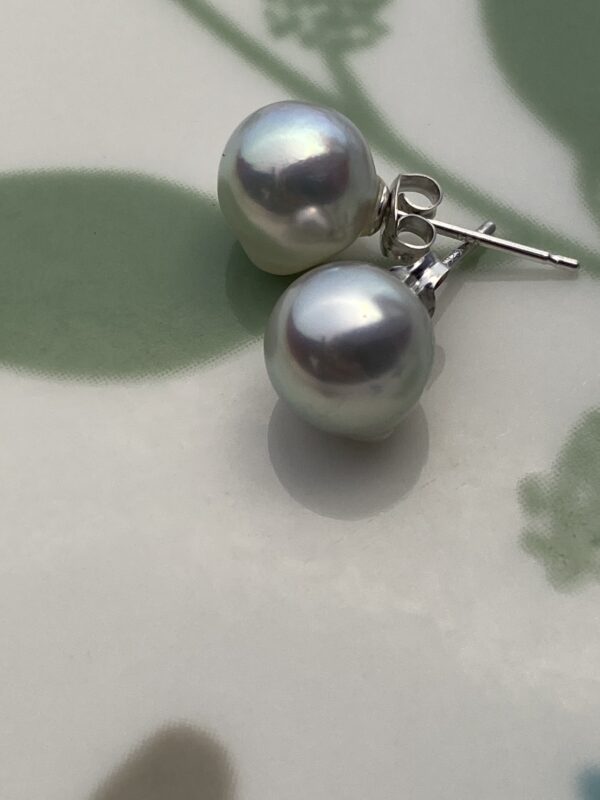
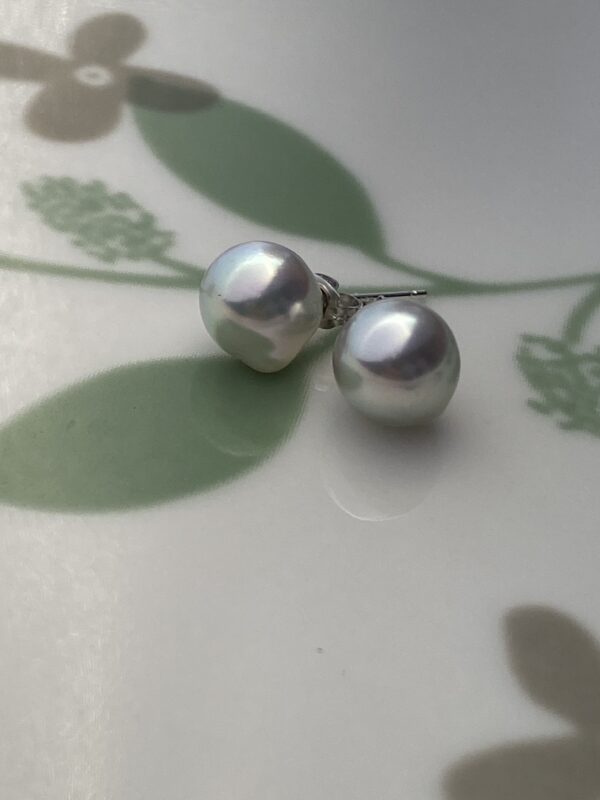
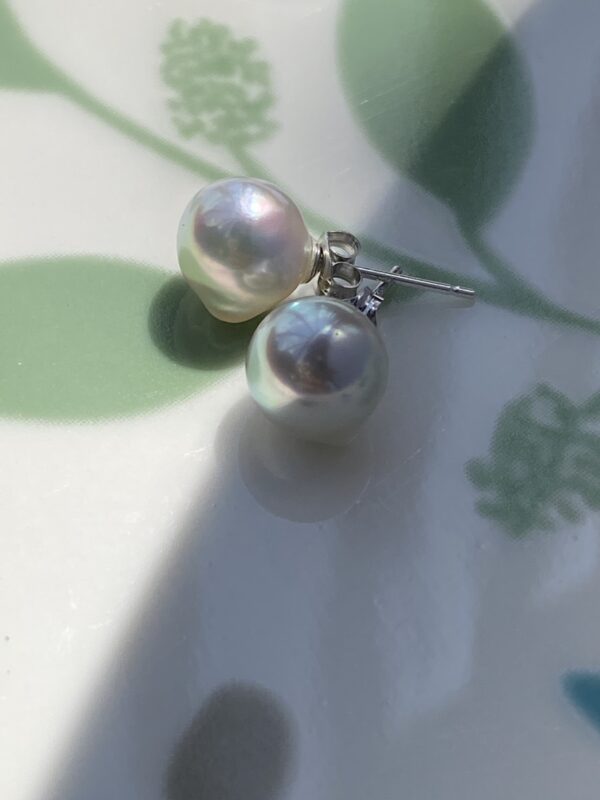
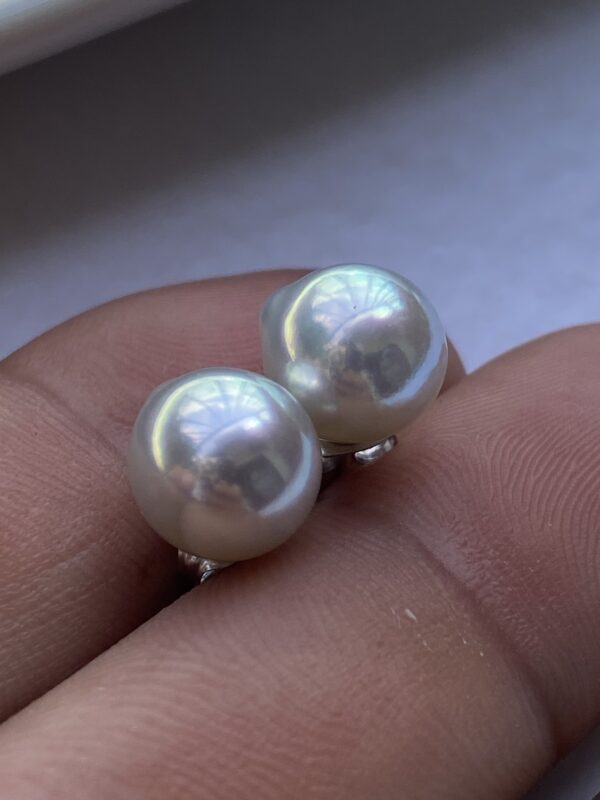
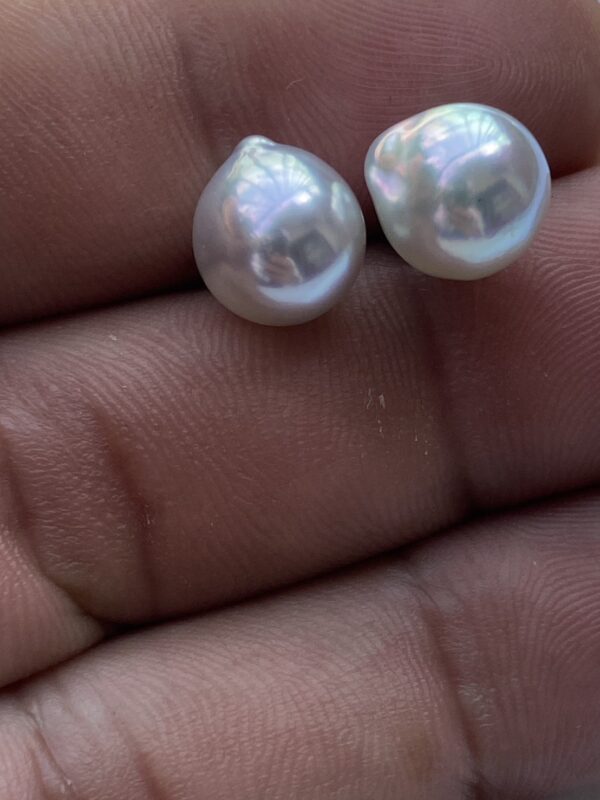
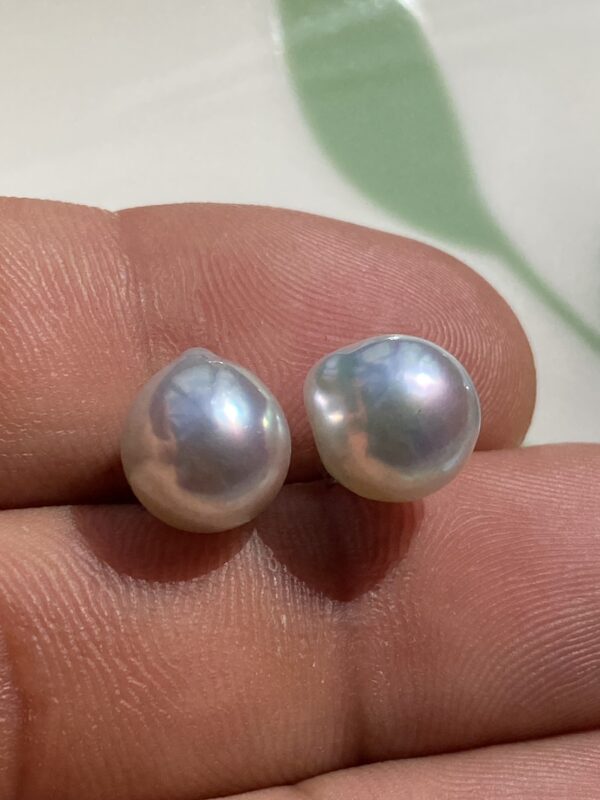
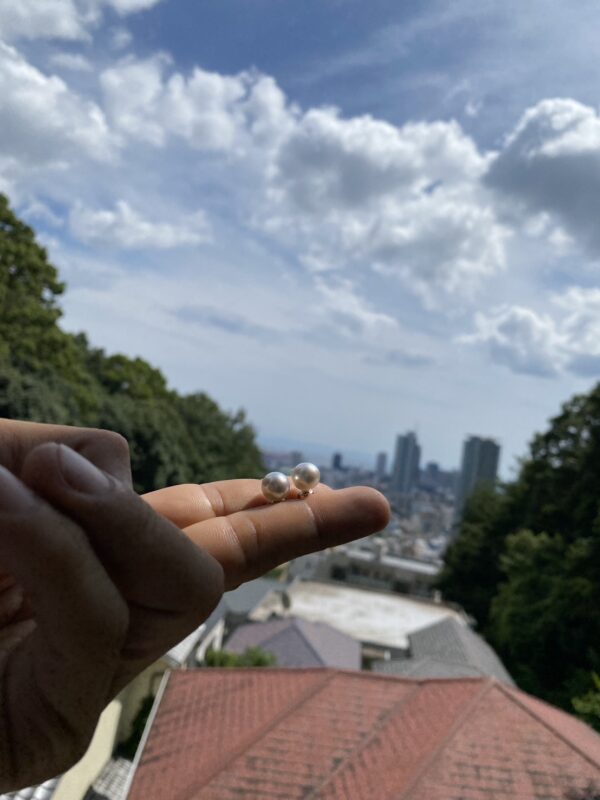
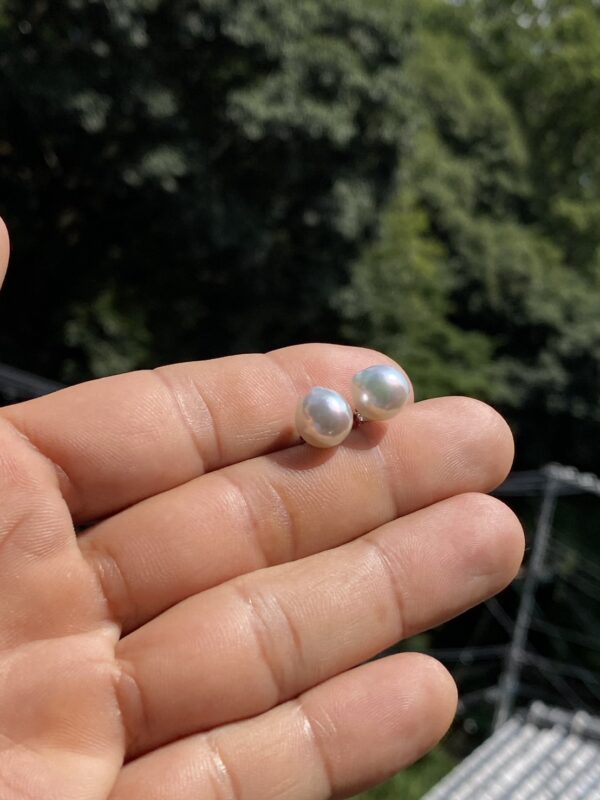
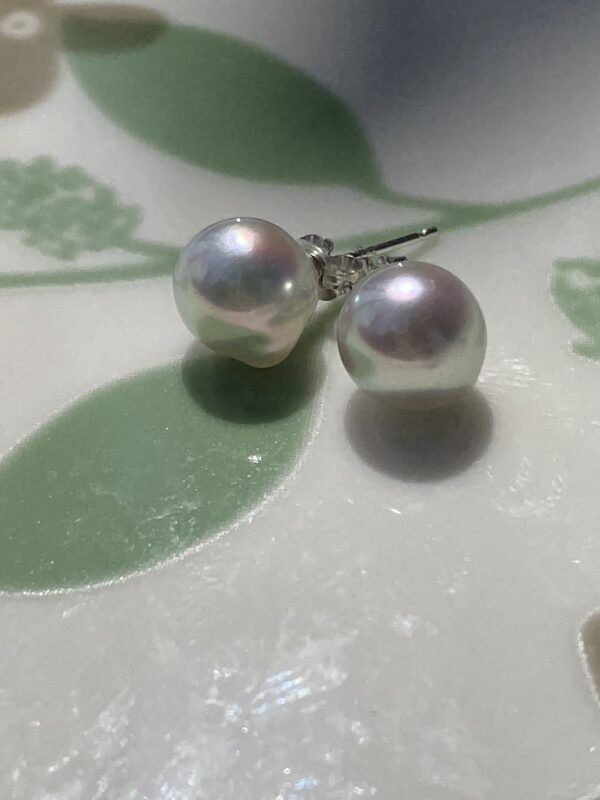
Natural Blue Akoya Baroque Pearl Earrings, 9.1mm / 9.1mm, Silver 925, Fine Luster, Japanese Akoya Pearls
Obon 07
$240.00
1 in stock
Thank you for taking a look at Obon-07 earrings.
These are natural-color baroque Akoya pearls.
Their luster is strong, earning an A grade among the seven pairs.
The findings are made of silver.
Perhaps their most distinctive feature is their large size of around 9mm.
By the way, have you already seen all seven pairs in the Obon series?
These seven pairs of earrings became the “Obon Series” for the simple reason that they were made just before Obon in 2026.
Obon-01 through Obon-03 were mostly about Obon, a traditional Japanese event. Obon-04 and Obon-05 contained more technical information about pearls, while Obon-06 became a story about the history of the relatives who used to gather together during Obon.
If you have not read them yet, I would be very happy if you started with Obon-01.
Now then.
I had originally intended to finish listing all seven pairs in the Obon series before returning to my parents’ home for Obon, but in the end, I did not make it.
Apparently, the articles kept growing far more than I had expected.
By the time I finished Obon-06, I had written approximately 75,000 characters.
Apparently, an average Japanese paperback novel contains around 100,000 characters.
And so, I am writing the article for Obon-07 here at my parents’ home.
Up through Obon-06, I had been looking back at Obon memories from the past.
Obon-07, however, is about this year’s Obon—Obon 2026.
That said, this year’s Obon has been so peaceful that there really has not been much worth writing about.
On August 12, I returned to my parents’ home, and that evening I went to visit our family grave with my mother and my older brother’s family.
While we were there, the family who live next to my parents’ home also arrived to visit their family grave.
As far as I can remember, it had been at least fifteen years since our grave-visiting times had happened to coincide like this.
The de facto head of their family is an 86-year-old woman.
She is 86, but she looks like she is in her early seventies.
She has an extraordinarily loud voice and is full of energy.
“●●! It’s been a long time! I remembered you as soon as I saw your face!”
“〇〇! It’s been a long time! You look well!”
We exchanged a simple greeting like that.
Their family no longer runs the business, but they used to own a bicycle shop.
A small bicycle shop in a small village.
However, I suspect that their sales were actually quite substantial.
At the public junior high school we attended, there was a mysterious rule that the bicycles students used for commuting had to be purchased from a bicycle shop designated by the school.
Yes.
That little bicycle shop in our little village happened to be one of the school’s designated bicycle dealers.
Every year, all the students entering junior high school bought their bicycles from that shop.
And the bicycles specified by the school were considerably more expensive than ordinary bicycles.
At the time, when a normal bicycle cost around 20,000 to 30,000 yen, the school-designated bicycle cost as much as 80,000 yen.
For 80,000 yen, you could buy a reasonably nice blue baroque pearl.
The reason for the high price was that the school-designated bicycles came equipped with an excessive number of features.
Turn signals, an on/off switch for the headlight, a brake light, a six-speed gear system, and so on.
My mother, who had three sons, became furious every time one of us entered junior high school and she had to buy another one of those bicycles.
“This is collusion between the school and the bicycle shop.”
“And besides, we live close enough to walk to school. Why do we have to buy a bicycle when you don’t even need one to commute?”
By the time I entered high school, I was no longer riding that unnecessarily elaborate bicycle.
I rode a much cheaper bicycle to high school instead.
One day, the rear wheel of that bicycle began having trouble.
I do not know exactly how it worked, but somehow, whenever the wheel turned, a screw seemed to tighten itself, gradually making the rear wheel harder and harder to move.
I had no choice but to take it to the little bicycle shop in the village.
The moment the owner saw my bicycle, he shouted at me,
“Throw a bicycle like this away!!”
So I had no choice but to drag the bicycle all the way home.
And then I repaired it myself.
The wife of the man who shouted at me that day is the 86-year-old woman I happened to meet again while visiting the grave today.
The man who shouted at me passed away and went to heaven quite a long time ago.
After visiting the grave, we went to a hot-spring facility about ten minutes away by car and washed off the sweat.
We returned home, relaxed for a little while, and then went to Kura Sushi, a casual chain sushi restaurant.
Even though my brother had made a reservation, we could not get a table right away.
The restaurant was extremely crowded.
Even the parking lot outside, which holds more than fifty cars, had a line of cars waiting for spaces to become available.
Anyway, once we finally got a table, we casually ordered whatever sushi we wanted from a tablet and each enjoyed our meal.
In the past, we would have ordered a large amount of sushi from a local caterer and eaten it together at home.
Today, however, we can simply go out and eat sushi casually.
And it is quite inexpensive.
My mother seemed extremely pleased that she no longer had to prepare anything herself.
As for Kura Sushi, I had always thought of it as a conveyor-belt sushi restaurant.
Apparently, that is not quite how it works anymore.
You order whatever you want on a tablet, and the sushi you ordered travels along a lane and arrives directly beside your table.
Most of the things endlessly going around on the regular conveyor seemed to be advertisements.
In the past, part of the fun of conveyor-belt sushi was watching the sushi travel around the restaurant and taking whatever looked good.
It seems that conveyor-belt sushi itself has changed.
Incidentally, most plates were around 100 to 300 yen, and many plates contained two pieces of sushi.
A medium mug of beer was around 800 yen.
Dassai, a sake that became quite popular a few years ago, was around 1,300 yen for 140 milliliters.
It seems like a reasonable price range for casually enjoying sushi.
That said, I am single, so I almost never go to conveyor-belt sushi restaurants in my everyday life.
I enjoyed the sushi with the curiosity of someone experiencing something slightly unfamiliar.
After we returned home, my nephew devoted himself to playing video games, while my mother and brother read books.
Every now and then, everyone ate some snacks or ice cream.
And so the day ended in complete peace.
The next morning, everyone stayed at home.
In the afternoon, we went out to do a little shopping.
My brother wanted to look for a bag he had seen at a certain secondhand shop back in May, while my mother wanted to buy some cord at a handicraft store.
We drove from my parents’ home to Himeji, where those shops were located, and everyone finished their shopping.
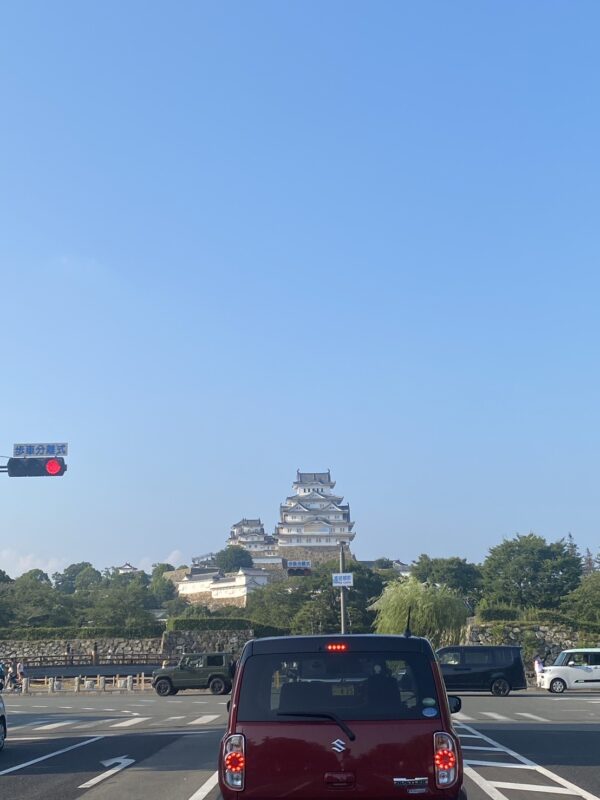
Then, for no particular reason, we decided to wander around a little longer.
So we drove another forty minutes or so south to Mitsu.
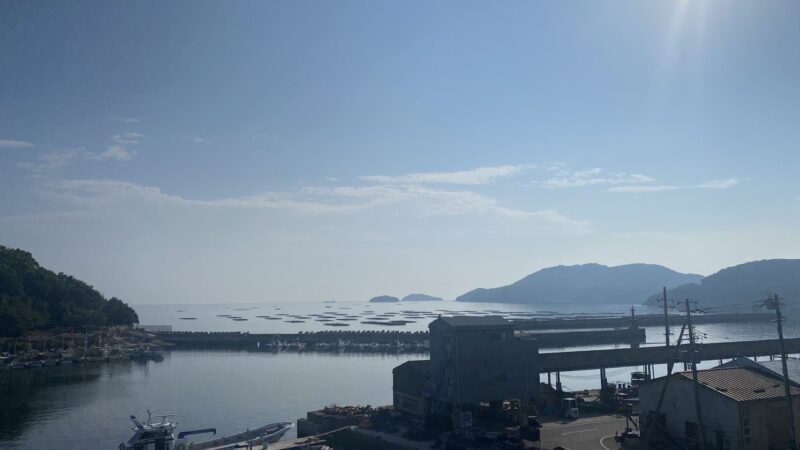
It is a town with a beautiful coastline.
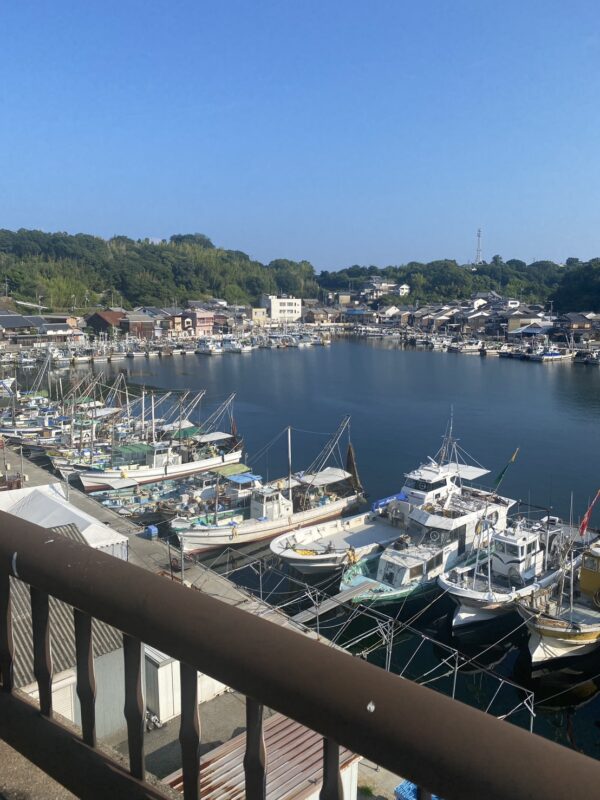
Murotsu Port, located in Mitsu, is a historic port that was established approximately 1,300 years ago.
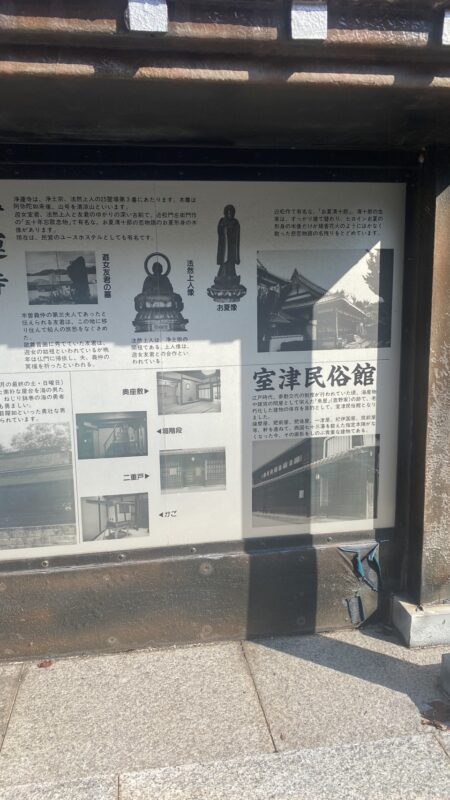
During the Edo period, the German physician Philipp Franz von Siebold also seems to have visited this area.
Siebold appears in the explanatory signs at an astonishing number of tourist destinations.
Apparently, he traveled to quite a lot of places during his time in Japan.
We visited at around 3:00 p.m., so it was not yet evening.
Thinking that the sunset here must also be beautiful, we left Mitsu behind.
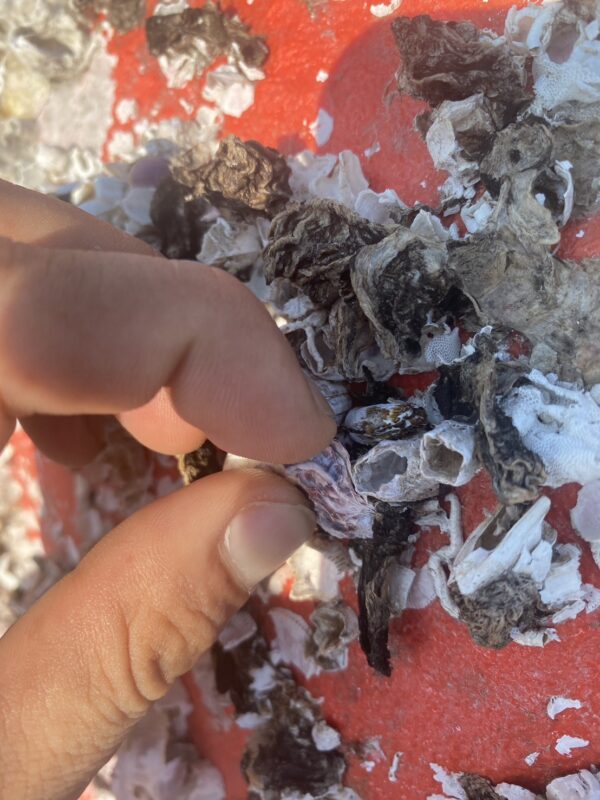
I stopped by the harbor in Mitsu and found myself examining the remains of oysters and barnacles attached to the buoys. Oysters and barnacles attach themselves to the surface of Akoya pearl oysters in much the same way. To remove them, we have to scrape them off with a metal spatula, taking great care not to damage the Akoya oysters.
We arrived home at exactly 6:00 p.m.
For dinner that evening, we had temaki sushi.
You could call it a kind of self-service sushi system.
You spread vinegared rice over a sheet of nori yourself, choose whatever sashimi you like, roll it yourself, and eat it.
My mother likes this style very much because it makes preparing dinner quite easy.
It requires relatively little preparation, yet it still looks quite impressive as a meal.
After dinner came another familiar stretch of peaceful time.
My brother and mother read books.
My nephew played video games.
By around 10:00 p.m., everyone had already started going to bed.
For better or worse, I was finally alone.
And that is how I ended up sitting here writing this article.
After listing Obon-01 through Obon-06, I had finally reached the last one, Obon-07.
And yet there was simply too little happening during this year’s Obon to turn into an article.
That is how peaceful this Obon has been.
There was only one small incident.
Around noon today, my father suddenly came out of his room and entered the living room where the rest of us were.
“Lulu! Lulu, come out!”
“Lulu? She isn’t in here,” we told him.
“What? Lulu has disappeared!”
My father suddenly became worried.
Everyone began searching around the house, calling,
“Lulu!”
For some reason, I decided to look inside my father’s room.
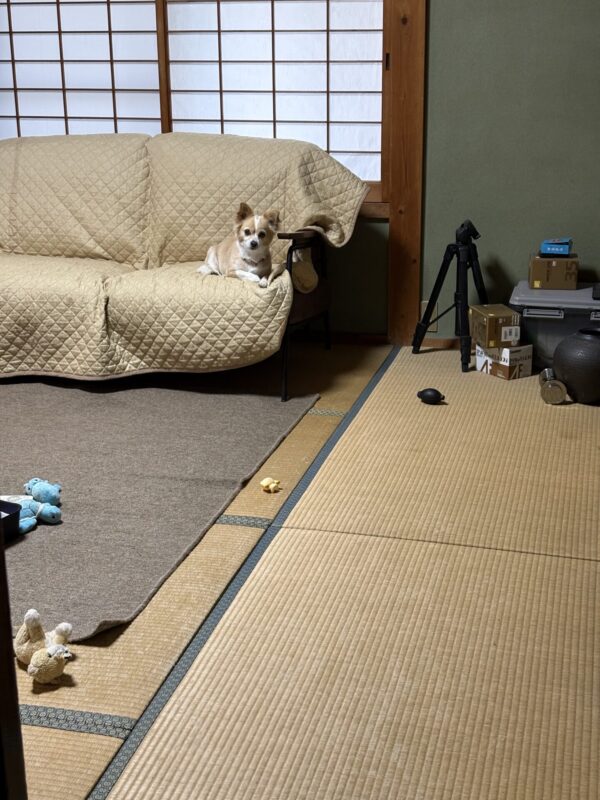
There was Lulu, sitting on a brown sofa almost the same color as she was, looking at me as if wondering what all the commotion was about.
I went back and told my father,
“Lulu is on the sofa.”
My father became angry and said,
“Lulu! You could at least answer me!”
That was about the only incident we had.
Obon in the old days was very lively, with large numbers of relatives gathering together.
As a child, I loved these occasions when all our relatives gathered for New Year and Obon.
But after I became an adult, Obon gradually became very quiet every year.
Because of everyone’s work and other circumstances, it is not always possible for the whole family to be together.
But this is not bad either.
All kinds of things happen in everyday life, and everyone is busy.
Perhaps it is good to have a place where time moves this slowly once in a while.
No.
Perhaps part of me would actually like to spend all my time surrounded by this kind of unhurried pace.
My personal ideal is that when I am around sixty years old, I will return to my parents’ home and spend my days making pearl jewelry from morning until night.
Traditionally, the eldest son would inherit the family home.
However, my older brother has already built a house elsewhere.
So, for the time being at least, it has been decided that I, the second son, will eventually take over this house.
I have absolutely no idea whether this shop will have grown into something respectable if I keep working at it for another ten years or so.
But I intend to keep moving toward that ideal, sometimes walking and sometimes running.
And with that, thank you very much for staying with me all the way from Obon-01 through Obon-07.
Pearl Bless You
Subscribe for Pearl Stories🐾
Receive occasional letters from my workshop —
stories about pearls, silverwork, Lulu the little dog, and quiet life in Japan.
As a thank you, you’ll get a secret code for 30% off —
usable every time you order, only here, not on Etsy.
I don’t send spam. Just little notes filled with love and pearls 💫 You can read our privacy policy for details.
2 Pearls for Obon 07
This space is not only for reviews. You are welcome to write freely about pearl jewelry, ask questions, or share what you feel when you see this piece. Member registration is required to submit your message.
talidegu
I loved the funny story about the bicycles! and the view of Mitsu Bay and missing Lulu…
Your renewed website did not remember me so I have rejoined!
Jem
Thank you for your comment. The story about the bicycle shop brought back a good memory that I had completely forgotten. I’ll make sure to give my website strict instructions not to forget you.