Hello.
Japan is moving from autumn into winter, and the weather is getting colder.
This week, I had Sunday and Monday off from my weekday job, so I am still in Kobe tonight, Monday evening. It is now 7:21 p.m., and I will be heading to Osaka later.
Yesterday, I listed about three bracelets that I had not yet listed from the seven bracelets I made using a lot of 114 pieces of 9 mm pearls.
With that, I have finally finished all the work involving those 114 pearls.
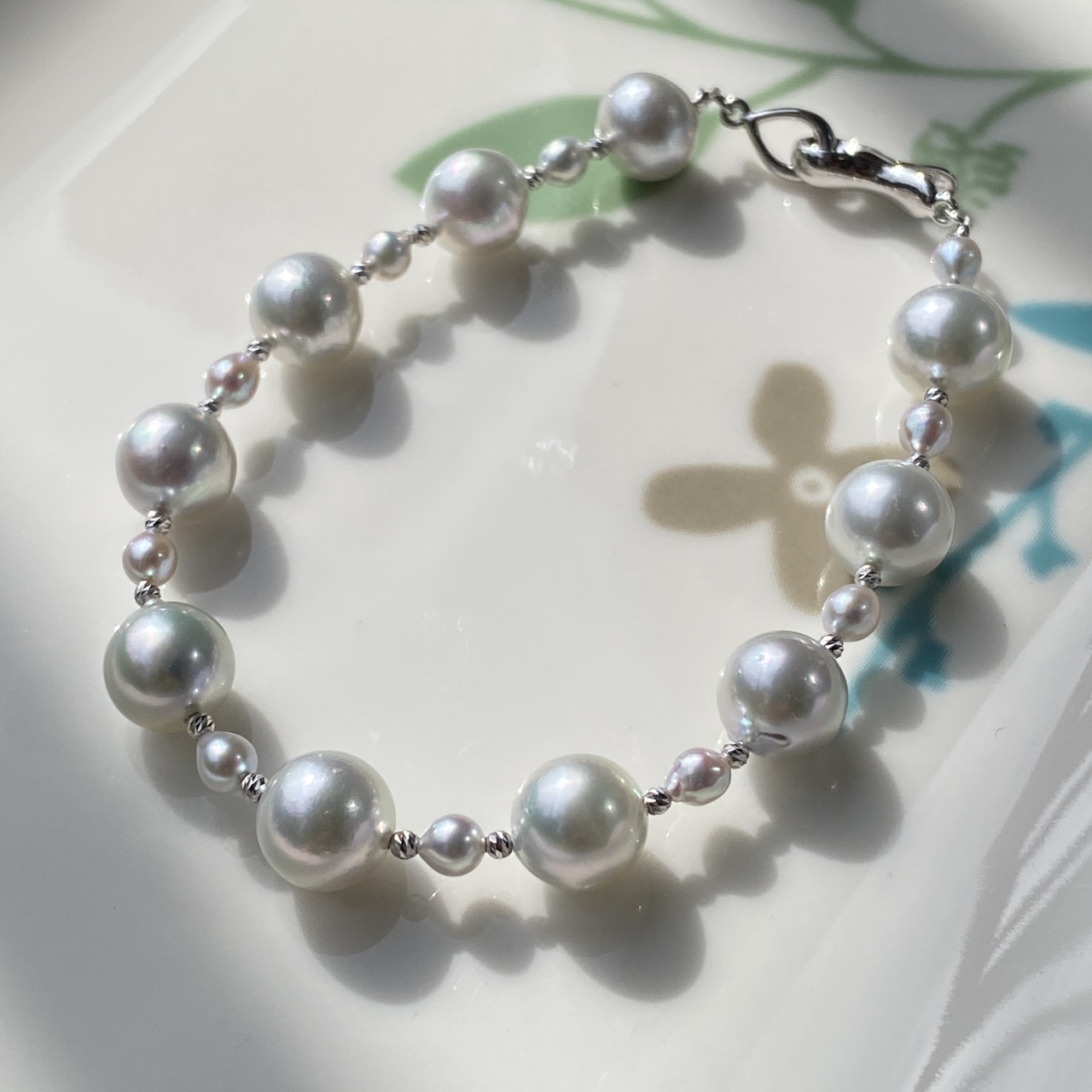
I still have another lot of more than 200 pieces of 9 mm pearls.
I also listed a ring made entirely of pearls, a pair of earrings made with fittings that I impulsively bought while waiting to pay at a pearl jewelry findings shop, and a brooch identical to one I previously made for a friend who cares deeply about his mother.
I am happy that the number of products listed in my shop has been gradually increasing recently.
Whether it is pearls or anything else, I think shops with lots of products are enjoyable.
Today, I had some wholesale work to do, so I visited pearl dealers and searched for many blue baroque pearls.
I finished that work at around 5 p.m.
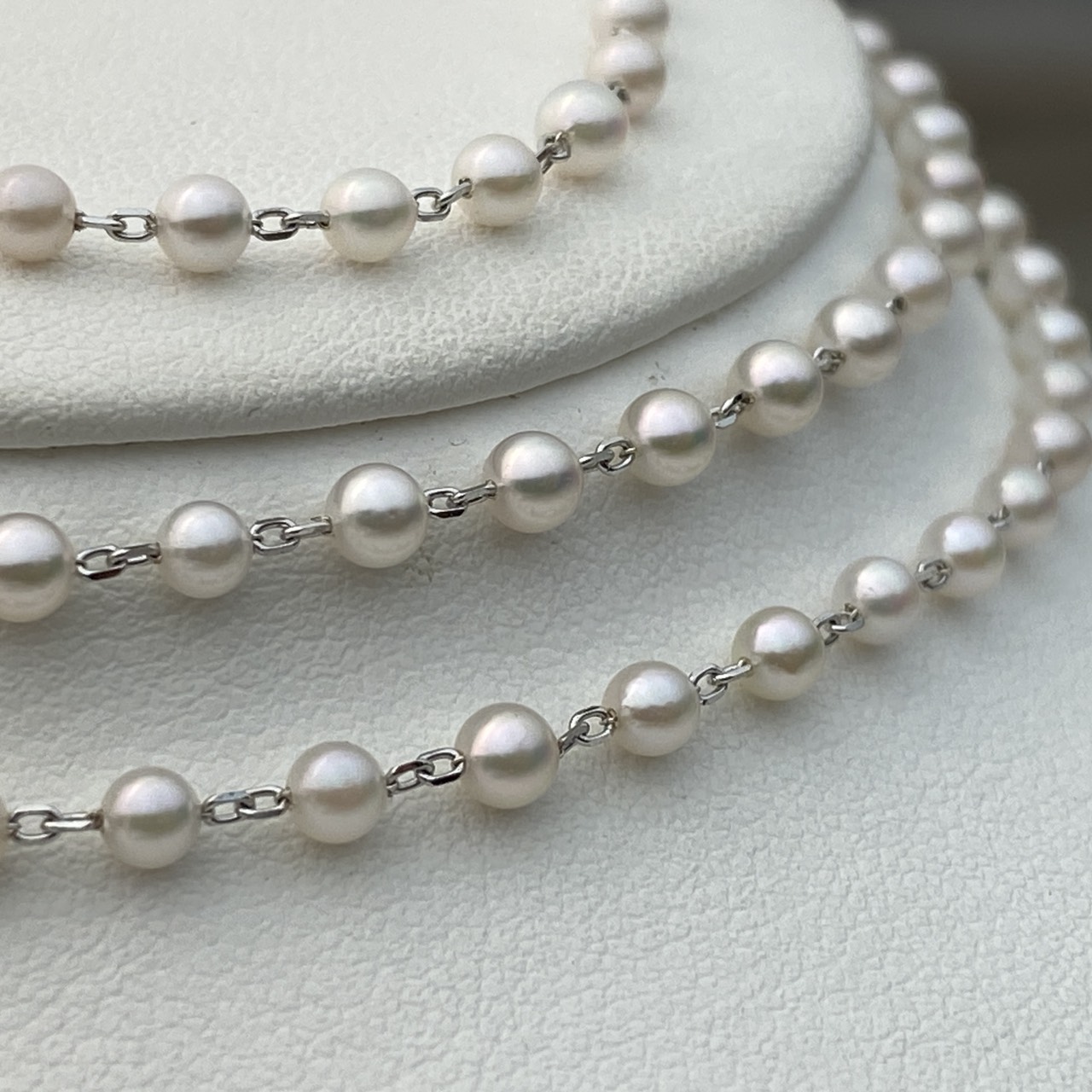
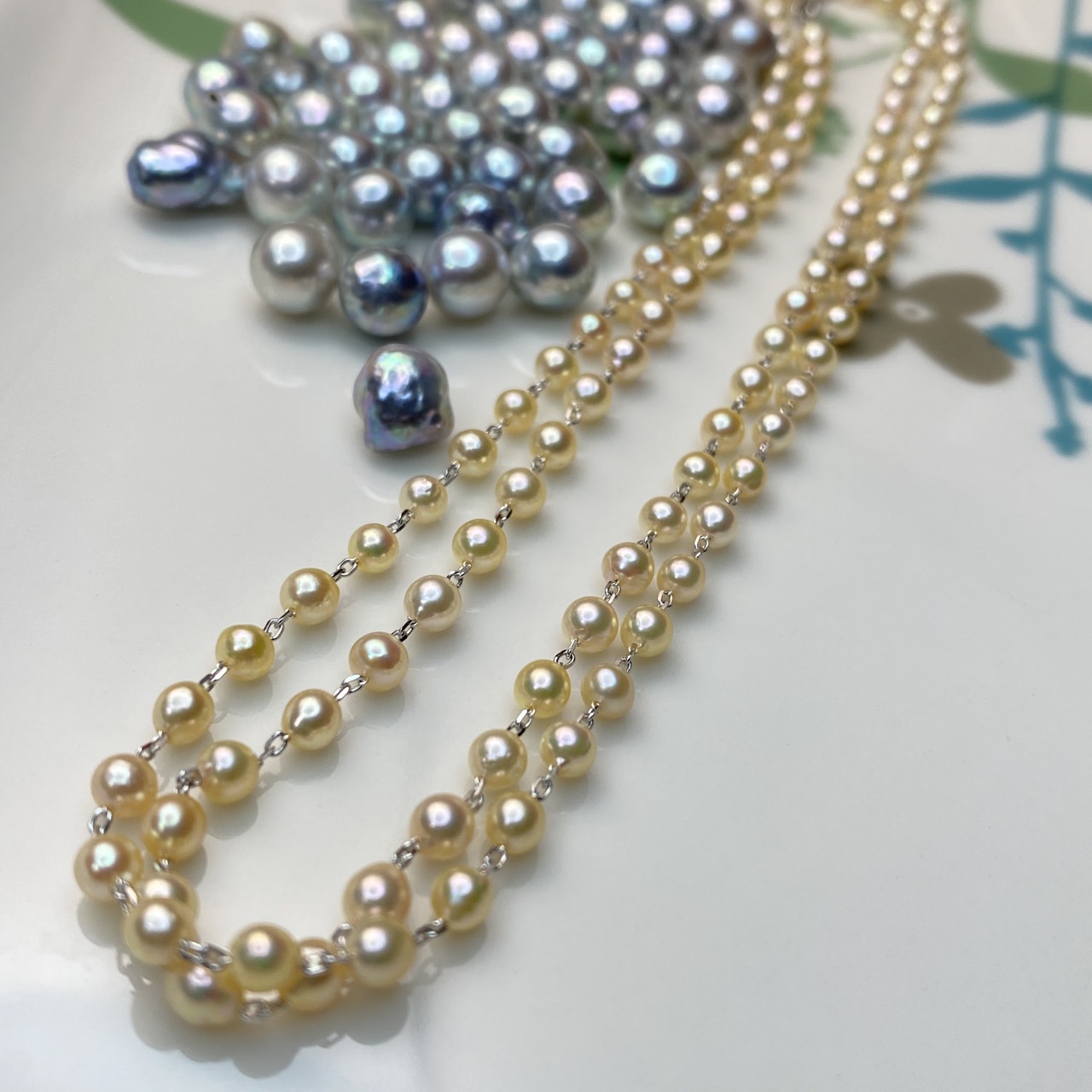
Afterward, I started taking new photographs of the 3–4 mm long pearl necklaces that I had listed previously.
These necklaces were made by Hiromi-san, who began helping me with the production of some pearl jewelry this year.
She does the work of connecting each pearl and two links of chain individually with wire.
I really like this combination of pearls and chain.
I originally learned about this design from a customer, but I had absolutely no time to make it myself, so I had given up on the idea.
Just around that time, Hiromi-san appeared, and I asked her to make them for me.
So far, I have listed three necklaces made by Hiromi-san, around August, but all three are still for sale.
I have been running Flower Jem for about five or six years, but I have hardly ever thought, “I hope this sells quickly.”
I am happy when something sells, and I am also happy when the number of products in my shop gradually increases.
I have only known pearls for about twelve years.
Before that, I had absolutely nothing to do with pearls, accessories, or jewelry.
Then I came to love pearls and eventually began selling them on my own.
I am almost a complete amateur when it comes to marketing, websites, and the retail business.
While working at a pearl company, I used to think that it would be nice if I could eventually make a living selling pearls by the time I retired at sixty or sixty-five.
However, I developed a mental health condition and left the pearl company.
For about two years now, I have been working at a job unrelated to pearls while trying to gradually grow Flower Jem.
Um, what was I talking about?
Oh, yes.
Because I have been taking my time with Flower Jem in this way, I rarely think, “I want my products to sell quickly.”
However, this time I am feeling a little impatient because Hiromi-san has helped me with the production.
Looking back at previous orders, some pieces have taken as long as three years from completion to sale.
On another occasion, I sorted around 20,000 pearls, drilled holes, selected pearls, arranged them into necklaces, and completed the all-knot stringing process.
I recorded the entire process on video and shared it publicly.
I felt as though I was making the necklaces together with the people watching.
On that occasion, an order arrived just as the necklace was completed.
Some pieces sell immediately, while others take several years.
All I can do is wait.
However, having become a little impatient, I decided to photograph these three necklaces again.
Personally, I particularly like the chain sections connecting the pearls.
But when I focus the camera on those parts, it becomes difficult to tell whether the jewelry is even a long necklace.
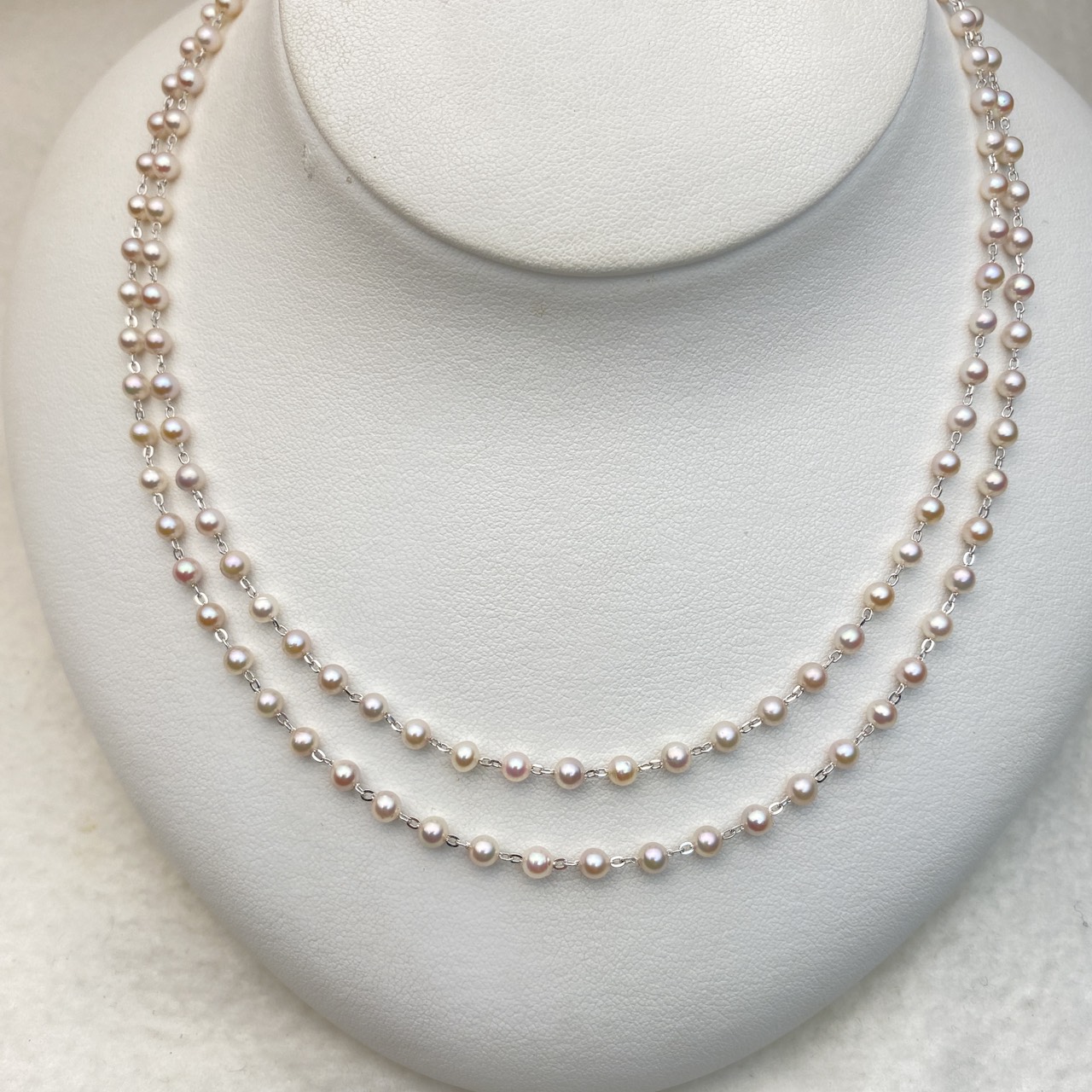
And when I try to capture the entire necklace, the chain sections become difficult to see.
In the end, the photographs turned out to look like those of an ordinary pearl necklace, without conveying what makes it special.
This time, I tried taking photographs that focus a little more on the chains between the pearls.
Each pearl is connected individually to two links of chain using wire, so the process requires a considerable amount of time and effort.
I suppose a true craftsman would never make a point of showing how difficult the work was.
It seems I still have a long way to go before I can call myself a craftsman.
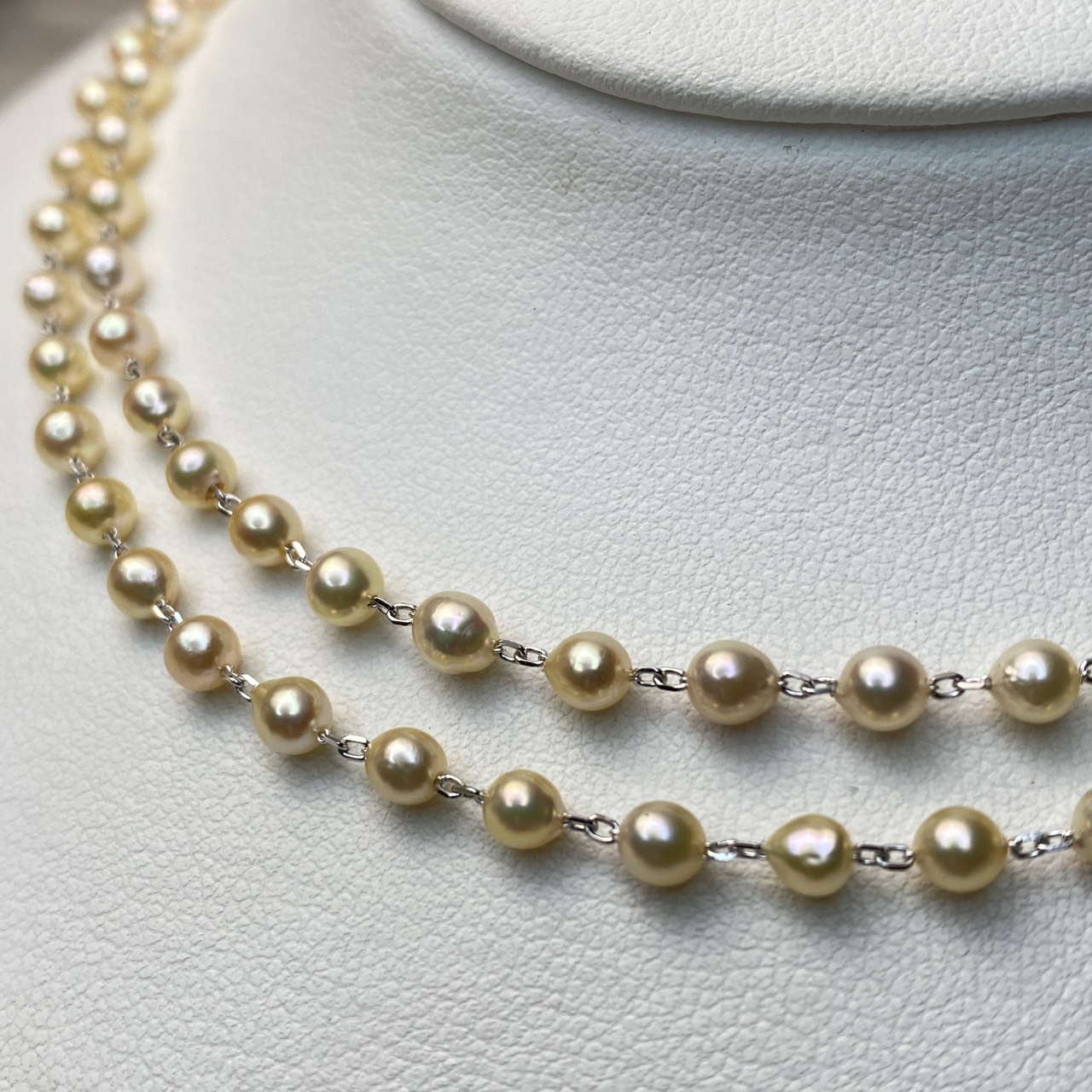
Also, regarding the Cosmos necklace, I described its color as cream in the product description.
However, when I photographed it on a white plate this time, the pearls appeared to have a lovely gold or cream-gold color.
As someone who has worked at a pearl farm, I am reluctant to casually describe pearls as gold-colored.
In the past, there were pearls with truly bright, rich, deep golden colors.
But recently, because of changes affecting the sea and Akoya oysters, pearls with those kinds of colors have become almost nonexistent.
Having known those golden pearls, I find it difficult to casually use the word “gold.”
However, when I looked at these pearls again, I thought,
“Wait a minute. Aren’t these gold?”
So I compromised and described the color as “cream gold.”
Sometimes I think this is rather pointless pride on my part.
I feel something similar when I see pearls advertised as AAA quality on Etsy and elsewhere.
Personally, I sometimes look at those pearls and think,
“How can these be AAA? They look like B or C quality to me.”
However, when I read the reviews, the buyers are extremely satisfied, so I cannot really complain.
Something similar happened at the pearl company where I previously worked.
The company was selling a beautiful necklace made with round, white-pink, no-toned Akoya pearls through mail order.
This was about ten years ago, when no-toned pearls were not yet a topic of general interest.
We received a letter from a customer who had purchased the necklace.
She wrote that the necklace she had purchased was very beautiful.
However, one day she decided to take it to an old-fashioned jewelry shop in her neighborhood and ask the owner to examine it.
The shop owner told her,
“This is fake. Real pearls don’t have such strong luster, and they have lots of blemishes.”
Naturally, she became worried.
“Is the necklace I purchased a fake?”
When we read her letter, everyone at the company was deeply moved.
We all said,
“This is the greatest compliment we could receive!”
Of course, we properly explained the situation to the customer and cleared up the misunderstanding.
The definition of pearl quality is rather ambiguous.
People who love pearls and buy them frequently gradually accumulate a certain amount of knowledge about pearl quality.
However, someone who is not particularly interested in pearls may accept a pearl of relatively low quality as a good one simply because a professional tells them,
“This is a good pearl.”
When I first started working at a pearl company, I once showed a friend a high-quality pearl necklace and a low-quality pearl necklace.
Without any explanation, he could not tell the difference.
When I said,
“Look, can’t you see the difference in luster?”
He replied,
“Well, now that you mention it, maybe I can.”
That was about the extent of it.
For this reason, I think it is very important to consider which pearl dealer you buy from.
Even among the pearl dealers in Kobe, each company has its own characteristics.
Some companies place particular importance on luster.
Others emphasize roundness.
Some focus on low prices.
There are also companies that handle pearls that are round, have few blemishes, and do not have particularly weak luster, yet somehow still feel lacking.
On the other hand, some pearl companies focus almost entirely on luster.
I absolutely love the pearls handled by those companies.
Oh dear, it is already 8 p.m.
This time, I took new photographs of the necklaces and gave their listings something of a renewal, so I thought I would write an article about it.
Originally, I intended to write a short piece and publish it as news.
However, it has become rather long, so I think I will post it on my blog for the first time in quite a while.
How happy I would be if I could stay in Kobe and work with pearls all the time instead of traveling to Osaka.
I always think about that for approximately five seconds just before leaving Kobe for Osaka.
However, if I eventually become able to make a living entirely from pearls, I will also find myself in a situation where I absolutely must sell pearls.
So it would not necessarily be a situation I could celebrate without reservation.
Perhaps this period of my life, when I am longing to someday make a living entirely from pearls, is also a happy time in its own way.
When we were children, I think we used to look forward to Christmas for about a month.
But the moment we received our presents, that excitement came to an end.
Our next dreams and hopes were the New Year’s money we would receive from our relatives.
Perhaps the excitement of a school excursion also reached its peak on the day before the trip.
People have been saying things like this for a long time, haven’t they?
And of course, marriage is the same…
No, no. Surely happiness continues to increase steadily even after marriage.
Oh, and while I’m at it, one more thing.
Recently, I asked an AI called Gemini whether it could suggest any improvements for a pearl shop called Flower Jem.
I usually use ChatGPT, but Chappy tends to agree with people a little too much.
So I decided to ask Gemini, which I do not normally use, for some rather harsh criticism.
Its response was something like this:
“Flower Jem is not a good shop name. It sounds cheap, like the name of a shop selling toys. Isn’t Jem a misspelling of Gem, which is the correct word? You sell pearls, yet the name doesn’t even contain the word pearl. This may make customers distrust your shop. You should change the name.”
That was quite a punch.
However, it is true that Jem is a misspelling of Gem.
Of course, I doubt that many people think much about the name of my shop in the first place.
Nevertheless, just to be safe, I thought I should occasionally explain its origin to clear up any misunderstandings.
And that occasion is now.
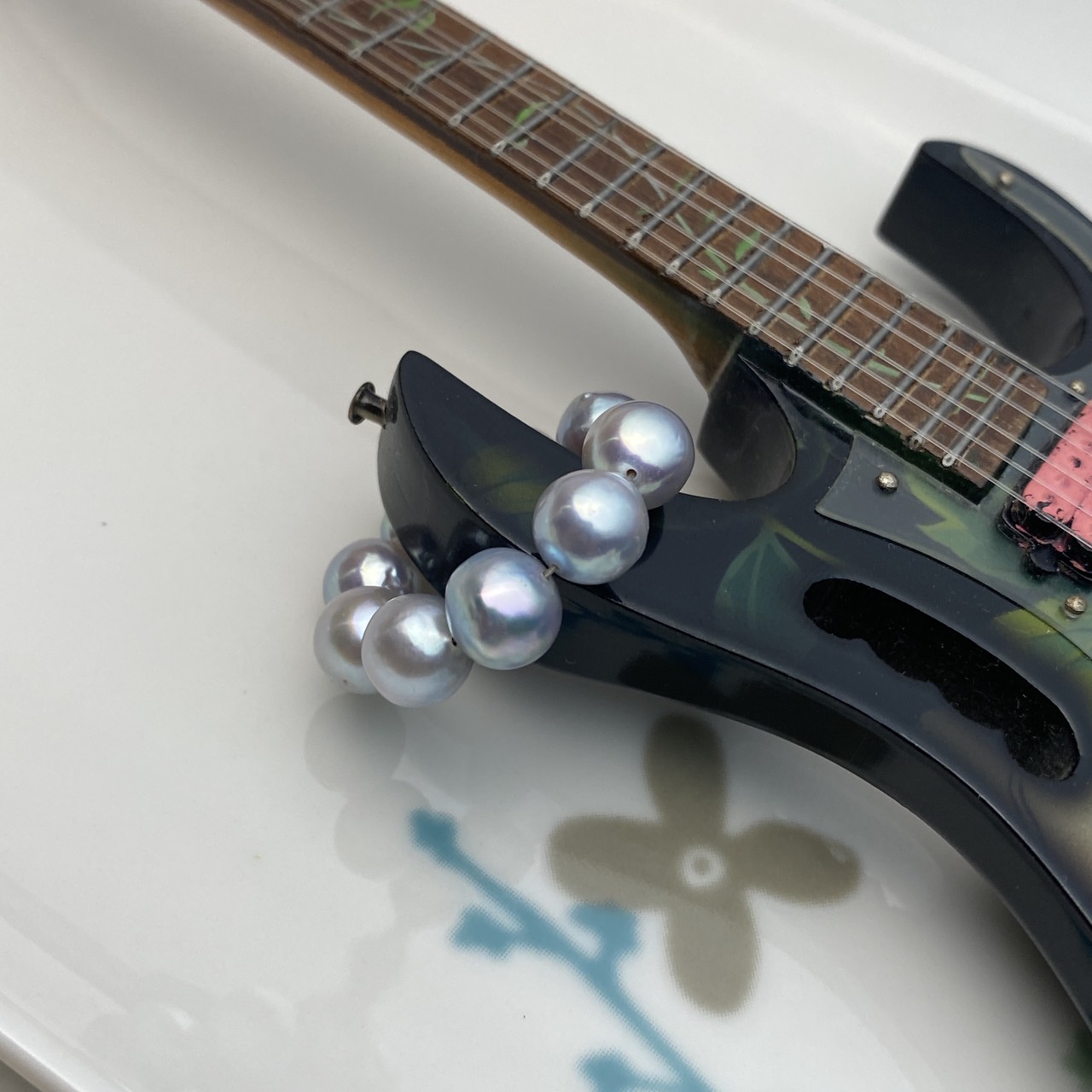
The name Flower Jem comes from a guitarist from Long Island, New York, whom I have admired since I was fifteen years old.
When I was around eighteen, I purchased one of his signature-model guitars.
The guitar had a design called Floral Pattern.
JEM is the name he gave to his signature guitar series.
Incidentally, I have heard that the name JEM did not originally come from Vai himself.
Apparently, it was the name used by Joe Despagni, a close friend of Vai’s since high school, for guitars that Joe made himself.
Vai apparently began using the name JEM for his own guitar series as well, partly to help promote his friend’s guitars.
I also vaguely remember reading somewhere that the word Gem was somehow included in the meaning of JEM.
I think it was in a context something like, “I want to produce a sound like a jewel.”
In other words, the name Flower Jem comes from the guitar that I love and use.
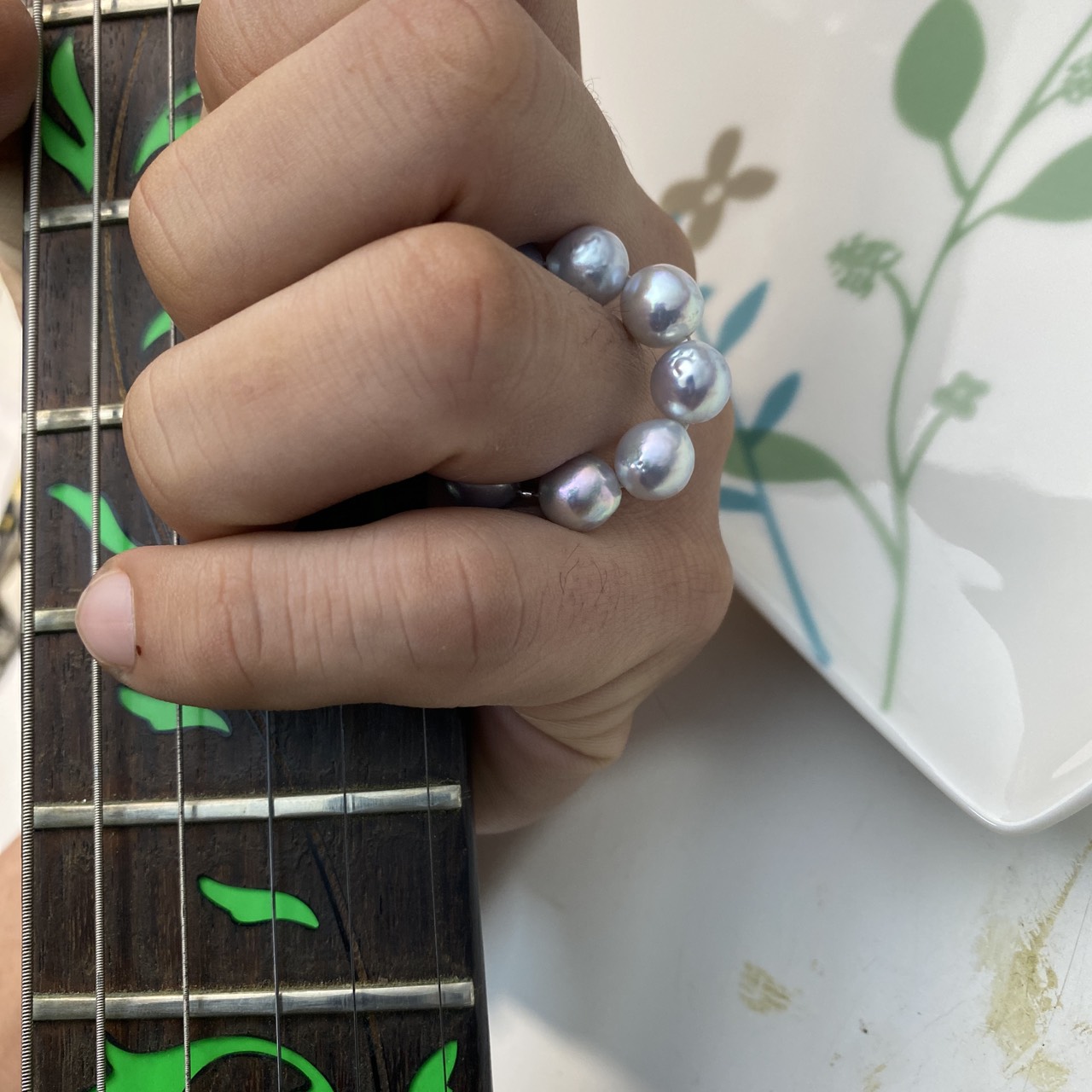
In the pearl farming industry, beautiful pearls discovered at harvest have long been called “Hana-dama,” regardless of any pearl grading certificates.
It is what you might call the traditional language used at pearl farms.
“Hana” means flower, and “dama” refers to a pearl, but it can also be interpreted as a gem.
So Flower Jem can also carry the meaning of “Hana-dama.”
“All right, all right. I get it already!”
Yes, I think I will stop here for today.
Before you go, please take a look at the Sakura, Cosmos, and Rose necklaces below as well.
Subscribe for Pearl Stories🐾
Receive occasional letters from my workshop —
stories about pearls, silverwork, Lulu the little dog, and quiet life in Japan.
As a thank you, you’ll get a secret code for 30% off —
usable every time you order, only here, not on Etsy.
I don’t send spam. Just little notes filled with love and pearls 💫
You can read our privacy policy for details.

Comment