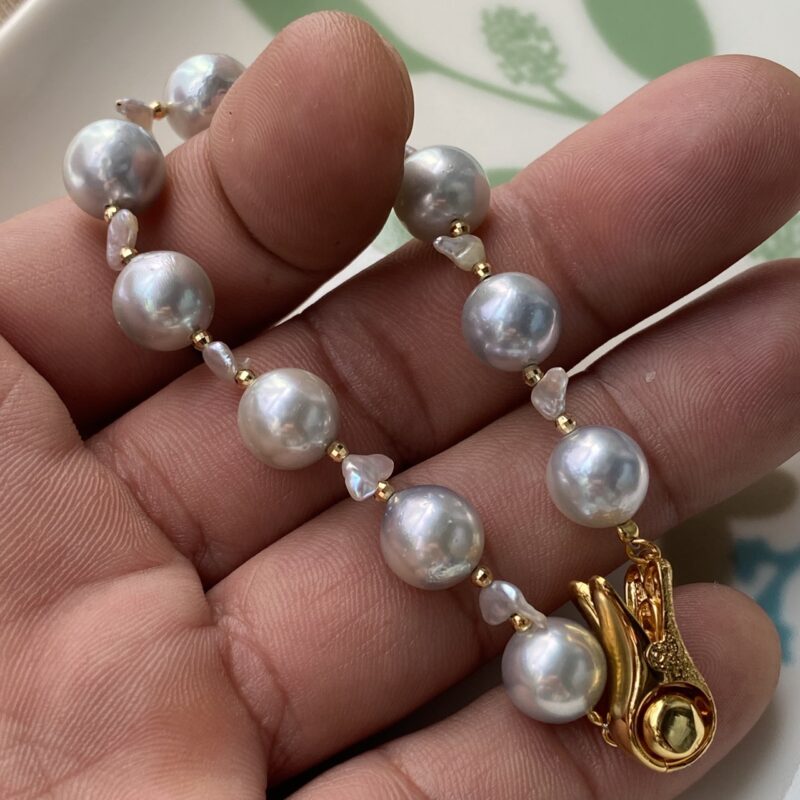
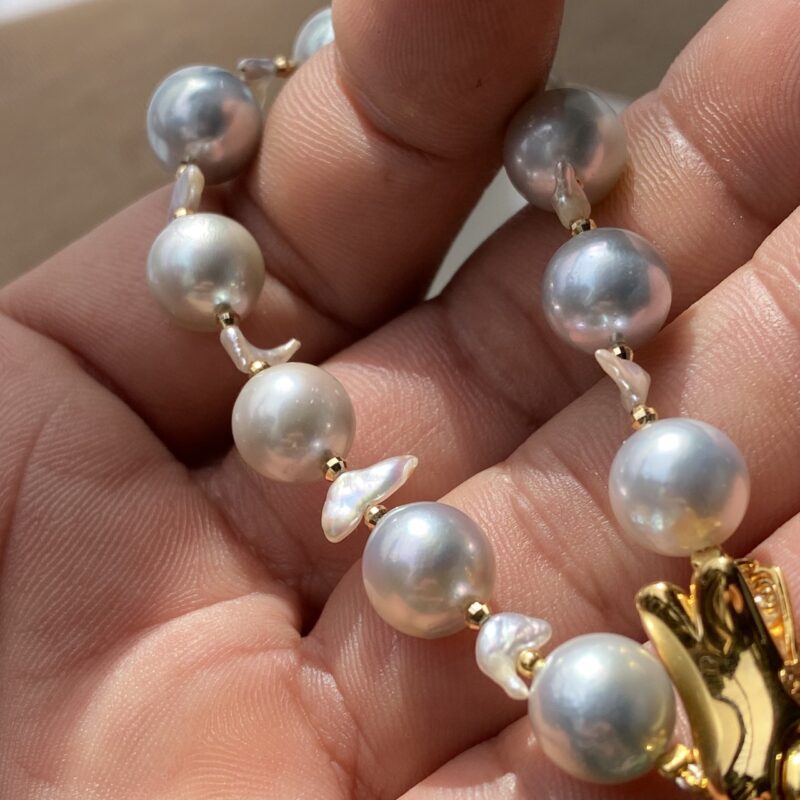
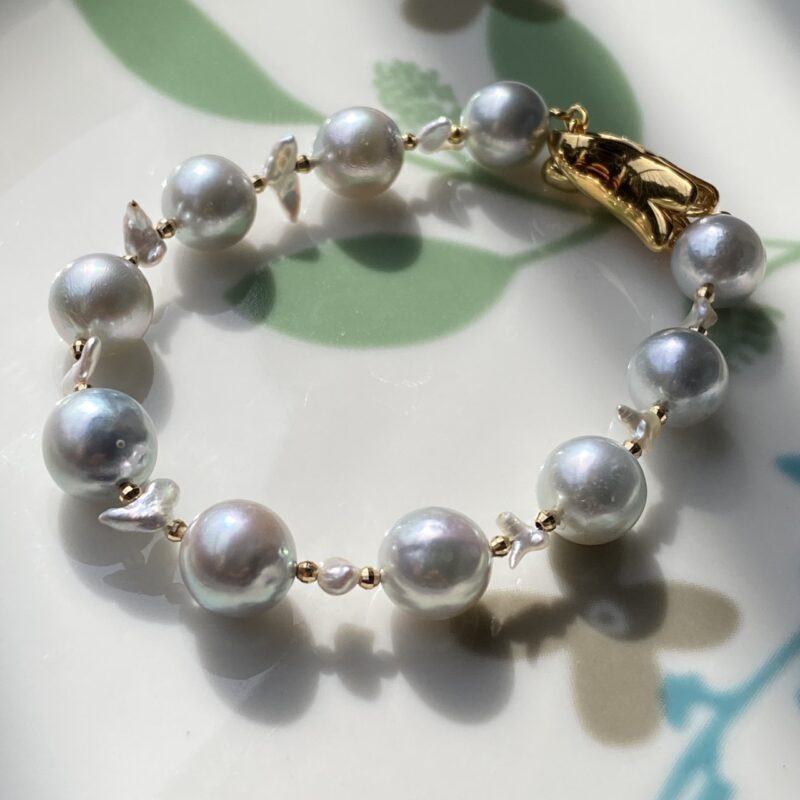
9mm Natural Blue Akoya Baroque Pearl Bracelet, 19 cm, Japanese Akoya Pearls, Keshi Pearls, K18 Yellow Gold Mirror Balls
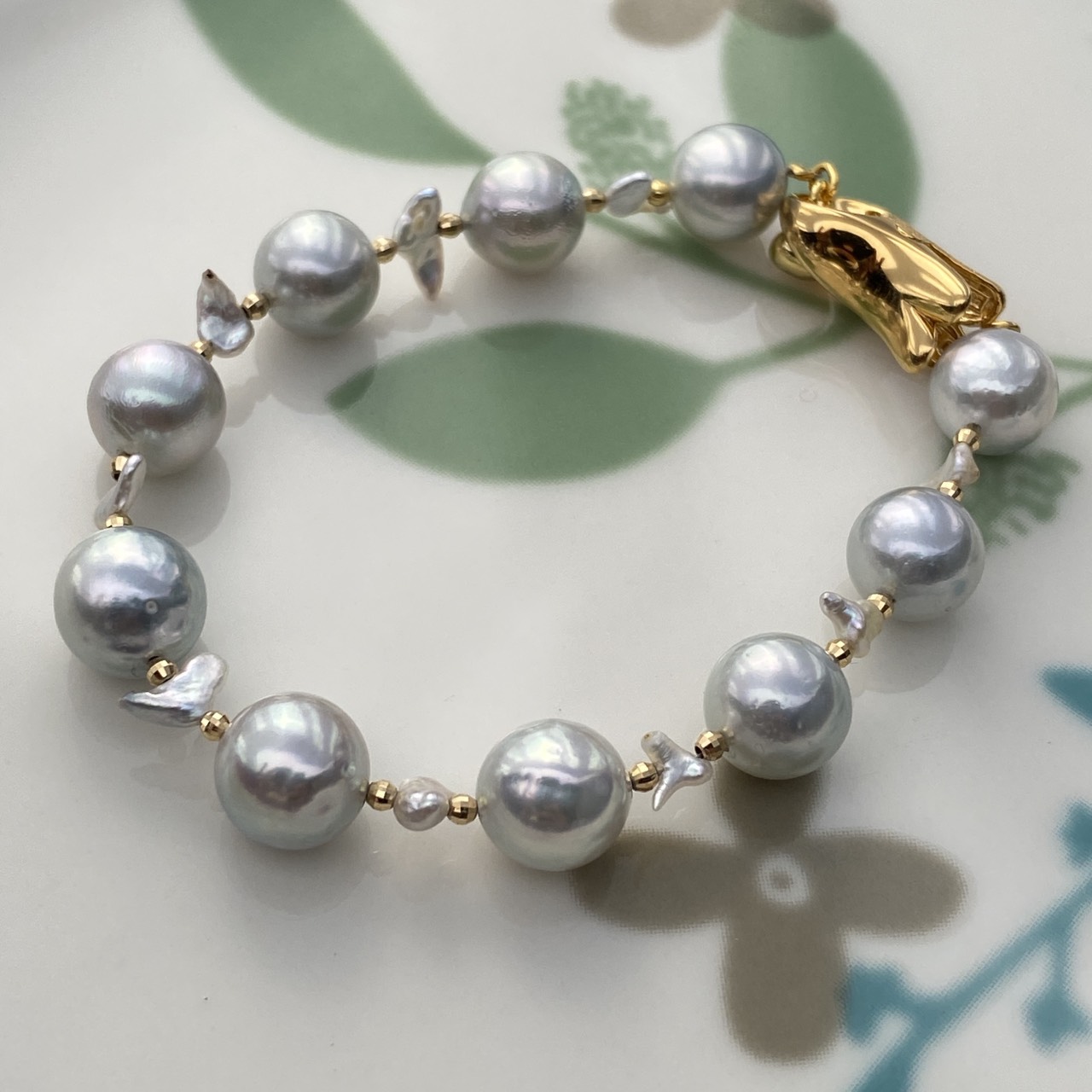
River Bloom 9-006
$740.00
1 in stock
🌸River Bloom 9-006
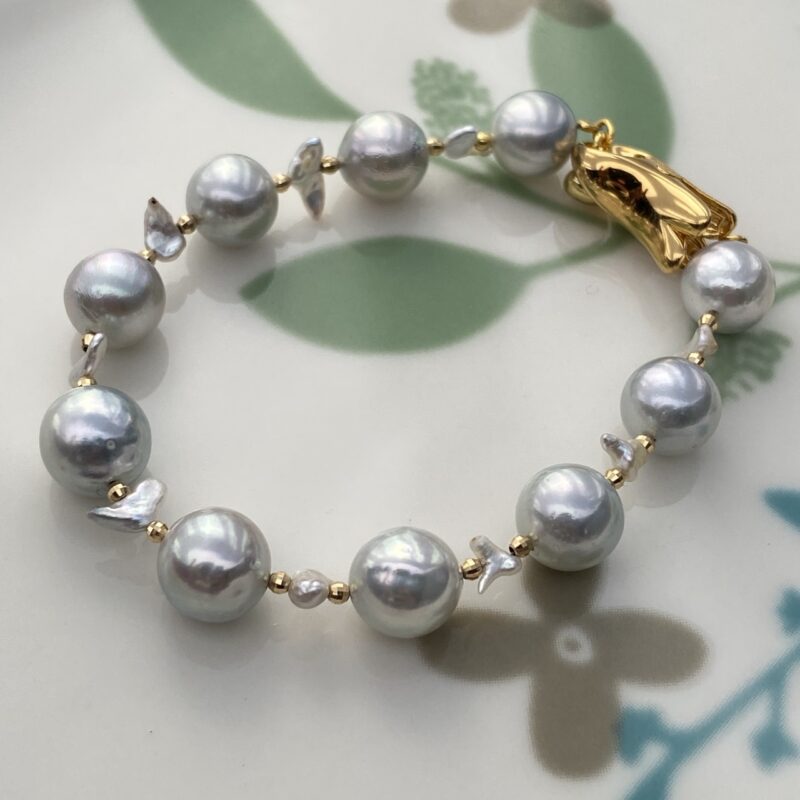
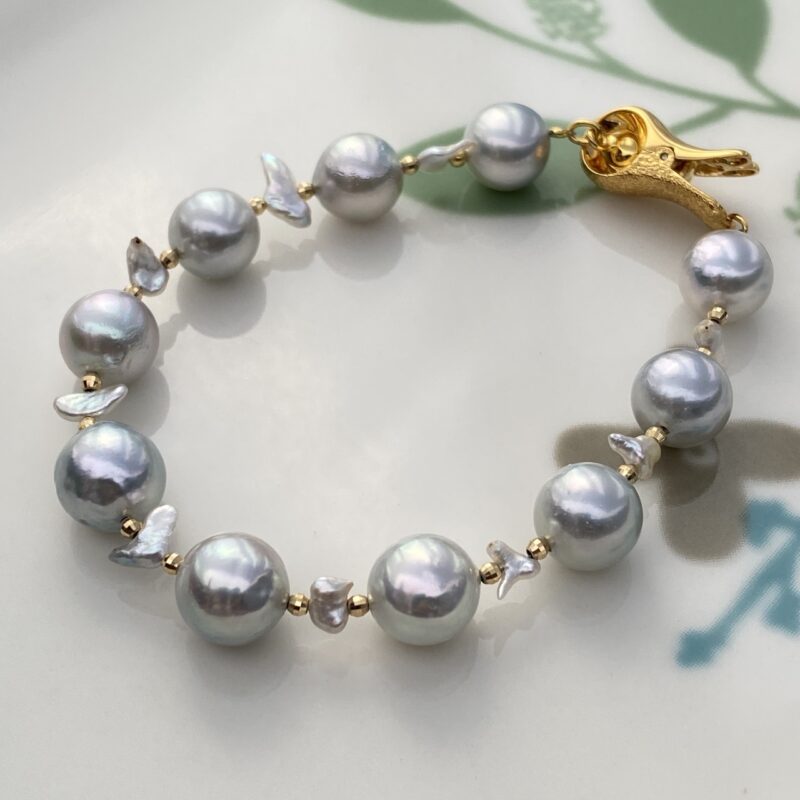
Length: 19 cm
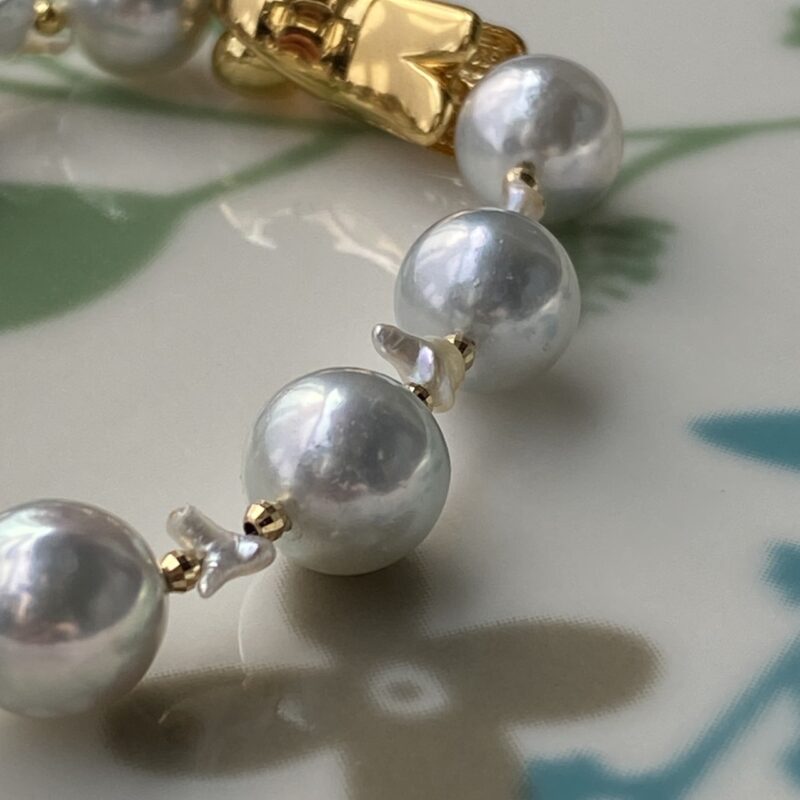
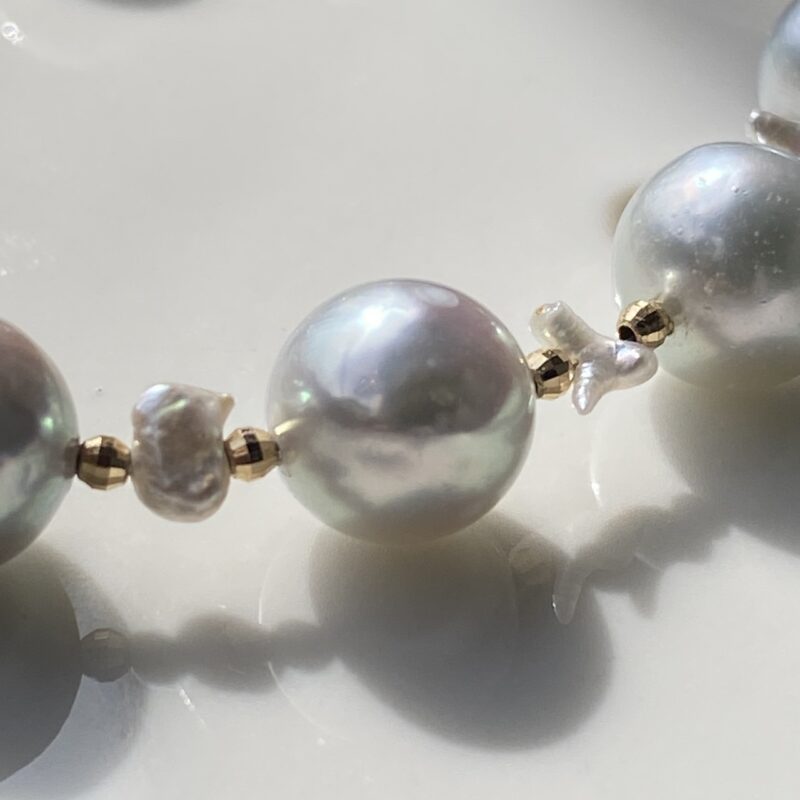
Pearls: 9 mm Natural Blue Near-Round Akoya Pearls (Untreated) and Natural Akoya Keshi Pearls
Luster: 3/5 (Moderately Strong)
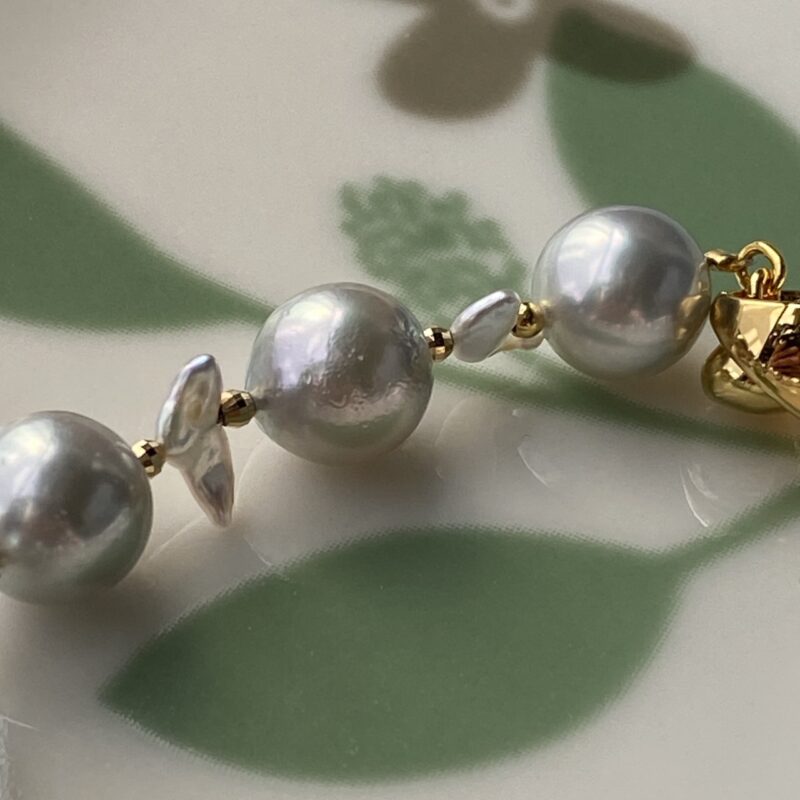
Mirror Balls: K18 Yellow Gold
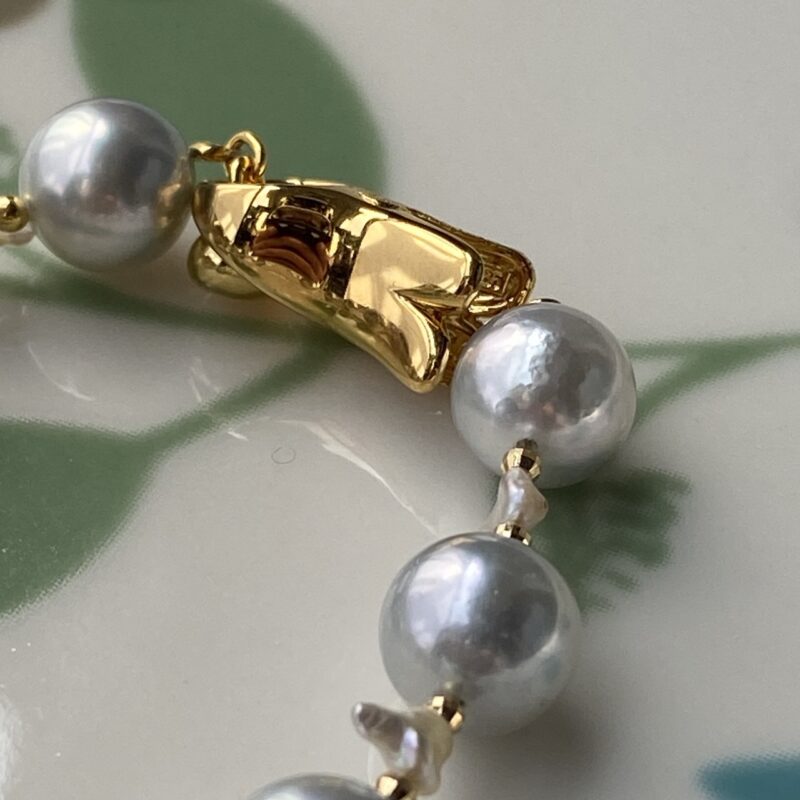
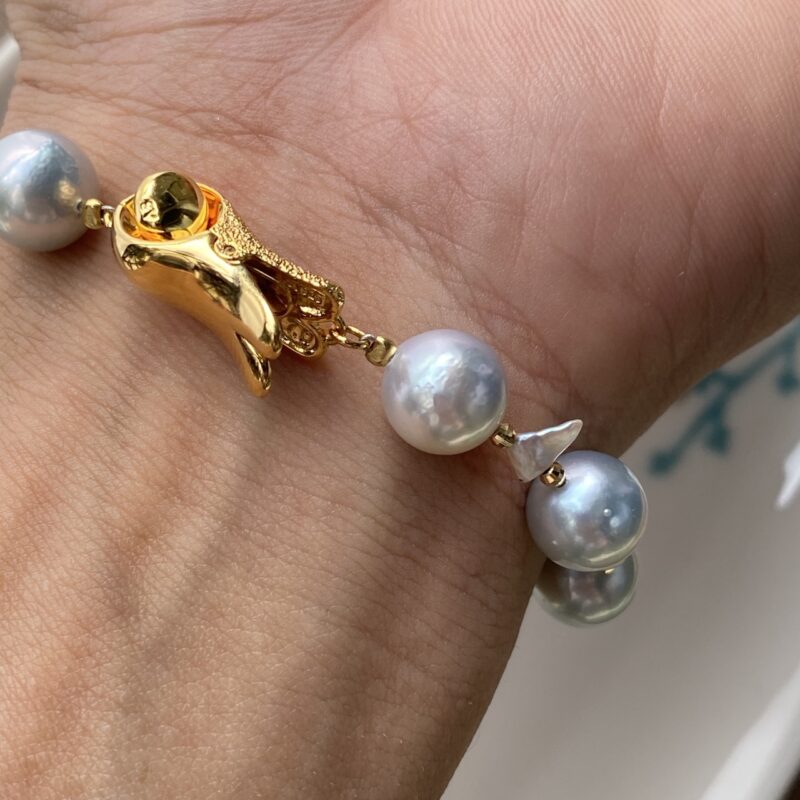
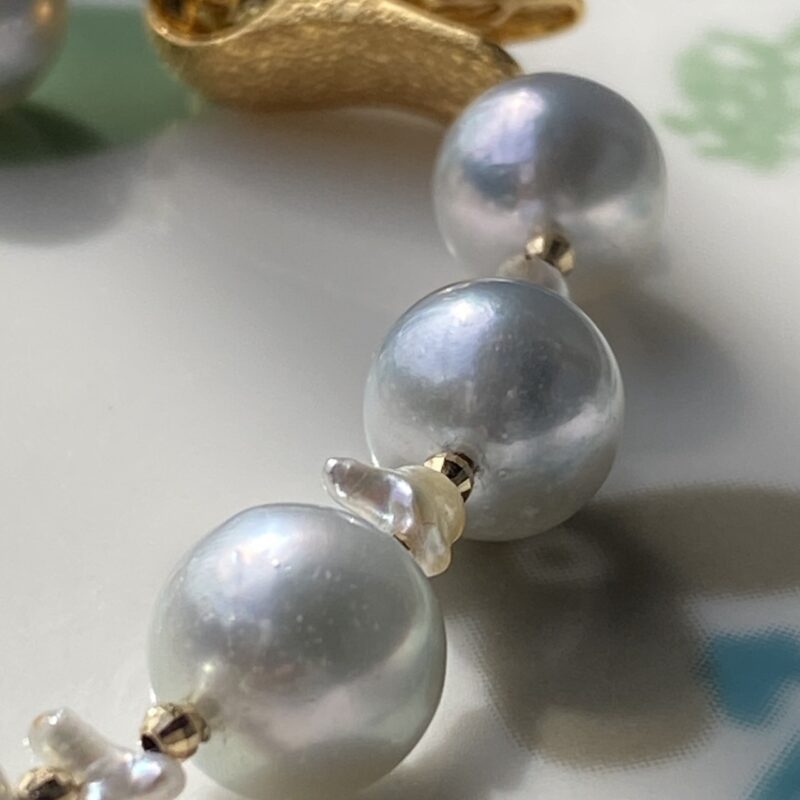
Clasp: Gold-Plated Sterling Silver
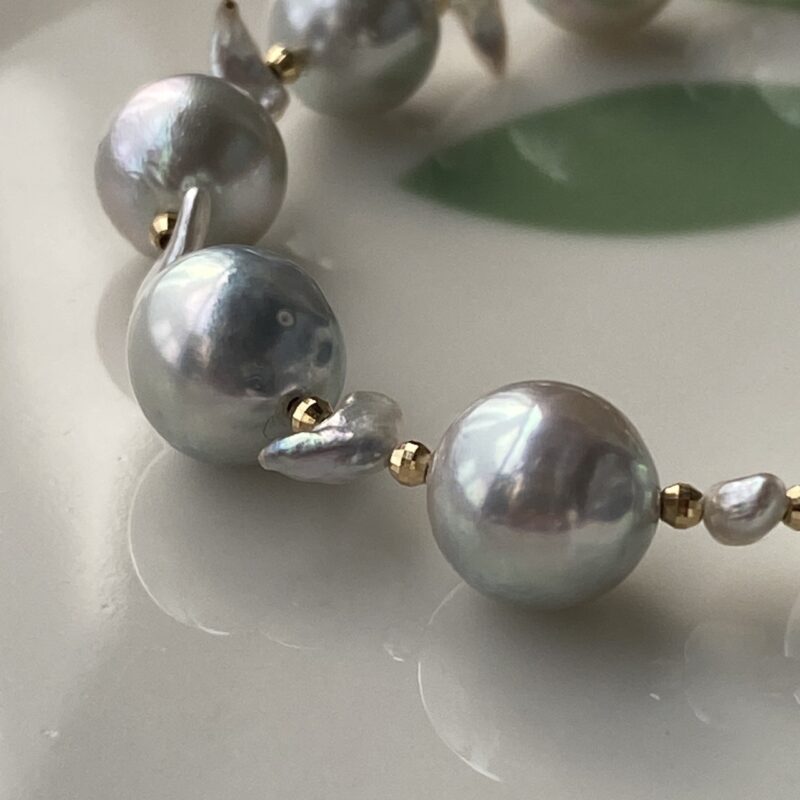
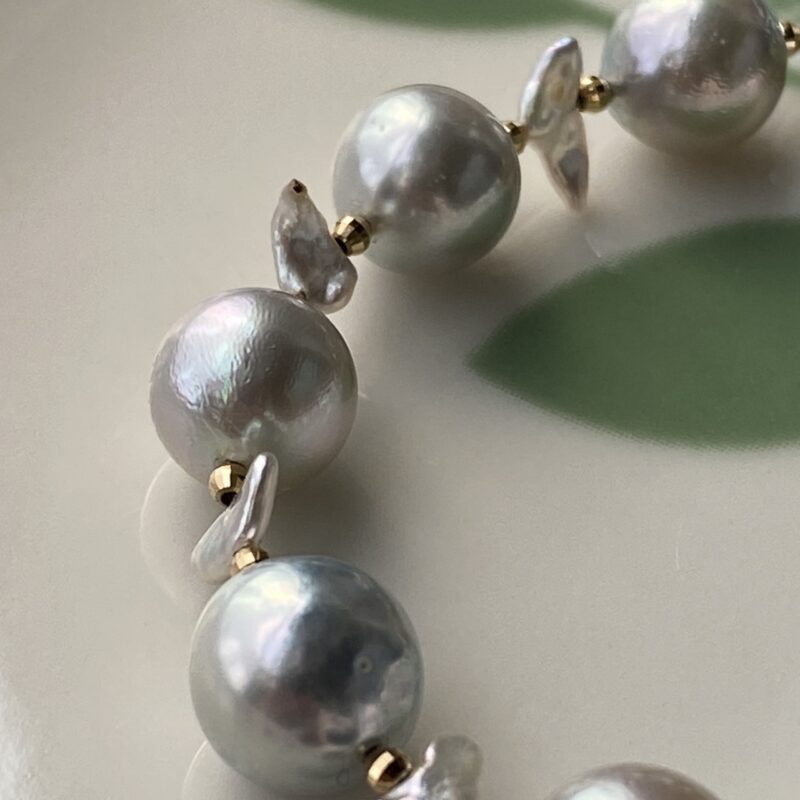
The sixth of seven bracelets handcrafted from a lot of 114 Akoya pearls. Some pearls have small white spots and fine surface wrinkles.
🌸Shipping to the United States
Flower Jem pays all customs duties and other import-related charges in advance for shipments from Japan to the United States. Your order will be delivered with these costs already covered by Flower Jem.
🌸How does the combination of blue pearls and gold fittings look to you?
To me, it somehow evokes the atmosphere of the Middle East.
I have heard that natural pearls from Akoya oysters were once a major industry in the Middle East.
Natural pearls were collected from Akoya oysters living in the Persian Gulf.
Since it was important enough to be a major national industry, I imagine that a considerable quantity of pearls must have been harvested.
I once heard from a pearl dealer in Kobe that people in the Middle East and Europe tend to prefer baroque pearls because they have been familiar with natural pearls for a long time. On the other hand, Americans tend to prefer round pearls.
I feel that this is merely an old generalization.
After all, there are Japanese people who dislike natto, and there are Australians who like natto. Generalizations do not apply to specific individuals.
If I worked in a national statistics department, such general statistics would probably be useful for my work.
However, for a small shop like Flower Jem, it simply comes down to the fact that every person is different, regardless of their country or the shape of the pearls they prefer.
Now, the pearl industry that had been a major industry in the Middle East began to decline after Mikimoto succeeded in cultivating pearls.
The industry that replaced the pearl industry was the oil industry.
Needless to say, it was an enormous success.
I have heard that cultured pearls were once one of Japan’s leading export products, but today their export value is even lower than that of mackerel, a seafood product.
A few years ago, I looked at JETRO’s statistics and was surprised.
“Less than mackerel?”
Incidentally, I love mackerel.
If I simply grill it and season it with sugar, mirin, and soy sauce, I find it very delicious.
Pearl production in Japan has also been declining year after year.
Rising seawater temperatures are said to be one of the causes.
A few years ago, I investigated a sea area where large numbers of Akoya oysters once lived.
Ten years before that investigation, it had been easy to collect three million Akoya oysters there.
However, when I asked several divers to search for Akoya oysters on several occasions, they found only 50 oysters.
Instead, they found black-lip pearl oysters here and there.
Black-lip pearl oysters live in warm waters.
Japan is becoming an environment where South Sea pearls might also be cultivated.
Global warming is a serious problem, but if we look at things over a slightly longer period, the Earth was formed 4.6 billion years ago.
During that time, there must have been ice ages and periods of extreme heat.
And there is that familiar comparison: if the Earth’s 4.6-billion-year history were compressed into a single year, humans would have appeared only a few minutes before midnight on New Year’s Eve.
When I think about things like that, a rise of two or three degrees in seawater temperature seems like a natural occurrence to me.
In fact, the manager of a pearl farm, who works with nature every day, accepts things beyond his control, such as rising seawater temperatures, quite easily.
“Well, there’s nothing I can do about it, so I don’t think about it. I just do what I can.”
That’s what he says.
He often told me that people like me, who do not normally work with nature, are more likely to think, “We have to do something to fight global warming.”
He said that such thinking comes from not understanding the greatness of nature.
That is something the pearl farm manager often told me.
However, a few years ago, that same manager rather readily installed an air conditioner in the workroom where nuclei are inserted into Akoya oysters.
Have you ever watched someone insert a nucleus into an Akoya oyster?
I have.
The Akoya oyster is fixed in position with its shell held open, and a narrow, elongated scalpel is used to make an incision of a few millimeters at a designated spot.
Through that incision, a long, spoon-like instrument is used to insert a nucleus into the oyster’s body.
The instrument is inserted diagonally toward the upper left, and then the nucleus is placed diagonally toward the lower left.
To cultivate beautiful pearls, the precise location where the nucleus should be placed is clearly determined.
However, when inserting around 800 nuclei a day, some workers prioritize speed, and the placement of the nuclei becomes less precise.
Also, although they should be performing the same operation every time, individual habits gradually develop. Before they know it, some workers begin placing the nuclei in the wrong positions.
The room where the nuclei are inserted is very quiet.
Occasionally, the only sound that echoes through the room is the little splash of an Akoya oyster being tossed into a bucket of water.
If an Akoya oyster is carrying eggs when the nucleus is inserted, the resulting pearl will be covered in spots.
When workers find such an oyster, they do not insert a nucleus. Instead, they toss it into the bucket in front of them.
Such Akoya oysters are called “tamago-modoshi,” or “egg returns,” and are sent back to the process where they are made to release their eggs.
They are returned to the egg-releasing process. That is apparently why they are called “egg returns.”
Now, let me introduce this bracelet as well.
I was about to end this article without doing so.
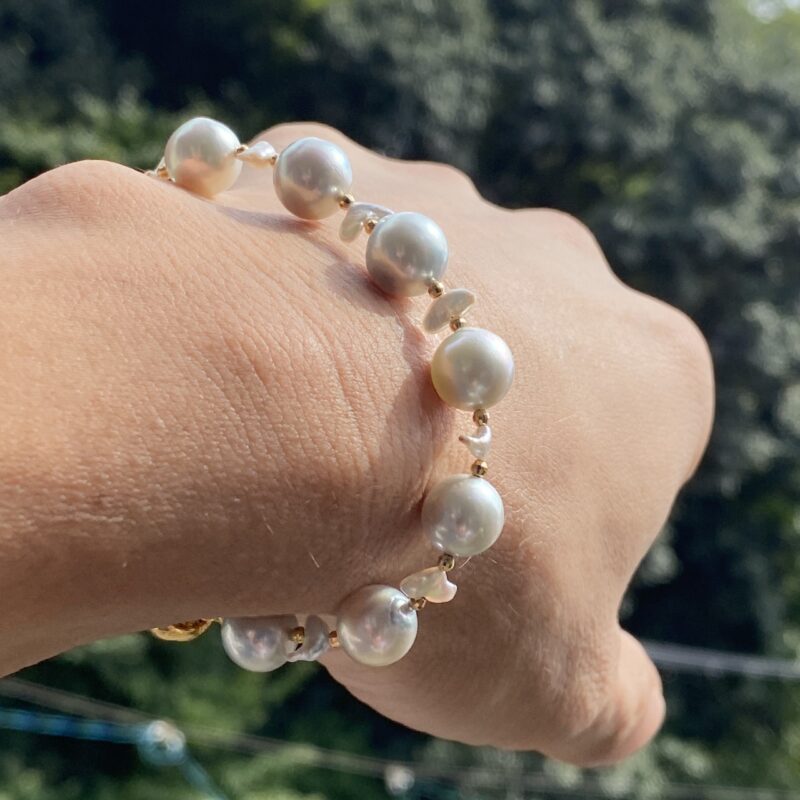
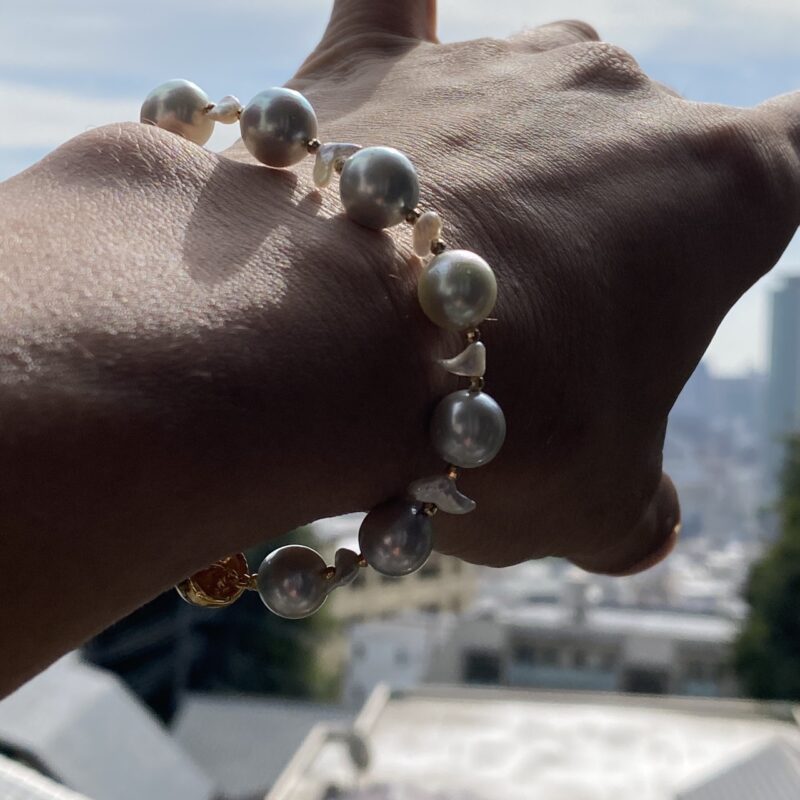
The length is 19 cm, and the 9 mm blue pearls have their natural color. They are what is recently fashionable to call “untreated” pearls, or “mouchoushoku” in Japanese.
Just to be clear, please remember that the distinction between color-treated and untreated pearls does not indicate a difference in quality.
It is like the difference between a beautiful woman without makeup and a beautiful woman wearing makeup.
Whether she is wearing makeup or not, a beautiful woman is beautiful.
And whether she is wearing makeup or not, if she is not beautiful, she is not beautiful.
That’s all there is to it. Whether she wears makeup has nothing to do with it.
This is a delicate subject, so please don’t think too deeply about it.
Just let it pass by without giving it much thought.
The pearls’ luster is about 3 out of 5, meaning that their luster is somewhat strong.
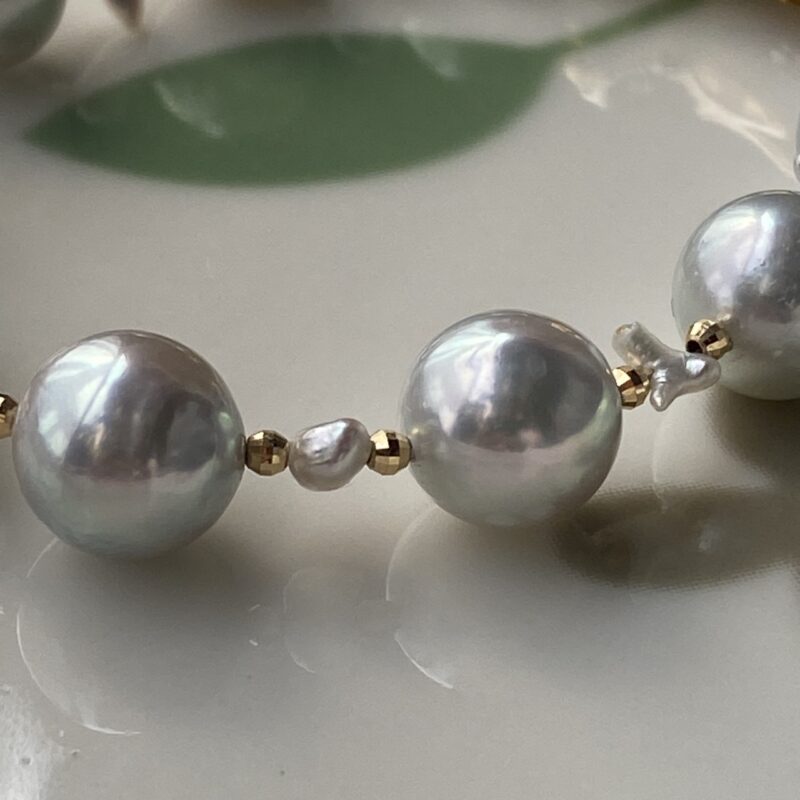
Their shapes are also closer to round than baroque, although they are slightly distorted. These are what we call near-round pearls.
Incidentally, the 9 mm pearls used in this bracelet originally came from a lot of 114 pearls.
I sorted those 114 pearls and made seven bracelets from them. This is one of those bracelets, and it was the sixth one I made.
As you might expect, the pearls used in the first bracelet were of the highest quality.
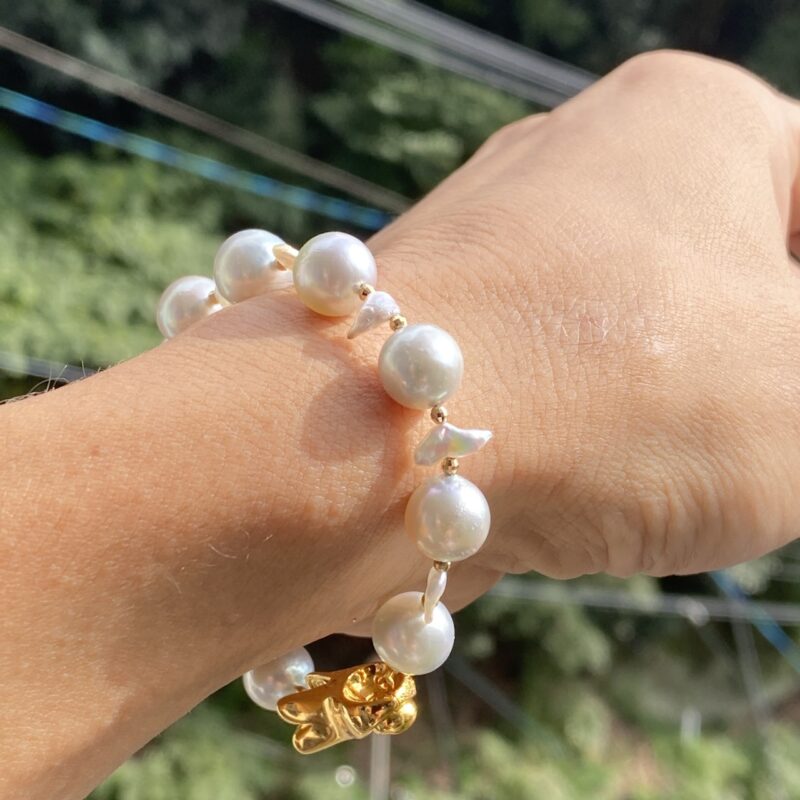
By the time I reached the sixth bracelet, many of the pearls had fine wrinkles or small white spots on their surfaces.
At least, those white spots and fine wrinkles are at a level that someone sitting across a table from you would not be able to see.
If someone sitting across the table from you says,
“There is a white spot on your pearl.”
Then that person is a little too particular about details, so it might be a good idea to see them less often.
And you should say this:
“You see, that white spot formed when the Akoya oyster was not feeling well and secreted something other than nacre while the pearl was still inside its body. That Akoya oyster must have had something unpleasant happen to it at the time. I wonder what kind of tiny faults someone had been pointing out to it.”
This is half a joke, but when an Akoya oyster becomes unwell, it secretes a white liquid.
This can form white spots, and in severe cases, the entire pearl becomes covered with a white film.
Pearl dealers regularly examine pearls taken from Akoya oysters during cultivation. By looking at the white films or spots, they can also use them as clues to determine approximately when the Akoya oysters were in poor condition.
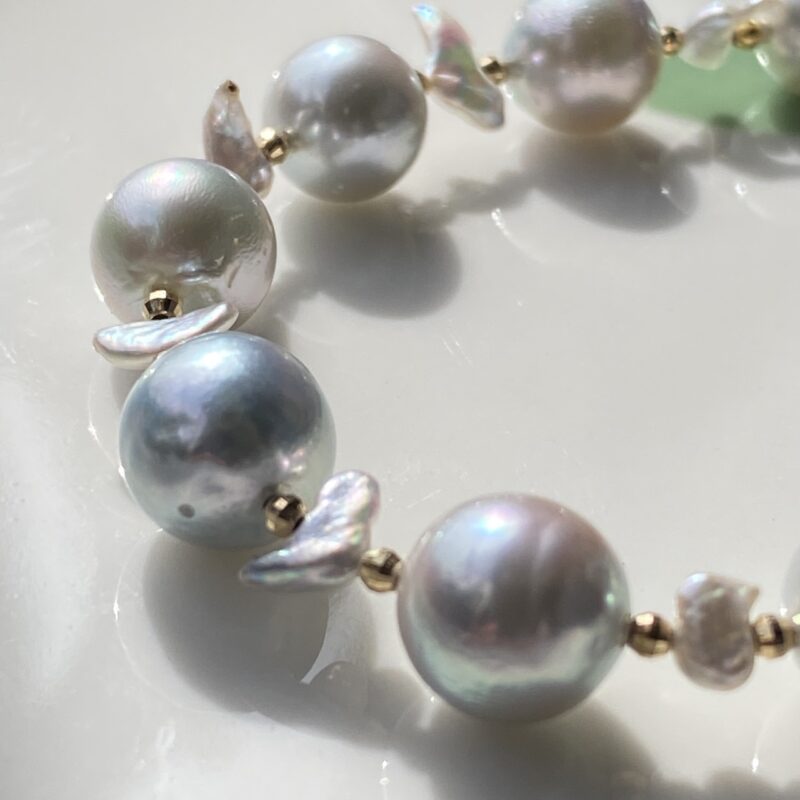
Even with such faint white spots, I think these are lovely pearls, as you can see in the photos.
And the mirror balls are made of K18 gold.
I could have used silver ones, but I thought K18 gold might somehow give the bracelet a little more tension.
The clasp is made of silver with gold plating.
I would like Flower Jem to become the kind of shop that can sell bracelets like this with K18 gold clasps.
I feel that the clasps used by famous and popular pearl shops are often made of white gold or K18 gold.
They are simply beautiful.
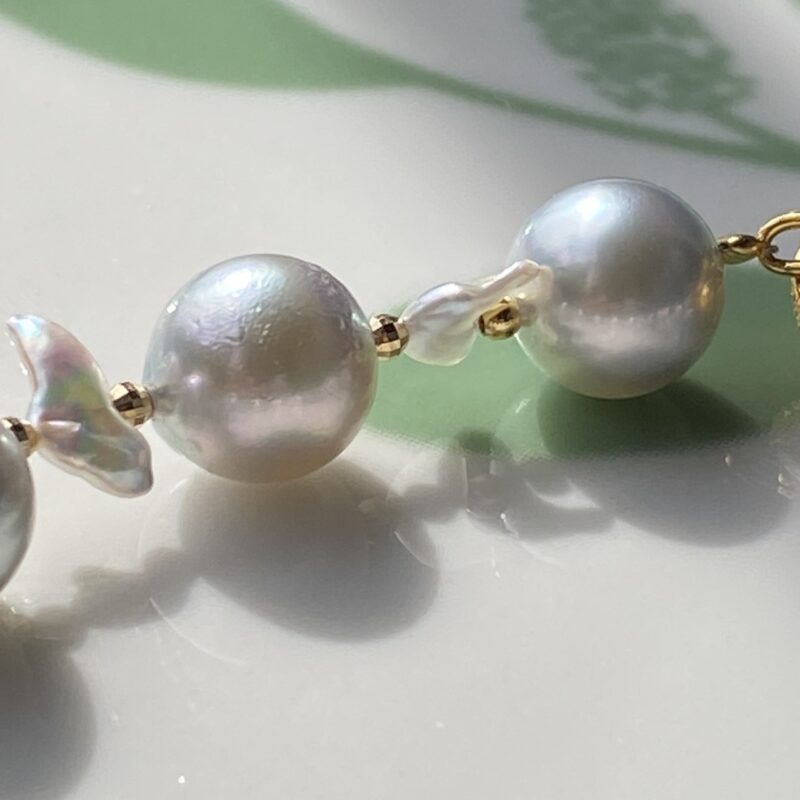
And between the mirror balls and the 9 mm pearls, there are Akoya Keshi pearls.
These are pearls that occur naturally inside Akoya oysters during pearl cultivation and are collected at harvest.
Normally, these River Bloom bracelets use 4 mm pearls, but this time I happened to use Keshi pearls that I had purchased around the time I was making the bracelet.
I made it as an experiment, but I think it turned out to be quite a charming bracelet.
There are River Bloom bracelets numbered from 01 to 07, so please look for the others and compare them.
Well, well, once again, this product description has ended up containing more digressions than information about the bracelet itself.
I am writing this article at 11:44 p.m. on Saturday, November 14, 2026.
On weekdays, I work in Osaka at a job unrelated to pearls. Since this week’s work is over, I returned to my home in Kobe from Osaka tonight.
My weekday job involves physical labor as well as a great deal of office work, so it is very tiring.
This week was also extremely busy, and I am very sleepy. However, my product listing work is behind schedule, so I am working now because I want to list at least one item tonight.
In other words, what I am trying to say is that I am sleepy, and that is why this article has become rather careless.
On the other hand, perhaps it could also be taken as an honest product description.
For me, the image of this bracelet is nothing but the Middle East.
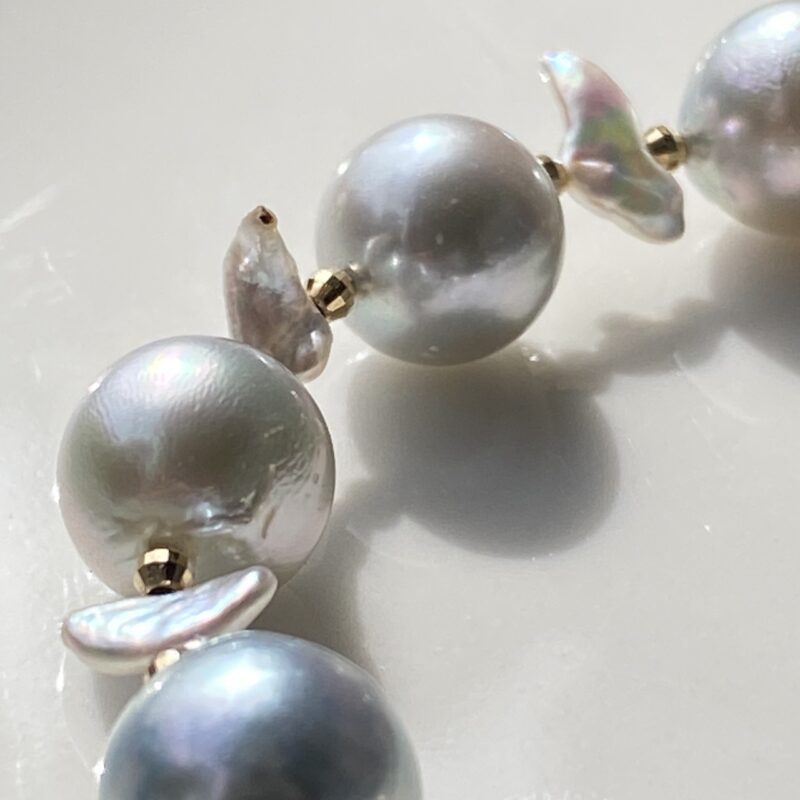
Thinking of the Middle East led me to the history of its pearl industry, Mikimoto’s success in pearl cultivation, and the transition to the oil industry.
As it happens, the 9 mm pearls in this bracelet are cultured, while the Keshi pearls are natural, so the story about the Middle East is neither completely unrelated nor particularly closely related to this bracelet.
Now, if the person wearing this bracelet becomes an oil tycoon, everything will be perfect.
If you become an oil tycoon, please contact me.
I have something important to discuss with you.
Until then, Pearl Bless You.
🌸This is an introduction video featuring all seven River Bloom bracelets.
Explore the Flower Jem Library
If you enjoyed this story, you might also enjoy these three articles from the Flower Jem Library.
The first two take you deeper into Akoya pearl cultivation, from preparing oysters for nucleus insertion to manufacturing the nuclei themselves.
The third is a rather different story about remaking an Akoya Keshi bracelet, everyday life, and the people I have met through pearls.
As usual, not everything is strictly about pearls.
The Hidden Cycle of Akoya Pearl Cultivation: From Eggs to Luster
The Hidden Cycle of Akoya Pearl Cultivation: From Eggs to Luster
Inside a Pearl Nucleus Factory: How the Core of an Akoya Pearl Is Made
Inside a Pearl Nucleus Factory: How the Core of an Akoya Pearl Is Made
The Current State of Pearl Cultivation
Subscribe for Pearl Stories🐾
Receive occasional letters from my workshop —
stories about pearls, silverwork, Lulu the little dog, and quiet life in Japan.
As a thank you, you’ll get a secret code for 30% off —
usable every time you order, only here, not on Etsy.
I don’t send spam. Just little notes filled with love and pearls 💫
You can read our privacy policy for details.
This space is not only for reviews. You are welcome to write freely about pearl jewelry, ask questions, or share what you feel when you see this piece. Member registration is required to submit your message.
Pearls & Stories
There are no stories yet.