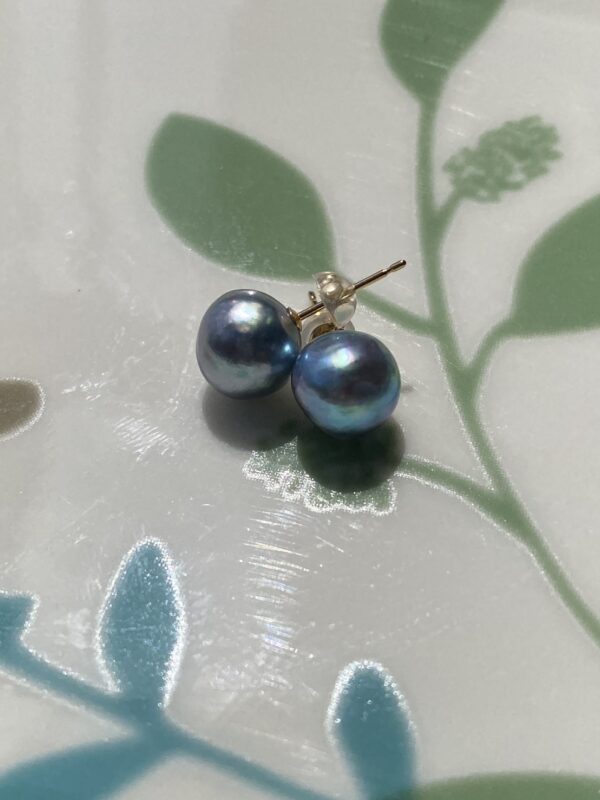
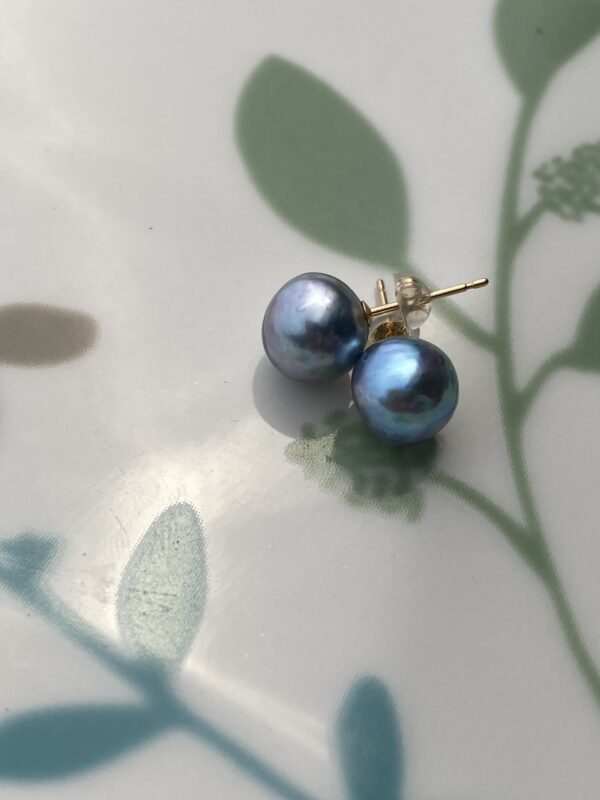
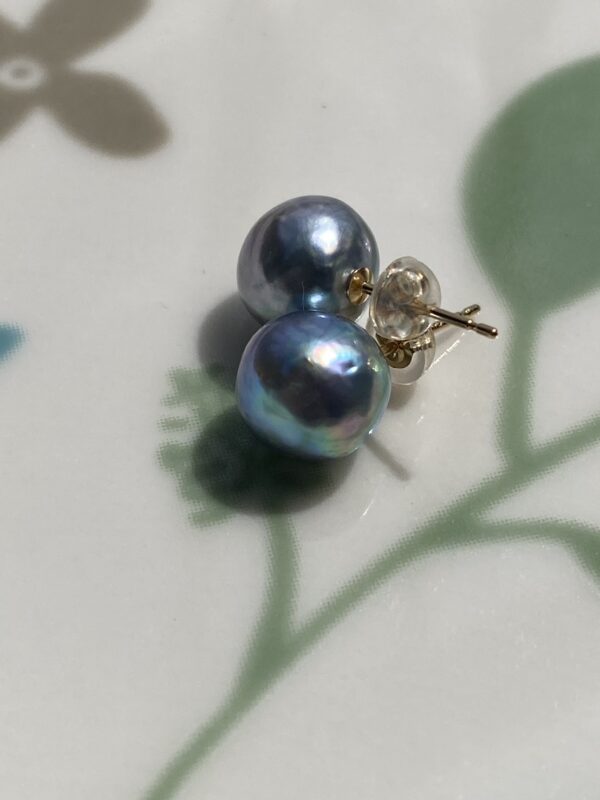
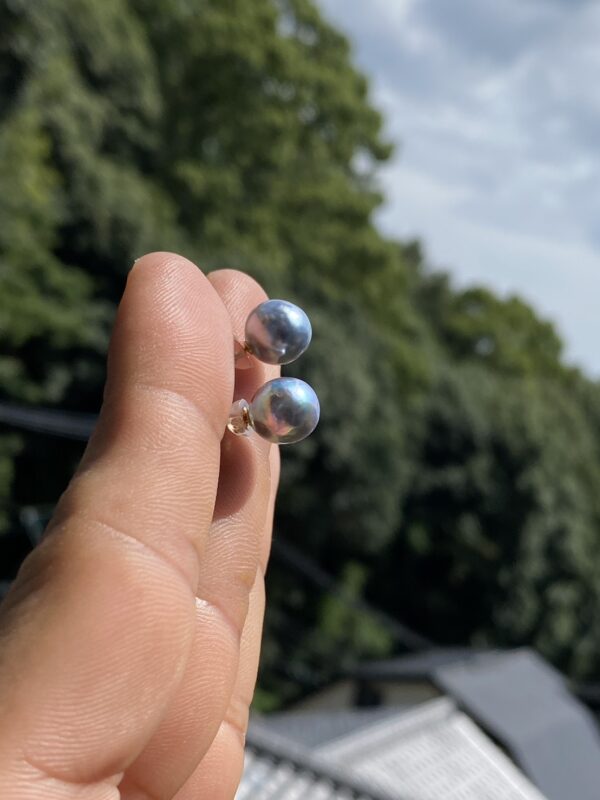
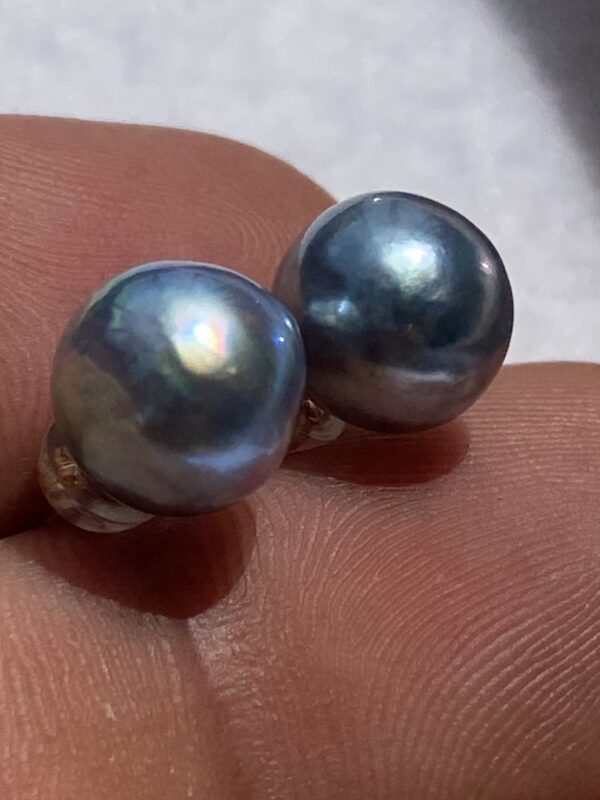
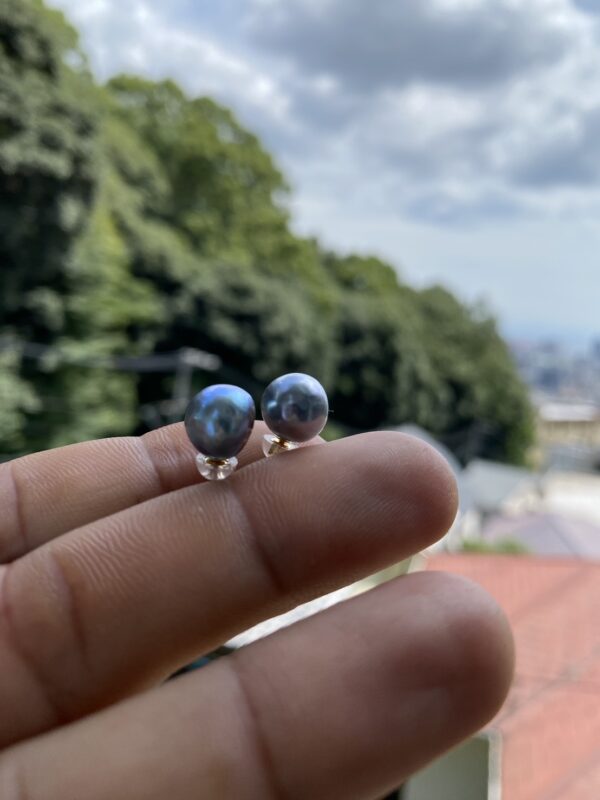
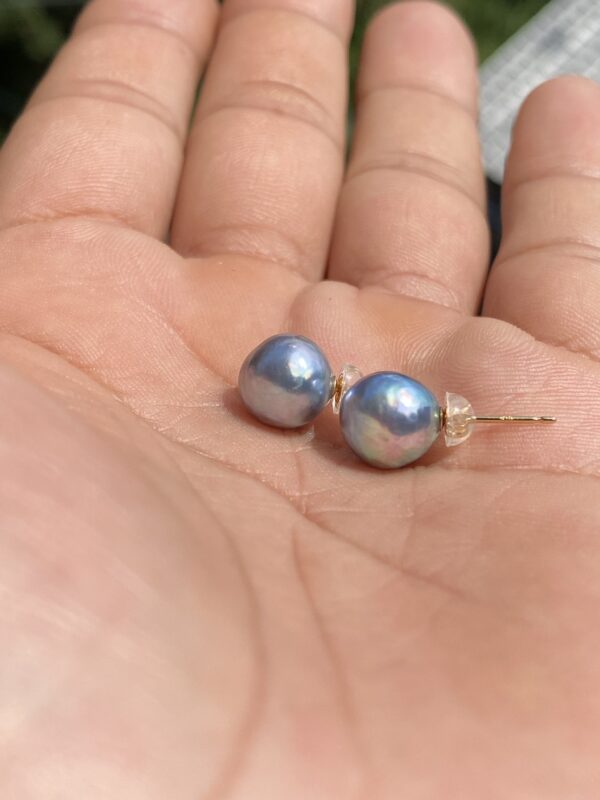
Natural Blue Akoya Pearl Earrings, K18 Gold fittings, Baroque Pearls, 8.5mm / 9.0mm, Good Luster, Japanese Akoya Pearls
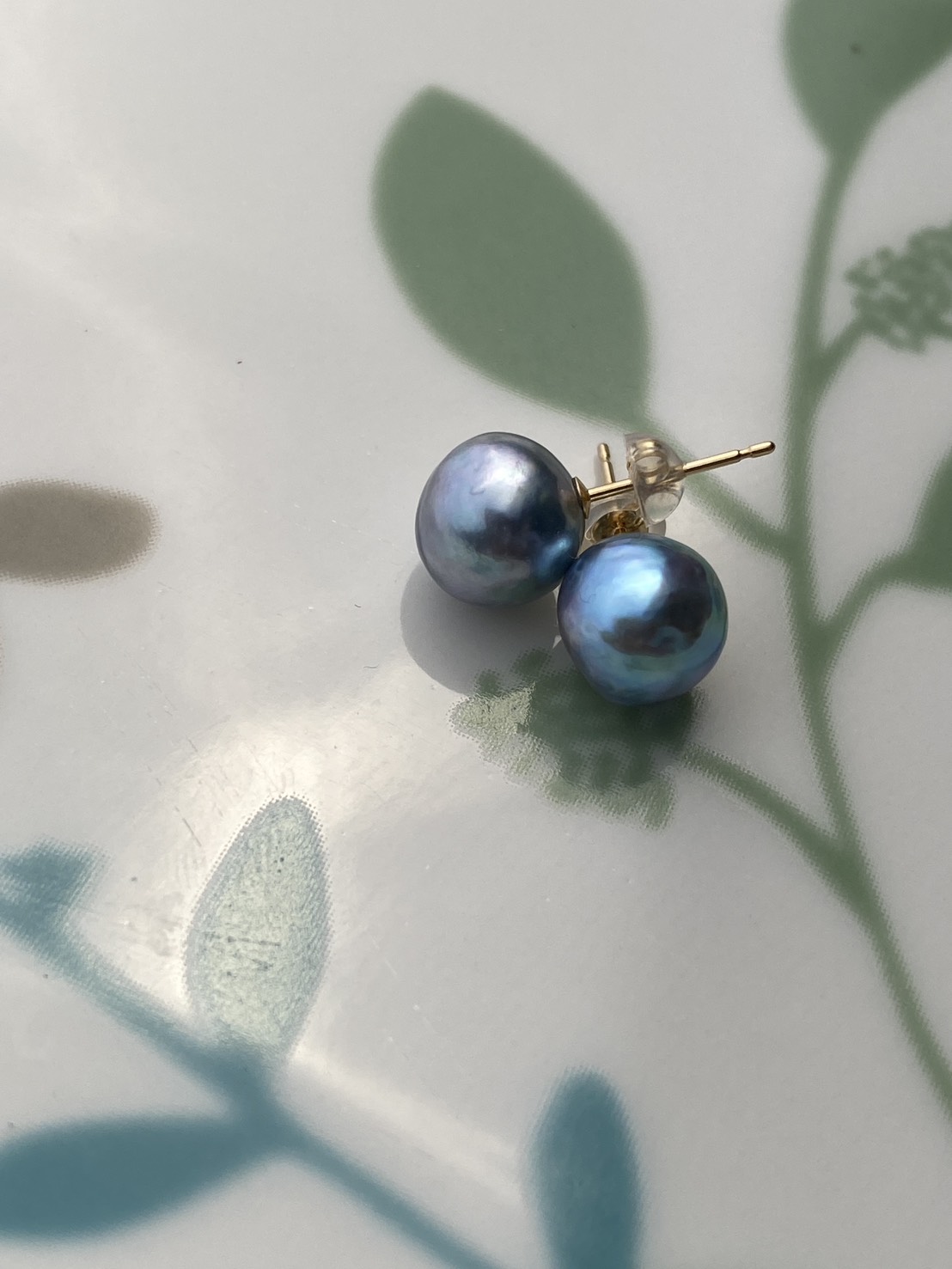
Obon-04
$330.00
Sold Out
Welcome to the world of blue baroque pearls.
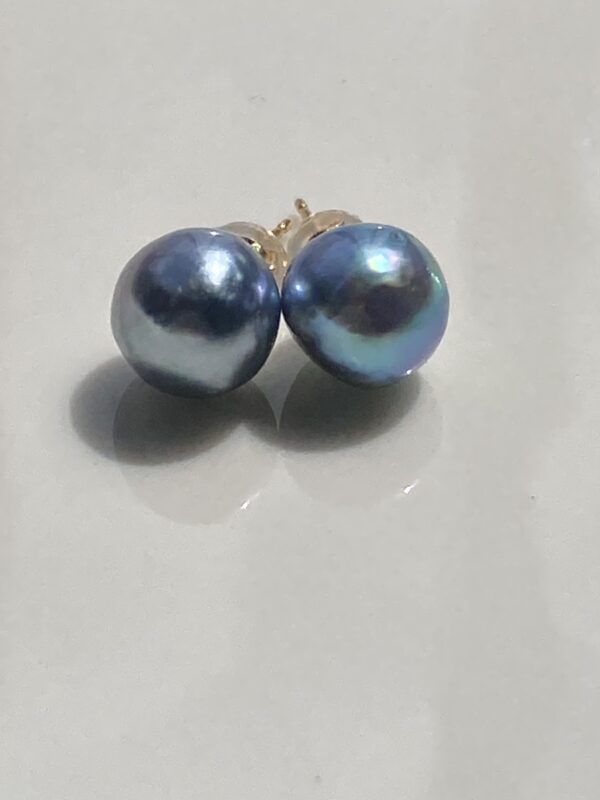
Did these deep natural blue baroque pearls catch your attention?
Before we begin, though, may I ask you one thing?
Have you already read the articles for Obon 01 through 03 before arriving at Obon 04?
If not, I would be very happy if you started with 01 and read them in order.
That said, please do not worry. This is not a mystery novel, and there is no puzzle that needs to be solved.
As you already know, Obon 04 is one of seven pairs of earrings in the Obon series.
I purchased approximately 114 natural blue baroque Akoya pearls in the 9 mm range, and the first thing I did was select the higher-quality pearls and make seven pairs of earrings from them.
This is one of those seven pairs.
After the seven pairs were completed, the remaining pearls were sorted once again and some of them were made into necklaces.
Even after that, more than half of the pearls are still left.
I will probably make something else from them one day, long after I have forgotten about them.
For about the past year, Flower Jem has been giving names to its pearl pieces.
Before that, my product names were rather mechanical things such as:
“8 mm Akoya Blue Baroque Necklace.”
Perhaps this was because I had spent years working for a pearl company, mainly in pearl farming and wholesale.
In that world, products are not given names.
There are only model numbers, sizes, shapes, and other mechanical specifications.
But with names like that, I could never immediately remember which pearl piece I had sold to which person.
So I began giving my pieces names.
Now, simply seeing the name of a piece often reminds me who bought it, and memories of making it also come back.
Of course, there are still a few pieces that have disappeared completely from my memory.
This time, I made seven pairs of earrings at once.
And, frankly, thinking of seven different names felt troublesome.
Since it was just before Obon, I decided to call them “Obon.”
I also realized that writing seven separate product descriptions about seven rather similar pairs of blue baroque pearl earrings would be difficult, even for someone like me who enjoys writing.
So I decided to write seven articles about Obon instead.
This is not something that began recently.
Ever since I first started Flower Jem on Etsy, I have been rather bad at writing normal product descriptions.
I never really knew what I was supposed to write about pearls, so even back then I often wrote diary-like stories, much as I do today.
At their worst, some of those descriptions were little more than complaints about my boss.
And yet I once received a message from a customer overseas saying,
“It was interesting because I learned what life is like for a Japanese salaryman.”
That surprised me.
Making the Obon Pair
So, for somewhat calculated reasons, I am trying to survive these seven earring listings by using “Obon” as their theme.
I have been working on listing Obon 01 since this morning.
I am now on the fourth pair, and it is already past 9 p.m.
Once I begin writing an article, I usually write almost continuously without stopping, but even then, each one seems to take more than an hour.
Now then.
For Obon 04, I thought I would become a little more serious and talk about Yusu, the area where these pearls were cultivated.
There are three major pearl-producing regions in Japan: Ise, Shikoku, and Kyushu.
Ise refers to the area around Ise in Mie Prefecture.
It is, of course, the home ground of Mikimoto.
I have heard that the number of pearl farmers there has decreased considerably, but there still seem to be many small-scale farms producing relatively small Akoya pearls.
Shikoku literally means “Four Provinces.”
The island contains four prefectures: Kagawa, Tokushima, Kochi, and Ehime.
Among them, Ehime is particularly active in pearl farming and is one of the largest pearl-producing areas in Japan.
I believe the founder of Takahashi Pearl was originally from Kochi in Shikoku.
Even today, I have heard that Takahashi Pearl purchases much of its pearl stock from Ehime.
One characteristic of Shikoku pearls is their size.
A great deal of production is in the 8 mm and larger range.
Perhaps one reason is the abundance of nutrients in the sea.
Because of geography and ocean currents, the waters around the region are considered particularly favorable.
Shikoku is also an important area for raising Akoya mother oysters—the oysters into which the nuclei are eventually inserted.
Many different strains of mother oysters are cultivated there and sold to pearl farms in Ise and Kyushu as well.
And then there is Kyushu.
Kyushu means “Nine Provinces.”
Today, however, the Kyushu region does not consist of nine prefectures.
Kagoshima, Oita, Kumamoto, Fukuoka, Nagasaki, Saga…
Wait.
That is not nine.
The name actually comes from the old provinces.
Chikuzen, Chikugo, Hizen, Higo, Buzen, Bungo, Hyuga, Osumi, and Satsuma.
Those nine provinces are the origin of the name Kyushu.
Incidentally, Satsuma, which corresponds largely to present-day Kagoshima Prefecture, once fought a war against Britain.
It began with the Namamugi Incident in 1862.
Several British people crossed in front of the procession of the lord of Satsuma.
At the time, this was regarded as an extremely serious breach of etiquette in Japan, and one of the British men was killed by Satsuma samurai.
This eventually led to a conflict between Britain and Satsuma.
More precisely, a British naval squadron and Satsuma artillery forces fought in Kagoshima Bay.
Through this conflict, Satsuma realized that it could not defeat Britain militarily.
Afterward, it developed closer relations with Britain and strengthened its military capabilities.
Several years later, Satsuma became one of the principal forces behind the Meiji Restoration, which brought down the Tokugawa shogunate and accelerated the arrival of Western culture and technology in Japan.
About a quarter of a century after the Meiji Restoration, Mikimoto succeeded in producing hemispherical cultured pearls.
Following the political reorganization of Japan, the old nine provinces of Kyushu eventually became the modern prefectural system we know today.
The main pearl-producing areas in Kyushu are Nagasaki and Oita.
Nagasaki is particularly known for Tsushima, which was recently featured by Pearl Paradise.
Tsushima is also close to the waters where the Battle of Tsushima, one of the decisive battles of the Russo-Japanese War, took place.
Compared with Shikoku, Kyushu seems to have somewhat less nutrient-rich waters, and 7 mm pearls have traditionally been an important size there.
There are, of course, some farms in Tsushima that specialize in 9 mm pearls, but broadly speaking, the 7 mm range has been very important.
They may be somewhat smaller pearls, but I have heard mid-sized pearl wholesalers say that pearls from Kyushu can sometimes have a better overall finish than those from Shikoku.
So, to summarize, the three major pearl regions in Japan are Ise, Shikoku, and Kyushu.
Ise no longer produces enormous quantities of pearls, but it carries the powerful identity of being the home of Mikimoto.
It is also a major tourist destination and plays an important role in introducing Japanese pearls to the world.
Shikoku is one of Japan’s largest pearl-producing regions.
It produces many somewhat larger pearls, particularly around the 8 mm range, and plays a central role in Japanese pearl production.
Kyushu produces slightly less overall than Shikoku, but it has a strong reputation for quality, particularly in pearls around the 7 mm range.
Tsushima is also home to pearl-farming companies with histories extending for more than 120 years.
Even today, they continue cultivating pearls while struggling with constant environmental change.
That was an extremely long introduction.
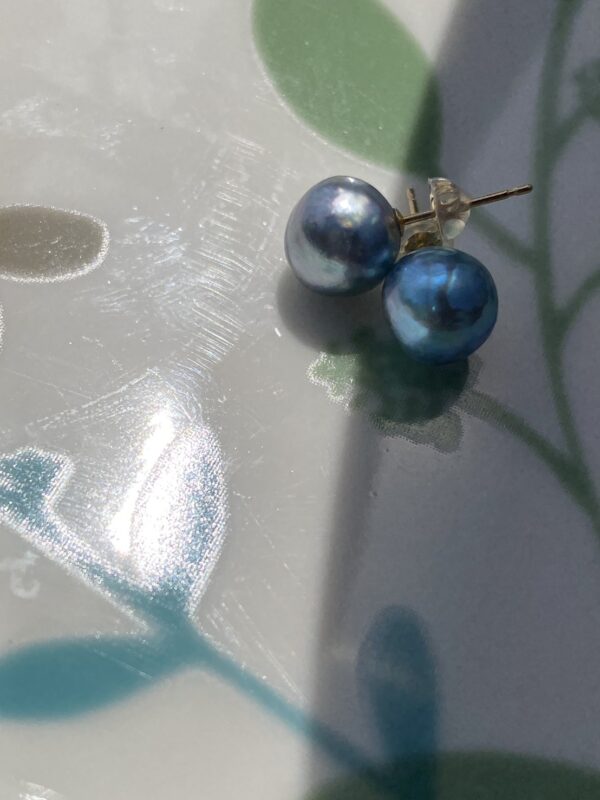
The pearls used in this Obon series were cultivated in an area called Yusu, in Shikoku.
As far as I know, pearl farmers in Yusu are said to have particularly strong skills in what is called “double nucleation,” or inserting two nuclei into a single Akoya oyster.
Normally, one nucleus is inserted into one Akoya oyster to produce one pearl.
At the pearl farm where I previously worked, single nucleation was also the main method, although perhaps around 30 percent of the oysters received two nuclei.
The reason is simple.
It allows you to make better use of a limited number of Akoya oysters.
You can potentially produce two pearls from one oyster instead of one.
However, double nucleation requires knowledge and skill.
I was told by a former colleague that many pearl farmers used double nucleation in the past.
Then, for a period of time, Akoya oysters became readily available and pearl prices were very strong.
There was less reason to conserve oysters, and many farms moved toward single nucleation.
As that continued, some of the knowledge surrounding double nucleation gradually disappeared.
Today, I have heard that an increasing number of technicians no longer know how to do it properly.
As a reference, let me show you an example of the yield from 10,000 oysters using single and double nucleation.
With single nucleation, aiming for 7 mm pearls:
approximately 1,500 momme of pearls from 10,000 oysters.
One momme is 3.75 grams.
With double nucleation, aiming for 6 mm pearls:
approximately 2,200 momme from 10,000 oysters.
That is probably difficult to visualize.
So let us make it easier.
For the single-nucleation example, suppose all 1,500 momme of harvested pearls are 7 mm.
One 7 mm pearl weighs approximately 0.15 momme.
That would equal roughly 10,000 pearls.
For the double-nucleation example, suppose all 2,200 momme are 6 mm pearls.
One 6 mm pearl weighs approximately 0.1 momme.
That would equal roughly 22,000 pearls.
Pearls are generally traded by weight.
In one particular year, the average price for 7 mm pearls was approximately ¥4,500 per momme, while the average for 6 mm pearls was approximately ¥5,200 per momme.
So:
1,500 momme × ¥4,500 = ¥6,750,000
and
2,200 momme × ¥5,200 = ¥11,440,000.
Pearl market prices change dramatically from year to year, so this cannot be treated as a universal rule.
But in that particular year, producing 6 mm pearls using double nucleation would have generated substantially more revenue than producing 7 mm pearls using single nucleation.
Of course, the market price of 6 mm pearls can sometimes fall dramatically.
And if the technical skill is poor, double nucleation can also result in large quantities of pearls that cannot be sold.
And, as I mentioned earlier, technicians with strong double-nucleation skills have become increasingly rare.
But perhaps even more important is this:
Pearl farmers tend to dislike this kind of calculation made on paper.
All of these numbers are based on outcomes after the fact.
You cannot simply take these calculations and insert them directly into the business plan for next year or the year after.
How many Akoya oysters can be purchased?
How many technicians are available?
How skilled are they?
How will market prices change for different pearl sizes?
And how much experience does the farm have in adapting to a constantly changing environment?
The people responsible for running pearl farms apparently build each year’s production plan by considering all of these factors together.
Personally, however, I still find myself thinking rather simplistically.
The number of oysters that can be nucleated per technician in a day will be lower with double nucleation than with single nucleation.
But if the eventual revenue can be much higher, I cannot help thinking:
“Why not invest more effort in teaching double-nucleation techniques?”
That is probably exactly the sort of simplistic suggestion that pearl farmers dislike.
Anyway, pearl farmers in Yusu are said to be particularly skilled at this double-nucleation technique.
I have seen not only blue pearls from Yusu, but also white and pink-toned pearls.
Many of them were extraordinarily high quality.
Their luster was almost like an LED light.
They had remarkable transparency, while at the same time giving a strong impression of dense, thick nacre.
At that time, I had mainly seen pearls produced by the farm where I worked, so seeing Yusu pearls was quite a shock.
The pearls from my own farm were also often excellent, but they tended to have a slightly cloudy, heavier-looking color.
Even today, part of me still believes that this was because of their thick nacre.
But one pearl dealer told me,
“Yusu pearls can have thick nacre and still remain highly transparent.”
This is an area where the judgment becomes too difficult for me, so I will leave the question open.
This may have turned into a story about Yusu that somehow explains a lot while still leaving things rather difficult to understand.
But the important point is that the pearls used in the Obon series were cultivated by a pearl farmer with a strong reputation and proven results within the pearl industry.
“What?! I would rather have pearls cultivated in Ise, where Mikimoto is!”
That might actually be a very realistic reaction.
Yusu is almost unknown in the retail world.
But within the pearl-farming industry, it is a well-known production area.
These pearls were purchased directly from a Yusu pearl farm by a pearl wholesaler I have known since my days working for a pearl company.
Normally, cultured pearls are first sold at auctions that only a limited number of pearl businesses are allowed to attend.
They are then processed and sold wholesale.
The businesses that buy them may sell them wholesale again.
If you are fortunate, a dealer like me may finally be able to purchase them somewhere around that stage.
In this case, there is only one business between the pearl farmer and me.
I once asked that wholesaler why he was willing to trade with me.
He said,
“You are crazy for trying to compete using only natural blue baroque pearls.”
Personally, I was very happy to hear that.
Now then.
This article has become rather long again.
There was not very much to laugh about this time, so next time I would like to return to something a little more casual, as usual.
See you again!
🌸 Next in the Obon Series 🌸
Subscribe for Pearl Stories🐾
Receive occasional letters from my workshop —
stories about pearls, silverwork, Lulu the little dog, and quiet life in Japan.
As a thank you, you’ll get a secret code for 30% off —
usable every time you order, only here, not on Etsy.
I don’t send spam. Just little notes filled with love and pearls 💫
You can read our privacy policy for details.
This space is not only for reviews. You are welcome to write freely about pearl jewelry, ask questions, or share what you feel when you see this piece. Member registration is required to submit your message.
Pearls & Stories
There are no stories yet.