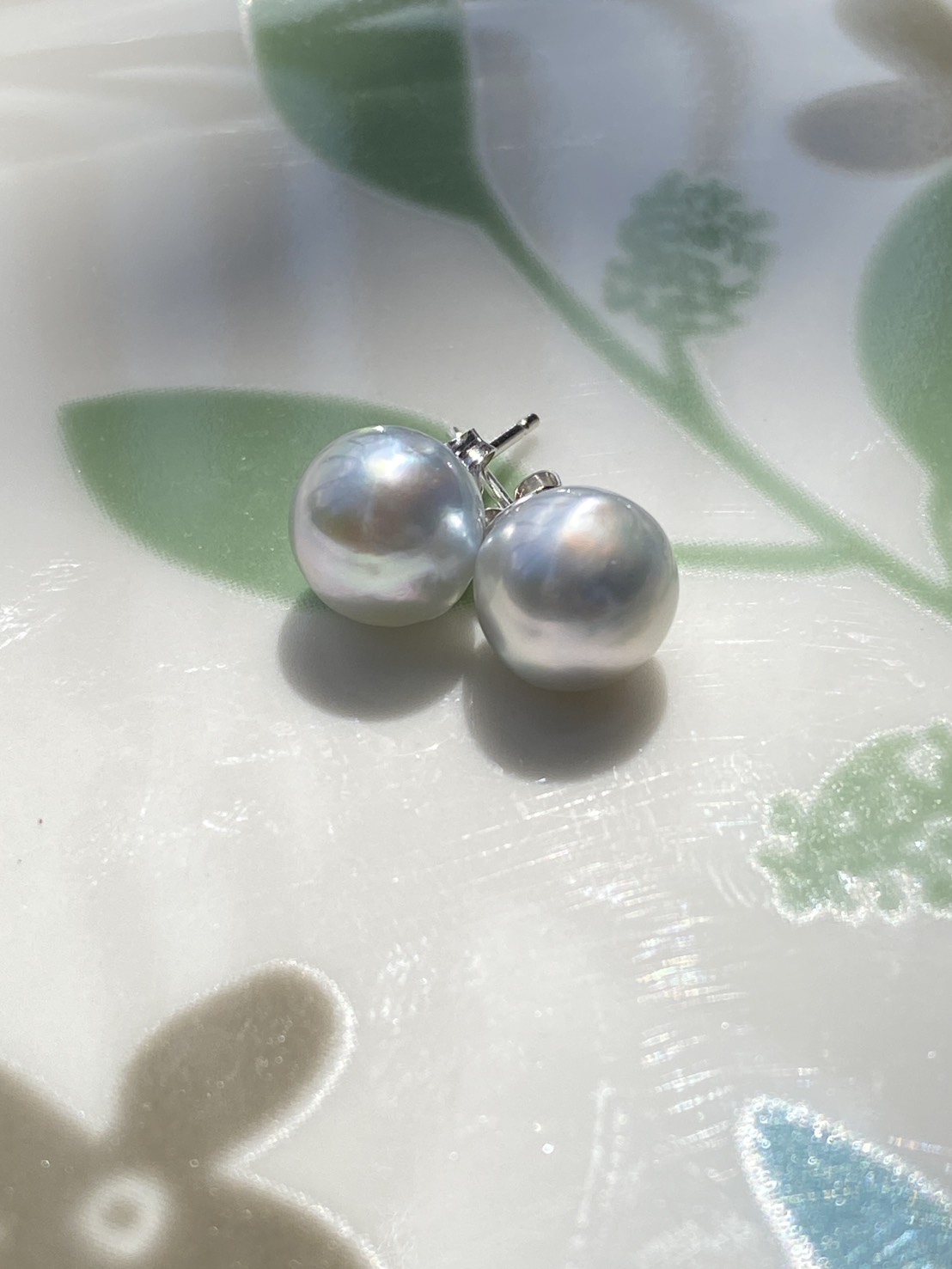
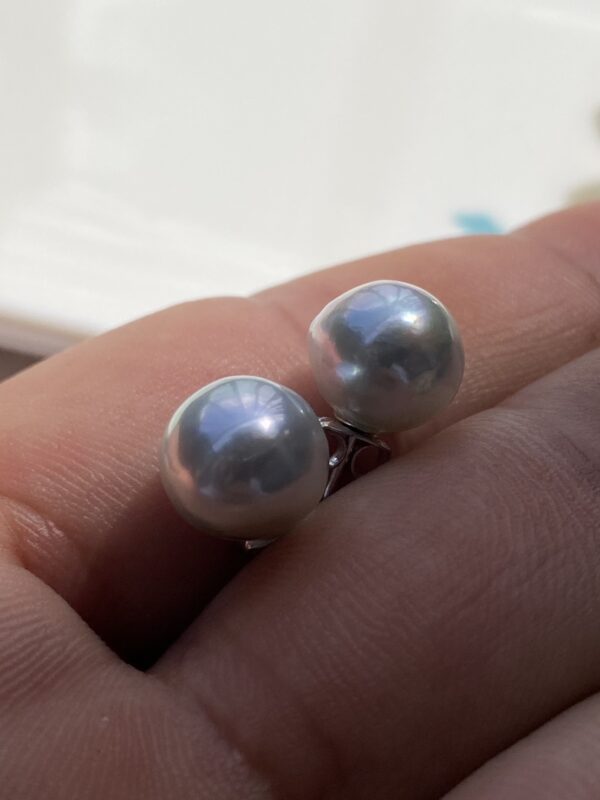
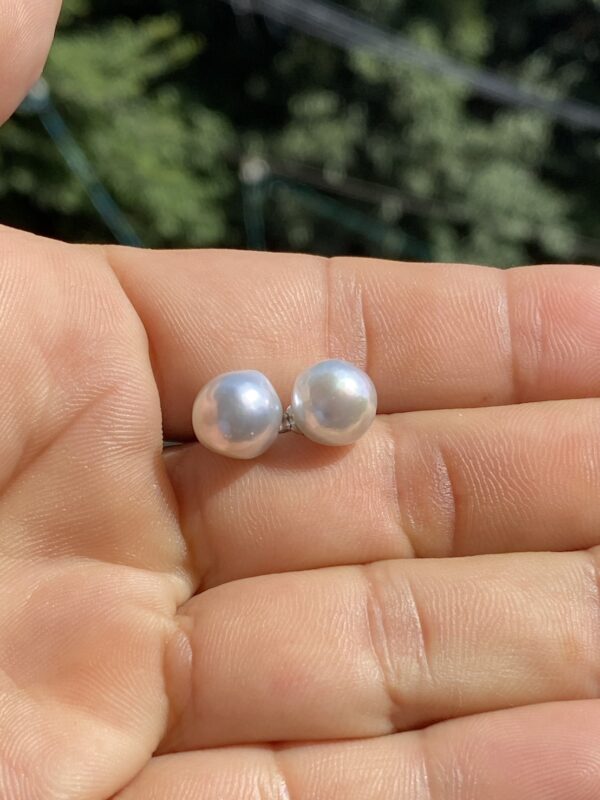
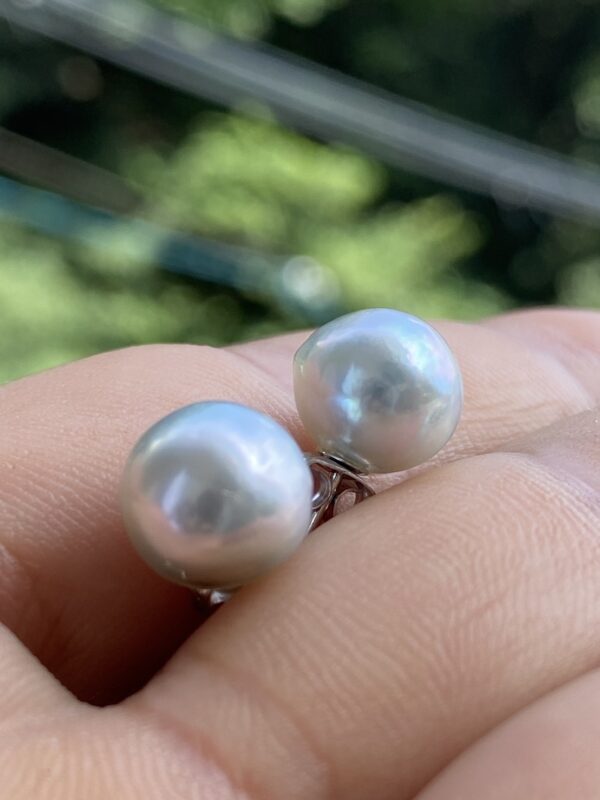
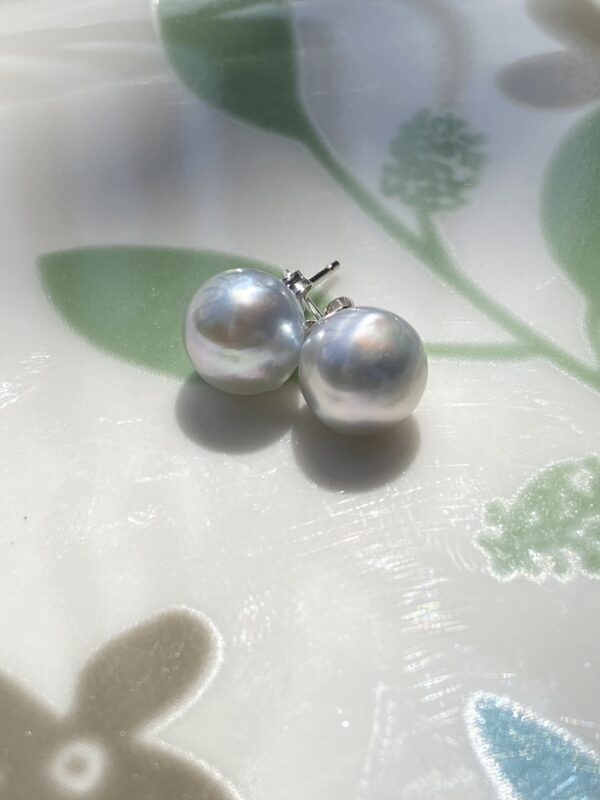
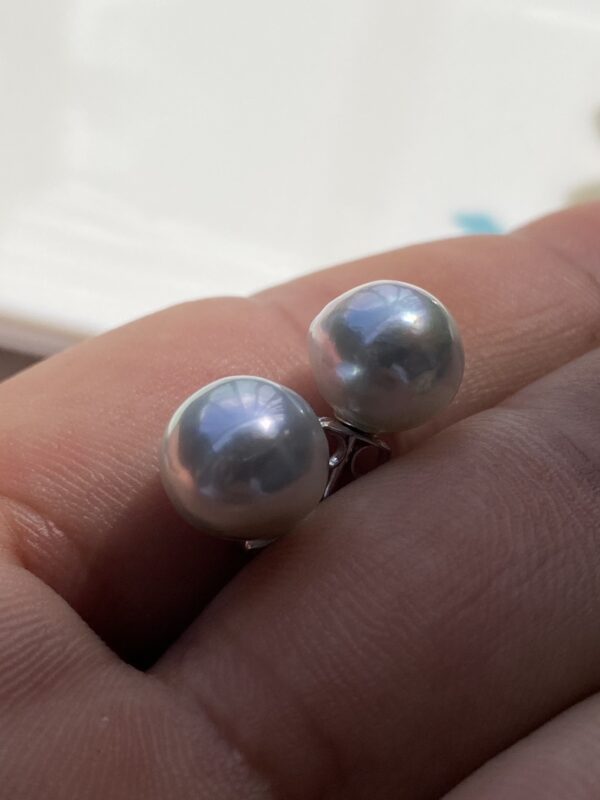
Natural Blue Akoya Pearl Earrings, Silver 925, Baroque Pearls, 9.2mm / 9.0mm, Soft Luster, Japanese Akoya Pearls
Obon-05
$200.00
1 in stock
Welcome.
Did these earrings catch your eye?
And there is something I would like to ask you.
These Obon Earrings are a series of seven pairs.
If possible, I would be very happy if you started with Obon 01 and looked through them in order.
I listed Obon 01 through 04 on August 10, 2026, but by the following day, August 11, someone had already contacted me about Obon 04, and its new home has now been decided.
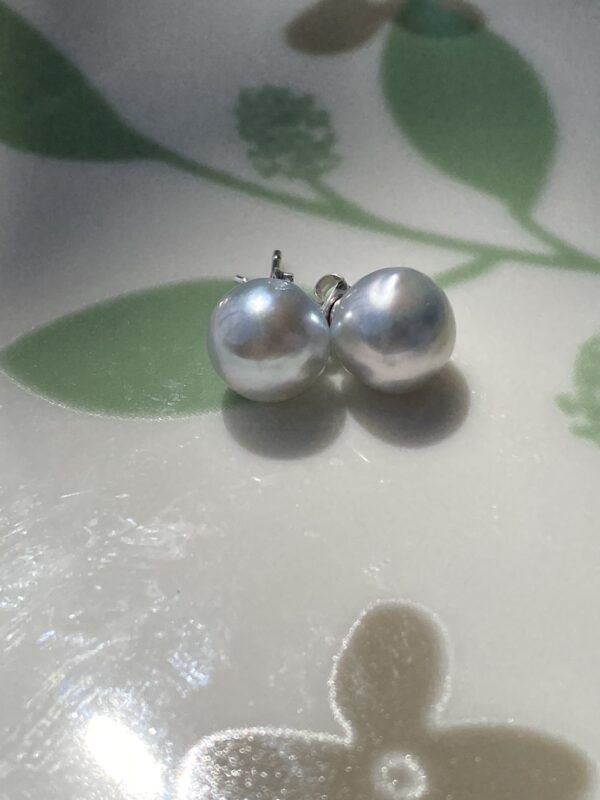
Now then, the luster of Obon 05 is somewhat gentle, and its color also has a soft atmosphere somewhere between blue and silver.
The size is 9.2–9.0 mm, but this measurement is taken from the narrowest part of each pearl.
We do the same thing when measuring our waist, don’t we?
If I measure both vertically and horizontally, the sizes are:
9.2–9.4 mm / 9.0–9.4 mm.
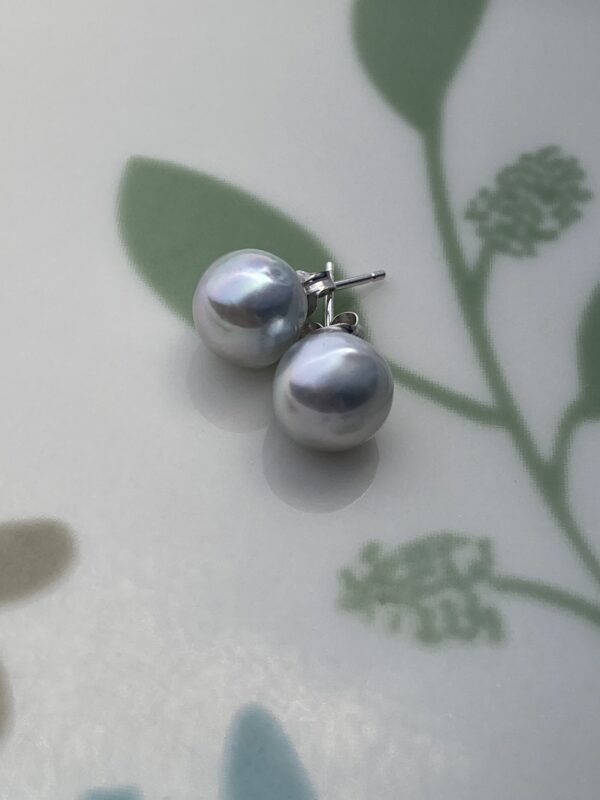
The surfaces of the pearls are not highly glossy, but they feel wonderful to the touch.
Almost like soft fabric.
They remind me of a modest person saying,
“I don’t really want to stand out.”
And yet, somehow, people like that often turn out to be beautiful.
These pearls feel a little like that.
There are seven pairs in the Obon series, and this is the fifth.
At this point, I seem to be putting more effort into thinking about what kind of article I should write than into actually listing the pearls.
Since I had seven pairs to list at once, I thought it would probably be easier if all seven shared one theme.
That is why I chose “Obon.”
Obon 01 through 03 contained many stories that had almost nothing to do with pearls, so for Obon 04 I decided to write more about pearls.
But that article became somewhat complicated.
So for Obon 05, I would like to write something a little easier to understand.
The pearls in this Obon series are around 9 mm.
Among Akoya pearls, 9 mm is considered a large size.
However, as consumers, you have probably heard shops say all kinds of things about pearl sizes:
4 mm is small and rare.
5 mm is also unusual.
8 mm belongs to the large-pearl category.
Every size seems to be advertised as unusual or rare in some way.
So this time, I would like to compare actual harvest quantities by pearl size and see whether these claims are really true.
For reference, I will use harvest data from one particular pearl farm in one particular year.
This farm mainly aims to produce 7 mm pearls and, if possible, 8 mm pearls.
If the Akoya oysters are not large enough to produce 7 mm pearls, the farm reluctantly produces 6 mm pearls instead.
Pearls are traded by weight, so producing larger pearls generally brings in more money.
About 70 percent of the pearls at this farm are produced by inserting one nucleus into one oyster.
In other words, roughly the same amount of effort is required for each pearl.
Raising an Akoya oyster also requires the same kind of care, sometimes for as long as eight years.
Pearls are traded at a price per momme.
Let us say a good-quality pearl is worth around ¥15,000 per momme.
A high-quality 6 mm pearl weighs about 0.1 momme, so one pearl would be worth about ¥1,500.
An 8 mm pearl weighs about 0.2 momme, so one pearl would be worth about ¥3,000.
That is twice as much.
Of course, there are many other conditions involved, but this simple difference is one reason pearl farmers try to produce pearls as large as possible.
However, producing large pearls requires correspondingly large Akoya oysters.
In recent years, Akoya oysters do not always grow as well as farmers would like, so producing larger pearls is not necessarily easy.
“How do you make Akoya oysters grow larger?”
There are many methods.
I will introduce just one.
When Akoya oysters are born and grow to around 2 mm in size, they are placed in bags with very fine mesh and moved from the hatchery into the sea.
This usually happens around early May.
Many Akoya oysters are born in February or March.
By June, the tiny oysters that were once only 2 mm have grown rapidly, and some exceed 1 cm.
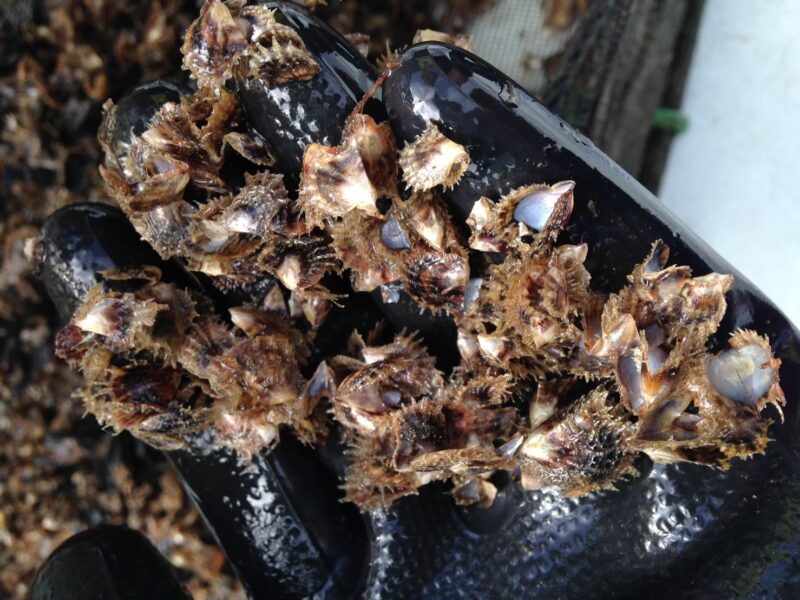
Akoya Baby
Among the hundreds of thousands of oysters, they are sorted into large, medium, and small groups.
Each group is then placed into mesh bags with openings small enough that the oysters cannot escape, and the bags are suspended in the sea again.
About another month later, they are sorted once more.
Within the large group, there are large, medium, and small oysters.
Within the medium group, there are again large, medium, and small oysters.
The sorting simply continues.
In other words, fast-growing Akoya oysters are periodically selected and grouped together.
As the oysters grow, the bags they live in also become crowded.
When a puppy first comes home, its doghouse may look enormous.
But once the puppy grows, sometimes only its backside will fit inside.
Akoya oysters are similar.
As they grow, their bags eventually become like Tokyo commuter trains during rush hour.
Japanese salarymen will continue working obediently no matter how terrible the conditions become.
Akoya oysters will not.
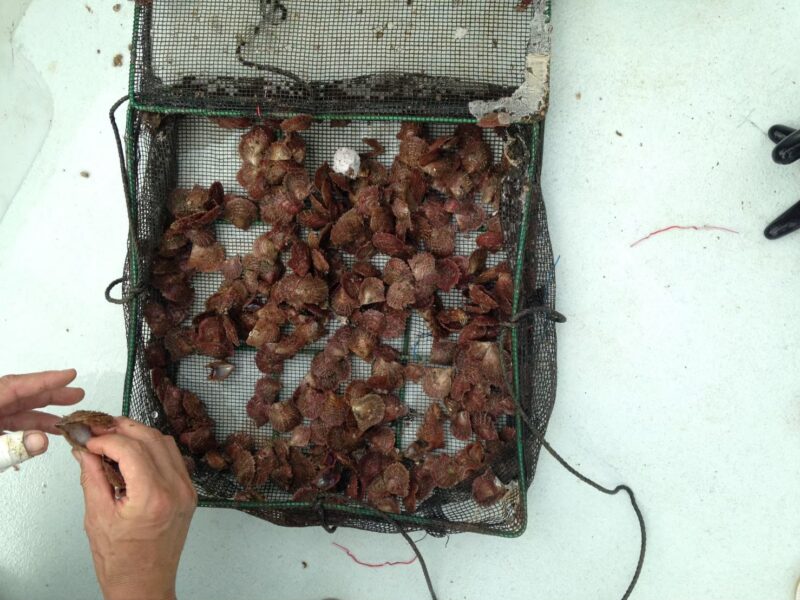
Before their bags become overcrowded, the number of oysters in each bag is reduced so they can live more comfortably.
Doing this also makes it easier for each oyster to obtain enough food, helping to promote growth.
Pearl farms repeatedly carry out this kind of sorting into large, medium, and small groups and continuously move the oysters into different bags.
Fast-growing oysters born in February may become large enough to receive a nucleus from around June of the following year.
Slow-growing oysters may not be ready until two years later.
If they grow almost twice as slowly, they naturally cost much more to raise.
So the farm manager is probably looking at them and begging,
“Please, just grow faster.”
Because this endless sorting and moving continues, a large pearl farm gradually develops different areas that are almost like kindergarten, elementary school, junior high school, university, and working adulthood.
Within the limited space of the farm, the manager moves each group to the area of sea that seems most suitable for them.
The kindergarten group goes somewhere with calm waves.
Akoya oysters that have just undergone nucleation—in other words, oysters recovering from surgery—are kept in calmer waters near the shore rather than farther offshore.
After resting and fully recovering, they may be moved farther offshore, where the waves are somewhat rougher but the water contains more nutrients.
Moving them is also hard work.
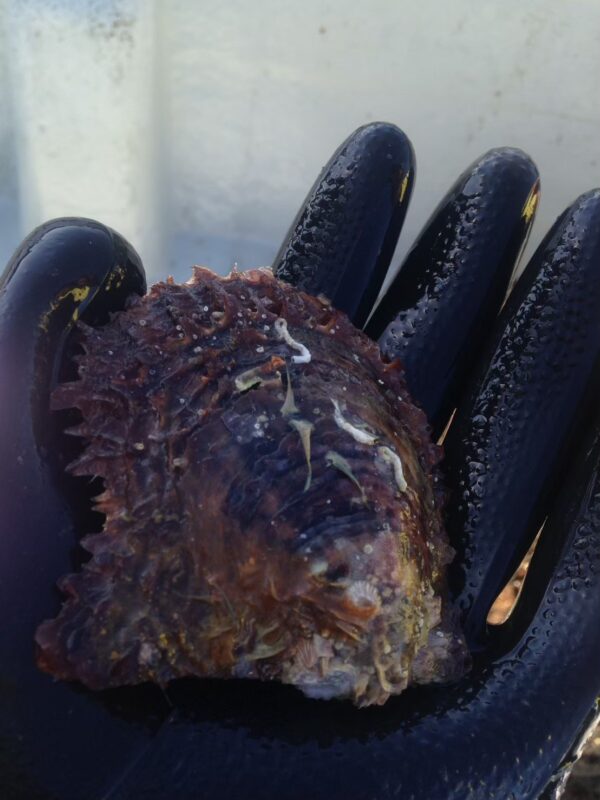
Adult Akoya oysters can grow to about the size of a person’s palm.
Around 32 oysters are placed into a single net with individual pockets.
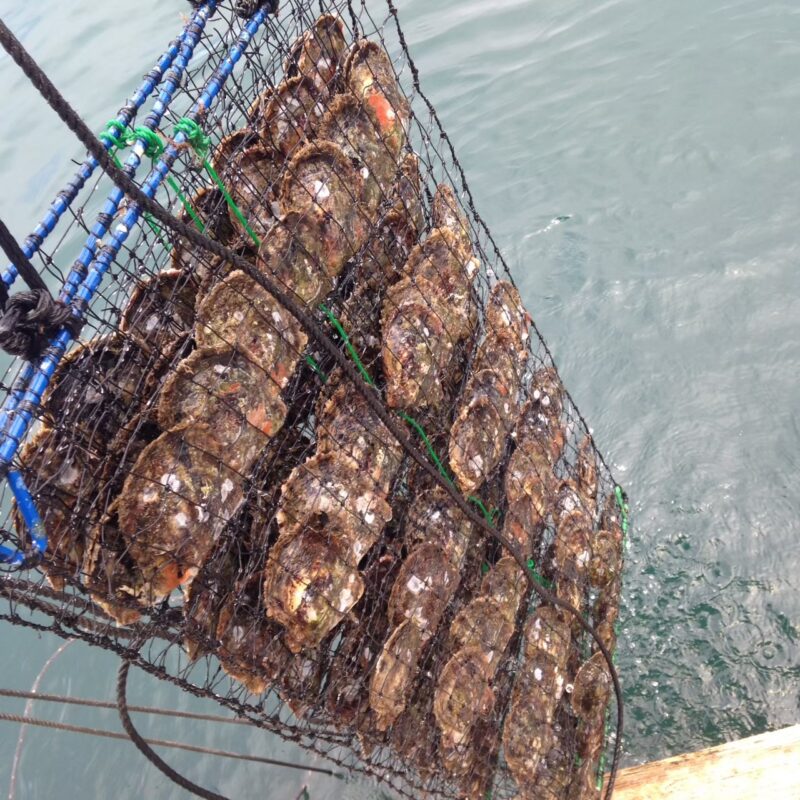
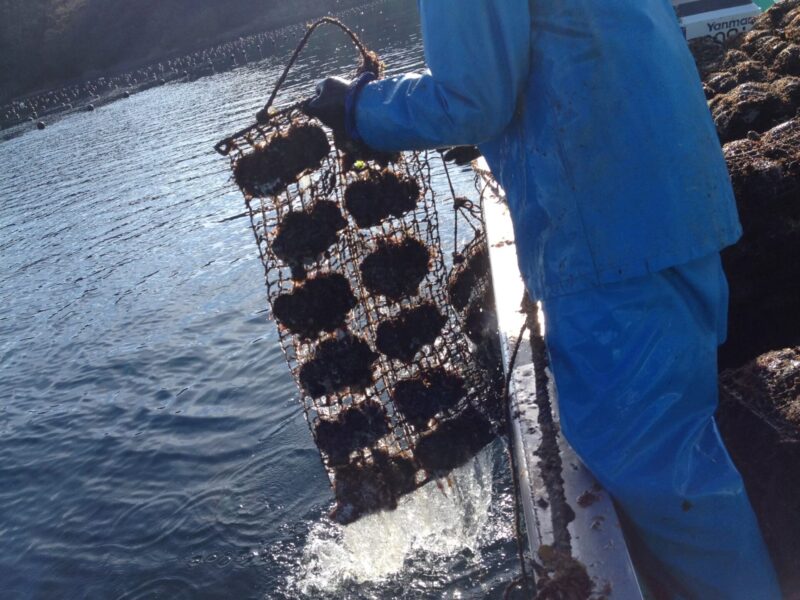
Many other marine organisms attach themselves to the oysters, making the nets even heavier.
One net containing 32 Akoya oysters can weigh around 4 kg.
A small boat can carry around 150 of these nets.
Along a rope roughly 100 meters long, these nets are suspended at intervals of around 1.5 meters.
The workers repeatedly pull the 4 kg nets out of the sea and stack them onto the boat.
Then the boat travels for a while and brings them to a small work shed called a yakata.
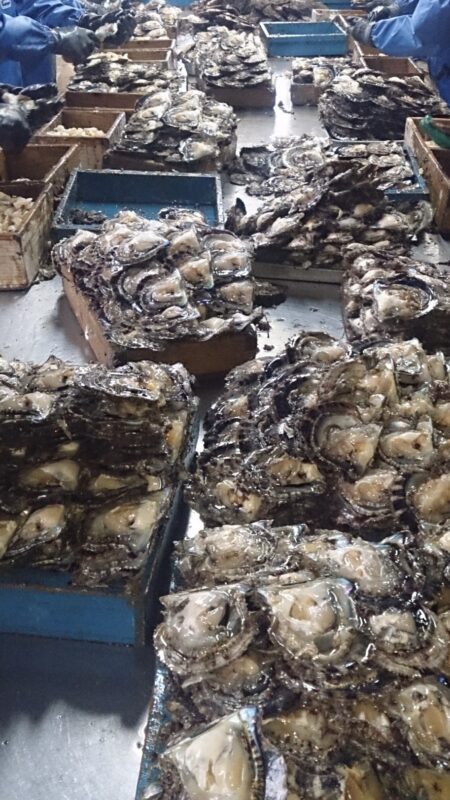
A Scene from the Pearl Harvest
There, the Akoya oysters are removed from the nets.
One by one, barnacles and other organisms attached to the Akoya oyster shells are scraped away using metal tools.
The worktable is about 1.5 meters wide and around 7 meters long, and sometimes the entire surface becomes piled high with Akoya oysters.
Once cleaned, the oysters are sorted again by size and placed back into nets, 32 at a time.
Then they are loaded onto the boat again and returned to the sea.
You may already have noticed something.
There is actually very little humans can do directly to make Akoya oysters grow larger.
There are no hormone injections.
There are no oxygen chambers.
There are no personal trainers.
What humans can do is create an environment in which the Akoya oysters can live as comfortably as possible.
That means cleaning their bodies about once every two weeks and adjusting the number of oysters in each bag so their living space does not become overcrowded.
Perhaps it is 80 percent nature and 20 percent human effort.
Maybe farming crops is similar.
But I do not know enough about agriculture, so I should probably stop making comparisons before I say something foolish.
Now then.
Let us finally look at the numbers and see whether 9 mm really belongs to the large-size category.
It is important to remember that every pearl size listed below requires all of the work I have described above.
Small pearls and large pearls alike receive the same kind of care.
Here is the harvest by size:
11 mm — 1
10 mm — 82
9 mm — 1,600
8 mm — 21,604
7 mm — 54,785
6 mm — 36,036
5 mm — 6,470
Total — 120,578
The unit is momme.
One momme equals 3.75 grams.
At this particular pearl farm, 9 mm pearls accounted for about 1.32 percent of the total harvest.
Of course, some pearl farms specialize in smaller pearls, while others specialize in larger pearls.
In those cases, the numbers would be different.
However, many ordinary Akoya pearl farms mainly aim for 7 mm pearls and try to produce 8 mm pearls whenever possible.
So I think these figures can still serve as one useful reference.
Now let us look at the percentage of the total harvest represented by each size.
11 mm — 0.00083%
10 mm — 0.068%
9 mm — 1.33%
8 mm — 17.92%
7 mm — 45.44%
6 mm — 29.89%
5 mm — 5.37%
The 10 mm and 11 mm pearls are almost accidents, so they are not particularly useful for comparison.
Occasionally, an Akoya oyster seems to go crazy and secrete an extraordinary amount of nacre.
You would think it could simply stop once the pearl reached 8 mm.
But instead, it keeps going until the pearl reaches 11 mm.
When a pearl like that appears at a farm, people start murmuring,
“Who nucleated this one?”
When I first joined the pearl farm where I worked, there was also an oddly shaped natural blue baroque pearl around 12 mm.
Apparently, it had been produced from a nucleus inserted by a newly trained technician.
The farm manager laughed and said to him,
“You made some kind of monster pearl.”
Now, 9 mm pearls account for only around one percent of the harvest.
8 mm pearls account for around 17 percent, not even reaching 20 percent.
The farm probably wanted a little more than that.
That year, the price per momme of 8 mm pearls was 1.25 times higher than that of 7 mm pearls, so perhaps they were disappointed.
7 mm pearls accounted for almost half of the harvest.
6 mm pearls accounted for nearly 30 percent.
That year, 6 mm pearls were priced about 20 percent lower than 7 mm pearls, so producing nearly 30 percent in the 6 mm range may also have been disappointing.
The basic goal was 7 mm.
And, if possible, 8 mm.
Then there were the 5 mm pearls, which made up around 5 percent.
Considering the size of the nucleus, only a very small amount of nacre needs to form before the pearl becomes 6 mm.
So if it remains 5 mm, technically it is a pearl, but much of what you are seeing is still essentially the nucleus.
It may be mostly nucleus, but visually it can still be beautiful.
Beautiful, yes.
But personally, I find it a little difficult to call such a thing a pearl.
So this time, I wanted to examine whether the claim that “9 mm pearls are rare” is actually true.
With the important condition that these figures come from only one fairly typical pearl farm, I think a harvest share of around 1.32 percent gives us at least one useful reference point.
Of course, not all of that 1.32 percent consisted of high-quality pearls.
Among the 1,600 momme of 9 mm pearls, there were no first-grade pearls.
There were 587 momme in the upper second-grade class:
mostly round in shape, but with some noticeable surface blemishes and some staining.
There were 323 momme in the lower second-grade class:
near-round to baroque in shape, with more surface blemishes and more staining.
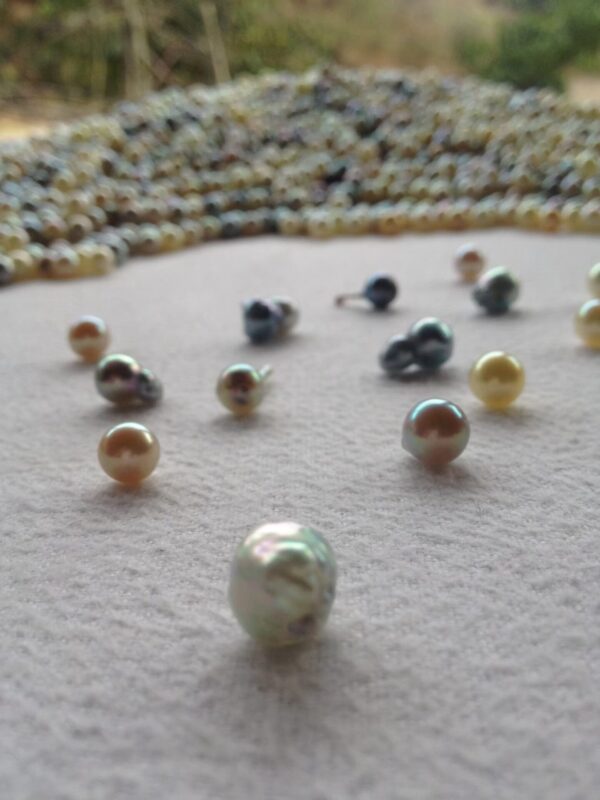
The remaining 690 momme were natural blue baroque pearls.
If 43 percent of the 9 mm harvest became natural blue pearls, that would actually be considered a rather poor result from the pearl farm’s point of view.
After all, pearl farms are fundamentally aiming to produce white, round pearls.
From the farming perspective, natural blue baroque pearls are basically a by-product.
From a retail perspective, however, those 690 momme of 9 mm natural blue baroque pearls account for only about 0.57% of the total harvest.
From the farm’s point of view, the smaller that percentage is, the better the production result. But from a retail perspective, the very same number becomes evidence of rarity.
When pearl farmers hear retailers happily using the phrase “rare pearls,” they sometimes make very complicated expressions.
After all, what the farmer sees as an occasional production failure is something the retailer looks at and happily says,
“Beautiful!”
I rather like this relationship between the two perspectives.
Natural blue baroque pearls are beautiful.
But simply because they are not round, their market value becomes lower.
That contradiction is something I can take advantage of—and also enjoy.
Now then, I think that is enough for Obon 05.
Only Obon 06 and 07 remain.
See you again!
🌸 Next in the Obon Series 🌸
Subscribe for Pearl Stories🐾
Receive occasional letters from my workshop —
stories about pearls, silverwork, Lulu the little dog, and quiet life in Japan.
As a thank you, you’ll get a secret code for 30% off —
usable every time you order, only here, not on Etsy.
I don’t send spam. Just little notes filled with love and pearls 💫
You can read our privacy policy for details.
This space is not only for reviews. You are welcome to write freely about pearl jewelry, ask questions, or share what you feel when you see this piece. Member registration is required to submit your message.
Pearls & Stories
There are no stories yet.