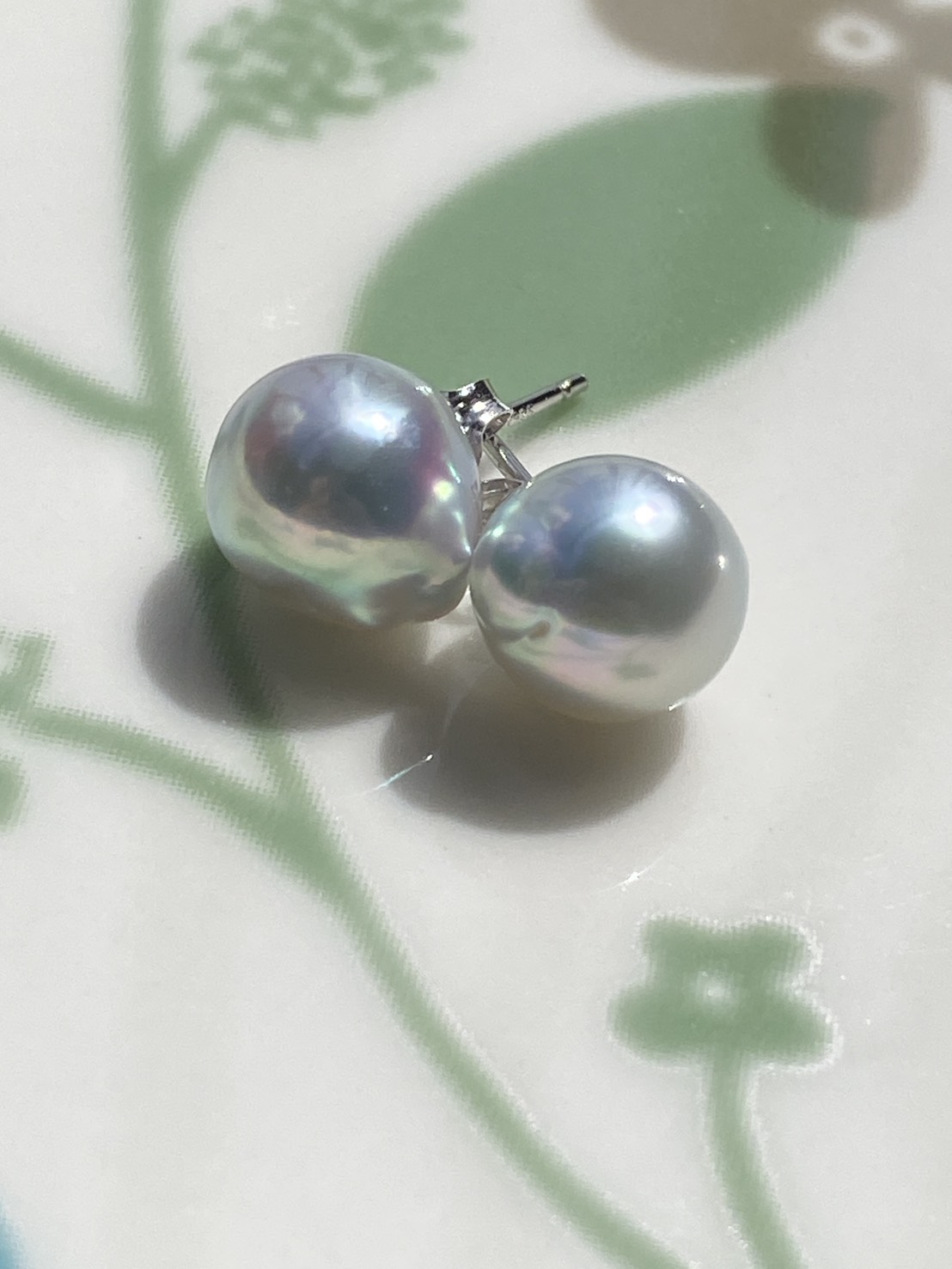
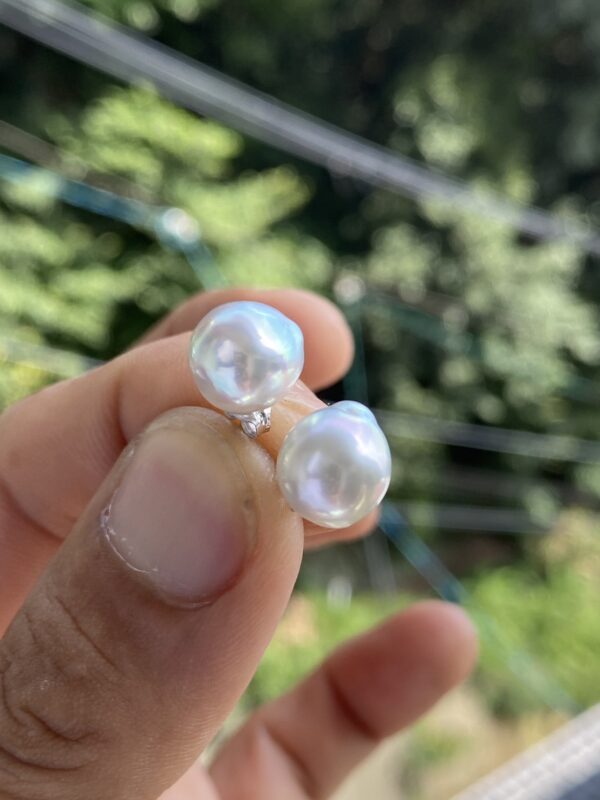
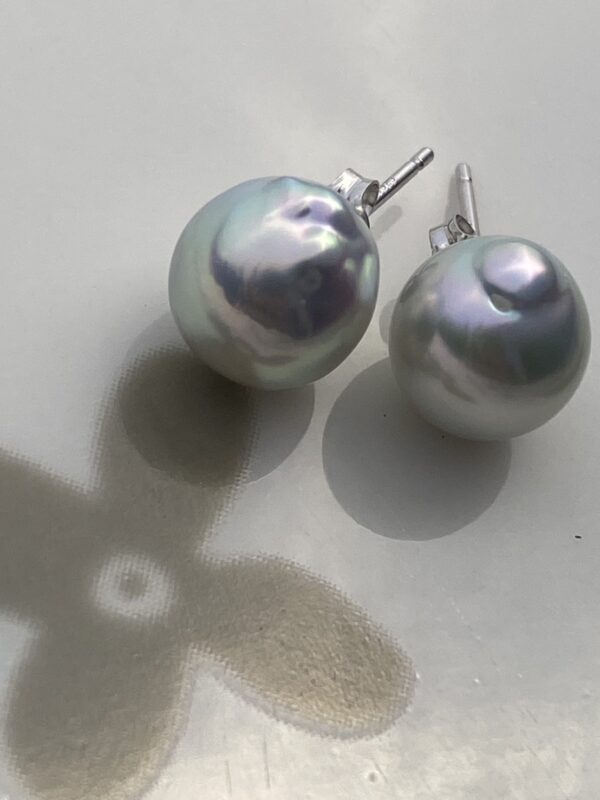
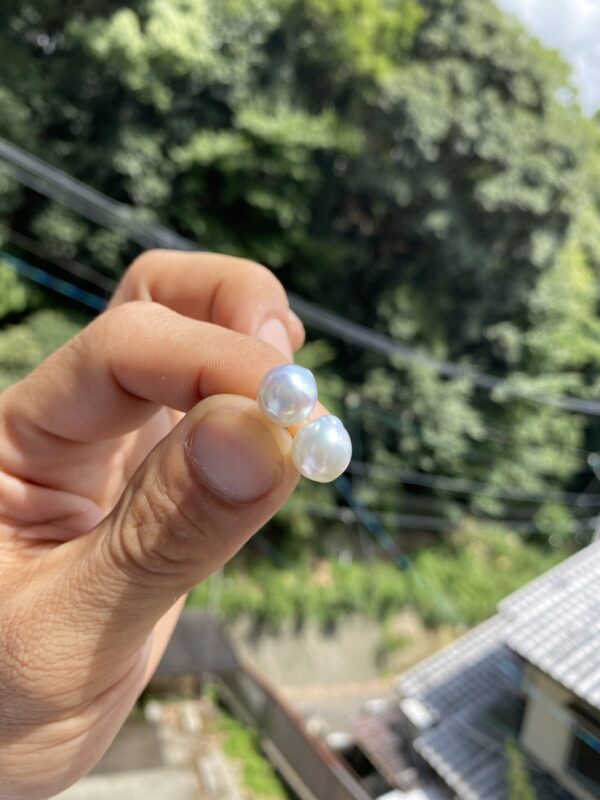
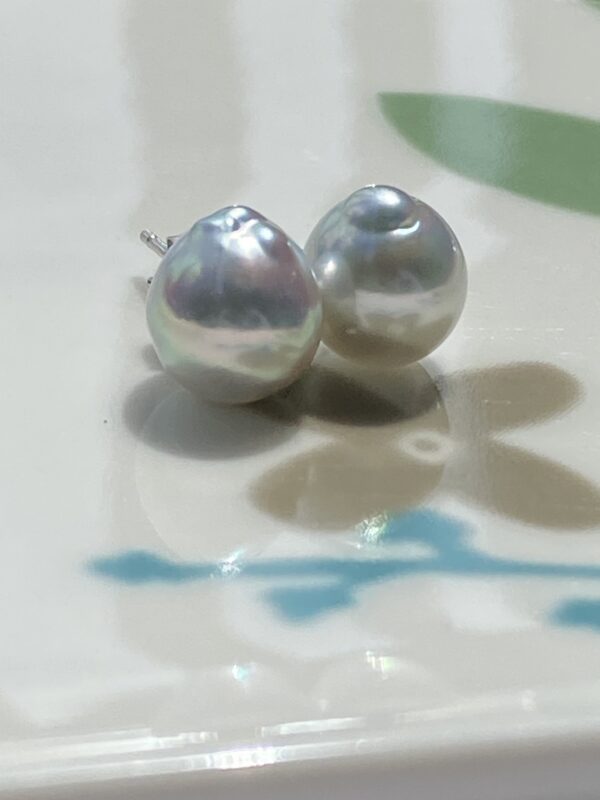
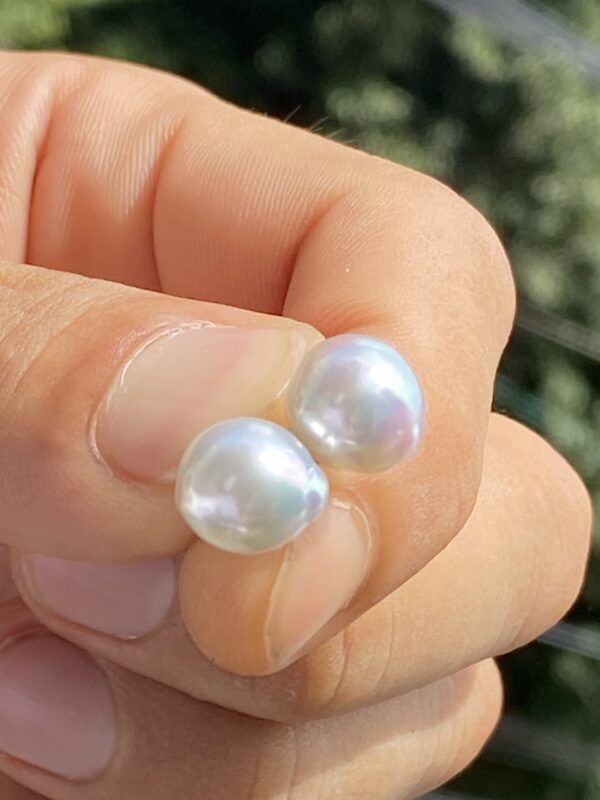
Natural Blue Akoya Baroque Pearl Earrings, 9.4mm / 9.3mm, Silver 925, Fine Luster, Japanese Akoya Pearls
Obon-06
$210.00
1 in stock
Welcome.
Thank you for coming.
It seems that you have taken an interest in pearls with a smooth luster.
These Obon-06 earrings are part of the Obon series, which consists of seven pairs of earrings.
Because all seven pairs were made just before Obon, I decided to treat them as one series and connect their articles as well.
I would be very happy if you also visited the pages from Obon-01 through Obon-05.
These earrings were listed on August 10, 2026, and although not even two days have passed, several pairs have already found their destinations. The articles, however, will remain available to read.
Now then, Obon-01 through 03 were mainly stories about Obon.
Obon-04 and 05 seem to have contained considerably more talk about pearls.
As for Obon-06, I still haven’t decided what I am going to write about, but I am thinking of returning to stories about Obon again.
Before that, however, let me give you a brief explanation of the Obon-06 earrings.
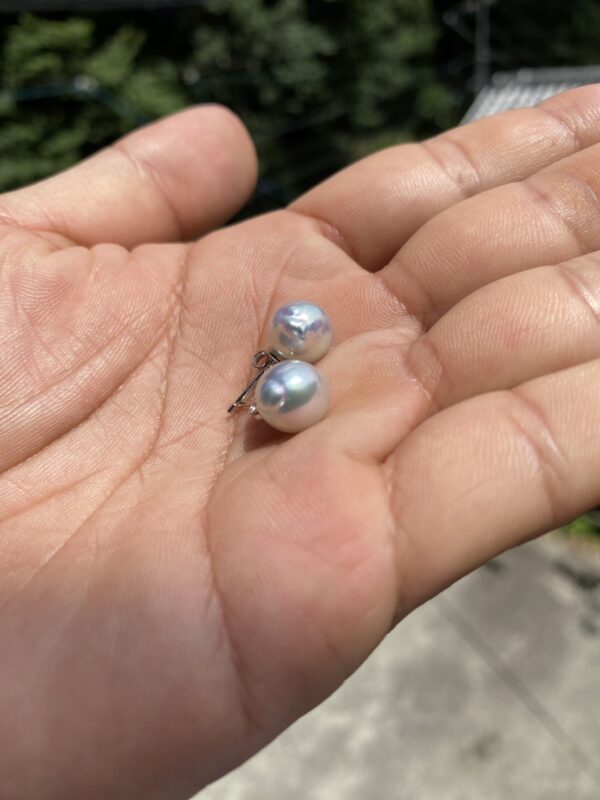
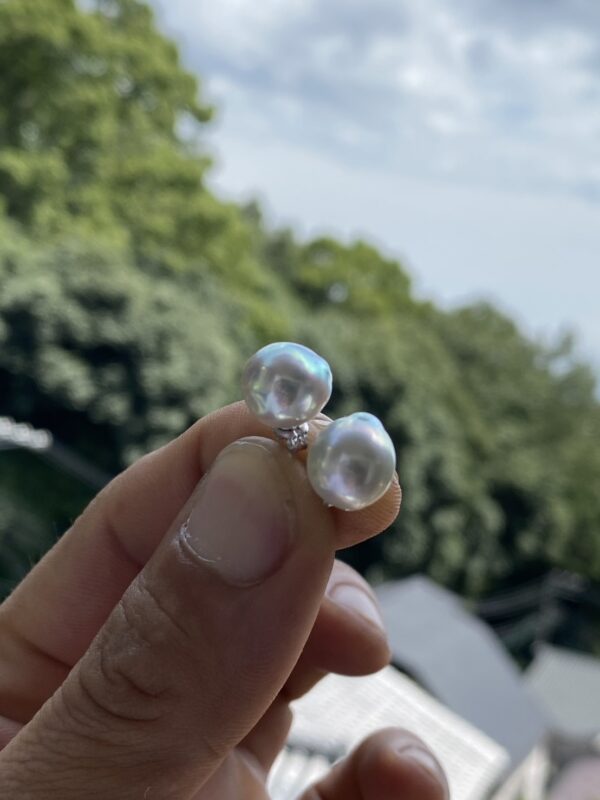
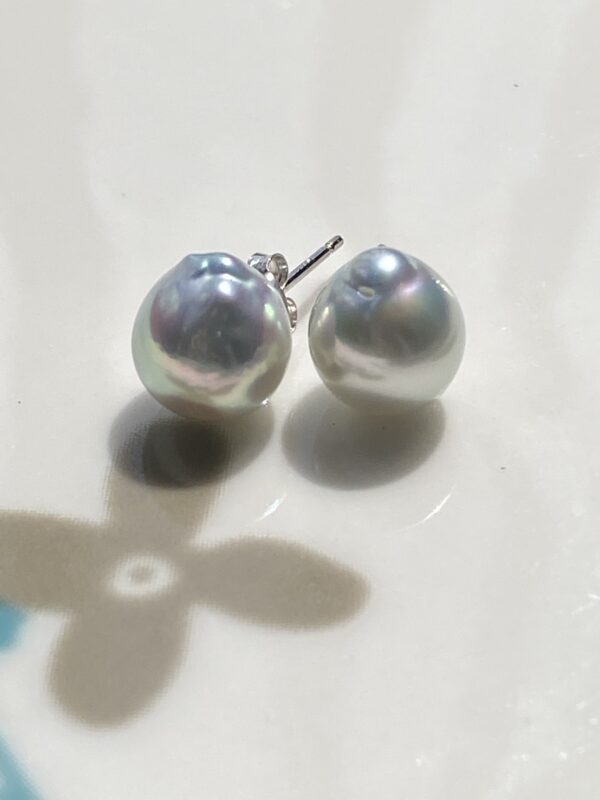
Of the seven pairs of earrings, the pearls in Obon-06 have either the strongest or second-strongest luster.
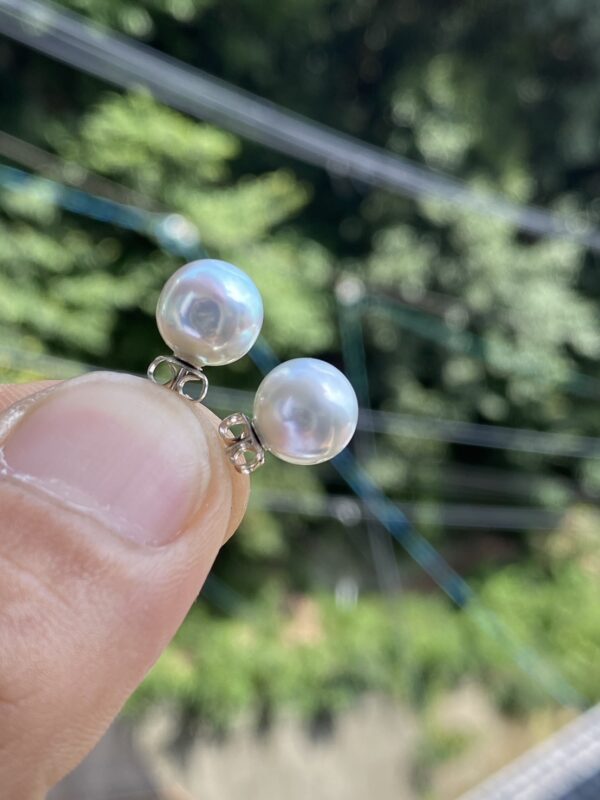
In particular, their surfaces are extremely smooth.
Their shape is a plump drop shape, which gives them a rather charming appearance.
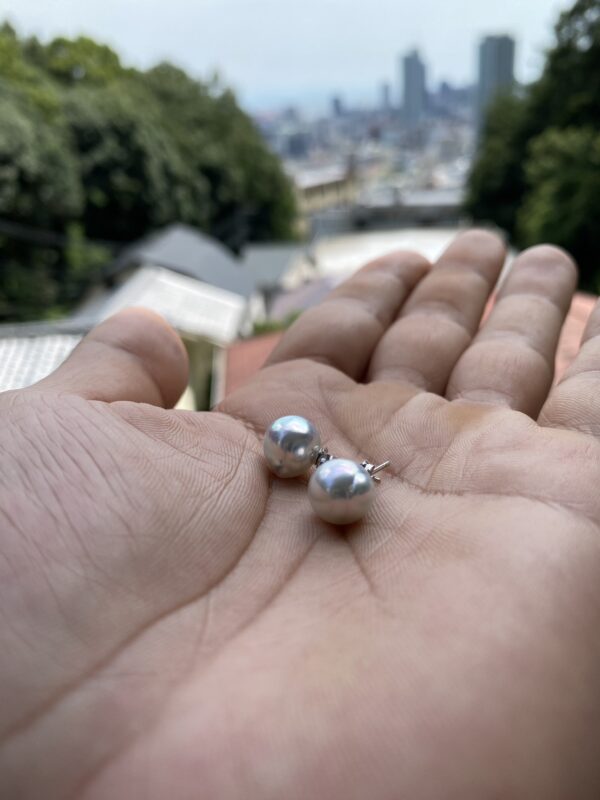
Recently, I have been handling so many 9 mm pearls that I have become accustomed to their size, but when you look at Akoya pearls as a whole, the proportion harvested at around 9 mm is actually very small.
I wrote about exactly how small that proportion is in the Obon-05 article, so please have a look if you are interested.
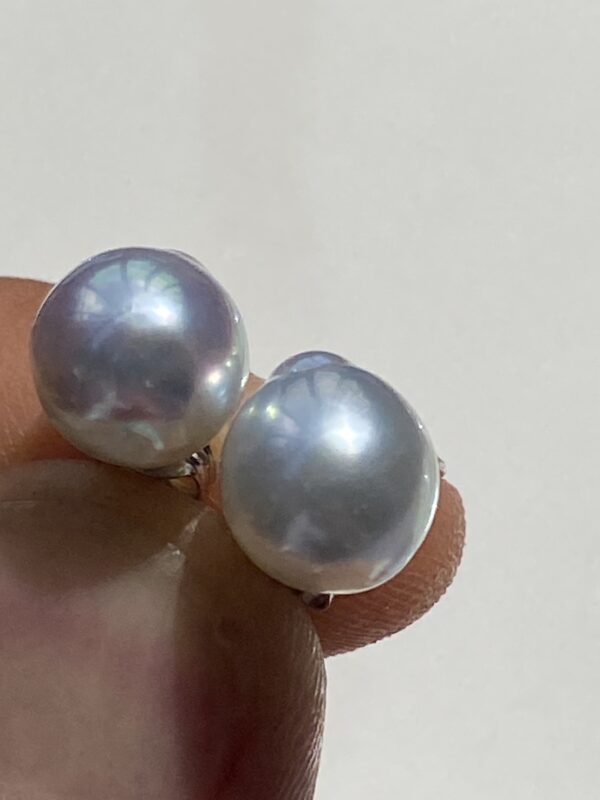
Now, as I look at these pearls again, I notice that one of them has exceptionally strong luster, while the other does not seem quite as strong.
In fact, you can see a slight haziness on its surface, almost as though it were covered by a thin mist.
Even so, I paired these two pearls because I wanted to make a pair of earrings using the pearl with the exceptionally strong luster.
Although the other pearl has slightly weaker luster, I judged that its shape and color allowed the two to work successfully as a pair.
In any case, although there is some slight haziness, there is no doubt that these pearls still have sufficiently smooth surfaces.
Now, regarding Obon, which is the theme of these earrings, I have described it in previous articles as an event somewhat similar to Halloween.
One of my customers offered a different opinion:
“Maybe Halloween isn’t quite right. Día de los Muertos might be closer.”
One similarity between Obon and Día de los Muertos may be the idea that the spirits of people who have died return to us.
Apparently, Día de los Muertos is celebrated with large public parades, while we have nothing quite like that in Japan.
In Japan, our ancestors are believed to return on August 14 and 15, while during Día de los Muertos, the souls of children are said to return on November 1 and those of adults on November 2.
I only learned this a little while ago when I looked it up.
Making a Pair of Obon Earrings
Another similarity seems to be the custom of placing offerings on an altar.
And now, Obon itself is approaching for me.
Today is August 12, 2026, and tomorrow I am planning to return to my parents’ home.
There I will be able to see not only my parents, but also our dog, Lulu.
My older brother and his family will be returning home as well.
Incidentally, I also have a younger brother, and he has a daughter, but because of the nature of their work, it is difficult for them to take time off during Obon, so they will not be able to come home.
For a while now, I have been trying to dig up memories of Obon from my childhood.
The usual scene was that our relatives gathered together, the adults endlessly drank alcohol and had roughly the same conversations every year, while we children devoted ourselves to playing Nintendo Famicom.
Among the men in our extended family, one worked in a family-run ironworks, another was the president of a small ironworks with about five employees, and another was a police officer.
My father worked for a major electric power company.
The two men who ran ironworks were, on the surface, calm and gentlemanly uncles.
But even though their companies were small, they were still presidents of ironworks businesses.
They seemed to take enormous pride in their work.
And my father frequently made comments that rubbed those two men exactly the wrong way.
“Well, you two may be company presidents, but your businesses are pretty small, aren’t they? My job is extremely important. I’m responsible for maintaining a stable electricity supply to tens of thousands of homes and businesses.”
Even as an elementary school student, I remember thinking:
“That was probably not a good thing to say.”
My two uncles knew very well that my father liked to show off as soon as he became drunk, so at first they would simply listen without taking him too seriously.
But once they became drunk themselves, they would begin to answer back.
“No, no. Our industries may be different, but every day I manufacture steel products to tolerances of less than 0.1 mm. It’s not such a simple job.”
“Come on. Machines can do that easily nowadays.”
“Machines have their limits. Iron has its own characteristics and quirks. We have to understand those and control them ourselves.”
And the argument would continue endlessly.
Incidentally, my uncle who was a police officer usually sat quietly and listened to everyone else.
Looking back now, he was the youngest of the adults, so perhaps he felt that he was in a position where he was supposed to quietly listen to his seniors.
However, some of the things he said were quite interesting.
The area where we lived was very rural, and at that time there were many bosozoku motorcycle gangs.
Occasionally, members of these gangs would even ride their motorcycles through the corridors of high school buildings.
I was born in 1979, and among people born up until around 1975, there seemed to be quite a few who joined those motorcycle gangs.
Among people of my generation and those one or two years older than me, on the other hand, there were many who disliked them.
Whenever the weather became warmer and the motorcycle gangs appeared, one of my police officer uncle’s duties was to help crack down on them.
He often complained:
“Japan has strict gun laws, so no matter how bad those motorcycle gangs are, we can’t use our pistols against them. It’s frustrating. I’d like to ram them with a police car, but if we did that, their parents would make a huge fuss. And even if they’re members of a motorcycle gang, if a police officer injures one of them, suddenly the police officer becomes the bad guy. How does that make any sense?”
He would also say:
“The police are deliberately being careful not to hurt them, but those idiots interpret that as ‘the police are afraid of the motorcycle gangs.’ How ridiculous is that?”
And then there was this:
“On television dramas, detectives are constantly firing their guns—bang, bang, bang. If we could fire ours that easily, our jobs would be much easier.”
I used to sit beside him listening to these stories and think with some horror:
“Do police officers everywhere really think such savage things?”
Even when he told these frightening stories, however, the wives in the family would make fun of him.
“Even if you fired your gun, you probably wouldn’t hit anyone.”
“You’d probably forget where you put your pistol anyway.”
Everyone was drunk, and they were all siblings and relatives even though they were adults, so everybody simply said whatever they wanted.
Today, drunk driving is severely punished in Japan, but at that time the rules and social attitudes surrounding it were nowhere near as strict as they are now.
The adults would start drinking at around two in the afternoon, continue until about ten at night, and then everyone would simply drive home.
To reach my parents’ house from the wide prefectural road, you have to travel about 100 meters along a very narrow road.
To go home again, everyone had to drive back along that same narrow road, which was only wide enough for one car, until they reached the main road.
There are rice fields on both sides of it.
The drop from the road into the rice fields is about one meter.
Some of you may already know where this story is going.
They regularly drove their cars into the rice fields.
We children loved this event.
Whenever a car went off the road, the wives would stand in the darkness shining flashlights at it, while the adult men tried to lift the car and get it back onto the road.
To be fair, the cars did not usually fall completely into the rice fields. It was more like getting a wheel stuck off the edge of the road.
If only one tire went off, getting the car back seemed relatively easy.
But if half the car went off the road, with both a front and rear wheel stuck, it could take quite a long time.
The three of us brothers, our three girl cousins, and our two boy cousins would all watch with great excitement.
Looking back now, I think my father’s four siblings who gathered at our house were actually quite close.
These days, because of a little political instability within the family, they mostly visit separately from time to time.
Incidentally, my father’s younger sister and my mother have apparently been friends since junior high school.
When my mother was in junior high school, she often visited her friend’s house.
Several years later, that friend’s older brother appeared as the man she was introduced to through an arranged marriage.
My mother says that in the old days, women did not really have the right to refuse an arranged marriage.
“I didn’t particularly care who it was. I just wanted to get out of my parents’ house. We were so poor,” my mother says.
But she also says:
“Looking back now, I think there were probably better men. I was actually quite popular when I was young.”
As her son, I still have no idea how I am supposed to respond to that.
Anyway, my mother and my father’s younger sister have been friends for a very long time.
And when women talk to each other, it is only natural that sometimes the conversation develops into complaints about their husbands.
My mother is no exception and complains about my father to her friend.
But from her friend’s point of view, those complaints and criticisms are about her own brother, and she cannot tolerate them.
As a result, my mother and her friend often end up in a rather tense atmosphere.
When my older brother heard about this relationship between our mother and our father’s sister, he said:
“This is why problems between Japan, China, and Russia never get resolved. Mum shouldn’t complain about Dad to his sister.”
And yet, even after things become tense between them, whenever my father’s sister needs something, she immediately turns to my mother.
“I bought some clothes the other day, but they don’t fit properly. Could you alter them for me? You’re good at sewing, aren’t you?”
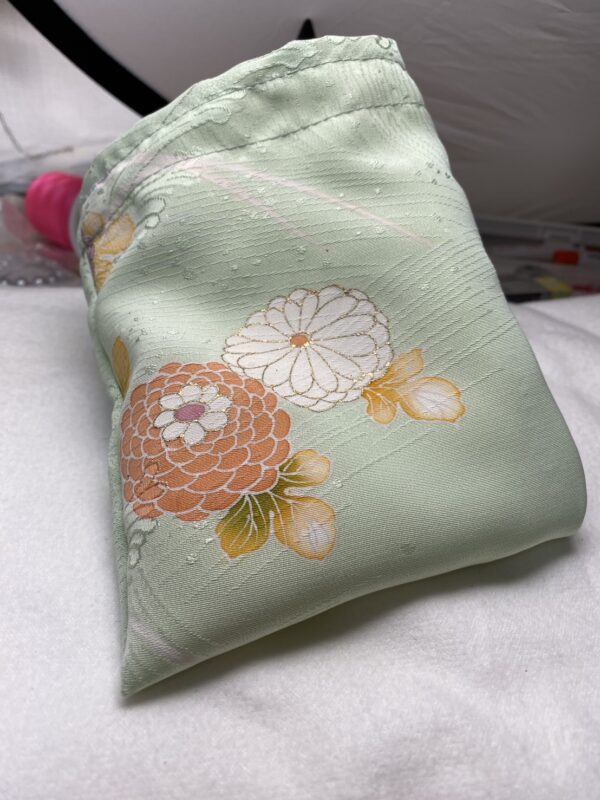
This pouch was made from the fabric of one of my mother’s kimonos, which was part of her bridal trousseau. Customers often tell me that they do not need a jewelry case, so I ask my mother to make these kimono pouches instead. My mother graduated from a vocational school for sewing, and even now, in her seventies, sewing remains one of the things she enjoys. I happened to be sitting beside her the first time she took a pair of scissors to one of her kimonos. “My family was really poor. Even so, my parents prepared several expensive kimonos for me. I knew it, of course, but I was so busy raising all of you that in the end, I never had an opportunity to wear them.” Then, as she cut into the kimono, she murmured, “It was so expensive…” with a slightly playful expression, but also a touch of sadness in her eyes. Those kimonos might otherwise have remained asleep in a dresser forever. Now they travel to many different people together with my pearls, and that makes not only me, but my mother happy as well. Sometimes I even receive lovely messages from customers who say nothing about the pearls, but tell me how deeply impressed they were by the kimono pouch.
Apparently, she asks things like this without the slightest hesitation.
My mother, still annoyed inside, alters the clothes for her anyway.
And somehow, before anyone notices, they have made up again.
This cycle has repeated itself endlessly.
After my mother alters something for her, my father’s sister apparently takes her out for a slightly nice meal.
My mother insists:
“It’s not as though I’m being won over by a meal.”
Watching them from the side, I often think that being friends with your husband’s sister seems to create all kinds of complications.
But at the same time, I think a friendship lasting more than sixty years is something wonderful.
While I am already writing about relatives, I may as well write about the police officer’s family too.
If they ever discovered that I was writing things like this about them, I would be in terrible trouble, but there is almost no chance that they will ever visit this website.
My police officer uncle’s wife was a nurse.
She was a glamorous, strikingly beautiful woman.
Apparently, whenever she went to a hair salon, the stylist would inevitably ask her:
“Do you work in the nightlife business?”
Despite her glamorous appearance, she was an extremely kind aunt.
Every time she saw me, she praised me.
It was almost as though simply existing was enough for me to receive praise from her.
Even though she was my aunt, she was technically a guest when she visited our house.
My mother might tell me to bring her coffee or serve her some sweets.
Even for something as trivial as that, my aunt would say with great sincerity:
“You’re such a good boy. You’re really clever. My children never do anything like this. You’re wonderful.”
She would repeat it over and over.
I loved this kind aunt very much.
My older brother, however, had a different opinion.
“She just repeats those things unconsciously like a robot. Her head is filled entirely with pachinko balls.”
That was a terrible thing to say.
But she was, as everyone in the family knew, a fanatical pachinko gambler.
According to her:
“Being a nurse is incredibly demanding. You’re responsible for people’s lives, you’re constantly busy, the hours are long, we’re understaffed, and every day you’re under enormous pressure. When I’m playing pachinko, my mind finally becomes peaceful.”
Whenever our relatives gathered for Obon, all the adult men would go out together to play pachinko for about two hours.
Yet my pachinko-obsessed aunt never once went with them.
“I prefer to do it alone,” she always said.
Perhaps she really was doing it for peace of mind.
Up to this point, there is nothing particularly unusual about the story.
The problem was that this aunt frequently took her junior-high-school-aged son to play pachinko with her.
Perhaps things were somewhat more relaxed because we lived in the countryside, but of course schoolchildren were not allowed to gamble at pachinko parlors.
Her son was the same age as me.
His mother taught him pachinko when he was in junior high school, and he continued playing even after entering high school.
Everyone in the family knew about it.
Everyone was bewildered.
But she would simply smile and say:
“It’s fine. We just play a little pachinko together.”
I am not sure how to describe it.
Imagine a beautiful, charming woman casually taking a lovely rose from someone else’s garden without permission, and when someone points out that she shouldn’t do that, she simply smiles and says:
“It’s only one rose. It’s fine.”
That was roughly the feeling.
My mother and the other relatives would try to say something, but when she responded so cheerfully and confidently with “It’s fine,” somehow the atmosphere made it impossible for anyone to continue arguing with her.
And then everyone would laugh and say:
“The only person who doesn’t know his son is going to pachinko parlors is his police officer father!”
Behind his back, everyone would joke:
“How does he manage to be a police officer?”
Even my older brother eventually felt sorry for him.
“That’s just too cruel to Uncle. He’s a police officer.”
Then, during Obon one year, my police officer uncle said:
“Recently, there are so many high school students going to pachinko parlors. We keep taking them into custody. And when we call their parents, they’re usually irresponsible parents too. There are so many families these days that don’t know how to raise their children properly.”
Every adult there almost burst out laughing at exactly the same moment.
The men desperately tried to suppress their smiles.
The wives suddenly discovered urgent reasons to escape into the kitchen, even though there was absolutely nothing they needed to do there. They fled with tears almost in their eyes from trying so hard not to laugh.
My older brother quietly muttered:
“This is the very definition of ‘the darkest place is under the lighthouse.’”
Looking back now, including all these things, I think they were a wonderfully lovable group of relatives.
Although if they ever discover this article, I may be in serious trouble.
Incidentally, the eldest son of my police officer uncle is now a respectable police officer himself.
For a while, his job was to spend the entire day patrolling the expressways around Kobe on a police motorcycle.
He became a police officer because he loved police motorcycles.
At the time, I said to him:
“I’m glad you achieved your dream of becoming a motorcycle police officer. Congratulations. I really respect you.”
He replied:
“I ride back and forth along the same expressway all day, every single day. I thought I was going to lose my mind.”
Apparently, there really is no such thing as an easy job.
These days, he seems to work at a small police box in the countryside.
Apparently, there is not very much police work to do there.
“Sometimes I give directions to an old lady. And occasionally I catch a lost dog and take it back home.”
It sounds like a story from a children’s picture book.
Now then, not only does any of this have absolutely nothing to do with pearls, I no longer even know what to say.
Having written this much about my relatives, I am beginning to feel slightly guilty.
If I absolutely had to invent a purpose for this article, perhaps it would be:
“Not only to let you know what kind of person is selling these pearls, but also what kind of relatives that person comes from, so that you can understand that although the person selling you pearls may not be particularly respectable, he is at least not suspicious.”
Even that is a very strained excuse.
Perhaps it would be better simply to understand Flower Jem as a talkative pearl shop whose owner writes whatever he feels like writing.
There may be a few imperfections here and there, but the pearl jewelry itself is properly made, so at least you do not need to worry about that.
And with that, I think it is time to bring the sixth installment of my Obon earrings series to a close.
Thank you again for reading.
If you have made it all the way to the end, you must surely have accumulated a tremendous amount of virtue.
Pearl Bless You
🌸 Next in the Obon Series 🌸
The Obon series will come to an end with the next installment, Obon-07.
I had originally planned to finish everything before returning to my parents’ home on August 13, but I wrote far more than necessary and did not make it in time.
So it looks like I will be writing the article for Obon-07 at my parents’ home.
Up through Obon-06, I have written about memories of Obon from the past, and Obon-07 will probably be about Obon in 2026.
“So… what exactly are you trying to sell here instead of pearls?”
Beautiful pearls you can see with your eyes, and the invisible pearls we call memories…
“Maybe you should just stop talking now.”
If you happen to notice when Obon-07 is listed, I would be very happy if you came to visit.
August 12, 2026, 6:53 PM (Japan Time)
Subscribe for Pearl Stories🐾
Receive occasional letters from my workshop —
stories about pearls, silverwork, Lulu the little dog, and quiet life in Japan.
As a thank you, you’ll get a secret code for 30% off —
usable every time you order, only here, not on Etsy.
I don’t send spam. Just little notes filled with love and pearls 💫
You can read our privacy policy for details.
This space is not only for reviews. You are welcome to write freely about pearl jewelry, ask questions, or share what you feel when you see this piece. Member registration is required to submit your message.
Pearls & Stories
There are no stories yet.